


According to the government’s 2022 Climate Change Accountability Report, B.C. is currently on course to reach 85% of its emissions targets for 2025.
“We are making progress. I don’t want to discount the effort the provincial governement has made, but they’ve made very clear climate commitments and they’re very clearly not on track to meet them,” explained Peter McCartney of the Wilderness Committee.
“Every year the BC government is required by law to put out climate accountability reports that show their progress towards meeting emission targets. We have consistently not been on track to meet the climate commitments that the provincial government has made. This year we see that again. We are about 15% of the way from meeting our targets in 2025.”
He added, “There’s only a few short years to make up that gap, but also even that number is a little misleading because a lot of the projections that they make are based on assumptions and not actual policies that are imminent or in place. They just sort of say that they’ll be reducing so much from oil and gas or from transportation without actually knowing what the policies to do that are going to be.”
This years government report states the province should be able to meet 97% of it’s emissions targets for 2030.

A Ministry of Environment spokesperson emailed: “The Roadmap is meant to be flexible and adaptable – it allows us to recalibrate policy as more information on progress becomes available through our climate accountability reporting to ensure we meet our targets. We will explore options to strengthen existing CleanBC Roadmap commitments and will look for potential actions in sectors where there are fewer targeted measures in the Roadmap such as in agriculture and forest management.”
“People in British Columbia expect to see progress on climate action and government transparency when it comes to tracking results.That’s exactly what we continue to do with the climate change accountability report – providing detailed information on actions taken over the past year through CleanBC.”
“We’ve seen significant progress in a number of areas:
- Electric vehicle uptake continued to increase and was the highest in North America;
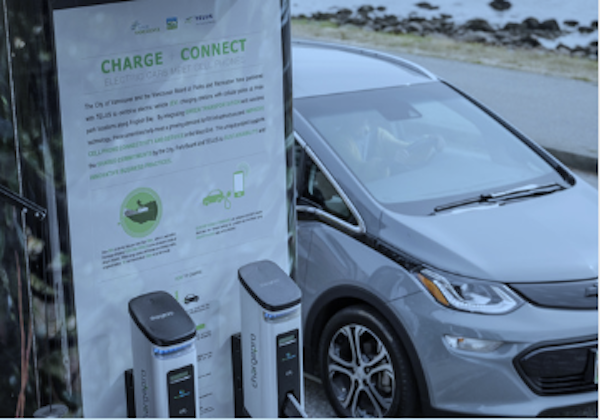
- There are more than 3,000 public charging stations across B.C. – an increase of 50% from the previous year;
- We’ve made significant investments in public transit – with billions of dollars committed to ensure people have reliable service and making it free for all children 12 and under;
- More people are accessing CleanBC rebates to make heat pumps more affordable and homes and buildings more comfortable – with more than 15,000 rebates provided through the Better Homes program;
- Methane emissions from oil and gas continued to decrease significantly, putting us on track to meet our 2025 target of 45% reduction.”

Peter McCartney: “They rely on some pretty creative accounting in terms of Fortis BC. Its purchases of renewable natural gas from outside of British Columbia that makes up about 5% of their target. So they’re actually further off track than they claim, if you don’t consider that Fortis can go buy some methane from a feed lot in Nebraska and claim those emissions reductions in British Columbia. We certainly don’t think that’s appropriate.”
“One of the things that they do in these reports is say, ‘okay, well if we model that we are successful in reducing methane emissions by 45% by 2025,’ for example. But the policies aren’t necessarily in place to do these things.”
“They do have methane regulations brought in, but they want to do a lot more and those consultations with industry to design these policies are still under development. So, it’s hard to tell just how far off they could be. At the same time, there’s still four more liquified natural gas proposals for British Columbia that they haven’t factored into these targets at all.”

Cortes Currents: Do you want to talk a little bit about those four projects?
Peter McCartney: “So there’s two projects that are already permitted, Woodfibre LNG and LNG Canada in Squamish and KItimat. The first half of LNG Canada and Woodfibre are in these emissions models that they’re using for this report, but Shell and its partners are currently deciding whether or not to finish LNG Canada. Phase two would create greenhouse gas emissions.”
“There’s also Tilbury LNG on the Fraser River in Delta, which is an existing storage facility from Fortus B.C., and they want to expand it to this major export and refueling hub. That requires another 2000 fracking wells in Northeast BC over the course of 30 years and those wells will all be creating climate pollution.”
“The other two are actually First Nations led proposals, although not every nation whose rights would be affected has given their consent to them. Cedar LNG and Ksi Lisims LNG, in Kitimat and the Nass Valley (In Nisga’a Territory).”
“When you add up all four of these, there’s 18,000 new frack wells and a doubling of gas production in northeast British Columbia that would completely annihilate all of the oil and gas climate commitments that have been made by this government.”

Cortes Currents: What would the emissions be if all four projects went through?
Peter McCartney: “I don’t have the numbers off the top of my head. You have to have some assumptions about when these facilities come online and that kind of thing.”
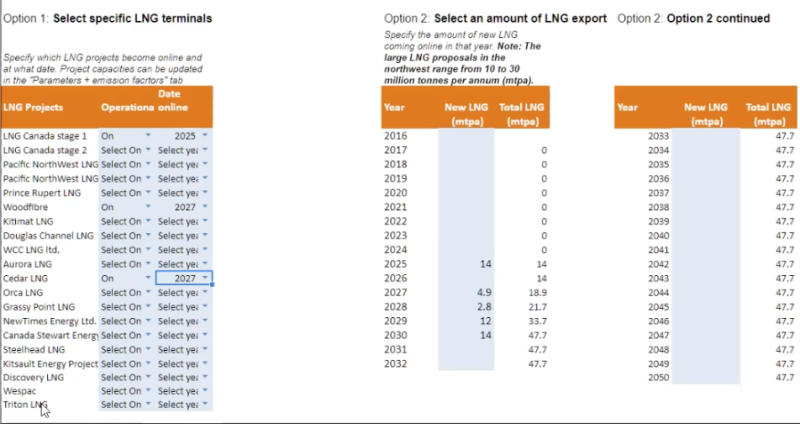
“The Pembina Institute has this really great Shale scenario tool that they published a few years ago and you can go in and turn on various LNG facilities and then it tells you how many fracking wells are needed, how much water and what the emissions would be for the various projects.”
“So if LNG Canada were to come online in 2025, let’s say Woodfibre LNG would come online say 2027, that means in 2030 we would have 16,715 kilo tons of CO2 emissions from this industry.”
The other ones on the block are Cedar LNG, if it was to come online in 2027. Westpac is now called Tilbury, but it’s still the same size. The Nisga’a terminal isn’t here because it wasn’t proposed, but I think it’s around the same size as Cedar.”
The total for all four projects would be about 33 megatons.
“So if all of these new liquified natural gas facilities were built, it would have the potential to double the emissions coming from the oil and gas industry in B.C.”
Cortes Currents: What would that do to our total emissions?
Peter McCartney: “So the total emissions is around 65 megatons right now. So it’s like another half of our emissions added onto our existing target.”
Cortes Currents: What’s the target for 2030?
Peter McCartney: “38 or 39 megatons. If the only thing we were doing in British Columbia to create climate pollution was exporting liquified natural gas, this would take up almost our entire budget for the 2030 greenhouse gas emissions target.”
“And if we were still doing that in 2050, we would be completely annihilating any chance of getting to net zero.”
That is, of course, Peter McCartney’s assumption. The BC government intends to find ways to reduce fossil fuel emissions and still meet its emissions targets.

Peter McCartney: “What this is showing is that there is no room for error and we are already off track. You can’t claim that something fits within our targets when we’re not on track to meet them. There are still numerous proposals that would only increase the amount of climate pollution BC is giving off when we know how hard and challenging it is to even meet the commitments that we’ve already made.”
“They really have a choice to make. They have to stand up to the fossil fuel industry and reject these liquified natural gas projects in order to meet our climate targets.”
Top photo credit: A fracking site – Photo courtesy th Wilderness Committee
Sign-up for Cortes Currents email-out:
To receive an emailed catalogue of articles on Cortes Currents, send a (blank) email to subscribe to your desired frequency:
- Daily, (articles posted during the last 24 hours) – [email protected]
- Weekly Digest cortescurrents – [email protected]