


Norm Gibbon’s novel ‘Sea Without Shores’ is set in the tiny village of Refuge Cove, on West Redonda Island, during some of the years he was a member of the community. Refuge Cove’s story goes back several decades before that, but in today’s broadcast Norm outlines some of the history surrounding the beginnings of the Refuge Cove Land and Housing Co-op.
NG: “In 1937, the Hope Brothers – that was Norman Hope, Buster Hope and Herbert Hope – purchased Refuge Cove, which consisted of 200 acres of property, a mile and a half of shorefront, the Refuge Cove General Store, and a whole mess of buildings that were there,” he began.
“The brothers didn’t really get along all that well. So Buster ended up running the store. Norman Hope ended up buying and running a logging camp up in Lewis Channel. Herbert Hope didn’t like being a part of this thing at all, so he sold out his interest to his two brothers and moved to Quadra Island, where he became very much involved in setting up all the boat radio communication on the coast. He did that along with Jim Spilsbury, who was building all the equipment.”
“Buster ran the store for many years and Norman worked in the logging camp. Eventually they didn’t get along very well, so Norman ended up buying out Buster. He and his wife Doris were then the sole owners of Refuge Cove.”
Norm Gibbons entered the story around 1953, when he was a 10-year old boy living in Vancouver.
“My mother Elisabeth and Norman’s sister, Rene Hope, both worked in the same store which eventually my mother bought. It was called Moirés Hosiery and Lingerie.”
“Rene said to my mother ‘I’ve got brothers and I’ve got a family up in this place called Refuge Cove and you’re welcome to come up there anytime. Take a week off. If you go up there, I’ll run the store for you and you can have a holiday.’”
“I think maybe the first time that I went up, I was about 10 years old, so that would have been probably about 1953. I started going up every summer after that and, when I was 12, I started working in the store.”
CC: Where were you living?
NG: “There were all kinds of houses there. Every year I got to live in a different house. Norman and Doris organized some people to cook for me. It was a pretty good deal. I learned a tremendous amount there, and just fell in love with the place.”


Flash forward to 1970.
NG: “Myself and my wife Denise and my two kids had been living in Vancouver. We were running a group home for teenage girls, and I was also running the crisis center in Vancouver. We did that as social workers for a couple of years, and then we were just totally wiped out. I suggested that I know this place, Refuge Cove, and why don’t I call Norman and Doris Hope and see if we can just go up there and just spend some time and then decide what to do with the rest of our lives.”
“So, we went up there and rented a tiny little cabin for $20 a month. We stayed for 8 months and just had an absolutely wonderful time.”
“There were very few people that were living there at the time because the whole coast was going through this transition period where logging was being taken over by all the big companies.”
“Part of the business for Refuge Cove was supplying all the little hand loggers. There were a lot of them. Every bay had a logger in there who was just hand logging in that little bay. They had their house on a raft and they just moved from bay to bay.”
“Also fishing was coming to an end. There were still day boats, like when I was there as a kid. They had a fish buying station. The packer came in twice a week, dropped off ice and took the fish. At that point there were still a lot of day fishermen around.”


“The other really big thing for the business was Teakerne Arm had a huge log sorting/booming ground. There were about 60 men who worked up there and all the logs from this entire area would go there, get graded, boomed up and then sent down to Vancouver to the sawmills.”
“The tugs that came to move all that lumber couldn’t come up and go back. They had to get fuel, and Refuge Cove was the place to get the fuel. This is hard to believe, but Refuge Cove had the third largest volume of marine fuel on the coast of British Columbia. There’s Vancouver, Prince Rupert, and then Refuge Cove. Refuge Cove had a volume of something like 140,000 gallons because of the tugs that were just going up and down, up and down, up and down. The tugs also didn’t have modern refrigeration at all either, so they had to shop in the store.”
“It was all coming apart. The fishery was disappearing. The hand logging was disappearing. Eventually the sorting grounds were closed down. By 1968, Refuge Cove had gotten to the point where it was all just petering out.”
“The only thing that was left, to any large extent, was a boating tourist industry which was really started by the Americans. The Americans were the ones that came up here first and boated up here. Refuge Cove was the place to go to in this area.”
“That store had everything in it too. You could buy a baby bottle; you could buy a Gilchrist Jack; you could buy everything that you needed.”

There was one more thing in transition: Norman and Delores Hope.
NG: “By 1968 they were getting quite old and wanted to retire. They were approached by an outfit called B. C. Coastal Marine Resorts, who set up five marinas up and down the coast and Refuge Cove became one of them.”
“There’s two things that are really important to point out. Number one is the night that the deal was made with BC Coastal Marine Resorts, the store burned right to the ground. They attribute that to their cat, which lived under the store. They think that it got into some wires and a bunch of batteries down there and that started the fire, but who knows what the real story is. Part of the deal was that there was a fire insurance policy and so BC Coastal Marine Resorts was able to replace the store.”

“They bought a barge from the company that ran the pulp mill in Powell River. It was a paper carrying barge. I think it was 110 feet long and 40 feet wide. They put a building on it, stocked it up with various things and sent it to Refuge Cove. It was a floating store.”
“Sad part about all of this was that when Norman made the deal with BC Coastal Marine Resorts, he only did it with a handshake. That’s how people did things in the old days and he was definitely from the old school.
“Over the next three years from 1968 to 1971, BC Coastal Marine Resorts managed to go bankrupt and they took everything of value out of Refuge Cove and sold it off.”
“So three years later, Norman and Doris Hope are left with this skeleton of a business and no money. It was like maybe $10,000 or something that they managed to get out of this company. They were in just a terrible situation.”
“This is how I get involved. I was like 27 or 28 at that point. I went to Norman and Doris and said, ‘Would you give me a first right of refusal? If you do that, I’ll go back to Vancouver and I’ll see if I can raise enough capital to buy the place.;”
“And they said, ‘Sure.’”
“In September, we went back to Vancouver. I got a job teaching at the School of Social Work at UBC for an eight month period, and during that time I contacted all my friends. We decided that we’ll form a housing cooperative and we’ll own everything jointly and in common, but the business was kept separate.”
“Norman and Doris were asking $110,000 for the property and $30,000 for the business. We didn’t argue, we just said that’s fine. None of us had any money either, but somehow we managed to pull it all together. We ended up giving Norman and Doris a down payment and we ended up with a 10 year mortgage that Norman supplied himself. We split it amongst ourselves. So we actually had a monthly payment of $50 a month for 10 years.”
“The other thing you see in this photo, this building was where Norman and Doris lived. We gave them the rights to live in that house in perpetuity and they lived there until they died. The Refuge Cove Land and Housing Co-op was officially incorporated, I think February of 1972.”
“That was also the time of the hippie movement. People were moving back to the land. Refuge Cove was no place to garden, it was just forest and rock, but there’s other ways to make a living.”
“I bought into the business.”
“Ken and Ann Ferguson were school teachers in Campbell River. When they heard about what I was doing, they said, Oh, count us in right away. We became partners in the business.”
“The third partner was the co-op, which turned out to not be a very good idea and eventually that the co-op decided they didn’t want to be a part of the business. So we brought in one of the other co-op members, Bob ‘Bobo’ Fraser. He was one of the members that was an owner in the business.”
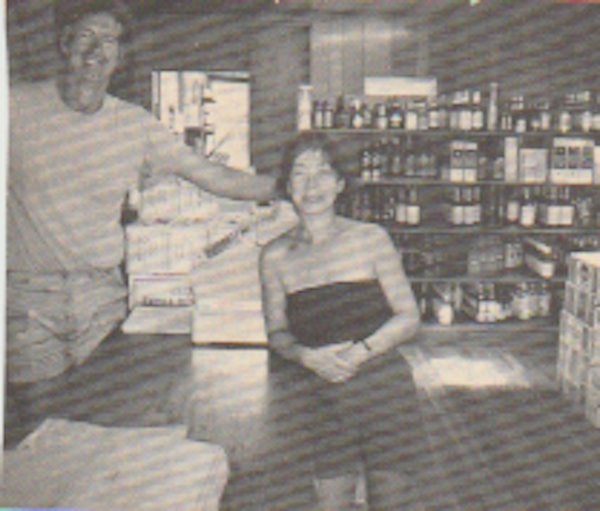

CC: Were Bobo Fraser and Judith Williams together at that point?
NG: “Yes. So there were a bunch of us that moved up and in this photo, that’s me and my wife Denise. Sherry Hall, who still lives there, back in the forest. Her husband Monty was in a boating accident and drowned. A bunch of the other people in here were all owners of a share in the co op.”
CC: So far, I’ve only heard about one business, and that’s the store. How does the community survive?
NG: “A lot of inventive ways. Bruce Stevenson became a log salvager. There was still lots of wood that was floating around and he did quite well. See all the kids lined up here. Initially you only needed eight kids for a school. So we had enough kids for a school and Ann Mullo got the job as a school teacher.”
“One of the interesting things in a place like Refuge Cove was the community was everybody. Norman and Doris were part of the community. All the co-op members, all their kids, all their friends, we all interacted and we all socialized together. Whenever there was any social event, we did it together.”

“One day I got all the kids together and said, ‘We’ll have a party if you guys pluck all the chickens.’ So it was called the Chicken Pluckers Dance. We did twenty five one day and twenty five another day. They plucked all those chickens and we froze them all and we fed everybody chicken.”
CC: You had two kids?

NG: “They were four and six when we moved there.”
CC: Did they end up working in the store?
NG: “Lisa ran the ice cube maker. She bagged all the ice cubes. Michael helped pump the gas. Other kids all worked for their parents in one way or another. It was like how families would have lived a hundred years before. It was really quite wonderful.”
“One of the things that happened was the kids really wanted more kids. They wanted to come to school on Cortes Island. For five years they were taught in Refuge Cove. Michael would have been like around 12 when we started boating back and forth every day from Refuge to Squirrel Cove. They all got picked up by the school bus. They went to school over here for the next five years and they really enjoyed that. Lisa still has friends here on Cortes Island that she went to school with.”

CC: What was happening with this store at this time?
NG: “In the summertime, the boating business was absolutely booming. All of Campbell River, Courtenay, Comox, Powell River, all the blue collar workers: they could afford to have a little 16 or 18 foot boat. They could cram their whole family in there and go on a holiday. It was unbelievable how many of them became our customers. They had to have ice, they had to have water, they had to have fuel, and they had to buy food. We were able to supply all of that.”
“Your busy period in the year was 40 days. On either side, you had a month, but you had 40 intense days. The place would open at eight o’clock in the morning, and usually by nine o’clock, the harbor was full of boats. We could fuel maybe six boats at a time, but there would be another 20 that are just circling around, just waiting for somebody to leave that spot so they could get in there.”

“Refuge Cove had the best water on the coast. Absolutely the best water. It came from a creek that had supplied the whole community for years and years.”
“The other thing was that there were these new ice makers that had come out and the temperature of the liquid glycol was really cold. You had these stainless steel containers that you would fill with water, put them in and so you could make a block of ice pretty darn fast. By fast, I mean in eight to ten hours. We had two great big walk-in freezers.”
“So, we had water, we had ice, we had fuel. Like I told you before, we had the third biggest storage of fuel on the coast.”
“Every other place was running out of fuel every once in a while. They’d run out of water. They’d run out of ice.”
“One year, it was really hot and the whole coast ran out of ice. I had a guy that worked for me, Skip, and he bought a boat called ‘Columbia’ and ran freight for us. He ran down to Powell river all the time. We had all the freight brought up from Vancouver and loaded onto his boat and then here. So I sent him down to Vancouver because I found an ice making plant in Vernon, and said I want you to send me a great big truck load of ice. So they sent down a 40 foot trailer of ice blocks. They started out as being 80 pounds and by the time they got to Vancouver, they were about 60 pounds. By the time they got loaded onto the Columbia and brought up here, they were down to between 25 and 30 pounds. But we were the only place that had ice and, when all the boaters found out everybody got on their phone, ‘Refuge Cove has ice!’”
“There was no way of managing it. So we just gave people ice picks. And we said, take as much ice as you want and come in and we’ll weigh it. Anyways, it got us through.”

CC: How long were you running the store?
NG: “I ran it until 1979 and then I sold my interest in the business. Ken and Ann Ferguson sold their interest in the business too. A whole new group bought it. Bonnie and Colin MacDonald bought Denise and my share in the business. Now, their daughter, Lucy, who was just a baby at the time, owns the store at Refuge Cove.”
“I was at this point in my life where I didn’t know what I was going to do with myself. Somebody told me they’d heard that salmon farming was the thing to get into. I made a little trip around BC and looked at a couple of salmon operations, but none of these operations were doing very well at all. In fact, one of them said to me, if I was going to do this all over again, I’d go into oysters.”
Which is what led to the Gibbons family moving across to Cortes Island, but that is another story.
Click her to continue on to Norm Gibbons: Cortes Island, beginnings of oyster cultivation and writing
Top image credit: Refuge Cove around the time the Co-op was formed – Photo courtesy Norm Gibbons
Sign-up for Cortes Currents email-out:
To receive an emailed catalogue of articles on Cortes Currents, send a (blank) email to subscribe to your desired frequency:
- Daily, (articles posted during the last 24 hours) – [email protected]
- Weekly Digest cortescurrents – [email protected]