

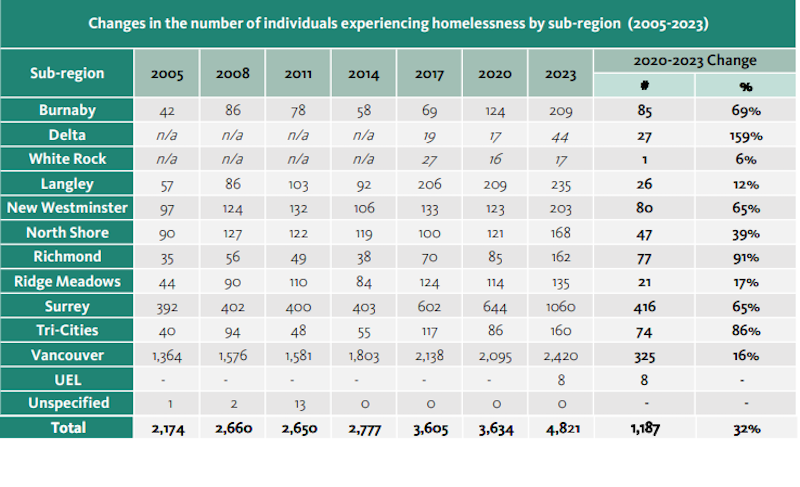
Editor’s note: Port Moody was one of the communities that participated in 2023 Homeless Count Greater Vancouver. It is one of the Tri-cities, whose homeless population people has almost doubled in the three years since the previous Point in Time Count (2020). A total of 4,821 people were listed in Greater Vancouver. When asked, the #1 cause respondents cited was ‘not enough income’ to afford housing. This was the same answer that Point in Time Counts found in Campbell River, the Comox Valley, Parksville/Qualicum, Powell River, Port Alberni and Sechelt/Gibsons. ‘Low wages,’ ‘the inability to pay rent or mortgages’ and the lack of available housing during the tourist season were among the reasons given by the 46 Cortes Island residents known to have ‘couch surfed,’ found some other temporary shelter or lived outside at some point during 2022.

By Patrick Penner, Tri-Cities Dispatch, Local Journalism Initiative Reporter
Port Moody is calling on the province to provide dedicated supportive housing for homeless populations in cities expected to densify around their transit hubs.
The motion, introduced by Coun. Amy Lubik on Jan. 9, advocates for an amendment to recent provincial legislation mandating densification around all SkyTrain stations.
Port Moody will be sending the policy to the Lower Mainland Local Government Association and Union of BC Municipalities (UBCM) conventions in 2024, and copies have been forwarded to the provincial ministers of housing, municipal affairs, mental health and poverty reduction.
“If they aren’t providing housing for the folks that are most in need, we’re missing a critical window of opportunity,” Lubik said. “This isn’t just for Port Moody. This is for everywhere.”
In November, 2023, the province introduced legislation forcing cities with rapid transit stations to create transit oriented development areas (TOD).
The policy imposed minimum standards for height and density allowances in 800-metre radius around rapid-transit stations.
This change could lead to approximately 100,000 new housing units being built in TOD areas over the next decade, according to the provincial estimates.
But the legislation has no stipulations related to affordability or supportive housing.
Lubik said the purpose of her motion is to request the province mandate an amount of supportive housing in the TOD area relative to each community’s homeless populations.
She noted the province has committed to homelessness issues alongside the housing crisis, and the 2023 Greater Vancouver’s Point-in-Time Homeless Count found there has been “unprecedented” increases in the number of people facing homelessness.
In the Tri-Cities, the homeless population has reached an all-time high, increasing 86 percent compared to the previous count in 2020.
“And we know that that’s an undercount,” Lubik said. “Many people have been without homes for years. The main reason was lack of income, with of course mental health and substance-use challenges being also a consideration.”
The Housing First model – whereas homeless populations are housed first, then provided other services related to mental and physical health, education, employment, substance-abuse treatments – has been well established as best practices, according to the motion.
It states that Port Moody is one of many municipalities trying to provide resources and land for services and housing, but land is in short supply.
If TOD areas are planned well with strong access to public services and opportunities, the motion posits they would be ideal locations for supportive housing.
“(Municipalities) don’t have all the tools that we need, we don’t have all the resources that we need, or the funding or the connection to services,” Lubik said. “We’re not providing the supports that are needed, where they are needed, and that’s a huge equity issue.”
Lubik noted the motion is not very prescriptive about how supportive housing would be mandated into the TOD areas, stating she wanted it to be flexible for discussion at UBCM.
She suggested that partnerships could be formed with property owners, and the provincial government would need supply funds and coordination of services.
The province did allocate $394 million in their 2023 budget for purchasing lands near transit stations specifically to build affordable housing over the next 10 to 15 years.
Five parcels were purchased by the province around Moody Centre SkyTrain Station for the housing project in the works, however the units are anticipated to be purpose-built rentals, according to a provincial spokesperson.
While supportive of the motion’s intent. Coun. Diana Dilworth had questions about how such a policy would be put into practice.
She said it would need to work out how services are allocated between municipalities, and for which homeless populations.
But a second larger issue for Dilworth concerned the build-out periods for TOD areas, which are expected to take decades.
She said that it is unclear how responsibility for building supportive housing would be allocated to private developers over such a long period of time.
“Is it borne across the entire TOD? Will the first applicants who come to the table bear the brunt of building that supportive housing up front? Will subsequent developers get a pass?” Dilworth said. “Clearly the why has been articulated, I’m still really hung up on the how.’”
Considering the rising expenses developers are facing, Dilworth said the private industry would not build supportive housing unless incentives were offered such as land, money and waiving development fees.
She said, ultimately, partnerships would need to be formed with higher levels of government and non-profit housing providers.
Dilworth brought forth an amendment, asking the provincial government to develop a partnership framework and policy between local government and non-profit housing providers.
A second amendment was introduced by Coun. Kyla Knowles to make the motion less prescriptive in terms of the number of units that need to be built.
Both passed unanimously.
Coun. Haven Lurbiecki said she has been disappointed with the number-based housing targets from the province, stating they are detached from the specific affordability needs.
She noted that Port Moody is on track to meet its housing targets, but added more supply of market units will not address its affordability issues, especially in terms of social and supportive housing.
“As far as I understand it, we don’t actually have a specific policy or approach right now (for supportive housing), except for hoping that something comes forward,” Lurbiecki said. “We don’t need to wait necessarily for the province to start on this.”