Tag Archives: BC Wildfire Service

Folk U: Life on Read and Sonora Islands (Part 2)

(Interview by Manda Aufochs Gillespie; written version by Roy L Hales)

In the conclusion of a two part story, Manda Aufochs Gillespie interviewed Renate Harvey and Renée Desautel from Sonora Island, as well as Sheila Hollanders from Read Island, about life on their islands. In Part 1 they talked about their daily lives, the seasons and community life. This segment deals with community support and future sustainability— the Surge Narrows Community Association and funding, land access/emergency preparedness, relationships with Homalco First Nation, youth and schooling challenges, and hopes for the next decade. 

Continue reading Folk U: Life on Read and Sonora Islands (Part 2)

Cortes Island’s greatest risk: wildfire

 My assumption is that we will, at some point in time, see a fire on Cortes of a severity that will flabbergast the population. It may not happen this year, and it may not happen in 10 years, but the conditions are getting very, very bad.

That is what Mike Brown, volunteer fire fighter and long time Cortes resident, had to say at the May 3rd meeting on Emergency Preparedness in the Pioneer Room.

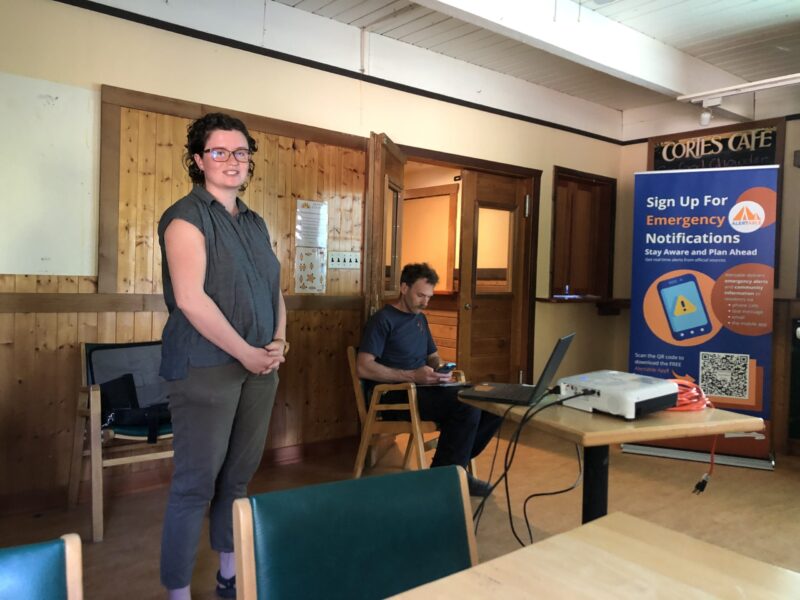
At that thinly-attended meeting, SRD emergency services staffer Sarah Rosen gave a presentation on emergency preparedness for individuals and households. As part of her presentation she reviewed potential emergencies in our local area.

Cortes Island is fortunate to be sheltered from tsunamis; earthquakes are rare in BC; the island has no rivers to flood or dams to burst (unlike Campbell River, where the hydro power dam is currently undergoing seismic safety renovations). The island has no hazardous chemical plants or huge fuel dumps. The one serious disaster-grade risk to the Cortes community is wildfire.

Continue reading Cortes Island’s greatest risk: wildfire

Be Prepared: are you ready for an emergency?

On May 3rd, Sarah Rosen from the Strathcona Regional District came to the Pioneer Room at Mansons Hall to talk about emergency preparedness… and there were about eight people in the room. As Sarah herself said, the biggest emergency preparedness risk on the island might just be that so few of us are thinking about it.

[I’ll admit that I’ve been procrastinating — not getting around to producing this story — and it might be because the subject is a little uncomfortable when you know that you yourself are not prepared. But avoidance and procrastination are exactly the problems that Sarah came to address, and she says being prepared might not be as daunting as you think.]

View Post↗

Sarah Rosen speaks at the Pioneer Room, May 3rd 2026 — photo by Roy Hales

With just three questions: should I stay, should I go, how do I know? I’m gonna walk you through how you could prepare for everything.


Continue reading Be Prepared: are you ready for an emergency?

Tseshaht prohibits all fires on reserve and Broken Group Islands

By Nora O’Malley, Ha-Shilth-Sa, Local Journalism Initiative Reporter

Port Alberni, B.C. – BC Wildfire Service may have flip-flopped on a May 7 campfire ban in the Coastal Fire Centre, but Tseshaht First Nation in Port Alberni is holding the proverbial burn line.

The nation is prohibiting all fires on reserve lands and the Broken Group Islands until further notice. Their decision is supported by Hupačasath First Nation and the City of Port Alberni, who are also maintaining a complete fire ban.

Continue reading Tseshaht prohibits all fires on reserve and Broken Group Islands

Amid climate impacts, leading Secwépemc firekeeper shares ‘a better way of looking after the land’

By Aaron Hemens, IndigiNews, Local Journalism Initiative Reporter

Growing up in Nlakaʼpamux and syilx territories in the 1970s, Joe Gilchrist can’t remember a single summer when wildfire smoke ever trapped him indoors. 

The Merritt, B.C., region’s semi-arid landscape still saw scorching summer temperatures back then, he recalled, but not the record-breaking fire seasons of recent years. 

“That was thanks to our work that the Indigenous ancestors did on the land,” said Gilchrist, a Secwépemc Nation member who now lives on Skeetchsn Indian Band’s reserve with his daughter.

“Then, everything was still fairly spaced out; the fires were easier to handle.”

Although settlers’ wildfire suppression efforts had become the dominant form of land stewardship when he was young, Indigenous communities in the Nicola Valley were still using fire to “cleanse” the land, Gilchrist said.

Continue reading Amid climate impacts, leading Secwépemc firekeeper shares ‘a better way of looking after the land’