


[OPINION/EDITORIAL] Public opinion and Federal and Provincial policy are finally swinging (at the eleventh hour) towards protection of the pathetic remnants of BC’s old growth forest and possibly some reform of forest management practise. In response, the timber/pulp industry appears to be mounting a last-ditch PR effort to defend its traditional extractive model and discredit its most vocal critics.
One fingerprint of this effort can be found in a recent Times-Colonist opinion/editorial by Alice Palmer. Published on April 20th, the article reassures readers that
The supposed “fact” that less than three per cent of B.C.’s productive old growth remains standing, and the implicit suggestion that we’re about to lose that too, are both patently untrue.
There is actually much more old growth left, and the majority of it is protected from logging.
Ms Palmer goes on to define “old growth.” She then cites some statistics from “forestry consultants” — from reports “from 2020 and 2021” — but with no authors, titles, or links. One set of data indicates concern because only about 3 percent of our old growth still stands, the other is far more reassuring and claims it’s more like 25 percent, nothing to worry about.
Ms Palmer strongly implies that the first set of numbers was arrived at by outmoded methods, whereas the second set is state of the art science; and therefore “We can relax, knowing BC’s old growth is safe.” She ends with the now industry-standard condescending pat on the head for activists:
… before risking your life for the cause, I beg you: please read the science first. You’ll be glad you did.
Is this the best the timber industry can do to fend off its critics? A few quick clicks are all it takes to cast some shade on this sunny picture.
Considering the Source
Ms Palmer’s published title of “independent forest industry researcher” sounds on the surface as though she might be a public intellectual in a watchdog role, “researching the forest industry”. (Like Ralph Nader, who independently researched the US automotive industry in his day? Or Alexandra Morton, who has dedicated her career to researching the Atlantic salmon CAFO industry?)
A quick perusal of her LinkedIn CV (PDF version), however, reveals that Palmer’s UBC degree in “forest resources management” was earned in the mid-90’s (nearly 30 years ago now), and that her professional activities since then have centred on marketing: marketing analysis, providing “market intelligence,” “managing market communications” for lumber products…
• My PhD research examined how pulp and paper companies have been strategically repositioning themselves in response to the global shift from paper-based to digital communications
o The results of my study helped participant companies, including the research sponsor, design their own repositioning strategies.
In other words, this “independent forest industry researcher” is actually a freelance marketing and PR consultant with a history of working for the timber/pulp industry, and “independent” only in the sense of being hired by contract rather than on the payroll.
The media-literate reader may, at this point, be wondering whether the op/ed is a truly personal opinion… or an example of the “market communications” that Ms Palmer’s LinkedIn profile says she “manages” for clients?

Industry-Funded Study Supports Industry Agenda
We live in a time of hasty, excessive, and often over-casual media consumption. All of us have at one time or another skimmed some misleading advertorial and been mildly misinformed. Nevertheless, it’s risky for professional PR agents to assume that no reader will actually follow a link or check a reference.
Ms Palmer’s citations sound respectable and even-handed (one study says this, another study says that). But if we peer at them a bit more closely, a few suggestive details emerge.
The Forsite study by Cam Brown to which she refers — and from which some of her text is drawn nearly verbatim — was given a splashy release in October 2021. The press kit prompted articles in many local papers (including our own Campbell River Mirror, by the indefatigable anti-environmentalist Tom Fletcher). Perhaps even more showcasing occurred in trade/industry and investment news sites such as Business Intelligence:
The Council of Forest Industries (COFI) fears the public isn’t getting an accurate picture of how much old growth is left in B.C. on the Crown harvest landbase, so it commissioned an independent forestry consulting firm, Forsite Consultants, to do another assessment of old growth in B.C., and it arrived at a very different number: 30%, not 3%.
Business Intelligence for BC article, 2021
What is COFI? It’s the BC Council of Forest Industries, a PR group funded by many of the major timber companies including Interfor, Weyerhaeuser, WFP and — yes — Mosaic, the company even now controversially planning to recommence industrial logging on significant chunks of Cortes Island. [Readers should visit COFI’s site and draw their own conclusions; in this writer’s personal opinion, it is 100 percent greenwash.]

So a typical industry PR front group (COFI) paid for a study that would cherrypick and massage data to support business-as-usual and deflect public concern? Nothing new here; it’s a standard business strategy for many decades, for businesses that can afford the service. It does seem less than transparent, however, for Ms Palmer not to mention that this cheerful study was commissioned by a timber industry coalition, or to name COFI. Earlier press coverage of the report did not omit this provenance.
BC Has More Than One Forest
It’s also perhaps worth noting that Forsite Consultants is based in the interior, and all the projects listed on their website involve BC interior forests, not coastal forests. Interior logging seems to be their core expertise.
How was their new super-optimistic figure arrived at? With some redefinition of terms, but also some lumping together of all BC forests (dryland interior, far northern taiga, and temperate coastal rainforest). Supposing we count as “old growth” the venerable but stunted jackpines hanging on near treeline in BC’s many mountain ranges, plus the vast tracts of far-northern “stubble” forest — neither of which any timber company has the least interest in — then BC has a lot more “old growth” than activists claim.
But today’s activists are not talking about high alpine or ragged taiga. They are talking about a very specific kind of old growth: intact stands of intensely productive mature temperate rainforest in the southern coastal region: a specific biome which in 2016, Sierra Club researchers were already warning us, was on the verge of collapse. This kind of old growth is shown in dark green on the map:

The above map is ten years old; yet more old-growth has been logged since it was drawn. This is how much of it there was before Anglo/Euro settlers commenced serious commercial exploitation of the forest:
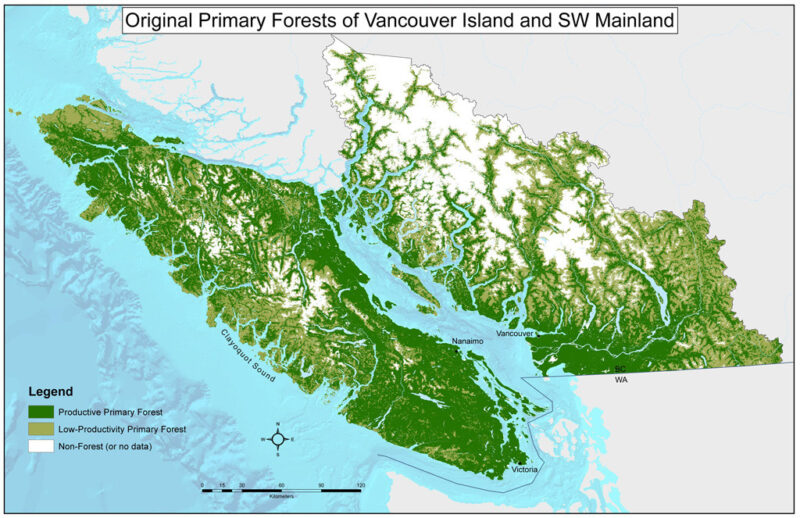
Ms Palmer’s article invites us to believe that the amount of dark green on the first map is 25 percent of the amount on the second map.
More Recent Refutation of Industry-Funded Study
It was perhaps an unfortunate choice of Ms Palmer’s, to cite studies by Veridian Ecological Consulting. Based in Nelson BC, Veridian appears to be an independent consulting company (not exclusively serving the timber industry, unlike Forsite) with experience in the survey and analysis of coastal forest ecosystems.
Anyone exploring Veridian’s publications will quickly come across a PDF dated January 2022, later than the other Veridian reports she mentions, and quite plainly titled “How Much Big-Treed Old Growth Forest Remains in BC?” [found on the “Old Growth and Resilience” page of their web site]. This report was written expressly to convey Veridian’s dissatisfaction and concern with the much-publicised Cam Brown report.
Here is a screen shot of the first page of this PDF.

from Veridian Ecological Consulting
Cam Brown’s report — the one whose soothing conclusions Ms Palmer invites us to accept uncritically — “concerns us as ecologists because it relies on three fallacies that have dogged the implementation of sound forest management over recent decades.” [emphasis mine]
1. The Brown report equates all forest types, suggesting that there is no subset of ecologically different old forest at high risk, and hence no need to consider different forest types for analysis and management.
2. Ignores that current policy directs protection away from these most at-risk forests.
3. And, equates “protection” with “area outside the Timber Harvesting Landbase”, ignoring the very different management status of these two designations, and the differing distribution of forested ecosystems typically found inside and outside the THLB.
Readers may wish to peruse the rest of this PDF publication — i.e. read the science that is not bought and paid for by the timber industry — and make their own evaluation of the COFI-funded study and of BC’s situation with regard to old growth.

(BC MFLNRO)
Misleading Claims
Both in the October 2021 press release cycle and in this latest op/ed, the timber industry’s PR agents have emphasised the theme of “modern” and “up to date,” implying that their analysis is the most recent and the last word. They are pushing the message that forest activists are working from obsolete data and their passionate urgency is therefore misinformed and “not science based.”
Even as Ms Palmer acknowledges that “the numbers are still up for debate,” she nevertheless concludes that the debate is now over — and our increasingly scary assessments of remaining coastal old growth over the last 20+ years are “misleading.”
Yet the 2022 publication from Veridian suggests the debate is far from over.
Is Ms Palmer’s op/ed the industry’s response to Veridian’s 2022 publication? Or was she merely unaware of its existence? As published, the article appears to try to sweep the latest Veridian report under the rug, and pretend that the COFI report remains unchallenged. The omission of links, authors, titles and other provenancing adds to this unfortunate impression.
If anyone is making misleading claims, in this author’s opinion it is the timber industry and its PR agents.
[Editorial comment: shame on the Times-Colonist for not fully and explicitly disclosing the author’s financial/professional affiliation with the timber/pulp industry. While the Opinion page is not traditionally held to the same standards as news reportage, it nevertheless should not become a free podium for advertorials promoting commercial interests.]
[feature image Photo by 愚木混株 cdd20 on Unsplash ]