

By Hope Lompe, National Observer, Local Journalism Initiative Reporter
A Campbell River non-profit research centre is stepping up, in the absence of extensive government testing, to help Indigenous clam and shellfish harvesters test their catch for potentially lethal toxins.
Clams and mussels have been a staple food for coastal First Nations for millennia. But amid worsening toxic algae blooms, some harvest areas are being shut down preventively. To preserve cultural practices, some are still taking the risk.
“Clamming has been really important pre-contact and also post-contact to bring in food or the resources to celebrate that holiday and make it through the winter months,” said Skye Augustine, assistant professor at the University of British Columbia and principal investigator with the Centre for Indigenous Fisheries.
Augustine says government agencies are not adequately testing to make sure shellfish are safe to eat, meaning harvesters are exposing themselves to risk of severe illness from paralytic shellfish poisoning and other harms.
“There are First Nations territories on the coast where no sampling happens, so if you don’t have an understanding of how these phytoplankton blooms are happening … then people are left with just making risk assessments,” Augustine said. She is also a Hul’q’umi’num’ scholar and marine ecologist from Stz’uminus First Nation.
She describes Elders and researchers from coastal communities in the United States who say people are willing to poison their bodies to feed their souls, because, to them, harvesting from the land is not the same as going to Costco for clams.
Testing is a multi-agency responsibility. Under the Canadian shellfish sanitation program, Fisheries and Oceans Canada (DFO) is responsible for managing shellfish-harvesting area openings and closures. It bases those decisions on recommendations from Environment and Climate Change Canada about marine sanitary water quality, and from the Canadian Food Inspection Agency on biotoxin testing, DFO wrote in an email to Canada’s National Observer.
Shellfish harvesting closures may happen when monitoring identifies a risk to human health or where established sampling requirements have not been met.
“In all cases, closures are intended to protect public health and help ensure that shellfish harvested for consumption are safe,” they write.
In 2019, the First Nations Health Authority had to put out a notice warning against consuming butter clams after paralytic shellfish poisoning cases were reported by those who consumed clams harvested from remote Dundas Island BC, near the Alaska–BC border.
The toxin that causes paralytic shellfish poisoning is the main concern, says Timothy Green, Canada research chair in shellfish health and genomics at Vancouver Island University (VIU), but there are others too, like amnesic shellfish toxin.
“Those two will kill you if you have a lethal enough dose. Then, there’s some other species that will make you hug the toilet bowl and wish you were dead. You will recover, but it’s a pretty scary experience,” he said.
“The challenge is, most of our coastline is closed to harvesting. In particular, it’s closed to the species that First Nation communities most want to harvest,” Green said.
This includes butter clams, which constantly filter the water around them and build up marine toxins in their systems over time. DFO’s bivalve shellfish safety harvesting map shows butter clam harvests are prohibited in all areas around Vancouver Island, with very few exceptions.
The lab at the BC Centre for Aquatic Health Sciences, which is being renamed the Indigenous Centre for Aquatic Health Sciences and Stewardship (ICAHS), is fundraising $250,000 for new lab equipment to test for shellfish toxins in samples from a harvest, if they are brought to the lab alive and fresh within the day.
“If it’s a beach that’s traditionally important, but not one that [is] going to commercially sell the clams out of there, [then] there’s not a lot of interest in testing,” said Peter McKenzie, chief executive officer of ICAHS. He points to capacity issues within the government agencies as the reason for the shortfall.
“This project that we’re working on is to develop that capacity, and we have the expertise in-house.
Changing climate breeds invisible threat
Traditionally, First Nations harvesters learned to dig for clams in the winter and avoid summer months to avoid ingesting clams contaminated by the toxic blooms — the reason for DFO shellfish harvest prohibition notices posted on beaches along the coastline of Vancouver Island.
Clams and other bivalve shellfish feed by filtering microscopic organisms from the water. As a result, harmful bacteria, viruses and marine biotoxins in the water can build up in the clam’s tissues and make people sick, the DFO website warns.
Green said the toxins can live in contaminated shellfish for up to two years.
The threat is further complicated because they are less visible. A type of toxic bloom commonly known as “red tide” is no longer an accurate predictor of a dangerous algal bloom because it can appear completely clear in the water, and not necessarily red, Green said.
Toxic algae blooms have always been part of marine life in British Columbia. But now, Green says, the tried-and-true timing is unpredictable thanks to ocean changes from climate change, inadequate sewage systems and shipping traffic, all of which affect marine life in the Salish Sea.
The combination means large amounts of nutrients from sewage flowing into the water, while international ships bring in new phytoplankton species from other parts of the world — all while ocean temperatures rise.
“There’s a long knowledge of these on our coastline and how to safely harvest,” Green said. “The concern is with our changing climate, we’re seeing these toxins at times that we wouldn’t expect, and in species that we wouldn’t expect.”
For McKenzie and the researchers, the shellfish toxin-testing project is about preventing people from getting sick. As monitoring the toxins becomes more complicated, government agencies struggle with capacity.
“There’s been health issues in the sense of sicknesses created by beaches that have had to be shut down,” he said. “Unfortunately, they’re shut down after people get sick rather than testing them before anybody gets sick.”
Links of Interest:
- Why is our cold ocean suddenly tropical blue? – The Marine Detective
- Algae bloom turns coastal waters off Vancouver Island tropical blue – Ha-Shilth-Sa
- Indigenous Centre for Aquatic Health Sciences
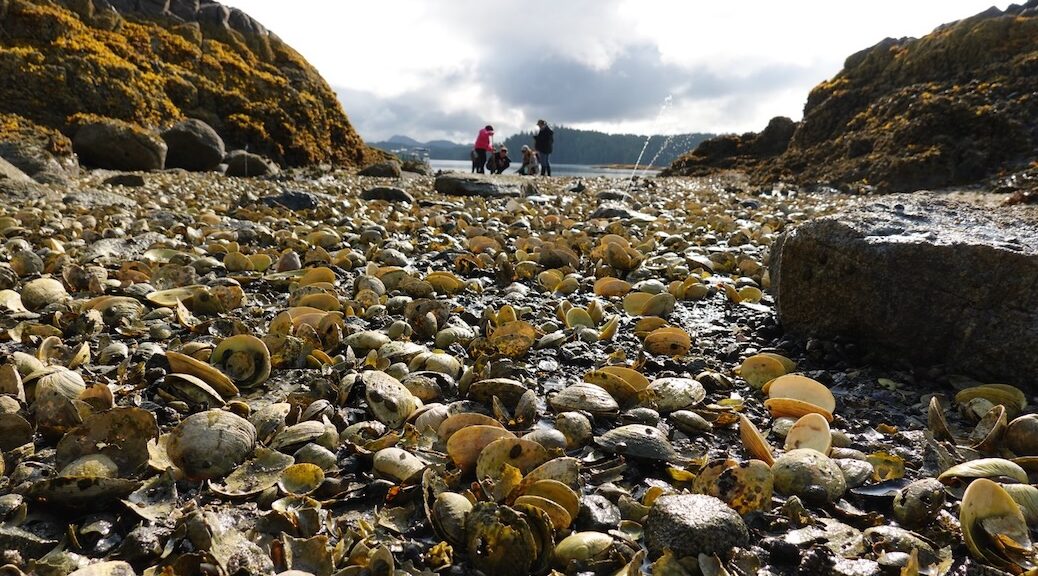
Top image credit: First Nations members and researchers work in a clam garden beach on Vancouver Island. Photo submitted by: Skye Augustine

Sign-up for Cortes Currents email-out:
To receive an emailed catalogue of articles on Cortes Currents, send a (blank) email to subscribe to your desired frequency:
- Daily, (articles posted during the last 24 hours) – [email protected]
- Weekly Digest cortescurrents – [email protected]