


“The goal of a MYCOblitz is to document MYCOdiversity; i.e. the diversity of fungal species present on Cortes Island.Fungal fruiting bodies vary month to month, location to location, season to season. Therefore ongoing MYCOblitz’s are required to cover these bases!!” – email from Sabina Leader Mense
Close to 70 people of all ages took part in Cortes Island’s community fungal forest walk on November 1, 2023. The students of the Cortes Island Academy were among them. We were greeted outside the Linnaea Education Centre by one of the islands better known scientists, who declared:
“Good afternoon. Good afternoon. ‘Truncocolumella citrina‘ you can call me, the Latin name for Lemon truffle. On any day other than MYCOblitz, my name is Sabina Leader Mense. I’m a founding director and an educational research associate with the Forest Trust for the Children of Cortez Island Society and it’s my pleasure on their behalf to be hosting MYCOblitz 2023.” (Cheers)

“‘Myco’ is the Greek word for fungus. So MYCOblitz 2023 is a celebration of the kingdom Fungi. And to add to our myco-merriment this very special day, we have invited three outstanding mycophiles, lovers of mushroom, and mycologists who do professional studies with mushrooms.”
Andy MacKinnon is the lead author of Mushrooms of BC, Paul Stamets founded Fungi Perfecti and Paul Kroeger is President of the Vancouver Mycological Society.
Kroeger quipped, “Looking at mushrooms started out as a hobby and became a serious profession when it turned out that my solitary pursuit of looking at mushrooms; out of personal interest, happened to be very timely because the Ministry of Forests began doing a lot of research on the role of mushrooms in forests. They needed somebody who knew mushrooms to identify what they were studying in the forest. So I began to actually do contract work and work as a professional, even though I’m a self taught mushroom enthusiast. So it will hopefully be a bit of an indication that it’s possible to take a passion for something in natural history and turn it into a living. Not a rich living, not a guaranteed living, but a living that keeps you happy nonetheless.” (Laughter)

All three of them have books which are currently for sale at Marnie’s Books on Cortes Island and numerous book outlets across the web.
They were there to help document the fungal diversity of Cortes Island for the Biodiversity Cortes Project and make a collection for UBC’s Beaty Biodiversity Museum.
Sabina Leader Mense: “We’re doing research forays. We’ve been out all morning. We didn’t walk further than 150 feet and we could well have 60 species of Fungi.”
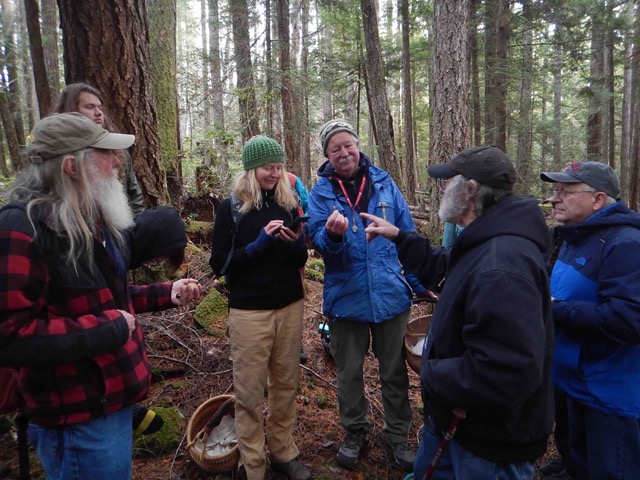
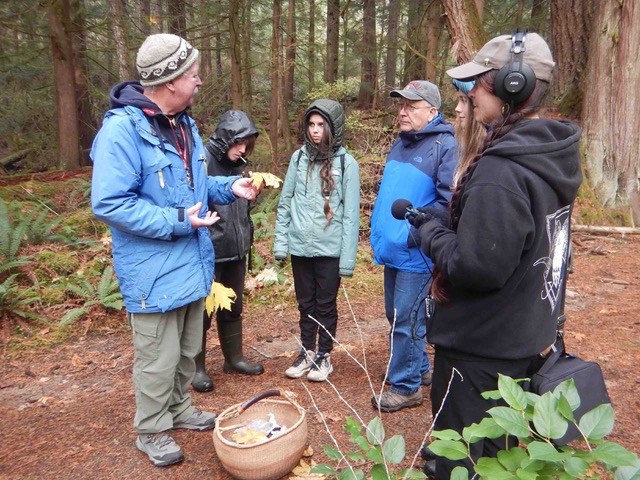
Coralie Grebenart-Castonguay was 1 of the 4 Cortes Island Academy students who explored the Children’s Forest between 8 AM and noon.
“Basically the teachers thought of two students that they knew would want to go, which is me and my friend, because we’re big mushroom nerds, and then a couple of other kids wanted to come.”
“We had Andy McKinnon, Paul Kruger and Paul Stamets with us the whole time.”
“Afterwards, when I was trying to sleep at night, I could hear key words I had learned about mushrooms whispering in the back of my head, keeping me up – because I had learned so much! Words like ‘Inocybe,’ Psilocybe’ and ‘Cortinarius.’”
“The Cortes Island Academy is amazing, and the teachers are so great. I love them all! There’s so much work that goes into it. It’s really an amazing school and it’s so different compared to other high schools. I find high schools are more made to mold you in a certain way, but this high school is created to enhance your capabilities – how it works best with you. I’ve done public school, even public high school before (in Quebec), and I can’t think of something I learned on the spot. But when I think of even last year at the Cortes Island Academy, I can think of so many things!”
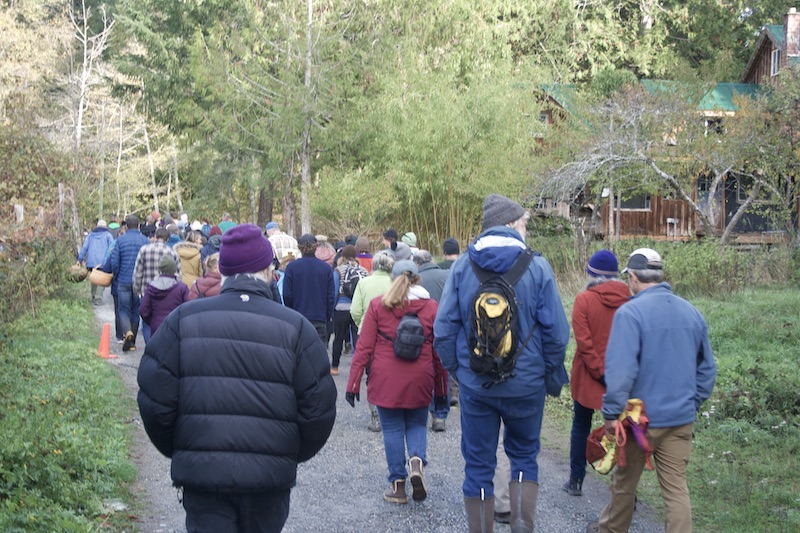
All 22 students from the Cortes Island Academy were in that group of 70 or so that followed Paul Kroeger and Andy McKinnon off into the forest and then separated into foraging parties.
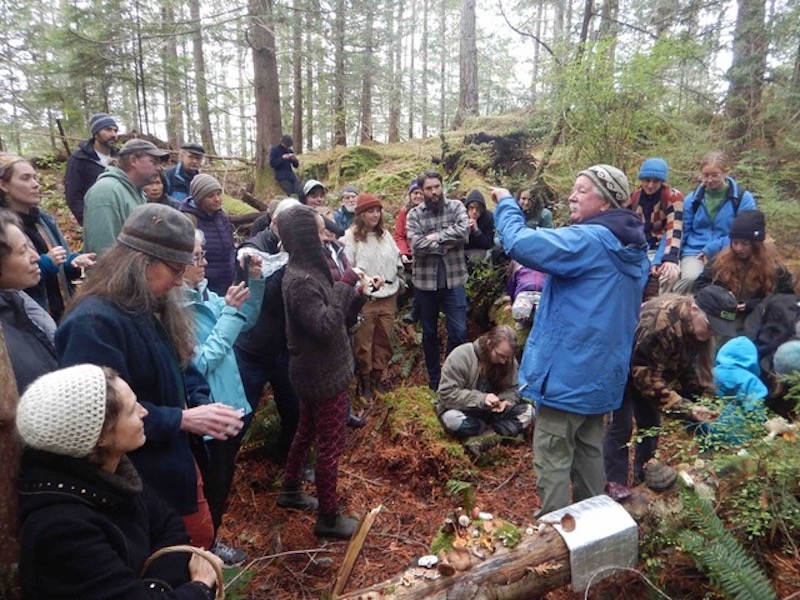
Coralie and I (Roy Hales) were both in Andy McKinnon’s group.
Coralie Grebenart-Castonguay: “You could go off the trail and find some mushrooms. We would all join back five minutes later, and we would sit down for an hour and talk about the mushrooms we found.”
I think the foraging segments were longer, but ended up with close to an hour long recording of Andy McKinnon.
Here are a few excerpts:
Andy McKinnon: “The mushrooms that we’re going to find today are the fruiting bodies of microscopic Fungi growing in the soil or in the woods. We only know they’re there when they make their mushrooms. Small mushrooms are generally the fruiting bodies of Fungi that are decomposing things, breaking down organic matter in the soil, or in wood, or something like that.”
“Large mushrooms are usually the fruiting bodies of Fungi growing attached to the roots of trees, forming what’s sometimes called Mycorrhizal Fungi.”

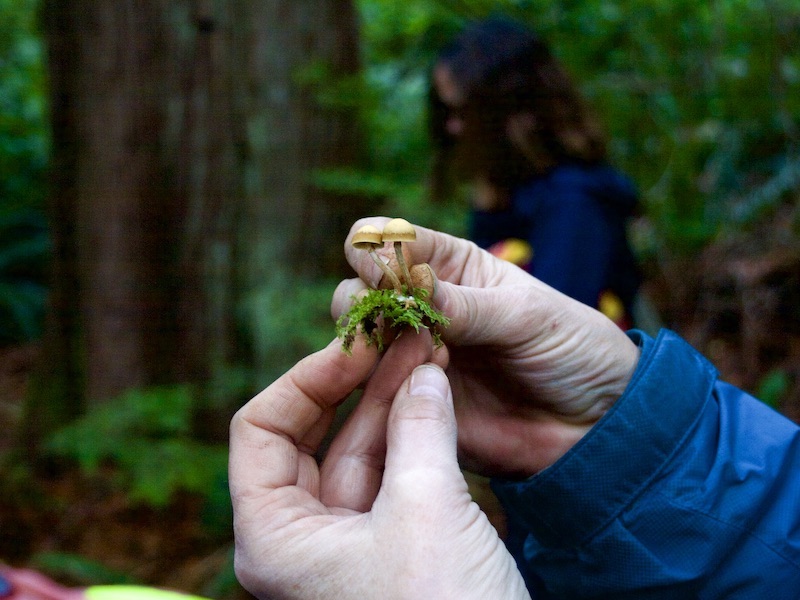

“Someone has handed me a specimen of a ‘Fibre Cap.’ This one right here is a genus called ‘Inocybe.’ They’re called ‘Fibre Caps’ because if you look at the cap, there are little fibres running from the center of the cap to the outside. They can sometimes even be quite shaggy. This one’s not. This one’s got just enough purple in the cap to tell me that it’s something we used to call ‘Inocybe Lilacena’ and is now unfortunately called ‘Inocybe Pallidicrema.’ ‘Lilacena’ worked for me ’cause it was kind of lilac coloured, but we’ll just call it the ‘Purple Fibre Cap.’”
“This little mushroom is the fruiting body of a Mycorrhizal Fungus. All the Inocybes are mycorrhizal with our trees here. Almost every mushroom that people like to forage for on Cortes Island will disappear if the trees are cut and, in part, that’s why there is a Trust to protect the Children’s Forest.”
“If I was able to excavate under my feet, you would find that the soil is largely made of microscopic Fungal filaments, each of them about 1/40th the thickness of a human hair. Beneath my feet there are probably somewhere between 50 and 100 kilometres of Fungal tubes, and it’s growing all the time. When it wants to make its sexual spores, it makes a mushroom. If you squish a mushroom down and look at it under a microscope, it’s composed of these microscopic filaments.”


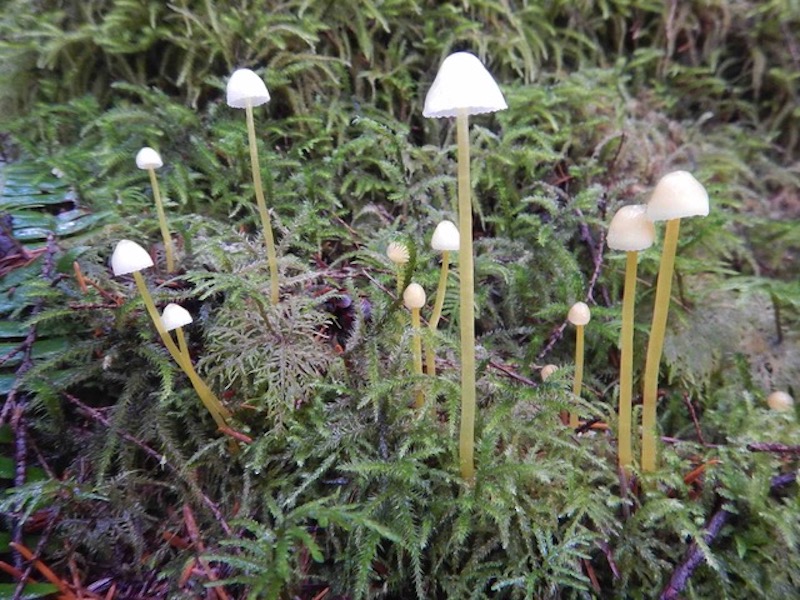
“People are still trying to tease out how the fungus makes these mushrooms. It’s the most extraordinary example of biological knitting that exists.”
“I think it’s safe to say that the reason we have life on Earth is because there are Fungi and if we didn’t have Fungi, there would be no life on Earth. For fans of life on Earth, that means that Fungi are important.”
“We’ve got a lot of conks here. We’ve got Fomes fomentarius, the Tinder Conk, and we’ve got the Western Reishi, or the Western Varnished Conk. The conks are mostly tree parasites, and a lot of them, after they’ve killed the tree, will decompose the tree as well.”
“They’re eating that cylinder of dead wood (heartwood) that runs up the middle of trees. When they’ve eaten enough of the tree, they will start producing these on the side of the tree. So by the time you see these on the side of a tree it is either dead or a goner. Any arborist or timber cruiser will tell you that if you see conks on a tree, it’s a ‘danger tree.’”
“There’s no merchantable timber left in the tree. What usually happens is the whole center of the tree is decomposed and the little sapwood layer around the outside still continues to function. The tree usually dies when wind snaps it off or something. One of the most common ways for conifers to die in forests around here is they get some kind of heart rot and then the wind snaps them off maybe three or five metres up.”
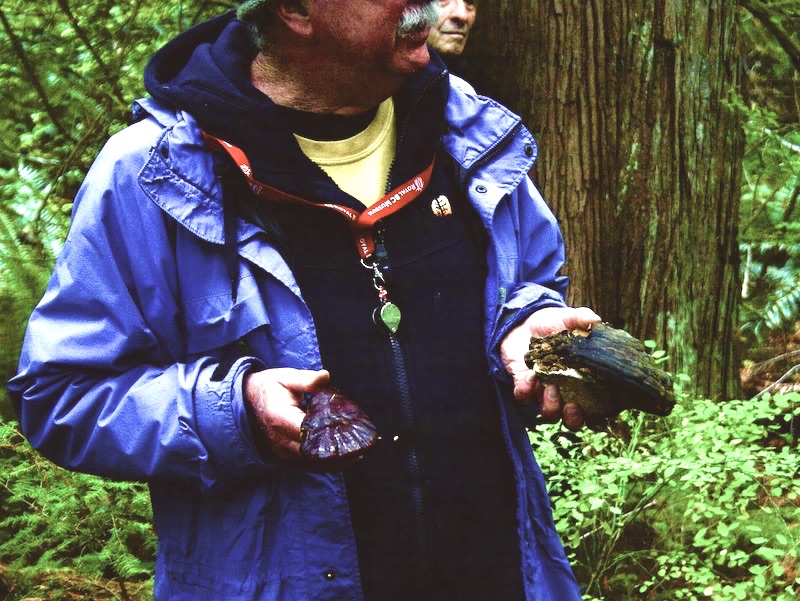
“If you see a whole bunch of conks on the side of the tree, they’re usually all the fruiting bodies of one Fungi. If you see a whole bunch of mushrooms on the ground, they’re usually all the fruiting bodies of one individual fungus.”
CC: If all the mushrooms I’m looking at are from one organism, how big are these organisms?
Andy McKinnon: “The largest that have been measured so far are about 600 hectares in size, one individual. So the world’s largest organism by a large amount.”
One of the mushrooms that McKinnon held up for us to see was a ‘Russula.’
Andy McKinnon: “There’s a few examples of Russulas that are easy to field identify. This is not one. This looks a little bit like a Shrimp Russula, but it doesn’t have the characteristic odour of a Shrimp Russula, and there are mushrooms that look a bit like Shrimp Russulas. In fact, some might think that this smells a bit shrimpy, but I think what it actually smells like is a bit rotten.”
“That’s just a good reminder that more than half of mushroom poisonings in North America are from people eating edible mushrooms. Eating edible mushrooms that are rotten; or eating edible mushrooms that they haven’t cooked or have undercooked; or eating edible mushrooms that they have a food allergy to. Even if this was an edible mushroom, which it’s not, I wouldn’t eat it because it’s rotten. That seems simple enough, but I also get to respond to poison control centres sometimes and someone who would never eat a rotten broccoli in their produce jar will eat a rotten mushroom. (Chuckles) It’s just unbelievable, so don’t be that fool.”
“Here we have a lovely little decomposing Witch’s Butter, which is a good kind of thing to find the day after Halloween. (Chuckles) When it was fresh, it would have been a brighter orange and firmer. I’m led to believe there are lots of witches on Cortes Island (More chuckles), there’s almost certainly lots of Witch’s Butter.”
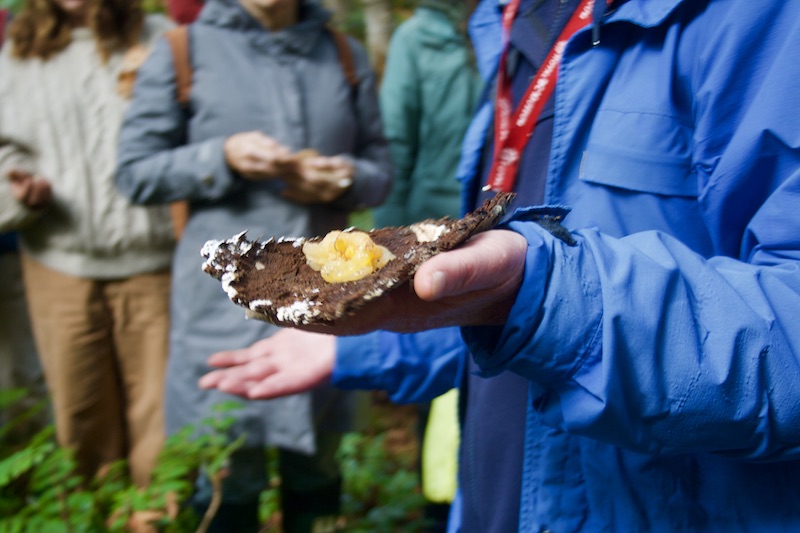
Some of the participants wanted to hear the folk tale connected to this Fungi.
Andy McKinnon: “I know one story I read in a 19th century book about Witch’s Butter, wherein witches were known to have familiars which were oftentimes cats.”
“A witch was generally just an older woman living on her own. In other words, presumably with no need of a man. I mean, what the heck’s up with that? She was also wise in the ways of the natural world.”
“So according to this explanation I read in this old book, if the cattle in a town stopped producing milk the most likely explanation is that the witch’s familiar was running out in the evening to suckle the cattle. That’s where all the milk went, into the familiar. As the familiar ran back to the witch’s house, it would churn the milk into butter, and then spew it forth on the fence posts, or the porch of the witch. That’s how you could tell a witch lived there. (Laughter) It’s kind of like one of my favourite Monty Python scenes. Have you ever seen that one in I think it’s the Holy Grail. ‘How do you know she’s a witch?’ (Laughter) Anyway, that’s the tale that I read.”
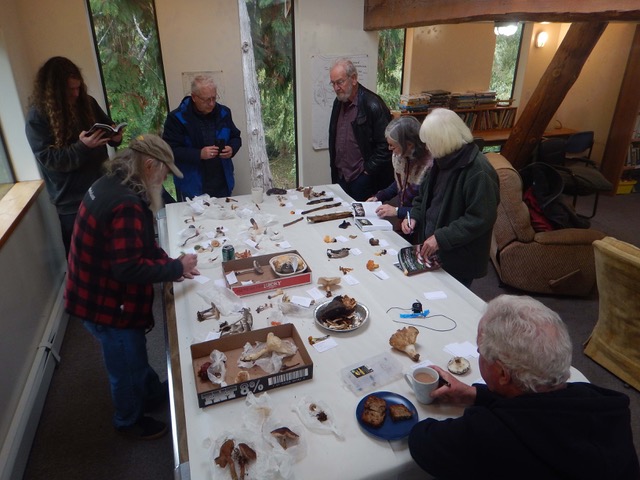
“Let’s look at a couple more and then I think we better head back. If you still have some mushrooms to be identified, we can look at them back at Linnaea Centre.”
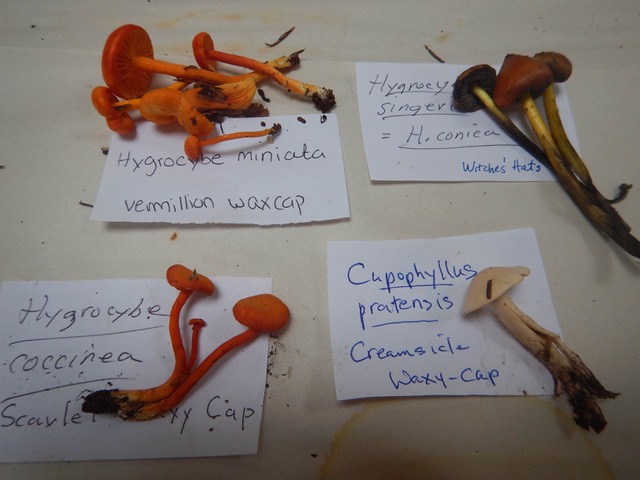
Coralie Grebenart-Castonguay: “At 8 PM, back at Linnea, we watched Fungi Web of Life, the new movie of Merlin Sheldrake and Björk. I love Björk, she’s one of my favourite singers. It was really a great movie. Very much recommended.”
Sabina Leader Mense: “It just screened for the first time at the Royal BC Museum IMAX Theatre in Victoria last weekend and we have the privilege, thanks to Merlin, to be able to show it to you at 8pm tonight.”
Andy McKinnon: “I’ve been fortunate enough to see the movie three times now on the IMAX screen at the Royal British Columbia Museum. It’s a spectacular film. So if you’re at all on the fence about it, I would encourage you to come out and see it. It’s lots of fun.”
There was another forest walk the following day.
Coralie Grebenart-Castonguay: “It was only two hours into the forest in the Whaletown Commons. Another student came from our class, and a student from the middle school came as well. It was with Andy McKinnon and Paul Krueger.”
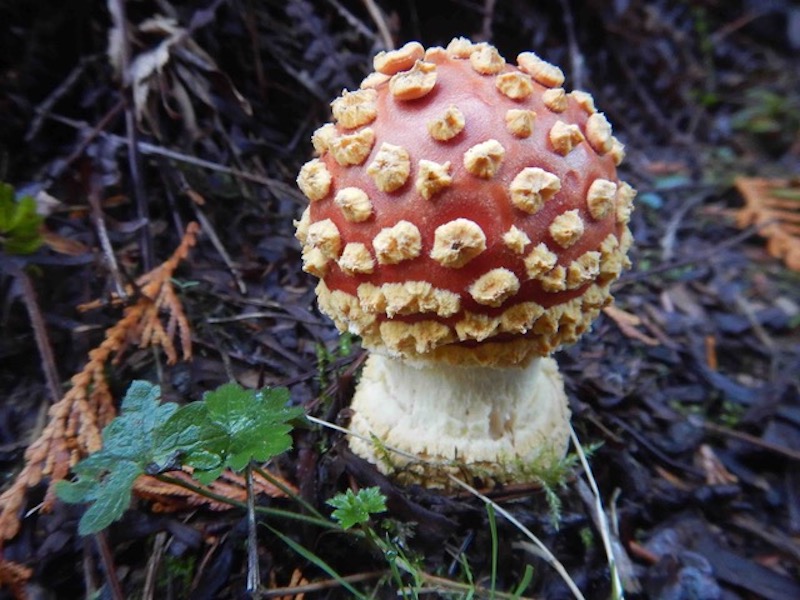
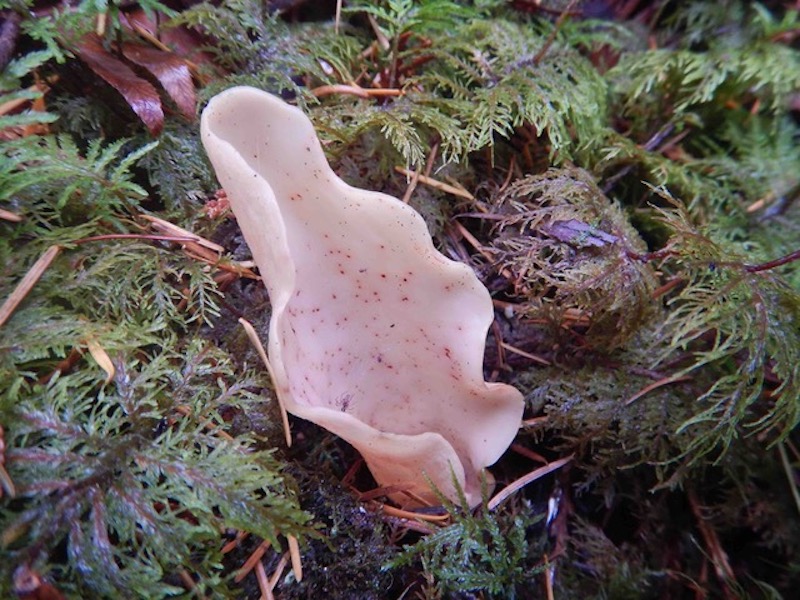
Paul Kruger has identified 3,500 Fungi in British Columbia, but at this point, it’s not known how many of them were found on Cortes island. The official count, prior to the MycoBlitz, was 175.
Sabina Leader Mense: “We’re hopefully adding many to that list, and we’ll have an idea in a week or so, just what we’ve been able to tally up, but the fact that we have 175, is simply looking at historical records, or workshops that have been done, where people provided us lists That’s by no means an indication of what’s actually here.”
“We have a project called Biodiversity Cortes and we’re part of a larger Salish Sea community of people who are very interested in biodiversity and securing and ensuring that the biodiversity on their islands continues.”
“We were working in all different kingdoms. Specifically, this MYCOblitz is sponsored by the Forest Trust for the Children of Cortes Island Society. We were documenting the diversity of Fungi. All of that leads to proving the ecological significance of these forests and ultimately assists us in the fundraising.”
“So the Forest Trust for the Children of Cortes Island ‘s Forest has 600 acres of forest and mycodiversity is essential in forests like that. That’s probably the most important reason for bringing mycologists in.”
“We’ve got incredible mycodiversity on Cortes Island. We’re just trying to document it. You can only do that when you bring the experts in the field in. It’s just a lot of little brown mushrooms out there, and unless you have an Andy McKinnon, a Paul Stamets, or a Paul Kruger helping you out, you don’t get much further than a little brown mushroom.”
“Microdiversity is just incredibly important. Paul Stamets was with our team this morning, doing the research in the Children’s Forest, and really emphasizing the medicinal value of our native mushrooms. Agarikon, of course, is the stellar mushroom that Paul Stamets has been working with medicinally.”
If we are able to protect the mycodiversity of our forests “we will be able to find and put these medicinal mushrooms to use securing people’s health.”
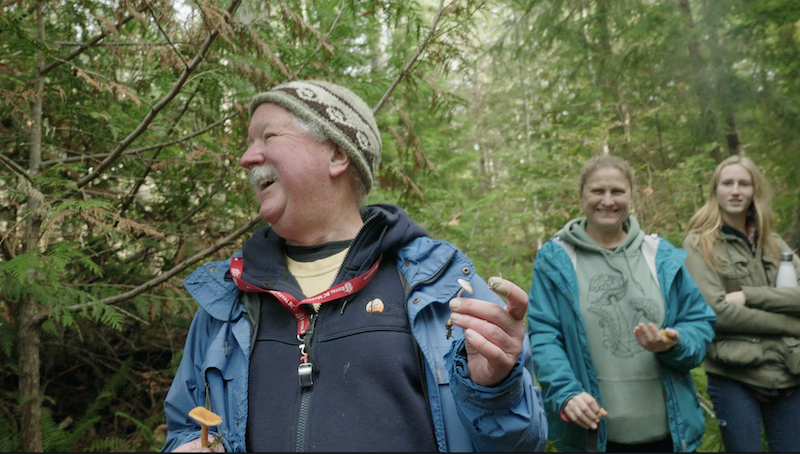
Top image credit: Andy McKinnon addressing his group – Photo by Bill Weaver
Sign-up for Cortes Currents email-out:
To receive an emailed catalogue of articles on Cortes Currents, send a (blank) email to subscribe to your desired frequency:
- Daily, (articles posted during the last 24 hours) – [email protected]
- Weekly Digest cortescurrents – [email protected]