
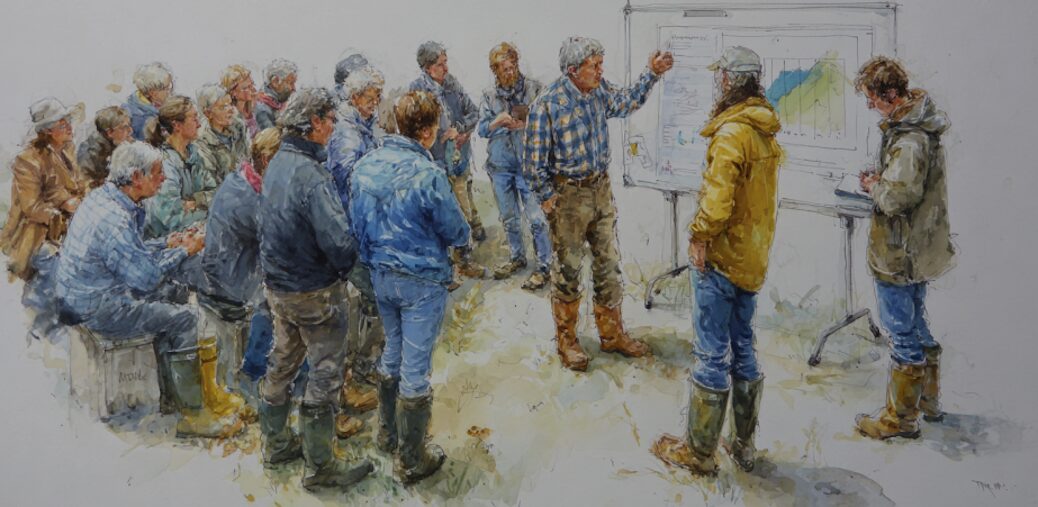

Island United’s proposed expansion of the Whaletown quarry locally known as “The Pit” became public knowledge via minimalist notifications in local media outlets earlier this month. The application to quadruple the Pit’s current footprint seems to be sparking more local controversy as more residents become aware of it. While some residents welcome the quarry upgrade, others are questioning the scale of the proposed expansion and its impacts on environment and community.
A public meeting to discuss these issues is planned for the evening of May 7th, Thursday, at 7pm at Mansons Hall. Organisers say they hope that Mr Nielsen or someone else from Island United will attend to answer some of the many questions being raised.
This Cortes Currents special feature presents some background information on Island United, plus a closer look at some details of the application documents filed by Island United requesting government approval of the expansion project.
Digging Deeper: Fracking Money Buys The Pit
The Pit lies on Crown Land, and the leasehold and physical plant were purchased from long-time operator Dave McCoy by Howard Nielsen a few years ago. Nielsen, a wealthy Alberta businessman who apparently made his fortune in the fracking industry, is the owner of multiple companies at least one of which is listed with Dun and Bradstreet . That company, Sand Source Engineering, shares a web site with Source Energy Services: “Leading the industry in oilfield logistics.”
We have proven experience in logistics, are the leading supplier of frac sand in the WCSB, and have the best in class proppant storage solution – the Sahara – for your well site.
— Source Energy Services web site
[“Proppant” is a solid material, usually sand or specially engineered particles, that is mixed with fracturing fluid during hydraulic fracturing (fracking) to keep fractures open in the rock, allowing oil and gas to flow more easily. “WCSB” is the Western Canada Sedimentary Basin, 1.4 million square kilometres of sedimentary rock much of which contains oil of some kind.]

Fracking itself as a practise and a technology continues to be controversial with significant negative impacts documented as affecting farmers, child health, downstream water users, and migratory birds. It is outright banned in eight countries including the UK, Spain, and Tunisia, as well as in four Canadian Provinces and five US states. Some critics say that fracking in Canada prevents the country from achieving its climate goals.
So Mr Nielsen, it appears, is no stranger to extractive activities that generate strong opposition and controversy. Indeed, his long and close association with the fossil fuel industry may be a factor in the unease and alarm some Cortes Island residents are expressing in response to his application to scale up operations at The Pit.
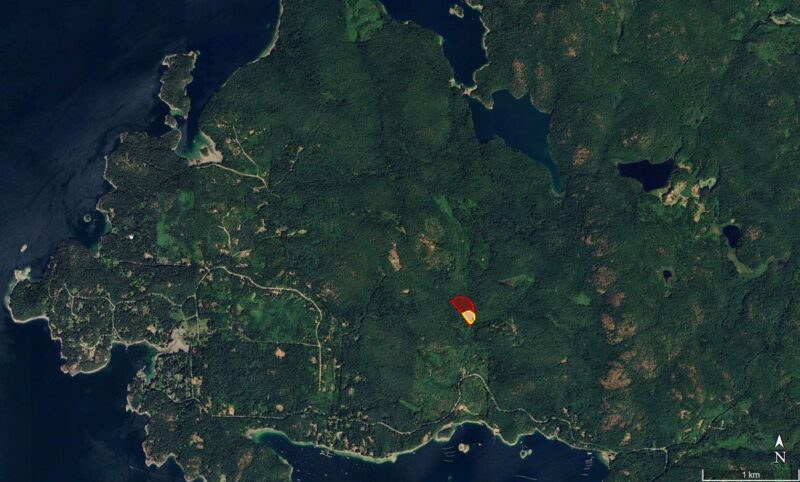
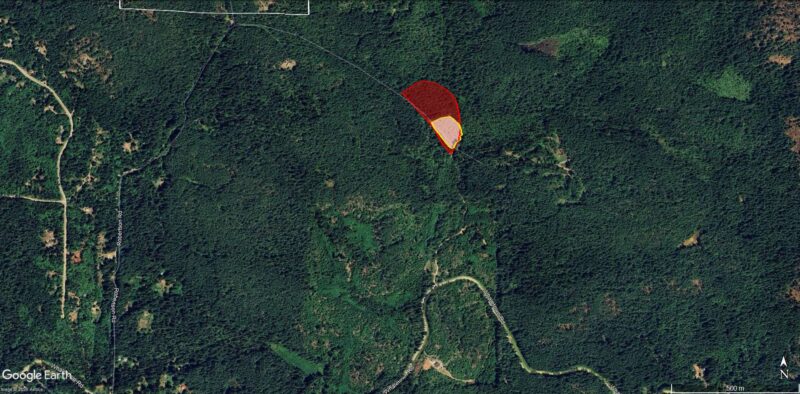
Diligent citizen research has revealed that application was initially made for this expansion in 2023. Despite potential impacts on the community, no public presentation, survey, town hall meeting or any other communication has been offered to Cortes islanders until the bare-minimum announcements earlier this month.
The application for a lease permit to expand the Pit area from 1.125 hectares to 5.16 hectares and a mining permit to quadruple (or more) the extraction rate has been, essentially, a secret. Residents now have only until May 14th to study the application documents, consider the issues, and submit their comments to the relevant government agency.
Island United, the name under which Mr Nielsen operates his gravel and concrete business on Cortes Island, is a subsidiary or “Trade Partner Name” of his Alberta-registered corporation 2385425 Alberta Ltd., incorporated in 2021. It is as 2385425 Alberta Ltd that he has applied to the relevant ministries not only for an expansion of the Pit footprint, but for the significantly higher extraction rate.
More Gravel Than We Know What To Do With?
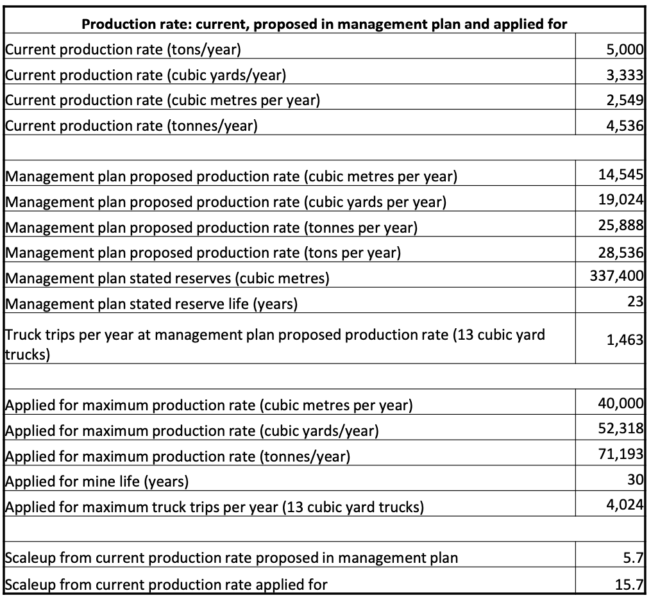
Two different extraction rate caps have been found in the application documents. The Management Plan declares a maximum of 39,999 tonnes per year, but the application document on the government website says “Material is used for construction and infrastructure projects on Cortes Island with an expected annual volume not to exceed 40,000m3.” At the standard estimate of 1.78 tonnes of gravel per cubic metre, that would be more like 71,200 tonnes per year. The higher extraction rate is about 1.8 times the lower one, which is a significant inconsistency.
Presumably one of these numbers is an error, and most likely the rate shown on the government web site is the correct one — but either of these numbers is very large. The scale of the proposal is definitely one of the things troubling island residents about this proposal. Island United’s own web site says that in the 4+ years of its operation on Cortes it has shipped some 20,000 tons of aggregate, or roughly 5,000 tons per year. So to scale up to 40,000 tonnes (44,092 tons) a year is almost a ninefold increase. And to scale up to 40,000 cubic metres per year would be nearly a 16-fold increase.
Several residents have pointed out that “the math doesn’t math.” For perspective: a standard slab foundation for the average 2000 square foot family home requires about 25-30 cubic yards of concrete. Concrete is about 40% aggregate/gravel by volume, so we can guesstimate 10–12 cubic yards of gravel per slab foundation. We can assume that Cortes houses need more gravel than most, because of the island’s notoriously long driveways. A hundred yard driveway 10 feet wide paved with 4 inches of gravel would take another 37 or so cubic yards, so our Cortes family home would consume maybe 50 cubic yards.
But the upper limit of extraction in the application is either 40,000 cubic metres per year (52,318 cubic yards) or 40,000 tonnes (29,395 cubic yards). That amount of aggregate is enough to build either almost 600 (lower upper limit) or almost 1050 (higher upper limit) complete house projects every year.
The production estimate that is probably more realistic and relevant is a third figure from the documents: the anticipated “average” annual extraction/output figure. At 14,545 cubic metres or 19,000 cubic yards it’s considerably smaller than the maximum annual extraction being applied for. But even if the mine never produces more than the anticipated “average” annual output, that’s still nearly a sixfold increase over the current (recent years) extraction rate — and enough to build 380 house projects per year.
Historically, the average number of new homes built per year on Cortes Island is expressed in low single digits.
Where Would the Excess Production Go?
Some residents are asking why Mr Nielsen has applied for a permit specifying such high maximum extraction rates — and why he predicts so high an average extraction rate as well — when the local market cannot possibly absorb more than a small fraction of the product.
If the local market doesn’t justify such high extraction thresholds, then the wider local region must be part of the business plan. But how is the excess product to be delivered to off-island customers?
Island United’s own web site does proudly proclaim that “We haul with tandem dump trucks (13-yard capacity) and can deliver across Cortes Island and to neighbouring islands”. The projected average production would require 1450 truck trips per year. There are about 250 working days in a year, so that average extraction rate would result in 5 or 6 truckloads every working day, on the island’s already crumbling roads.
The maximum proposed mine production volume in the Management Plan (40,000 tonnes per year) would require 2,260 trips per year to deliver, using 13-yard capacity trucks. The higher maximum production volume in the BC government application (40,000 cubic metres per year) would require 4,020 trips. If any substantial percentage of those trucks are going off island, the impact on the roads would be nothing compared to the impact on the ferry lineups.
Water and Traffic Issues
Residents also flagged language in the application documenting intent to install a “concrete plant” and an aggregate washing facility of some kind. This immediately raised concerns about water supply: both these activities are water-intensive and produce potentially harmful runoff. The Management Plan claims that all contaminated water will be stored above ground and trucked out, and fresh water will be trucked in: “Wash water will be sourced from an offsite license and trucked to site when required.”
Aside from the implication of yet more truck traffic in the Whaletown residential area, some questions have been raised about the acquisition of water from “an offsite license”. If the plan is to purchase that water, a recent ordinance governing Cortes and Quadra islands may strictly limit or even prohibit the sale and purchase of bulk water.
Returning to residents’ concerns about a concrete plant: such a plant is simply a mixing facility — it is not like a cement plant which crushes and powders limestone and other inputs, generating lots of noise and dust. But a concrete plant does need those other dusty ingredients (limestone powder, sand) as well as water, to mix with aggregate to make the finished product we use for foundations, steps, etc. There is no limestone on Cortes Island, and no sand quarry. So presumably powdered limestone and sand would have to be brought in from off-island. How much of this inbound traffic would there be, given the application’s predicted extraction rates?
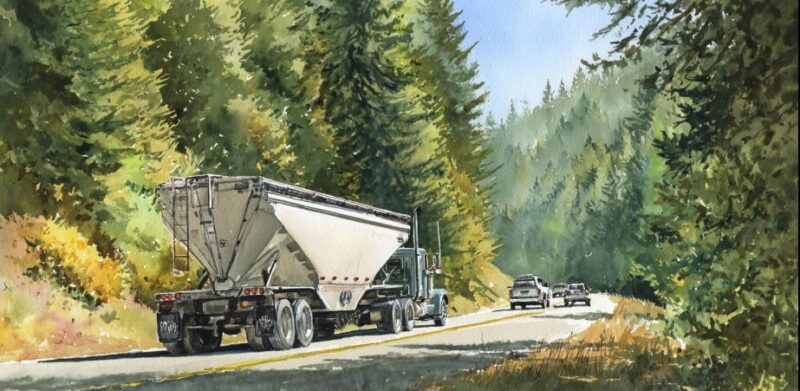
Taking the predicted average (not maximum) gravel production forecast and assuming for the moment that only half of it is for making concrete, we get some disturbing numbers. [Worksheet at end of article, for those who want to double check the math.].
We end up with about 3 powdered cement tanker trucks per week, 8 or 9 sand trucks per week, and 2,700 gallons of water per operating day based on a 5 day week. That’s about as much water as one average tanker truck can haul, so one tanker truck trip to the site per day.
If we add up all those truck runs, it’s about a dozen inbound heavy vehicles on the ferry per week, plus a water tanker visit every day (or multiple visits if it’s a smaller tanker).
Our previous calculation regarding houses and driveways suggests that perhaps a much smaller fraction of the mined aggregate will become concrete. But even if it turns out to be a tenth of the output rather than a half, it’s still more year-round heavy vehicle traffic than Whaletown is accustomed to… continuing for the next 30 years, per the application.
Cortes and Whaletown Inaccurately Represented
Whaletown as a residential area, according to the Management Plan, is of negligible importance. “Most of the island’s population of about 950 people live on the southern half.” Whaletown is “located 3km west of the site.”
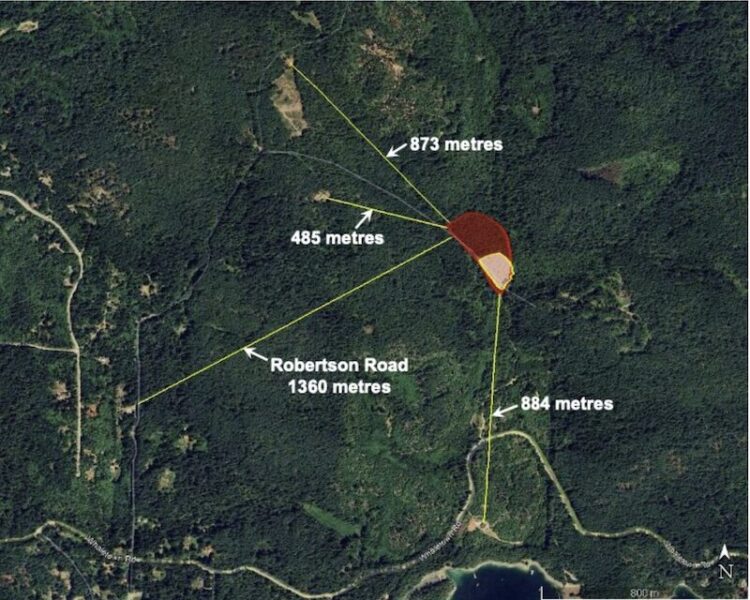
In fact, what most people think of as “downtown Whaletown” is located only about 1km west of the pit driveway on Whaletown Road. Any ferry oriented truck traffic generated by the project has to pass through this area, which contains the post office, community hall, gas station, grocery store, and a school bus stop.
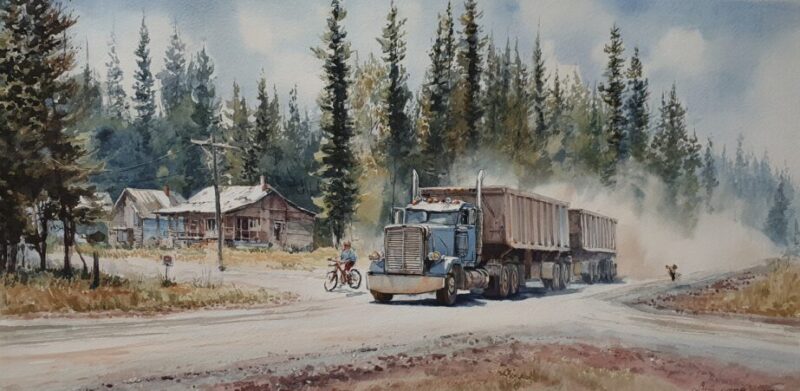
Information in the Management Plan document about Cortes Island is strangely inaccurate. It claims that “The main access to Cortes Island is by BC Ferries which runs a small boat from Quadra Island to Cortes island twice a day,” This makes Cortes sound like a remote and isolated outport. BC Ferries offers six sailings a day from Heriot Bay to Cortes, and the new ferry coming to our dock this summer can hardly be described as “a small boat”.
Directions given for driving to the quarry are nonsensical, referencing a “Robinson Road” which does not exist. Presumably this is an erroneous approximation of the real Robertson Road — which is not by any stretch of the imagination a quarry access road. This language in the document has sparked alarm among residents living on Robertson Road.
It appears that whoever wrote the Plan did not bother to consult a map which would have easily distinguished Robertson Road from Jimmy Smith Grade, the actual quarry access road. The private road owner at the uphill end of Robertson says he has not been contacted by Island United for permission, and would under no circumstances allow this use of his property. As it stands, the application is a statement of intent to trespass. So there is approximately zero possibility that Robertson Road residents will be hearing gravel trucks rumbling by their homes.
But errors such as these, even if absurd, tend to increase the local perception that this project is being planned and managed remotely, from Alberta, by people with no local knowledge of the island.
“The area is remote and there are few neighbours” gives a misleading impression of deep isolation — “Forests surround the licence area in all directions.” However, specific Whaletown neighbours have been able for years to hear industrial noise coming from the Pit. Due to peculiarities of topography, noise from the Pit (which is located on a granite knob) travels all the way across Gorge Harbour to the water-access properties on the far side. Tens of neighbours are going to hear blasting when it occurs. Tens of neighbours have already been annoyed by the scale of truck traffic during Island United’s paving of a private jet runway at Eagle Acres — which itself was a controversial project.
The quarry operation is not nearly so isolated and invisible as the Management Plan paints it. Whaletown is a low density rural neighbourhood, but it is inhabited.
The Management Plan also specifies year round operation, Monday through Friday during daylight hours. In the summer, daylight hours are from 5am to almost 10pm; so this language also has Whaletown residents worried about truck traffic and machinery noise potentially disrupting the rural peace which drew them to Cortes Island. The plan offers no guarantee of quiet even in the early morning or late evening.
We Need Gravel, But Do We Need This?
Some opponents of the plan have specific concerns about further deficiencies and misstatements in the application documents regarding potential environmental impacts of the quarry expansion on Community Forest land. Currents hopes to publish their fact-checking and research soon. But for most Whaletown neighbours, the scale of the plan seems to be the issue of most concern.
While no one questions the need for construction gravel on Cortes Island, or the wisdom of supplying it locally rather than clogging the ferry with heavy dump trucks, the scale of Mr Nielsen’s plan strikes many as puzzlingly and alarmingly grandiose, transitioning the Pit from a small family or one-man operation to an industrial mine site producing far more gravel than the island can use.
This would be the first large-scale heavy industry on Cortes Island. For some Whaletown residents, in particular, it is not a welcome development. They fear that an aggressively expanded Pit operation is going to have detrimental impacts on their quality of life — and possibly also their property values. Thus far, most islanders who have expressed enthusiasm or support for the quarry expansion have not been Whaletown residents; but even some more southerly residents are concerned.
“It’s a slippery slope — we could soon look like Texada, since there’s lots of crushable granite on Cortes.” said one long-time homeowner in the Manson’s Landing area.
[Public meeting May 7th at 7pm, Mansons Hall — presentations and facilitated discussion.]
[Many thanks to D Hughes for research & map making, also math proofreading; thanks also to “Claude” (an LLM) for math proofreading and computational help. Some numbers and units originally published on the morning of Monday 27 April have been edited based on feedback from D Hughes and Claude; however, the overall scale of the quantities involved has not changed, only the fine details.]
Nerd Appendix:
Worksheet for materials transport guesstimates
Starting point: 14,543 m³ of gravel per year, half going to concrete = 7,272 m³ of gravel as concrete aggregate.
Concrete mix proportions by volume (approximate):
- Coarse aggregate (gravel): 40%
- Fine aggregate (sand): 30%
- Cement: 15%
- Water: 15%
So if gravel is 40% of the finished concrete: 7,272 ÷ 0.40 = ~18,000 m³ of finished concrete per year
Cement required (15% of finished concrete): 18,000 × 0.15 = 2,700 m³ of cement powder
Portland cement bulk density ≈ 1.5 tonnes/m³: 2,700 × 1.5 = ~4,050 tonnes of cement per year
A bulk dry-powder tanker carries roughly 25 tonnes: 4,050 ÷ 25 = ~162 tanker deliveries per year, or about one every 2.25 days — roughly 3 per week.
Sand required (30% of finished concrete): 18,000 × 0.30 = 5,400 m³ of sand
Sand bulk density ≈ 1.6 tonnes/m³: 5,400 × 1.6 = ~8,600 tonnes of sand per year
A flatbed or dump truck carries roughly 20 tonnes: 8,600 ÷ 20 = ~430 sand deliveries per year, or ~8-9 per week
Water required (15% of finished concrete): 18,000 × 0.15 = 2,700 m³ of water per year
2,700 m³ = 2,700,000 litres = ~713,000 US gallons per year
Or roughly 1,950 gallons per day on a 365-day operating schedule — call it 2,700 gallons per working day on a 5-day week.
Summary of inbound supply traffic:
- Cement tankers: ~162/year (~3/week)
- Sand trucks: ~430/year (~8-9/week)
- Combined inbound supply: ~590 heavy vehicle ferry crossings per year, or 11-12 per week