

By Dave Flawse, The Discourse, Local Journalism Initiative Reporter
At the end of May, the B.C. government gave a third and final reading of the K’omoks Treaty Act, which will now go to the federal legislature to be ratified, a moment that has been over thirty years in the making. If passed, the treaty will give K’ómoks First Nation the ability to self-govern and bring economic development to newly acquired lands in the Comox Valley.
“The economic opportunities are huge,” says K’omoks First Nation Chief Nicole Rempel in an interview with The Discourse, adding that “it’s all about working together.”
What are the potential economic benefits for the First Nation and wider Comox Valley community? And how does the Nation’s economic development plan compare to other nations with treaties in B.C.?
Here’s what you need to know.
How will the K’omoks treaty affect private lands?
The treaty includes the transfer of Crown land and private land already purchased by the province of B.C. for the treaty settlement to the Nation.
“We have 12,500 acres in our treaty,” Rempel says. That makes the Nation the second-largest landowner in the Comox Valley, according to recent information published on the Nation’s YouTube channel.
The B.C. treaty process is designed to get Crown or government lands back into the hands of First Nations and does not impact private property without special agreements in place.
“Any private lands in our treaty are on a willing seller, willing buyer basis. So, [K’omoks First Nation is] not expropriating anybody’s property,” Rempel adds.
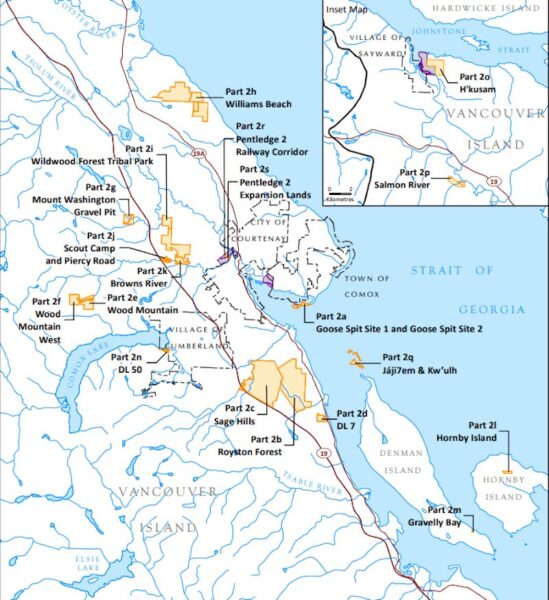
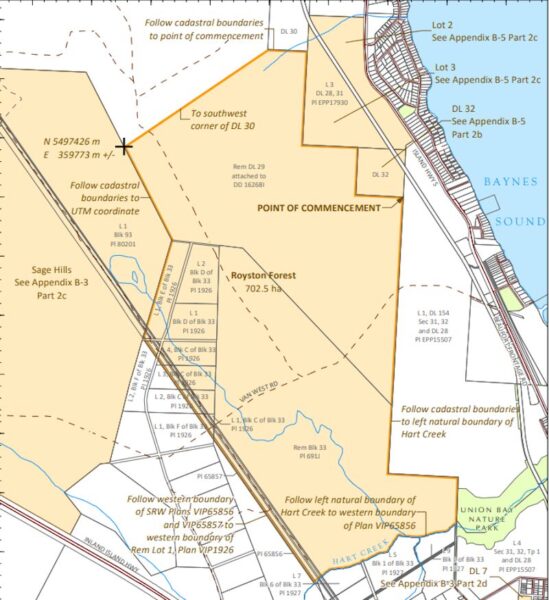
The treaty lands include several parcels throughout the Comox Valley and K’omoks traditional territory. The largest is what the Nation calls the Southlands, a section in south Royston between highways 19 and 19A, marked as “Part 2b Royston Forest” and “Part 2c Sage Hills” on the map below.
Plans already exist to bring sewer infrastructure to the Southlands area, which Rempel says is probably the Nation’s “most immediate opportunity for growth,” noting that septic systems in the area are failing and “they flow right into Baynes Sound, the shellfish breadbasket of Canada.”
“To be able to partner with the regional district and the city to provide services to better opportunities there is also really important,” Rempel says. “Just the economic opportunities for the whole region and throughout our territory, I think, are really important as well.”
Opportunities to build housing
Providing critical infrastructure, such as sewer, to the Southlands will also make way for housing to be developed according to Rempel. And she says the Nation hopes to address housing needs not just for K’omoks people, but for people in the Comox Valley as a whole, with Rempel noting the importance of partnering with local governments for any future projects.
“You look across the country and there’s just a housing crisis for everybody,” Rempel says. “If K’omoks can utilize some of our treaty lands to address that, I think that it’s all about working together.”
Daniel Arbour, Area A Director with the Comox Valley Regional District, agrees.
“The treaty is welcomed by the Comox Valley Regional District, and I think it will bring opportunity for the Nation but also for the Valley as a whole,” Arbour says.
“It’s going to be a change in growth in the south if everything comes through.”
Some of the land covered in the treaty is adjacent to Union Bay Estates, a large, master-plan development that had promised to change the community. But all work by the regional district related to the project “has been paused until further notice,” according to the regional district’s website.
The developer, Kensington Union Bay Group, is under receivership and the partially developed land is under a court-ordered sale.
Union Bay Estates, the regional district and K’omoks First Nation had partnered to bring sewer infrastructure to the area. With Union Bay Estates no longer able to commit funding to the Sewer Extension South Project, the regional district and Nation are seeking additional grant funding to cover the shortfalls.
“There will always be some unknowns around how the relationship will evolve but [K’omoks First Nation] has been excellent to work with,” Arbour says, adding that the Nation is “very open-minded and forward-looking.”
Melissa Quocksister, a K’omoks member and communication and engagement consultant with the Nation, says the treaty also provides the Nation the ability to “build differently.”
“We have to match or beat the B.C. Housing standards and codes, but I think there’s a real opportunity to look at how to develop in a different way,” Quocksister says. “No urban sprawl, really green technologies. [We can] build it in a way where it fosters community and gatherings and really exciting stuff like that.”
Quocksister says the Nation could also be a future employer for the region. She says the treaty is a benefit to everyone involved on a greater scale.
Other examples of First Nations with modern treaties
Several nations in the province, including Tsawwassen First Nation, have fully ratified modern treaties, which gives them the right to self-govern their land.
The Tsawwassen Economic Development Corporation has leased land for several residential, commercial and industrial projects, including the Tsawwassen Mills shopping centre and a Vancouver Fraser Port Authority and Canada Border Services Agency inspection facility, according to an implementation report on the treaty.
“Every nation has something unique and special about how they can prosper,” Quocksister says. “The possibilities are potentially endless with the amount of land we have.”
But Quocksister also notes that with so much happening, K’omoks First Nation will need a lot of support.
“That’s one of our key messages. This is a Comox Valley treaty. This is a Vancouver Island treaty, a B.C. treaty, a Canada treaty. It’s for everybody. Everybody will benefit,” Quocksister says.
Rempel says the Nation approaches partnerships with neighbours, “whether it’s Indigenous communities or local governments,” with collaboration, asking, “How do we all move forward together in the same canoe, building something bigger and better for everybody?”
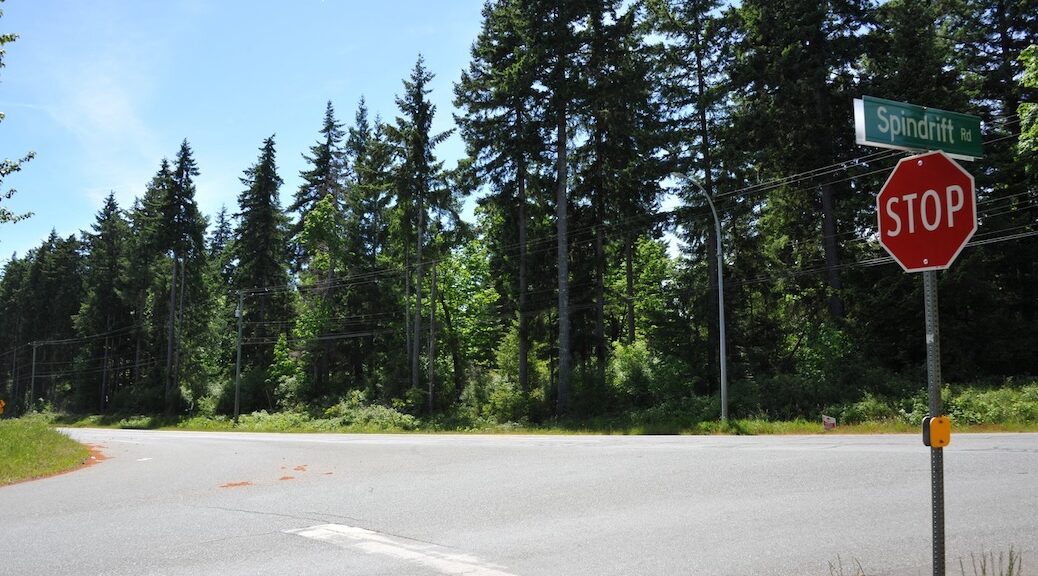
Top image credit: The K’ómoks First Nation treaty includes what the Nation calls the Southlands, a large parcel in Royston between highways 19 and 19A. Photo by Dave Flawse/The Discourse

Sign-up for Cortes Currents email-out:
To receive an emailed catalogue of articles on Cortes Currents, send a (blank) email to subscribe to your desired frequency:
- Daily, (articles posted during the last 24 hours) – [email protected]
- Weekly Digest cortescurrents – [email protected]