
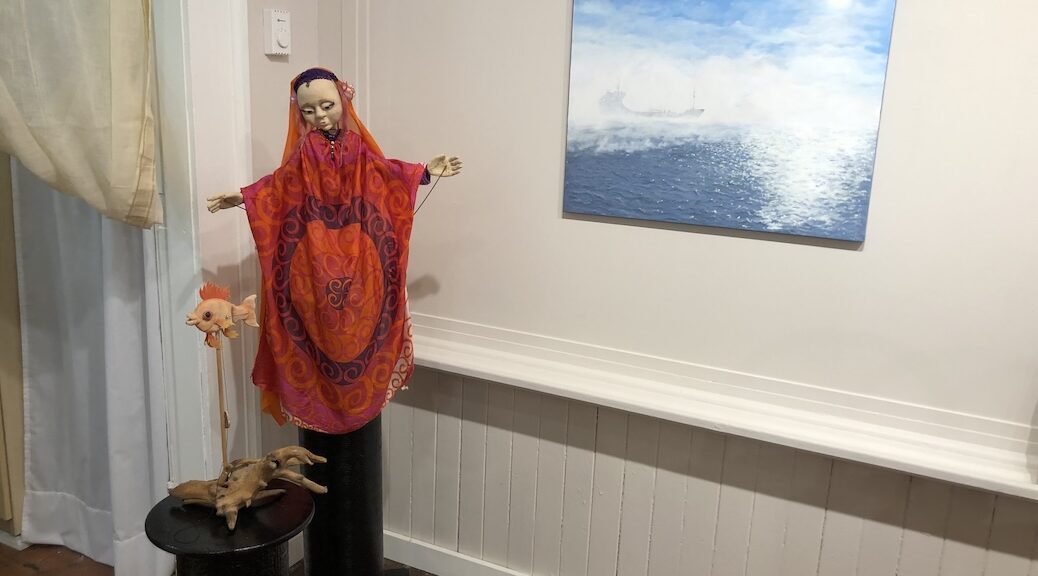

‘The Uncanny and the Sublime’ exhibition opens at the Old Schoolhouse Art Gallery at 6:00 p.m. on Friday, June 19, and runs until July 5. In this morning’s interview, exhibiting artist Meinsje Vlaming discusses her puppets and paintings.
Meinsje: “I’ve been involved with the Academy of the Wooden Puppets. That’s a two-year education online by Bernd Ogrodnik, a German teacher, master puppeteer, and carver who lives now in Iceland. That’s one of the good things that happened with COVID: we have a lot of things online now, and we don’t have to go there.
“Bernd put together a program on carving puppets—from the beginning, very simple puppets, to a very, very complicated marionette. Of course, being a puppeteer, that had my interest. So I enrolled.”
“Well, actually, I first applied for a grant. I got it, I enrolled, and I started carving. I got all these puppets that are not really related, and I haven’t put them in a puppet show, but it would be nice to hang them on the walls in a gallery and display them.”
“So we thought about that, and then it’s like, well, I don’t have enough to fill the gallery. And then I also enrolled with a wonderful painter teacher, Michael Orwick, whose style is really resonating with my own style—my own work. So I thought, ‘Why don’t I put those two together?’ – But how do you connect the wooden puppets with the paintings that are about light?”
“If you look through my work, it’s very diverse—there’s a lot of different styles and trying out styles. But the thing they all have in common is the light. So I took two elements from two different disciplines and tried to connect them. What they have in common is a ‘P’: painting and puppets—then I started to dive a little deeper into what they have in common, which is the sublime in the paintings.”
“The Romantics, the Tonalists, the Luminists—they’ve all used that. I personally think light is the most sublime thing on this planet. It’s in paintings, and it’s connected to the spiritual.”
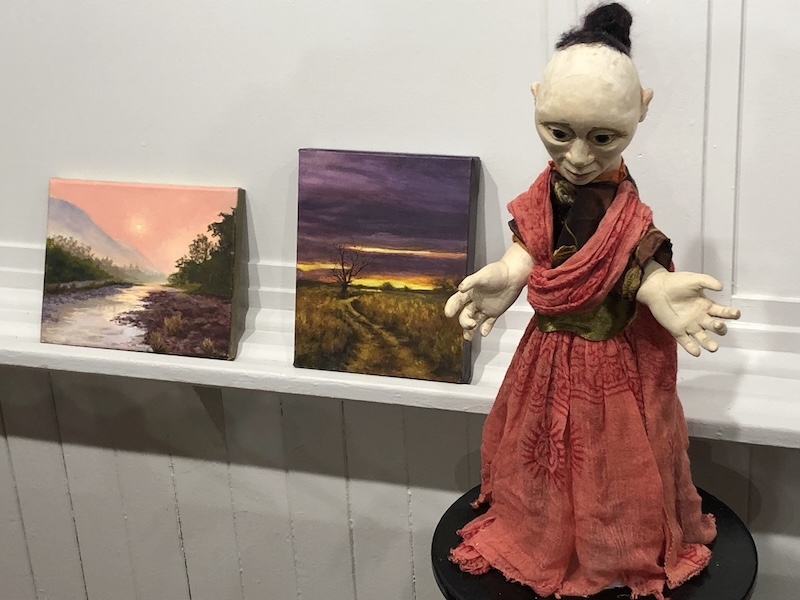
“Then I was like, ‘Okay, how do my puppets connect to this?’ Puppets are uncanny. They have this same feeling of reality and not reality, as paintings have with the sublime, and as puppets have with the uncanny. Although, with puppets, you would put it more into the supernatural than the spiritual and natural in paintings.”
“That’s how I came to decide: ‘Let’s put puppets and the paintings together into the show.’ And that works—I think, I hope.”
Cortes Currents: Some of your paintings reminded me a little bit of the old Dutch masters.
Meinsje:“Really? I try very hard to paint what I am, and who I am. Which is a question: what kind of a painter am I, and what of a puppeteer or carver am I? But the roots don’t lie. They stay, and I can’t help myself.”
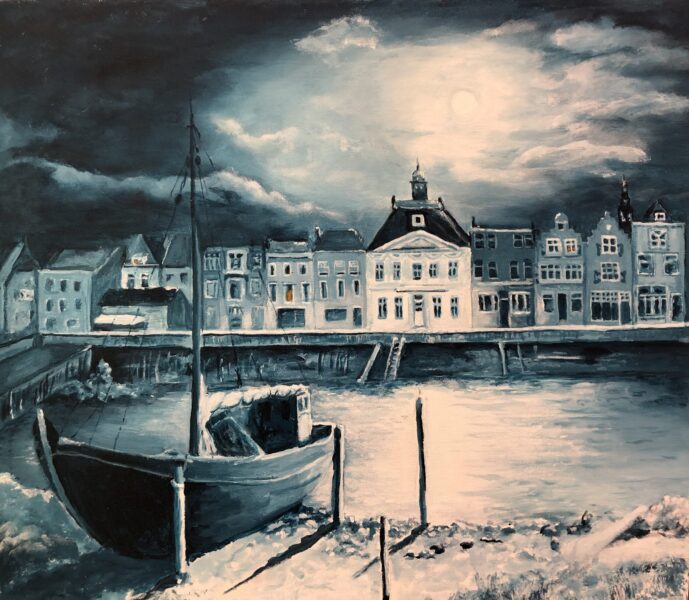
“I think the subject matter also makes you go to that place. There’s a lot of old places from when I was a child growing up in the Netherlands, and of course growing up with Dutch art.”
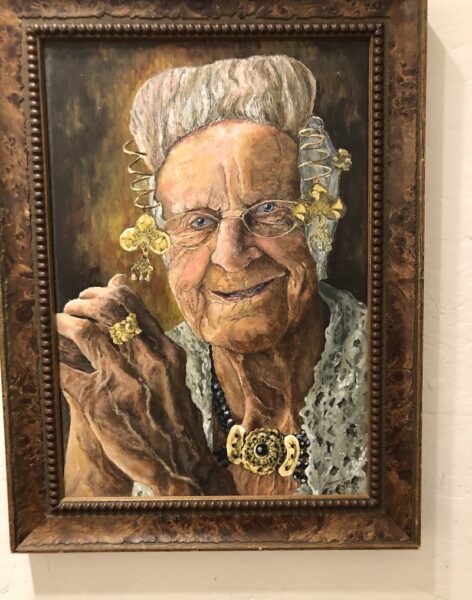
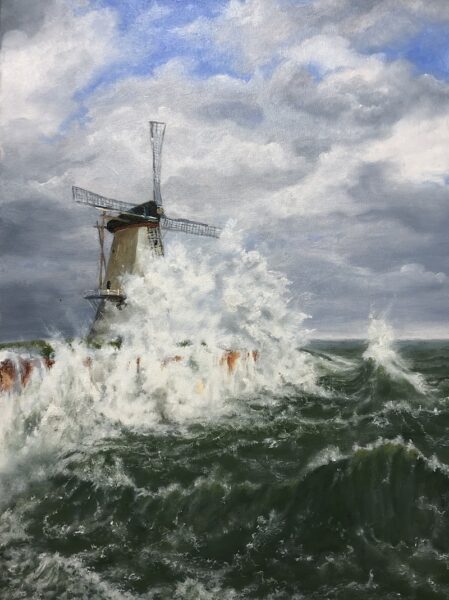
“One of the paintings is of a 102-year-old lady who lived in a village very close to mine. I used Rembrandt’s palette, so I tried to work with his techniques a little bit. Of course, in the Dutch tradition, the light’s very important because the country is so low—so low that it’s under sea level.”
“So the way the light filters is different than here. We have different cloud formations. And even though I paint a Canadian or a North American subject, I am still going back to that place of using the light in the old-fashioned way, as centuries of artists before me did.”
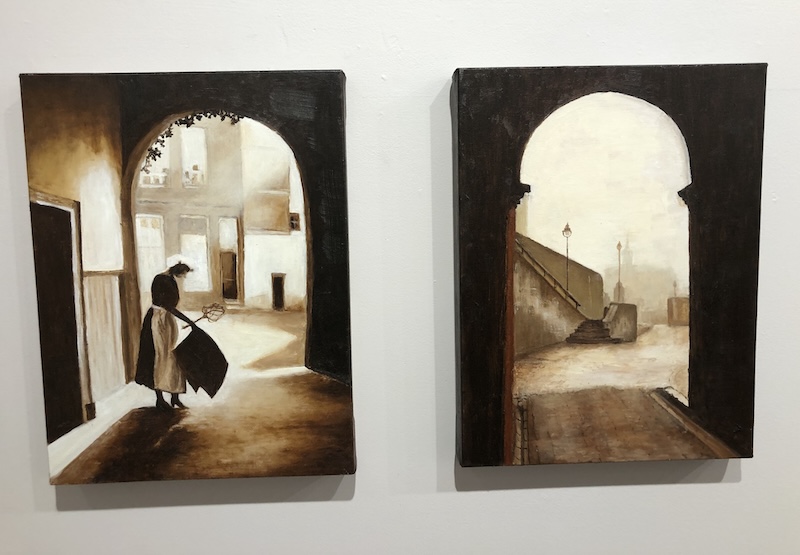
Cortes Currents: This is just from a quick walkthrough, but I’m thinking of three in particular. They were bluish, and the women had headdresses—were they still wearing this when you were in Holland?
Meinsje:“Oh, yeah. There were a lot. Some are still wearing it now.”
Cortes Currents: Some of the poses actually reminded me of Johannes Vermeer (1632-75).
Meinsje:“This is at the root of who I am.”
Cortes Currents: Where were you born?
Meinsje:“I was born in a small village called Yerseke in the southwest of the Netherlands.”
Cortes Currents: How much of this show goes back to Yerseke?
Meinsje:“So much … Yerseke was on one island, and when I was about eight I moved to another island—Vlissingen. It has an English name: Flushing. It’s in the mouth of the river, the Schelde. They’re not islands anymore, because the Dutch being the Dutch, they connected everything and let water out, put sand in the whole thing.”
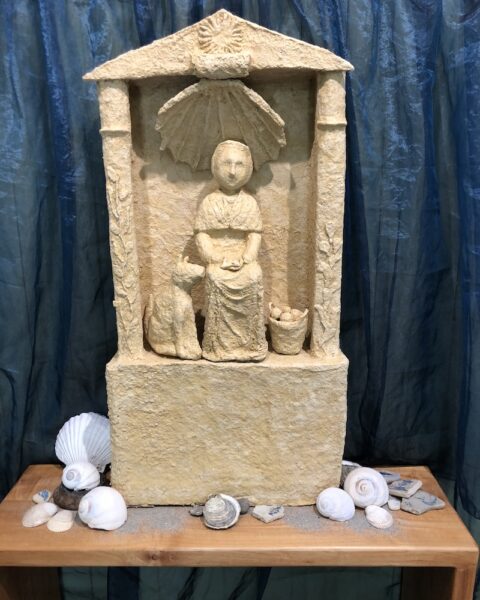
“The Schelde is quite important actually for my show. When you just step into the gallery, you will see an altar—the goddess Nehalennia. She dates from about 5,000 years before we start to count our calendar.”
“She was a goddess of the ocean, and in the Netherlands a mother triple goddess. She disappears under the ocean—like stuff does happen in the Netherlands. If you have a country that’s below sea level, these things happen.”
“In 1647, the tide went out very far and some of the altars became visible, but people were very much into the Christian religion, so they hid it away. In 1970, some fishermen fished up about 157 altars—pieces of temple—and her statue. It was immediately an archaeological sensation.”
“My mom took me to one of the first exhibits, which was in the town hall of our island. To me, that was the absolute max of uncanny and sublime all together: that this entity—lost for centuries—suddenly emerged from the waters.”
“I have a big history with fishermen. My dad was an oyster fisherman, and mussels and fishing. They had big businesses all over Europe in seafood—so that’s very important to me. That gave such a big impression that I had to make from paper-mâché one of her altars. That’s what you see when you come into the show.”
“Anyway, that’s why that place is so important for this show: the place where I grew up. And also because Nehalennia wasn’t just on that island. She was all over Europe. Some of the altars were found even as far as Germany.”
“Nehalennia—means ‘she who’s from the sea’ or ‘from the swampy grounds,’ and it’s actually Gaelic. She’s a Gaelic-German goddess.”
“I develop myself and my art in a different way. I also tried to work with gold leaf and silver leaf, which is very much more contemporary and not really used by old masters.”
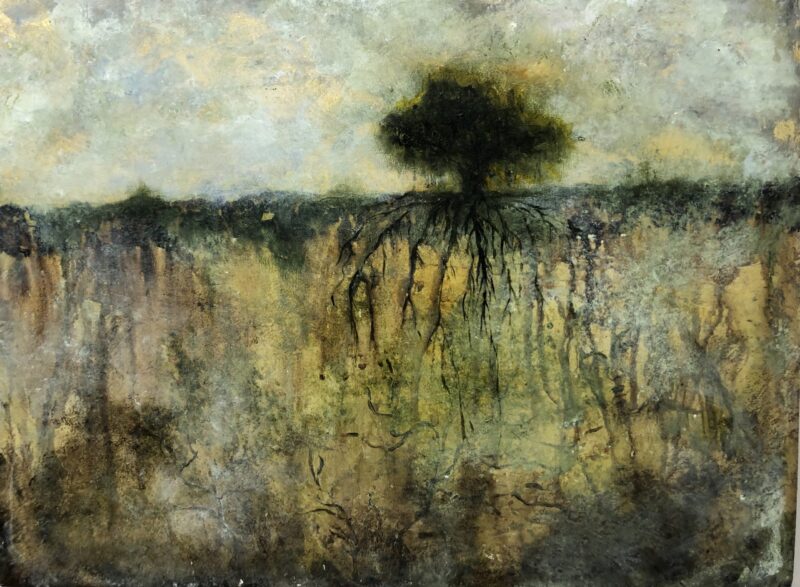
Cortes Currents: Some of your landscapes aren’t naturalistic. I’m not sure of the correct term to use.
Meinsje:“Luminous. They’re luministic.”
Cortes Currents: Tell me a little about those.
Meinsje:“I found a new favourite colour: Indian yellow. I can’t stop painting with it. This is definitely Michael Orwick’s influence, because he uses that a lot. When I found it, I just fell in love with it.”
“It gives such a nice glow to all the paintings, and I even used it in some of my Dutch subject matter. Like, I have this old little town hall painting—In the Morning Dawn. I just put subtle little pieces of that colour on a Dutch painting. It seemed to work and elevated it, from the old Dutch painters, to me being a modern-day painter.”
“Although I try very hard to be more contemporary and abstract even, I fall into my own trap of representation and old-school matters.”
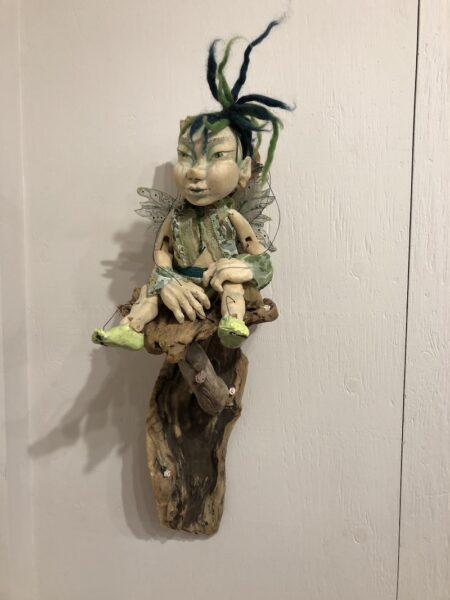
Cortes Currents: Do you want to say anything about any of your puppets? I notice you have different types of puppets.
Meinsje:“Most of them are wooden puppets. I carved them all. There are some tabletop puppets that are very simple to operate. There are some more complicated tabletop puppets. Then there are very simple hand puppets.”
“The whole journey for me was really to find out what works. I would never carve a hand puppet in my life anymore because it doesn’t make sense. It’s very heavy on your hands and not easy to move at all.”
“So I would go with papier-mâché for hand puppets. They don’t suffer as much as a marionette either. Normally, I find a story, and then I find the puppets. But in this case, I created the puppets and then needed to find a story. It’s not how I work.”
“So these are prototypes of what I do. It was more to learn the skill, to finish the school, to have a certificate of the school—which I had to have to promise to the art council that I really did that with my money. I didn’t just go and blow it—on popcorn and bubblegum, or whatever.”
“I’m definitely going to use the techniques I’ve learned. I’ve learned a lot of control for marionettes. I learned how to make different joints. I’m planning to make a belly dancer, because I’m not dancing so much anymore. So it would be great to have a belly dancer.”
“There are so many types of puppets. I’ve had a few puppets that I created for a stage play—Cinderella—in The Tide Mark. I made a fox and a raccoon, and they’re very different. They were made out of fabric and paper-mâché.”
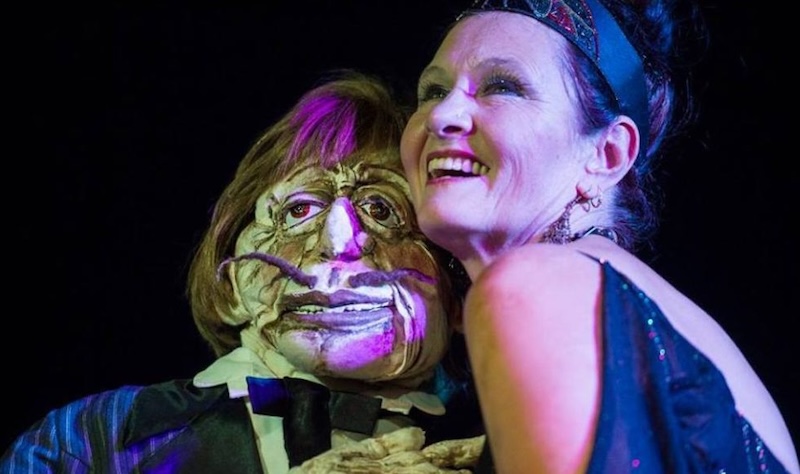
Cortes Currents: Are any of your puppets going to be in the Lip-Sync this summer?
Meinsje:“Oh, God. That’s a good question. None of these guys. I have some different ones that I already made for Lip Sync. I mean, we buried Charles, right? Right. I don’t know what we can do about that.”
Cortes Currents: Like television series—they keep on bringing characters back.
Meinsje: “Maybe, you know what – he could have a brain transplant, or something else, and become something else.”
Cortes Currents: Or he’s been genetically engineered.
Meinsje: “There you go, or defrozen – like Disney or something. He might be back. He would like to, but I don’t know—he’s a little fragile still. I still have him. I look at him and I wonder, it’s like, ‘What am I gonna do with this guy?’ But we’ll see.”
“So these guys (in her current show) are not Lip Sync material, because none of them have a moving mouth. So that would be tricky. They could dance—that’s kind of it.”
“The other thing is, the wooden puppet can have a mouth mechanism, but then you get this ventriloquist look with the fake eyes and the fake mouth. If I use a puppet for talking or singing, I like to create more expression—so it would be foam or something. But then I don’t like to work too much with foam either, because it’s so plastic, and we have enough plastic in the world.”
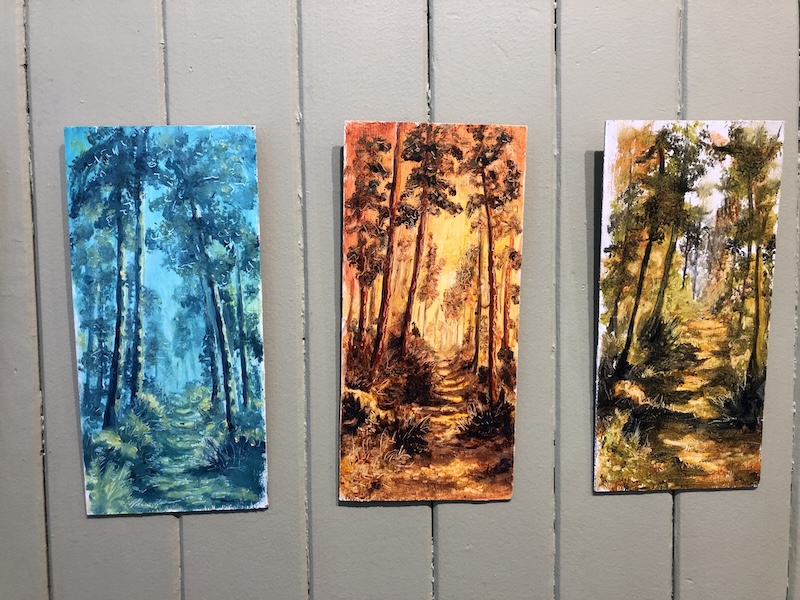
The exhibition “Uncanny and the Sublime” opens in the Old Schoolhouse Art Gallery at 6:00 p.m. tomorrow,Friday, June 19.
Meinsje:“With snacks and a wine bar.”
Meinsje will talk about her paintings on Friday, June 26, and Soma Feldmar’s workshop “Writing in Colour” is on June 28, 12:00–2:00 p.m.
On Friday, July 3, Meinsje will talk about her puppets.
Gallery hours are 6:00–9:00 p.m. on Fridays, and 2:00–6:00 p.m. on Saturdays and Sundays.
Links of Interest:
Photos of Meisje’s artwork by Roy L Hales
Changes to Article: Article originally published June 18, half a dozen photos added June 22, 2026
Sign-up for Cortes Currents email-out:
To receive an emailed catalogue of articles on Cortes Currents, send a (blank) email to subscribe to your desired frequency:
- Daily, (articles posted during the last 24 hours) – [email protected]
- Weekly Digest cortescurrents – [email protected]