Some seven or eight years ago, longtime Cortes residentTanya Henck perceived a need for more support for women on the island struggling with various issues — domestic violence, sexual harassment, housing insecurity, poverty, mental health, social isolation — and launched the idea of a Women’s Resource Centre. Joined by a few other island women, she rented a space in the Mansons Hall building and formed a partnership with North Island Transition Society. In 2019, the Centre opened — just in time for the Covid pandemic.
Since then, the Cortes Island Women’s Resource Centre has served island women in many capacities. In an interview with Tanya in late May, we discuss recent organisational changes (the Centre is now a BC Non-Profit Society in its own right), current programming and services, the level of need on the island for those services, the ongoing relationship with North Island Transition, and Tanya’s plans for expanded services and projects in the coming year.
Many people assume that because Cortes Island is a small, remote and neighbourly community where people leave their houses and cars unlocked, that domestic violence and sexual harassment are not a problem — something that happens in other, grittier places, not here. But islanders are just people like any other people, and like any human community in the modern world we have members who struggle with mental health, substance abuse, and anger management — or brought with them archaic values of male supremacy, like men’s “natural right” to dominate and control women. Domestic bullying and violence do happen on Cortes Island.
In the interview, Tanya and I discuss how a small community in some ways makes abusers easier to keep track of (“we pretty much know who they are”).
We know who a lot of the key players are in abusive relationships. Especially after being here as long as we have — well, as long as I have, 20 years this year on Cortes — we know, if a woman walks through this door… we’ve gone through the women, right? The women have come and gone. Multiple [partners] for these same people. And that’s another thing that’s unfortunate — we tend to lose the women. Those abusive men tend to stay here. We also see typical behaviors in abusive men, like they tend to find women who don’t live here and then bring them here. And of course, this all seems like magic at first, right? it’s beautiful, a community, all these things. And then, you know, winter hits or the honeymoon’s over or whatever.
Tanya also acknowledges, however, that the rural and remote environment also makes it in some ways easier for domestic abusers to control family members, and harder for those family members to escape or get help. Houses are often isolated, neighbours are often out of earshot, and the police are hours — not minutes — away. Although urban environments offer more risk in terms of “stranger danger”, idyllic rural communities can put women at a disadvantage in dealing with abusive partners or other family members.
Tanya notes that the distorted housing market on Cortes Island adds another layer of difficulty, contributing significantly to keeping women in abusive situations, because “there is just nowhere else to go.”
One of the biggest things that put women and children in harm on this island is the lack of housing. There’s amazing things happening with the housing society But still, hands down, that is one of the biggest factors that puts women and children in unsafe scenarios, is the lack of opportunity to just move.
Safe Homes and Safe Telephones
Safe Home
For immediate refuge from danger, North Island Transition Society coordinates a network of “safe homes” — residential spaces made available on a temporary basis to women in crisis who need shelter from an immediately abusive partner. Most of the spaces can also accommodate young children, and some will shelter pets as well. North Island’s safe home coordinator works in partnership with the women’s centre to provide safe homes on Cortes Island.
We- we’re not a crisis centre, but we certainly can help link women in crisis to resources; and the space is accessible to members 24 hours, so it becomes a safe space. We’re not set up for crisis, at least at this point. So it’s more of like a, a safe space where you can know that you can kinda get away, get some time to think or whatever or make calls that you need to make to different resources or to get help.
Cortes’ dysfunctional housing situation also affects the availability of safe home spaces. They become less available in summer as residential units are occupied by absentee owners, or get “AirBnB’d.”
Although the Women’s Centre is not itself a crisis centre, it can serve as a conduit to crisis services for island women. And for members, it’s available 24 hours a day — a safe and warm space with a kitchenette, emergency food, and a land line and internet access. For some women whose partners monitor their phone calls, don’t allow them to have a phone at all, or don’t allow them internet access, the Centre offers the opportunity to communicate with family or crisis services in privacy.
This is particularly important because statistically, women who are starting to plan their exit from an abusive relationship can be in even more danger than those who remain stuck. The most-cited figure for this widely acknowledged pattern comes from the BC Battered Women’s Support Services, a Vancouver organization: 77% of domestic violence-related homicides occur upon or after separation, and there is a 75% increase in violence upon separation lasting for at least two years. BWSS
Afraid to make the call
As Tanya says, “Being open 24 hours is kind of a benefit too; you can make a phone call during hours when you maybe wouldn’t be missed.”
Advocacy, Counseling, and Events
The Centre can also help with mediation between women in crisis and police/legal services. Tanya emphasises repeatedly that trauma impairs our cognitive and executive function, which can make it hard to deal with law enforcement and other state services.
We’ve sat with women while they have police interviews here. Also we may be able to escort a woman to a doctor’s appointment. When a woman is in a moment of crisis and trauma, those situations can go sideways really easily, and sometimes having an advocate with you who is clear-minded, can go a long way. And also just because a lot of the time those people, doctors and police, they’re not as trauma-informed as you might hope or expect.
Advocacy: standing between a client and officialdom
North Island’s safe home coordinator Hayley also offers discussion circles and free counseling sessions to women on Cortes. I asked Tanya approximately how many women in crisis turn to the Centre for help in any given year, and she thought it averaged about 12 or 15 requests for help annually. But, she emphasised, she’s not aware of every help request that goes directly to North Island Transition, and has no information about the use of safe homes on the island — “confidentiality is absolute, if I have a safe home and you have a safe home we don’t even know about each other.” .
She also clarified that not all requests for help from the Centre are due to domestic violence. Women could be in crisis due to homelessness, food insecurity, a family emergency, or a mental health issue. The Centre is there for any woman-identified Cortes Islander — and not just for those moments of crisis. It also hosts celebratory and informational events, and any member can use the space to host a meeting or event.
That kind of stuff largely comes down to our membership. So if you wanted to hold a book club or a knitting night or that type of thing, then we’ve got a calendar and our members can book time, we can do up a poster and advertise it and all that type of thing.
Currently, the Centre hosts a couple of regular scheduled events:
Hayley’s doing her women’s circles the last Monday of the month, and every Wednesday Donna is hosting a prenatal and babes-in-arms peer group, which is really great. It’s really beautiful to see. And so that’s from 5:30 to 6:30 currently on Wednesday evenings. New mamas with babies up to about a year are welcome and also mamas in their pregnancy… to kinda connect, and explore all the beauty and magic that goes on during that super crazy time in life!
Newly Independent with Two Membership Tiers
Although the Cortes Women’s Centre started out as a kind of outpost or branch of North Island Transition, it has recently become a BC Non-Profit Society in its own right. I asked Tanya about the motivation for becoming more independent and whether this had reduced the Centre’s funding.
She clarified that North Island Transition never directly funded the Cortes centre, but acted as banker (received grant funding that the centre applied for, and disbursed those funds as needed). Becoming an independent BC Society, she decided after a while, would expand some grant funding opportunities.
There’s a lot of grants now that we could apply for that we couldn’t apply for before — because if the transition society was applying for them, we couldn’t. You can only do one application per society, right? So now that kind of opens up the grant world to us a bit more, gives access to some more significant and larger grants, that we couldn’t apply for before.
More Paperwork
Becoming a non profit society under the Societies Act brought new formalities to the Centre’s operations. Now membership had to be organised to comply with the Societies Act, more paperwork had to be filed, a Board of Directors had to be formed. I asked Tanya how membership works now, and what the donation path is now that NIT doesn’t receive donations on the centre’s behalf.
She explained that there are two levels of membership. One is the Ally Member, which costs $25 per year to maintain and is available to anyone of any gender who feels like supporting the effort. The other is the Access Member, which is by donation (sliding scale) and available only to women-identified people who live on Cortes Island at least part time. Access Members can request the door code to the centre, use the facilities there, and put their own events or gatherings on the calendar.
Tanya was excited about the next year or so at the Centre. She feels that Canadian society in general, and Cortes Island in particular, are becoming more aware of the importance of mental health support — not just in responding more caringly to women in trauma, but also recognising the role that mental health plays in family dynamics and domestic violence.
We are hoping to build up more of a team and hire on another person, and do more training, within our staff team so that we can be more supportive. Because even when you have that crisis help, what’s the follow-up like, right? So being able to do more follow-up, being able to have some training for some locals that are interested in being able to provide that support, have more conversations and workshops on a regular basis around mental health. Becoming more of a resource and emotional wellness is important because the other thing is that with a lot of these [family] conflicts, there’s a lot of mental health issues. It sounds like there’s two mental health nurses now working out of the health clinic, which is amazing, and it sounds like they’ve got a good enrollment.
Tanya is also committed to the Women’s Centre’s participation in Truth and Reconciliation on Cortes Island.
The two priorities that we’ve put forward since becoming a nonprofit are creating kind of a mental emotional wellness team agenda, and reconciliation. And that’s a spot where volunteers of any gender could participate and help out. We want to find opportunities to show that we’re devoted to reconciliation, and figure out how can we do that in accessible ways, in ways that involve community more I’m hoping that we can do some indigenous film nights in the fall. Last January we did a reading challenge, and this is something that we intend to do every winter now — and the challenge is to read a book by an indigenous author. And, you know, that could expand in ways to come in the future. Maybe we’ll make it actually like a book club.
Tanya said that the Centre does have some indigenous Access Members and she feels there’s some potential for it to serve as a bridge between the settler and first-nations communities.
Not all of our members arenecessarily here because they’re going through trauma! Women are a lot of the time here because they want the warm space, and their trailer’s not that warm in the winter. Or because we’ve got internet or they can print up colored posters for their, events or offerings that they’re putting out in community, you know? But yeah, we definitely have indigenous members. And I feel that Cortes as a community could do more on the level of reconciliation. I just think that it could be something that’s more of a working part of our community and something that we do on a more regular basis, and that the settler community should be putting together.
Tanya also had some hopes of improved support for men on the island.
Men at Lunch
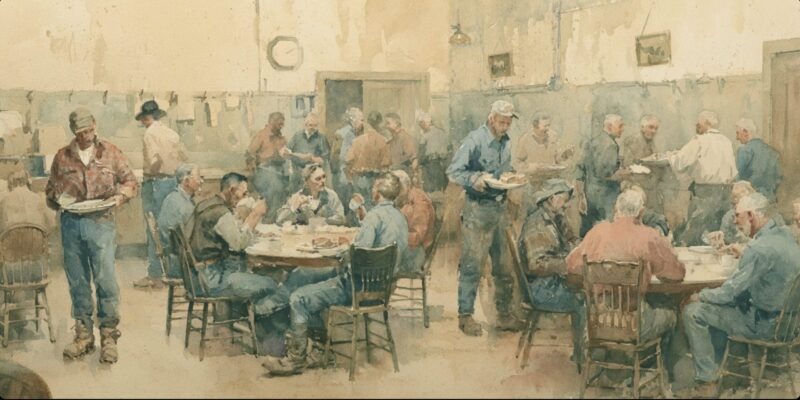
I’m hesitant to talk about it because I don’t wanna, like, make promises before we’ve actually got the money in pocket and we’re doing it. But one of the initiatives that we’re working on is a Men’s Wellness Luncheon that will hopefully be hosted once a month throughout the winter season. It would be pretty casual, but our hope is to have some key players there. We already have commitments from a few, which is really exciting. But basically it would be a pretty informal lunch for a couple of hours, and hopefully we’d have some information there. One of the people that I spoke with was Tamara, so the ambulance team has some kind of paramedic community outreach program. So you could get your blood pressure checked, if you’ve been meaning to do that for six months. [A number of local men have expressed interest in offering other supportive services or information at these luncheons.]
We’ve seen the power of women getting together with intention, you know? And so it’s a way for us to, to offer something to the men in the community that will hopefully make them feel good — just a little bit more connected — or a place to go on a Sunday once a month, grab some pizza and soup or whatever our caterers offer. Basically, men who are happy and healthy make for a safer community.
Keeping the Lights On: fundraising
Tanya’s hoping to do some fundraising over the summer.
We almost focus more on fundraising during the summer — and then get more program-oriented again in the fall and winter. We do have a Patreon account, which can be a one-time payment, but also works as an automatic monthly donation, and that can be a really helpful way to support us. But we don’t have many people supporting us through Patreon at this point. Or if you’re interested in having a tax receipt, donations can be made to us through the Cortes Community Foundation. Or e-transfers can be sent to [email protected]. This summer we hope to encourage our membership a bit more and get some summer donations in.
I asked how secure — or precarious — the Centre’s funding is.
It’s always tricky, you know, the November, December, January months are always tricky. Things are always thin and it’s always like, “Okay, what’s gonna happen?” And amazingly, so far in all of our seven years, we’ve always just pulled it through. So I’m proud to say that — it builds confidence that things will all work out. But that’s definitely a time that we could use a bit of help and support from donors to help us get through.
Tanya mentioned some other ways to support the Centre: buy a membership, volunteer to organise an event, attend the AGM.
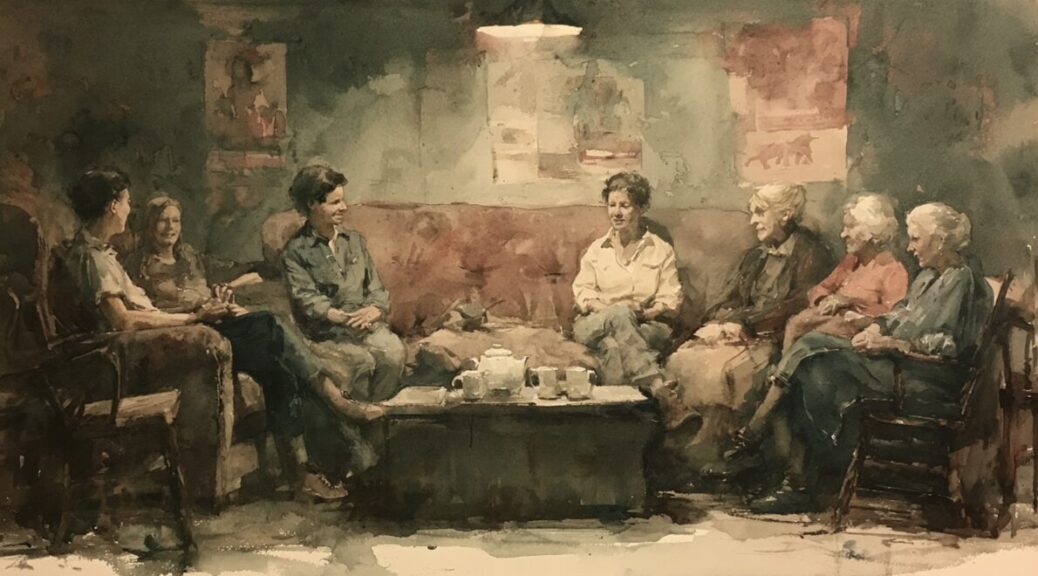
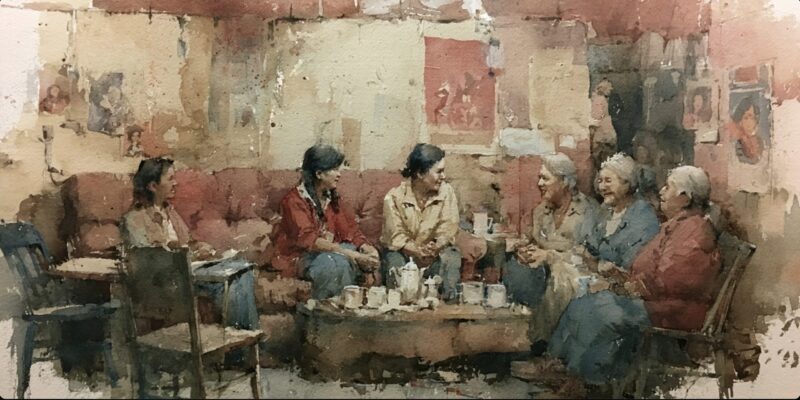
A warm and cosy place to gather and talk
Contact Information
If you or a woman you care about is at risk or in crisis, confidential support and help are not far away. To contact the Cortes Women’s Resource Centre, call 250-203-6501 or send email to [email protected]
To contact North Island Transition Society, call the 24 hour crisis line: 250-286-3666 or 1-800-667-2188.
That is also the line to call if you would like to participate in the Safe Home program by offering temporary living space to women in need of temporary shelter.
This article includes excerpts taken from a deeper and more wide-ranging interview. The radio version includes much more of the original interview and consists of 3 episodes, airing for the first time on Tuesday-Thursday June 30-July 2 2026.
[Illustrations by MidJourney, prompts by author. The theme music for De Clarke’s Cortes Currents radio segments is “It Ain’t Necessarily So” played by Burnett Thompson, from his album Uncertain Times.]