

By Sonal Gupta, Canada’s National Observer, Local Journalism Initiative Reporter
A national protest movement against AI data centres is emerging in Canada, as residents in a dozen cities push back against the speed and scale of projects they say could strain supplies of water and power and the quality of life in their communities.
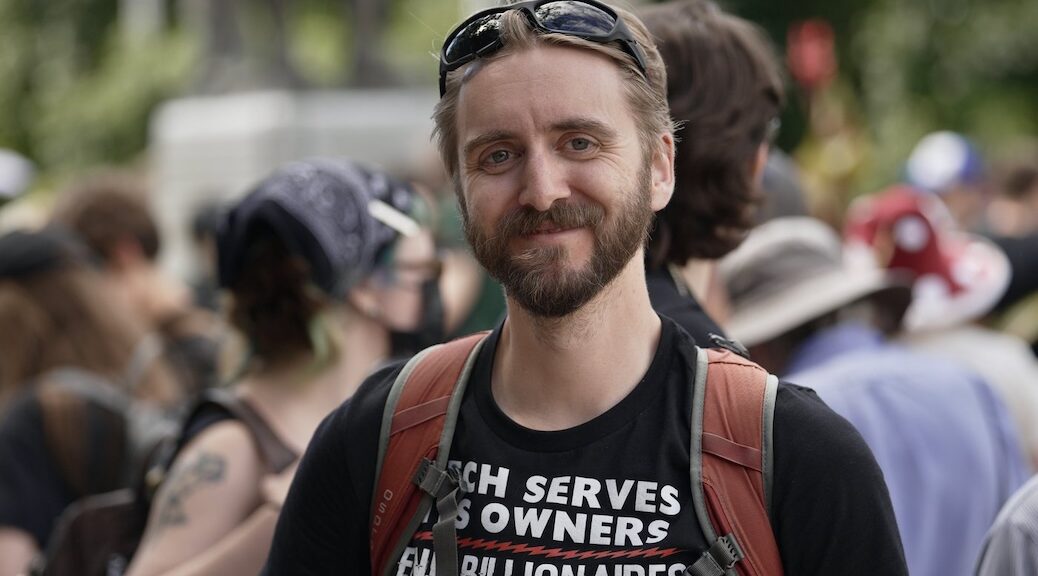
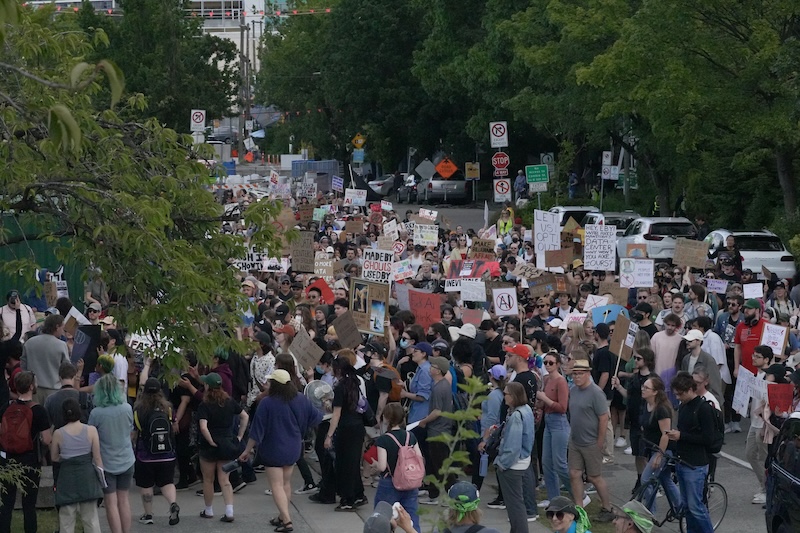
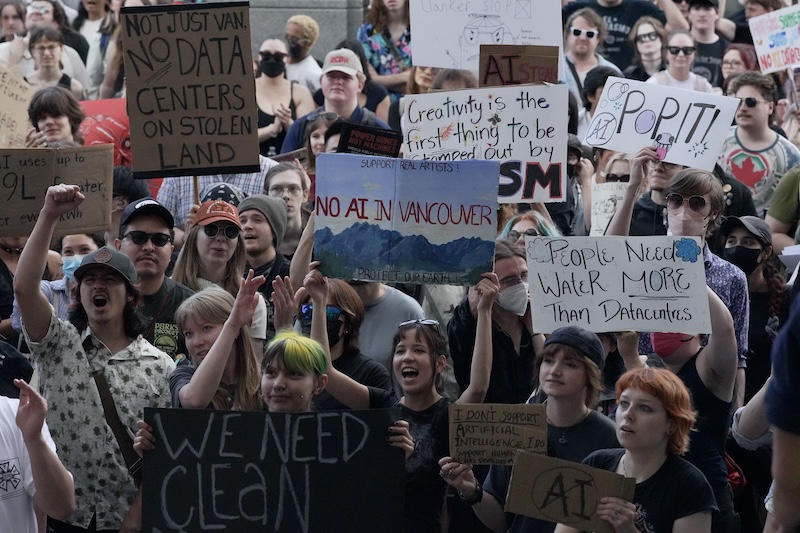
In Vancouver, demonstrators marched from the Vancouver Art Gallery to City Hall against two proposed TELUS-linked AI data centres, part of a BC cluster that could consume 150 megawatts of BC Hydro power by 2032. The protesters “feel it’s been imposed on them and that they had no say and that their interests are not being taken to heart,” said Guerric Haché, a 36-year-old organizer with NO AI Vancouver.
Haché said demonstrations were coordinated the same day in 13 other cities across BC, Alberta, Saskatchewan, Ontario and New Brunswick, linking local fights unfolding there. Organizers say their campaigns are now finding common ground around water use, power demand, farmland and projects moving ahead before residents understand the tradeoffs.
Anne Pasek, an associate professor at Trent University who researches data centres and climate politics, said the national day of action points to a “country-wide democratic gap” around hyperscale data centre development. “Communities don’t have the information, processes and time they need to weigh the impacts and benefits of proposed data centres,” Pasek said.
A data centre is considered hyperscale once it passes the 50-megawatts mark, enough electricity to power about 37,500 homes, says a new toolkit released by the Council of Canadians. Canada has five hyperscale data centres operating, but at least 96 projects in development.
Vancouver’s TELUS centres
The Vancouver movement started after they saw posts about AI data centres in the US and worried about their impacts in Vancouver, said Torin LaRocque, an 18-year-old university student and founder of NO AI Vancouver. LaRocque said he had never attended a protest, let alone organized one, until he and a friend put up posters and made Instagram posts for a demonstration in May that drew more than 500 people.
In Vancouver, many residents say they did not realize the Mount Pleasant proposal was for an AI data centre until TELUS and federal officials announced the projects in May as part of a broader push for Canadian “sovereign” AI infrastructure. The Mount Pleasant location is expected to go online by the end of 2026 and draw up to 26 megawatts, while the downtown area expected to open in 2029 will require up to 100 megawatts of electricity.
Haché said the city’s early materials, which described the use as “Bulk Data Storage,” did not make clear why Mount Pleasant residents should be looking for major infrastructure impacts. “It was very short and kind of vague,” Haché said. “There was no real indication that there was going to be a significant increase in electricity use or any sort of cooling requirements.”
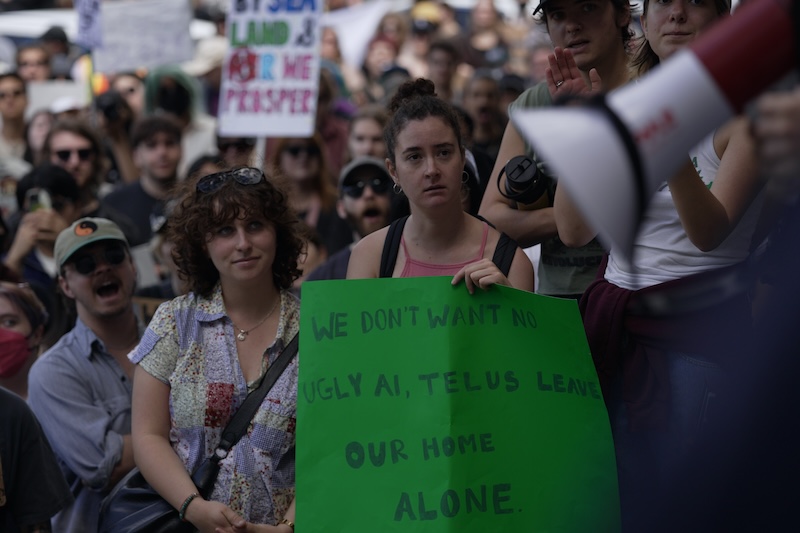
A Mount Pleasant resident said she first learned of the proposal from a city sign while walking her dog past the building. The two-week public comment period earlier this year was too short for residents to fully understand what the project was. “Why in a community that’s super walkable, has tons of local artist studios and daycares and schools and is close to the SkyTrain, why put this huge energy drain?” said the resident, who works in tech and asked not to be named because she fears employers might penalize workers who publicly criticize AI..
Since its announcement, TELUS has presented its broader AI data centre buildout as a more sustainable model than conventional facilities. The company said the Vancouver sites would use closed-loop cooling to reduce water use and capture waste heat for local thermal energy systems, instead of releasing it into the atmosphere. But some residents say those assurances do not answer what the project would feel like in summer. “Lots of people I know in the neighbourhood do not have air conditioners,” said Cheryl Cameron, another Mount Pleasant resident who lives two blocks east of the proposed site. “We rely on open windows and open doors to our decks to slightly cool our apartments.”
Cameron said she worries residents could be left with excess heat and industrial fan noise in a dense, walkable neighbourhood close to shops, patios and the Olympic Village. “I don’t really know why we have to have this right in the middle of such a densely populated area,” Cameron said.
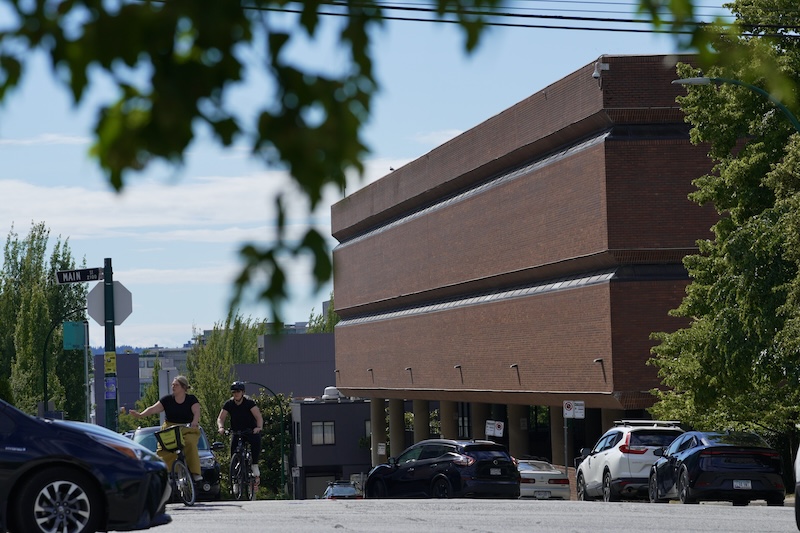
In an email response, the City of Vancouver said both the Mount Pleasant and downtown proposals have followed the city’s standard approval process, including public notification, published application materials and opportunities for comment before any council decision. The Mount Pleasant rezoning application remains under review and is expected to go to council in July, when the public will have another chance to speak.
The city said the projects were described in public materials as “Bulk Data Storage,” because that is the established zoning category for that type of use. The rezoning process does not specify or distinguish what kind of data will be stored.
Detailed operational questions, including electricity demand, cooling, backup power, noise, waste heat and water use, are not typically outlined at the rezoning stage, the city said. Those details are usually refined later and reviewed through the development permit process.
In an email response, Coun. Sean Orr questioned whether the TELUS data centres are really job creators, truly “data sovereign,” safe or the best use of Vancouver’s limited land. He pointed to unresolved issues around who would pay for grid upgrades, how much heat and noise the facilities would produce and whether expensive data centre infrastructure could quickly become outdated as chips and AI hardware are replaced by newer technology.

“I don’t want to have a knee-jerk reaction but the concerns I’m hearing from the community are very visceral around this topic,” said Orr, who’s also a member of the Coalition of Progressive Electors. “I think it’s best if we do our due diligence here. I think people deserve answers, especially considering Metro Vancouver is running out of drinking water.”
LaRocque said their group is calling for a halt on construction until the long-term local, environmental, electrical and financial impacts are better understood.
Similar demands are emerging in other provinces, where residents say proposed data centres would sit close to homes, farmland and local infrastructure.
Outside Vancouver
Kayla Piccinin, an Olds, Alta., resident involved in the Olds Transparency Project, is opposing Synapse’s proposed gas-powered data centre about 130 metres from her front door. As a mother in a small town, Piccinin worries about a gas-powered project near families, seniors and schools and whether Olds has the roads, classrooms, emergency services and housing to handle years of construction.
The project would include 10 data centres and 10 power plants on the same parcel of land, with a proposed 1.4-gigawatt gas plant to power the facility, roughly equivalent to Edmonton’s daily electricity demand.
“I’m not necessarily anti-AI,” she said. “I’m against these data centres and power plants being near our home, using up our finite resources.”
Piccinin said residents from Olds and nearby communities joined protests in Calgary, Red Deer and Edmonton on Saturday.
In Regina, the Saturday protest was the fourth local protest organized through No Data Centres on Treaty Land, said Taya Triffo, one of the protest organizers. The group formed after residents learned about a proposed Bell hyperscale AI data centre in the Rural Municipality of Sherwood, just outside Regina.
Lynn said residents’ concerns include government accountability, treaty obligations, water use, power costs, noise and the broader energy future being shaped by a 300-megawatt project. She said the issue has united people across urban, rural, Indigenous and non-Indigenous communities. “We deserve to have basic answers about a project of this size when it’s only steps away from residential neighbourhoods,” she said.
Pasek said the protests show a gap between the size of hyperscale data centres and the rules used to approve them. Developers are moving quickly, while communities often lack the information and time to weigh the risks and benefits. “That needs to change or the protests are only going to grow stronger,” Pasek said.
Links of Interest:
- What Will Canada’s AI Strategy Mean for Jobs and Safety? – the Tyee
- BC’s new data centre cluster sparks new discussion of ‘sovereign’ AI pus – Canada’s National Observer
- Large Language Model AI Programs: Hallucinations, Other Challenges and an Incredible Potential – Cortes Currents
- Articles about, or mentioning, AI
Top image credit: Guerric Haché, an organizer with NO AI Vancouver, a group founded by 18-year-old university student Torin LaRocque to oppose proposed AI data centres in the city. – Photo by: Sonal Gupta

Sign-up for Cortes Currents email-out:
To receive an emailed catalogue of articles on Cortes Currents, send a (blank) email to subscribe to your desired frequency:
- Daily, (articles posted during the last 24 hours) – [email protected]
- Weekly Digest cortescurrents – [email protected]