

By Sonal Gupta, Canada’s National Observer, Local Journalism Initiative Reporter
Coastal First Nations are welcoming the federal government’s commitment to keep the North Coast tanker ban in place as part of a new development deal with BC.
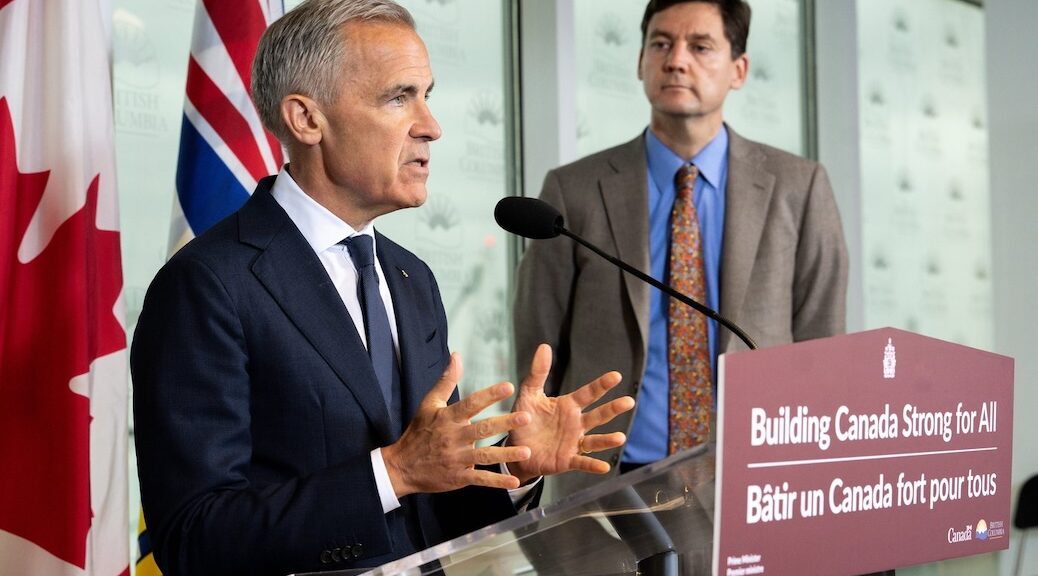
Prime Minister Mark Carney and BC Premier David Eby announced a nearly $20-billion agreement in Vancouver, with federal support for electricity transmission, LNG, mining, ports and transportation — while confirming the tanker ban will remain, even as Alberta Premier Danielle Smith and Carney prepare to announce details of their pipeline deal on Thursday evening.
Federal Conservative Leader Pierre Poilievre criticized the tanker ban, calling it “ridiculous” and telling Carney to “get out of the way” of Alberta’s pipeline plans. Poilievre said the best way to diversify oil exports would be to permit a pipeline from Hardisty, Alta. to Prince Rupert or Kitimat because a northern BC route would be faster to Asian markets than a southern one.
Tanker Ban in Place
Marilyn Slett, chief councillor of the Heiltsuk Nation and Coastal First Nations president, said the federal tanker ban protects the North Coast economy, livelihoods and the Great Bear Sea from oil spill risks. The Heiltsuk people have experienced this disaster first-hand after the 2016 Nathan E. Stewart diesel spill near Bella Bella in BC’s central coast.
“This has not been about blocking Alberta’s access to oil markets,” Slett said at a press conference. “This is, and it always has been, about keeping this special place free from oil.”
Environmental groups and critics warned the new agreement puts billions behind LNG expansion and leaves open the possibility of a new Alberta pipeline to the Lower Mainland.
Jason Alsop, president of the Haida Nation and vice-president of Coastal First Nations, said many First Nations remain concerned about LNG development, climate change and shipping impacts, even as some projects in the region have Indigenous support. He said that balance depends on governments respecting environmental limits and not forcing a pipeline through on top of existing development pressure.
“If you have all these LNG projects and a pipeline feeling like it’s jammed through, for our people, it becomes tipping over the balance of what we think we can sustain and try to manage,” Alsop said.
Pipeline risks shift south
While the tanker ban commitment protects the North Coast, environmental groups and critics say it does not erase broader concerns about LNG expansion or the risk that a possible southern route for Alberta oil could bring a major spill threat to BC’s coast.
The tanker ban makes a northern bitumen export route through BC far more difficult. But Carney declined to say whether Alberta is now focused on a southern route. “You can draw your own conclusions, but you can also wait until this afternoon,” Carney said.
Christina Smethurst, head of communications for the environmental group Dogwood, said the sparing of the North Coast tanker ban should not be treated as full climate or marine protection.
“This agreement is a three-way grand bargain for a maximalist oil and LNG agenda,” Smethurst said. “Premier Eby will get to expand the LNG industry he’s been pushing for with even more federal support, in exchange for rolling over on a possible Alberta pipeline to the South Coast, ” Smethurst said.
Valeria Vergara, senior scientist with Raincoast Conservation Foundation, told Canada’s National Observer keeping the tanker ban is good news for the Great Bear Sea and North Coast marine ecosystems, but does not address risks to southern resident killer whales in the Salish Sea.
Vergara said their NoiseTracker data found the percentage of quiet hours off Saturna Island in the Southern Gulf Islands dropped from 35 per cent in 2017 to 15 per cent in 2023, after the Trans Mountain expansion caused the number of tanker trips through Boundary Pass to surge. The pass is a major shipping corridor between the Gulf Islands and Washington state.
“These whales don’t get a quiet room to retreat to,” Vergara said. “Boundary Pass is their home, and it’s also Canada’s busiest shipping lane.”
Lance Barrett-Lennard, a marine mammal scientist and director of Raincoast’s cetacean conservation research program, said new shipping tied to Roberts Bank Terminal 2, Trans Mountain expansion and any future oil terminal could add more noise and spill risk for a population of about 75 whales.
Any southern route should not be treated as straight forward just because the existing Trans Mountain pipeline already reaches the coast, said Eugene Kung, a staff lawyer with West Coast Environmental Law. He pointed to the project’s cost overruns, delays and construction challenges through tight terrain, where some sections had to be redesigned because crews could not safely blast through rock. A new pipeline would face those same constraints in an even tighter corridor, he added.
Eby said the agreement does not require BC to support Alberta’s expected pipeline proposal, but because interprovincial pipelines fall under federal jurisdiction, the province would not go to court to fight one. Kung said Eby’s statement to not go to court does not remove the legal risk for any pipeline project because First Nations challenges have been central in past pipeline fights. Those include opposition to Northern Gateway from Tsleil-Waututh Nation, Squamish Nation and Coldwater Indian Band to Trans Mountain and from Gitga’at and Gitxaala Nations, among others.
Federal-BC deal
Carney framed the BC-federal deal as a push to speed up major projects, expand exports beyond the US and make BC a gateway to Asian markets.
The agreement includes $3.5 billion in federal support for the North Coast transmission line, $500 million for the Red Chris mine expansion, up to $3 billion for the George Massey tunnel replacement and support for $10 billion in upgrades at the Roberts Bank shipping terminal, south of Vancouver.
Ottawa also says it will help speed up LNG projects, including LNG Canada, Ksi Lisims LNG, Cedar LNG and Woodfibre LNG.
Kung said the deal leaves major questions about what Ottawa is committing to, what conditions will be attached to federal funding and whether the push to speed up projects could “weaken and water down Canadian environmental protections and laws.”
He said he will watch Alberta’s announcement to see if a private proponent or financial backer emerges. If Alberta remains the main proponent and relies on a provincial loan guarantee, he said that would not meet the terms of the Alberta-federal MOU.
“All of this has been so steeped in petropolitics, it’s kind of hard to really take anything at face value anymore,” Kung said.
Links of Interest:
Top image credit: Prime Minister Mark Carney makes an announcement in Vancouver while BC Premier David Eby observes on July 2, 2026. – Photo by: Ethan Cairns / The Canadian Press

Sign-up for Cortes Currents email-out:
To receive an emailed catalogue of articles on Cortes Currents, send a (blank) email to subscribe to your desired frequency:
- Daily, (articles posted during the last 24 hours) – [email protected]
- Weekly Digest cortescurrents – [email protected]