


Shane Berg, BC’s Chief Forester, has a message he is taking to trading partners around the world. On Thursday, October 2, 2025, he made a presentation to the Strathcona Regional District’s Natural Resources Committee.
In today’s broadcast there are select clips from that presentation, including reactions from the committee. Also Bruce Ellingsen, one of the founding directors of the Cortes Community Forest Cooperative and a local thought leader on forestry matters, gave his opinion about the presentation and what he believes it lacks.
Berg claims that the amount of old growth forests is increasing. According to Ellingsen what is not clear is that he is talking about the 80% of relatively small old growth trees growing in less productive areas, not the ‘big tree old growth’ that the environmental community is concerned about.
Berg told the Natural Resources Committee, “There is a perception out there that BC’s forests are being over harvested, that they are being the last vestige of old growth and very critical and unique forests are being devastated. We’ve got the European Union definition on deforestation claiming that British Columbia is denuding its forests in a manner that doesn’t meet the international standards.”

“So I use this slide to make it very clear that the management of our forests is of paramount importance. We manage 37% of the forest in the province and 63% of the forests are going to have old forest habitat, unique ecosystems that we will never disturb. You may see hikers, you may see mountain bikers, you may see horseback riding – but you will not see roads and cut blocks on 63%of BC’s forest.”
Bruce Ellingsen responded, “He was almost speaking a fictional story of what’s going on in British Columbia, rather than what the reality is on the ground.”
Cortes Currents: How is he misleading both the SRD committee and the province?
Bruce Ellingsen: “… And the countries in the world that he’s going to. He is misleading them because he’s suggesting that we’ve got 11 million hectares of old growth forests still in the province but he is not clarifying that the great majority of it is in undersized or stunted or slow growing areas (photo at top of page) of the province forest land base.”
“He did mention during that conversation with the Natural Resources Committee that they were often dealing with companies that found it economically unrealistic to go to the outlying areas to harvest, especially if they’re getting into areas that are not that good quality timber. Just because they’re incorporated in the land base doesn’t make them economically viable to go and harvest and process.”
At one point in his presentation, Berg mentioned a subset of the province’s old growth: “Part of those old growth deferrals that the Technical Advisory Panel came up with: They really focused on old growth that was unique and at risk and so that’s why, of the 11 million hectares of old growth, they selected 2.6 million of that to say that was unique, big and also remnant.”
This appears to be where Mr Berg’s facts appear to start lining up with those of some of the leading critics of the forestry industry.
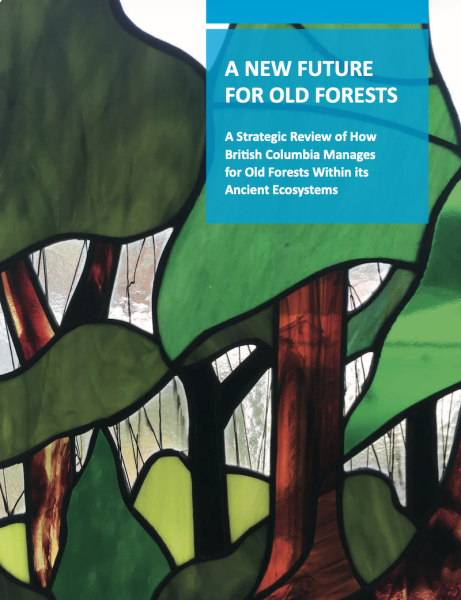
According to the Old Growth Strategic Review panel study, ‘A New Future For Old Forests’ (2020), “As much as 80% of the area of old forests consists of relatively small trees growing on lower productivity sites.” (p. 26).
“Less abundant are ecosystems that are more productive from a timber perspective and have not already been heavily logged.’ (p 26)
“These ancient forests are globally unique, rare, and contain species as yet undiscovered, and many of these ecosystems and old forests are simply non-renewable within any reasonable time frame.” (p. 27).
The distinction between ‘old growth’ and what is sometimes called ‘big tree old growth’ is very clear in literature from Sierra Club BC: “B.C.’s most endangered old-growth forests, in particular those with very big trees” and “Only about 35,000 hectares of old-growth forests with very big old trees remain across the province”
The Wilderness Committee writes of the more widely less productive old growth: “These ecosystems matter, but they are not the iconic forests with huge trees we associate with old-growth.”
This is not the message the Natural Resources Committee was getting.
Sean Smyth, Vice Chair of the Natural Resources Committee and one of Campbell River’s Directors said, “A couple of years ago, the province came out with the old growth forest review and Sierra Club manipulated the numbers in that to come out with the whole 3% of old growth left, which was a complete lie through stats, but that was something that came out of the provincial government that was taken to be held against the industry and it wasn’t true and then the industry had to defend itself on it.”
Shane Berg: “Agreed.”
For the record, the percentage Smyth just mentioned was quoted by the Sierra Club, but comes from a study published in the peer-reviewed journal, Frontiers in Forests and Global Change. In “Estimating the amount of British Columbia’s “big-treed” old growth: Navigating messy indicators,” it states:
“The calibrated indicators agreed that very little remaining old growth supports large trees 1.5–3.3% for the biggest trees” – that’s where the 3% figure comes from – and “6–13% including medium-sized trees that represent the largest growing trees in lower productivity interior ecosystems.”
Three of the four scientists who wrote this study – Karen Price (PhD), Rachel Holt (PhD) and Dave Daust (MSc) – were on the province’s Technical Advisory Panel.
Kermit Dahl, Mayor of Campbell River, asked, “You mentioned the European Union and the perception that we’re over harvesting, that they’re spreading. Generally those groups are super well funded by some wealthy eco-terrorist group. So I’m wondering how much is the province spending to educate people that that is, in fact, just ideological @#!!?”
Shane Berg: “It’s a great question, Mayor. I was in Japan in May speaking to wood buyers, call it producers. The two by four industry in Japan is huge. They use our lumber to make panels for housing. I was asked to give this type of presentation to help the Japanese buyers know that the rhetoric that they’re hearing was false. We are not grinding our old growth cedar to make pellets, that’s a fact and so that was the premise for my going over. “
“I’ve been to Finland, two years ago, to share information with the Finish people. A country a third the size of BC harvests the same amount that we do, but they’ve been practicing innovative silviculture for five generations. There’s an Asian wood tour happening next month, I believe. I think the minister, a number of First Nations, and my deputy minister are going. So these investments in spreading the facts are being shown, but it’s more than just jumping on a plane and going to another country and sitting in a boardroom. We are working to make this information more readily available.”


Kermit Dahl: “Who chooses who goes on these committees?”
Shane Berg: “Committees specific to …?”
Kermit Dahl: ” …old growth.”
Shane Berg: “Like the Technical Advisory Panel?”
Kermit Dahl: “Yeah, like when they end up with a bunch of Sierra Club members and things like that and no industry people involved. I don’t understand how you came up with a balanced answer to a question when you have an unbalanced panel.”
Cortes Currents: A quick background search of the Technical Advisory Panel’s five members revealed that Mayor Dahl is correct in-so-far as the fact none of them came from industry. Garry Merkel is a forester, and one of the co-authors of A New Future for Old Forests; Rachel Holt and Karen Price are ecologists; Dave Daust is a forest analyst. The only member that Cortes Currents found with easily identifiable links to the environmental community was Lisa Matthaus, an environmental economist who the Times Colonist described as ‘provincial lead for Organizing for Change, a coalition of environmental organizations.’ Prior to that she was with Sierra Club BC for 10 years.
Shane Berg: “That decision was made at the political level and the ministries don’t have any influence in that, but to your point, Mayor, I think it makes sense to make sure that you’ve got a balanced representation when you put these type of provincial panels together.”

Cortes Currents asked Bruce Ellingson if the though Berg accurately portrays the current situation with BC’s old growth forests as mentioned by the Technical Advisory Panel and environmental groups?
Bruce Ellingsen: “No, the Chief Forester lumps it all into one bunch and calls it all old growth forest when in fact it’s old growth, but it incorporates areas on low productivity sites that grow very slowly and will take a long time to regenerate. They’re probably on a land base that hasn’t got the nutrients we do on the coast, because of the maritime climate that we enjoy. He just wraps them all together and talks about 11 million hectares of old growth timber still in the BC timber harvesting land base.”
“The thing that burns me is that I’m certain that just about anybody who listens to him will be thinking of big old trees.”

BC fertilzes 20,000 to 40,000 hectares a year – from the presentation; on average, 200,000 hecatres were harvested (2017-21) – Ministry of Forests
Cortes Currents: Ellingsen mentioned another problem with the Chief Forester’s presentation.
Bruce Ellingsen: “Nobody is addressing the fundamental requirement of any living system, whether it’s a single cell or whether it’s a major ecosystem like a forest ecosystem or even bigger if you want to talk about Gaia and the whole world’s ecosystem. Any living system or cell requires an ongoing source of nutrients in order to thrive and be able to sustain itself. If that is lacking or drawn down by repeated extractions from it, sooner or later, and depending on the sites you’re not going to get anything thriving, even if you stick it in the ground and hope that it’s going to grow.”
“They’ve never incorporated that reality into their forest management planning. They’re doing umpteen studies about little niche issues and questions and getting all sorts of information about those little slivers of information regarding different aspects of the complexity of a forest system.”
“They never get down to saying everything has to be able to feed on nutrients in order to thrive and if it doesn’t thrive, it’ll disappear. It is about as simple as that.”
“Each time you cut a forest down in a forest land base, you’re taking out nutrients, at least half if not more of the nutrients that it took to grow that crop of trees.”
“I know from growing spuds, the first year was great. Second year was pretty well normal potato size. Third year was an inch, inch and a half, and two inches. I didn’t plant it there again, of course, because I could just see it happening.”
“In many areas, we’re into the third harvest. That’s what Mosaic is doing all over Vancouver Island, where they control the forest management and harvesting. That’s why you see so many logging trucks on Vancouver Island now, with 150- 200 small pecker poles of a load.”
“I’ve heard that there’s areas in the interior where the soil has become so impoverished that the planted trees don’t thrive, and you might end up with one tree out of 20 or something like that. Varying numbers, of course, depending on the site. One tree that will thrive and the rest are having to be replanted again. Sometimes three or four times to try and get something to grow again in some of the areas where there’s been heavy forest fires, or wildfires that burn up a lot of the organic matter in the surface of the soil. That pretty well removes much of the nutrients that are in the ground for the next generation. They need food to keep them thriving.”
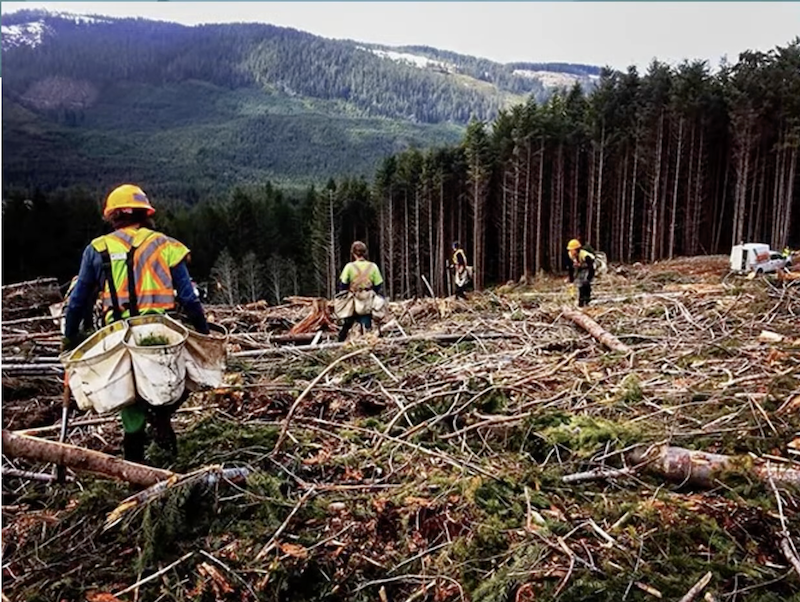
– from the presentation


Cortes Currents: Ellingsen referred to a website that uses NASA’s Landsat satellite imagery to map and colour code forest cover loss and gain over time.
Bruce Ellingsen: “If he was going to do a balanced presentation to the SRD committee that showed the reality of what’s going on in the province, he would’ve brought out the image from the University of Maryland Global Forest Change website that’s open to anybody to look at and shown what’s been happening in the last 20-24 years on the landscape.”
“You could ask almost anybody who looks at that, do you think that rate of change in our forest from wildfires and harvesting and mountain pine beetles and all the things that are happening exacerbated by climate change and global warming? Does that immediate visual impression suggest to you that it is sustainable?”
“I’m a hundred percent sure that it’s not sustainable, but no conversation around that was presented. He could have zeroed in on Vancouver Island, which is a real example of what we’re harvesting.”

“Look at the area here. There’s Campbell River, Quadra Island, and there’s the north end of Vancouver Island and to me that looks like about half of the area has pretty well been harvested in the last 24 years – since they started looking at the satellite imagery in 2000 and began compiling it year after year at the University of Maryland.”
Links of Interest:
- Video of Natural Resources Committee Meeting of Oct 2, 2025
- A New Future For Old Forests: A Strategic Review of How British Columbia Manages for Old Forests Within its Ancient Ecosystems
- Interactive Map at Global Forest Watch website
All undesignated photos are from Shane Berg’s presentation to the Natural Resources Committee
To receive an emailed catalogue of articles on Cortes Currents, send a (blank) email to subscribe to your desired frequency:
Weekly Digest cortescurrents – [email protected]
Daily, (articles posted during the last 24 hours) – [email protected]
I’m curious why they see an increase in provincial AAC in 2076? Perhaps because we’ll be running low on fossil fuels by then, the harvest will have to be increased just to burn for energy?
I’d love to see this information incorporated into Wild Cortes. There’s nothing so basic and so important as the destruction of once thriving forests. Humanity simply cannot live without them. Nor can any other creature.