
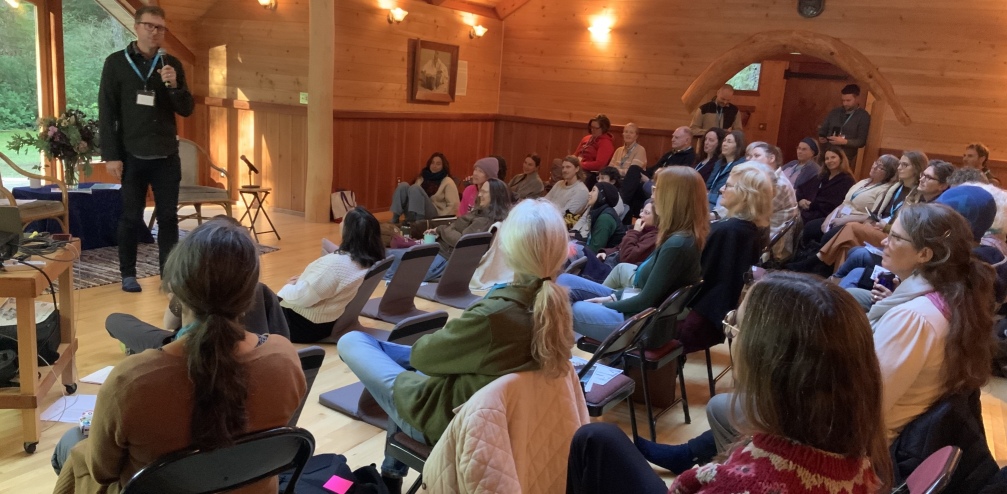
On Tuesday, October 14th the Cortes Island Foundation invited island nonprofit and public service organisations to attend a Social Profit Forum hosted at Hollyhock. This all-day event was well attended and featured presentations by two representatives from “local economy” projects with successful track records: Tara Janzen from the Shorefast Institute for Place-Based Economics and Andrew Greer from Purppl, a consulting group that advises clients who wish to establish “regenerative enterprises.”
Ms Janzen gave a slide presentation describing the successful economic re-invigoration of a small Newfoundland island called Fogo. Mr Greer offered some tools for turning social profit goals into specific business plans and strategies, using examples from the Okanagan area.
Attendees were invited to come up with ideas and concepts for place-specific economic development on Cortes Island, with the goal of providing living-wage jobs that would allow — among other things — local kids to grow up and remain in their home community instead of having to leave in search of gainful employment. The theme of the day was how to create a local economy that provides employment, investment, and income to benefit the community, rather than importing labour and goods and benefiting distant shareholders.
The full event title was From Edge to Opportunity: Collective Pathways for Social Impact. It attracted representatives from almost all the islands’s non profit societies and projects, including CCEDA, the Fire Department, FOCI, the Housing Society, the Cortes Food Coop, the Women’s Centre, the Food Bank, and more. The crowd filled most of Olatunji Hall, one of Hollyhock’s larger venues.
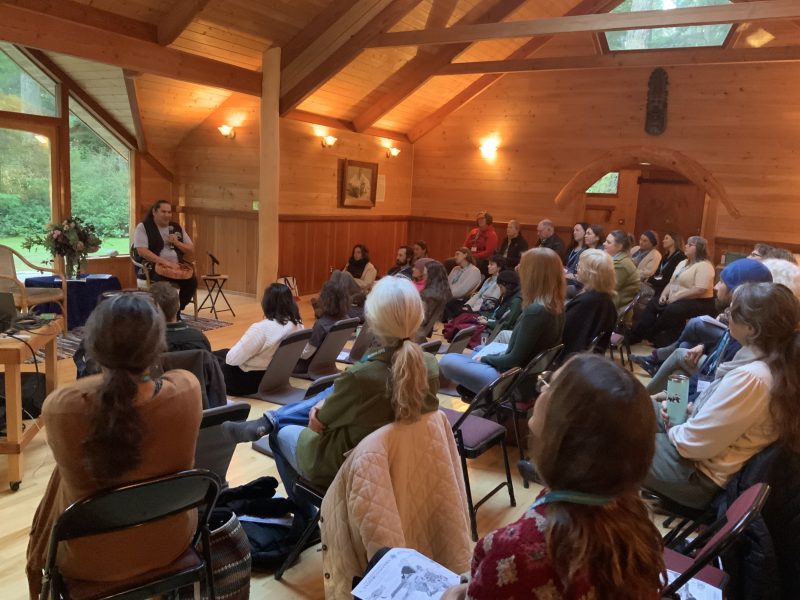
The programme opened with a land acknowledgment and welcome to the attendees. Andrew Greer then gave an extensive talk on the finances of social-profit organisations and how they contribute to the national economy: “For every dollar of government funds received, community nonprofits return $3.88 in value.” He described the rise of business-like but community centred entities such as “community contribution companies” (in the UK often called “community interest companies”). “This is a vast and growing movement,” he said. A third of startups today have some kind of social profit goal built into their founding documents.
Nonprofit corporations represent $225 Billion CAD in computations of Canada’s GDP. Six years ago that figure was $190B so Andrew sees this sector growing faster than the conventional for-profit economy. The social economy also employs more women (70 percent of its workforce) and visible minorities (28 percent) than the conventional economy. In Canada, 60 percent of investment portfolio assets are “ESG” screened. This is “the highest rate in the world.” It appears that Canadians are deeply interested in socially responsible investments and businesses.
“There is an appetite for community ownership and control of essential resources,” said Andrew, “We can’t just give it all away to the wealthy people.”
Andrew reminded the audience that many indigenous groups have been doing “social enterprise” and “community economics” for many decades. “Some of the best and most basic social enterprise is found among First Nations. We should learn from them.”
Andrew talked about the challenge of trying to maintain social profit organisations on a purely volunteer basis and the need to establish reliable income streams. “If you have some customer revenue you can better achieve your mission.” His job is to consult with social profit endeavours to help them develop reliable revenue streams that are consistent with their principles and missions.

He described the Kelowna Innovation Centre as one successful project combining social profit and community service with a business plan and job creation. This building combines office space for incubating small tech startups with space leased to government and community organisations. The parent organisation that built the centre is the Kelowna Innovation Society, a registered non profit.
Andrew shared a conceptual/analytical tool he uses in consultation with clients, a roadmap for getting from desired impact in the world to concrete and immediate actions.

Fogo Island: a case study in community-centred development
After a brief break, Tara Janzen presented a case study of a successful social enterprise with a reliable revenue stream that generates local employment and keeps as many dollars as possible within the community. Her presentation covered the origin and success story of the Shorefast Institute on Fogo Island, Newfoundland. Fogo is a small island with a population of about 2600, featuring a near-Arctic climate (including icebergs) and situated in the Labrador current off the north-east coast of Newfoundland.

Settler families on Fogo Island made a decent living for hundreds of years from the cod fishery of the north Atlantic. Overexploitation of the cod fishery led to a catastrophic collapse: by 1992 fish stocks were at only one percent of historic levels. The impact on the outports of Newfoundland was devastating. The government imposed mandatory relocation of small outport communities, trying to concentrate the population closer to services such as schools and medical care as the remote coastal villages shrivelled for lack of employment.

One of the old fishing families of Fogo Island were the Cobbs, and one of the Cobbs could see the writing on the wall and advised his daughter to get qualified to do something other than cod fishing. Her name was Zita Cobb, and she left home to make her fortune in the tech industry. She retired wealthy and returned to her home island, where she was determined to re-create some kind of prosperity. She founded the Shorefast Institute to explore the problem of creating a local economy.

After years of research and consultation, the community decided that its unique asset (now that the cod were gone) was the famous hospitality and friendliness of Newfoundlanders. They decided to venture into the upscale tourism business, building a luxury hotel to attract high-spending tourists. One central motto of Shorefast is “It matters who owns what.” The hotel is owned by the institute and operated for the benefit of the community, not for outside shareholders.

The project strove at every point to hire local people. It was designed by a local architect and built by local boatbuilders and carpenters. Locals made its furniture and decor. “We are a charitable foundation that owns a luxury hotel.” One goal of the Institute was to preserve traditional skills such as boat building and quilting; local people sell their handicrafts to visitors directly, as well as supplying the hotel. The hotel kitchen buys its fish from local fishermen and as much produce as it can get from island growers, resorting after that to the most local grocer who will deliver by ferry.
After the hotel was established, vital signs on Fogo are encouraging: there are now over 70 small businesses, average income has doubled, and two small restaurants (in addition to the hotel) are able to operate during the tourist season. “Everyone on the island now has a chance to find work and stay here.”

Zita Cobb’s father could see the cod fishery disaster happening, and warned his daughter that “they’re turning the fish into money.” Zita now says that “we’re turning the money back into fish.” Cod stocks are showing some signs of recovery and locals no longer need to overexploit them in order to survive. Fogo Island is seen as an exemplary success story for community-centred economic development.
Manda Aufochs-Gillespie from the Cortes Island Foundation summarised some findings of the Foundation’s “Vital Signs” survey, fingering low income, shortage of jobs, and shortage of housing as major problems facing Cortes Island. Our median home price is almost $800K but to be affordable on our median income it would have to be $200K. There are 200 people on the waiting list for affordable housing.

She expressed the Foundation’s interest in “local, regenerative economies” and the goals that such an economy could achieve: “We want this to be a place where islanders can really live, where we can work and raise our kids and grow old, and it’s getting harder to do that.” She concluded with a quote from Robin Kimmerer: “All flourishing is mutual.”
The meeting then turned into a brainstorming session for breakout groups focusing on several key questions: What’s working well in our social economy? What’s tricky or challenging? What do we need to do differently, or create?
Having considered these questions for a while, the attendees gratefully took a break for lunch (provided by Hollyhock in their dining room).
After the lunch break, Andrew invited attendees to imagine what a “thriving Cortes” looks like. If Cortes were thriving economically a few years from now, he asked, what would a headline from that time look like? What would be the local news?
Attendees in their breakout groups came up with many headlines, some humorous and some more serious. Mostly, they focussed on housing, environment, energy security, independence from SRD, food security, and better (more inclusive) communication. Many people stressed the advantages to be gained by our over 30 non profit organisations worked more closely together, or in some case perhaps even merged. Serious concern was expressed by many attendees about the recent proposal to absorb Cortes (and the other three rural areas) into the Campbell River planning and zoning authority. Many attendees expressed enthusiasm for more, not less local self-governance.
The Cortes Island Foundation will be publishing results from this workshop shortly and this article will be updated with a link when that report is available. At the end of the workshop, the Foundation offered specific help and support to organisations wanting to continue the discussion or to collaborate on social-profit ventures.
