

By Radha Agarwal, Delta Optimist, Local Journalism Initiative Reporter
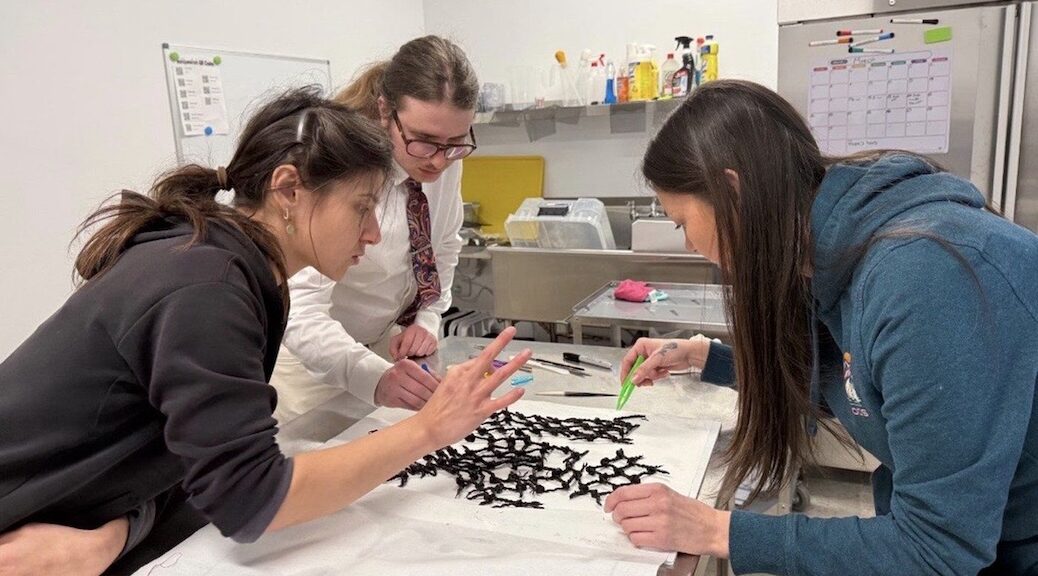
A rare 2,000-year-old fishing net unearthed in Tsawwassen is undergoing conservation at the First Nation’s repository, providing a window into the coastal life that flourished in the region millennia ago.
“It really highlights the deep cultural importance of fishing for our people. It’s a privilege to be able to care for and hold a piece of our ancestors’ history and perpetuity,” said Tia Williams, Archaeology Coordinator at the Tsawwassen First Nation (TFN).
The department used radiocarbon dating to determine the age of the net. It has also undergone multiple tests and is currently undergoing cellulose analysis after researchers confirmed that it is made from bark fibres, but not cedar. Some professionals, weavers, and elders suggest the material could be stinging nettle or bigleaf maple.
“In archeology, we almost never recover a complete fish net. Most of the time, we’re lucky if we find small fragments, maybe a knot, a leaf. Usually, we only see traces,” said Williams.
According to Williams, they have a larger and much rarer piece, preserved only because it remained in a wet site.
Williams explains that most archaeological sites are dry, which means organic materials typically break down over time. As a result, archaeologists often find stone and bone tools, or small remnants, while materials such as fibres, wood, or textiles rarely survive.
Wet sites, however, are different. In water-saturated environments, such as clay, mud, or peat, oxygen cannot easily reach buried objects. This creates an anaerobic environment that significantly slows, or even stops the decay of organic materials.
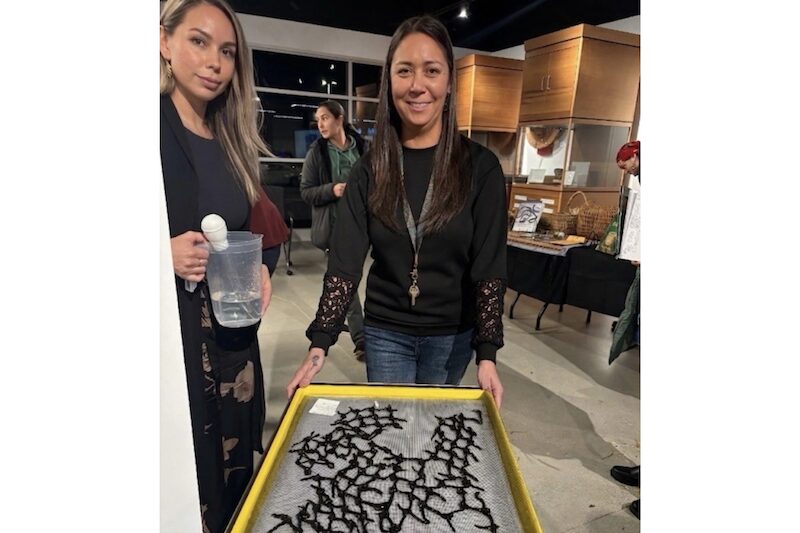
The net was first discovered in May 2024, found at a wet site on the north end of the Beach Grove Golf Course during monitored municipal excavation work. Workers saw it hanging from the equipment, an incident that highlights how fragile and easily lost such artifacts can be. Once out of its natural environment, it can very quickly fall apart and disintegrate.
“We work on the traditional territory of Tsawwassen people, and whenever we find belongings of our ancestors, oftentimes when we’re in the field, we’re the first ones to touch and hold those belongings since our ancestors were the last ones to touch them,” said Williams. “It’s very impactful to all of us who do this work, and it’s incredible.”
Each piece is carefully cleaned, monitored, and kept cold before undergoing years of conservation, including polyethylene glycol treatment and freeze-drying, to prepare it for display.
The TFN repository opened in 2025, and Williams hopes for it to lead to a museum and cultural centre someday.
“I don’t know if it really sets a precedent, but it’s monumental to have a First Nations repository handling their own belongings and ancestors over a colonial institution, and we’ve been very fortunate to have wonderful relationships with all the local museums and universities,” said Williams.
The space already houses many other ancestral belongings, such as basketry, historic fishnets, and stone and bone artifacts.
Williams says there is abundant evidence of hunting and fishing throughout Tsawwassen, with numerous fish camps once located around Beach Grove, Boundary Bay, and the Tsawwassen beach area.
“I think discoveries like this remind us that Indigenous history isn’t abstract, it’s tangible. It’s sophisticated and deeply connected to the place, so we are fortunate to be able to protect and learn from it.”
Top image credit: Hope LaFarge (left), Conservator), Tyler Wheeler (middle), TFN Member, Archaeology Field Technician and Melinda Cassidy (right), TFN Member, Archaeology Field Technician, Repository Technician. – Photo by Chief Laura Cassidy

Sign-up for Cortes Currents email-out:
To receive an emailed catalogue of articles on Cortes Currents, send a (blank) email to subscribe to your desired frequency:
- Daily, (articles posted during the last 24 hours) – [email protected]
- Weekly Digest cortescurrents – [email protected]