

Editor’s note: Will any other municipalities or regions follow this example?

By Theresa McManus, Freshet News, Local Journalism Initiative Reporter
New Westminster tenants aren’t allowed to freeze to death in their apartments — nor should they be allowed to succumb to heat in their homes.
That’s the motivation behind bylaws that will require New Westminster landlords to maintain safe temperatures in at least one living space in rental units occupied by a tenant. City council unanimously supported three readings to business bylaws at its March 30 meeting.
“This is a very exciting piece of work that the city is taking on,” said Coun. Nadine Nakagawa. “To the best of my knowledge, we are the first municipality in Canada to take this move to protect renters against extreme heat.”
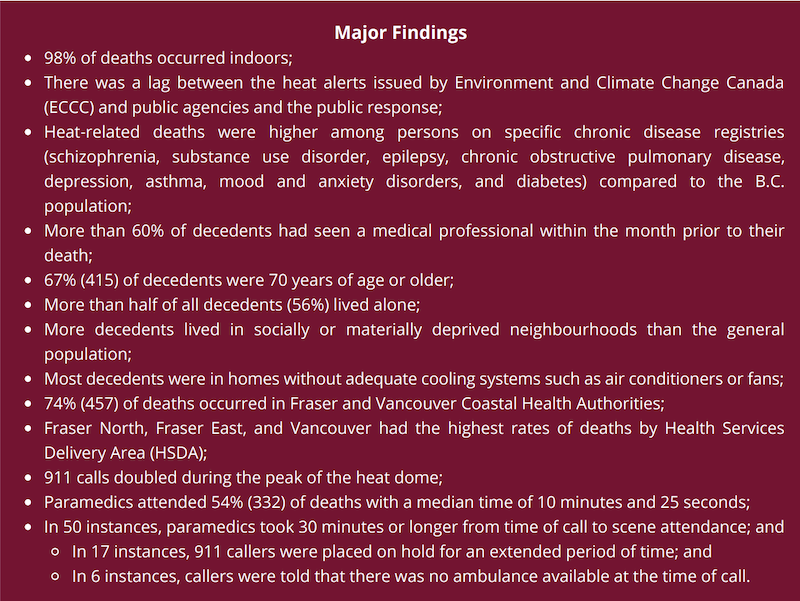
(Screenshot from Extreme Heat and Human Mortality: A review of Heat-Related Deaths in B.C. in Summer 2021)
Nakagawa said it’s “inevitable” heat domes will impact citizens in the future.
“The most dangerous place should not be people’s homes,” she said. “In 2021, we know that 33 members of our community died because their homes were too hot. And we know this happened mainly in older rental buildings.”
During the 2021 heat dome, Nakagawa was living in a bachelor unit where the only window was a sliding glass door, which prevented an air conditioner from being installed. Due to the extreme heat in her suite, she had to stay at a friend’s house during the heat dome.
“It was deathly hot, and I was in the neighbourhood that saw the most deaths,” she said. “So, it’s very, very real.”
Deadly heat
In April 2022, the British Columbia Coroners Service convened a panel to review the deaths of 619 people who died during the June 25 to July 1, 2021 extreme heat event. Its report — Extreme Heat and Human Mortality: A review of Heat-Related Deaths in B.C. in Summer 2021 — said the “unprecedented heat dome” resulted in temperatures of over 40 C in many parts of the province and “uncharacteristically high” overnight temperatures.
“High indoor temperature was the primary cause of injury and death during the extreme heat,” stated the report.
Of the 619 heat-related deaths in B.C, 33 were in New Westminster — one of the highest death totals in British Columbia. Only B.C.’s three most-populated cities — Vancouver (117), Surrey (75) and Burnaby (73) — saw more deaths during the heat dome.
The panel’s findings included:
- Heat-related deaths were higher among persons on specific chronic disease registries, compared to the B.C. population. This includes people with schizophrenia, substance use disorder, epilepsy, chronic obstructive pulmonary disease, depression, asthma, mood and anxiety disorders, and diabetes
- 67 per cent (415) of decedents were 70 years of age or older
- More than half of the people who died (56 per cent) lived alone
- Most decedents were in homes without adequate cooling systems such as air conditioners or fans
Mayor Patrick Johnstone said the heat dome was the largest single natural disaster experienced in New Westminster. He said B.C. has laws ensuring renters can live in apartments where the temperature does not get so cold that they freeze to death in their homes.
“They have no equal protection for living in an apartment that gets so hot that they die from it,” he said. “We do not have people freezing to death in apartments in New Westminster; we did have people die of heat exhaustion in their apartments, at home. So, we need to do what we can to address that.”
In August 2023, council approved a motion from Nakagawa and Coun. Tasha Henderson directing staff to explore the tools available for the city to adopt a bylaw that prevents at least one room of the unit from exceeding the standard recommendation of 26 C.
Henderson said some council colleagues around the region have opposed this kind of move because of potential costs to landlords.
“It is just unthinkable that in 2026 that people could die in their homes,” she said. “It feels really untenable that we could let that happen. So, I’m really proud to make this move.”
Taking action
Following the heat dome, city council directed staff to explore immediate and long-term actions the city could take to ensure it is prepared for future heat domes. Actions have included:
- endorsing an extreme heat response plan in September 2024
- supporting extreme heat cooling centres and misting stations at various locations in the city
- embarking on an extreme heath vulnerability assessment to identify rental buildings vulnerable to overheating
- adopting a bylaw amendment prohibiting landlords from prohibiting cooling devices, such as air conditioners, including provisions for an exemption process (May 2025)
The March 30 staff report said a safe indoor temperature means an average temperature of 26 C (78.8 F) or below, as measured between 8 p.m. and 8 a.m.
As part of the new bylaws, the city provides instructions for proper measurement of heat in living spaces, but it allows property owners to determine what cooling measures are most appropriate to implement in their buildings in order to comply with the new requirements.
“It provides both supports and flexibility for the practicalities of trying to provide cooling,” Johnstone said. “It is not prescriptive on how cooling is provided.”
Tina Rottboll, a member of the New Westminster Tenants’ Union, worries how extreme heat impacts her neighbours, including seniors, families with babies and young children, and pets. She welcomes the city’s efforts to address cooling in rental buildings.
“It’s long overdue.”
Rottboll, however, does not think the city’s bylaws go far enough in requiring an average temperature of 26 C or below between 8 p.m. and 8 a.m.
“The hottest time of day is between 3 and 6,” she said.
In addition to extending the hours to cover the afternoon period, Rottboll also thinks the bylaws should require apartment units to have more than one room that meet the temperature requirements.
“People don’t just need one room,” she told Freshet News. “We need two rooms – at least.”
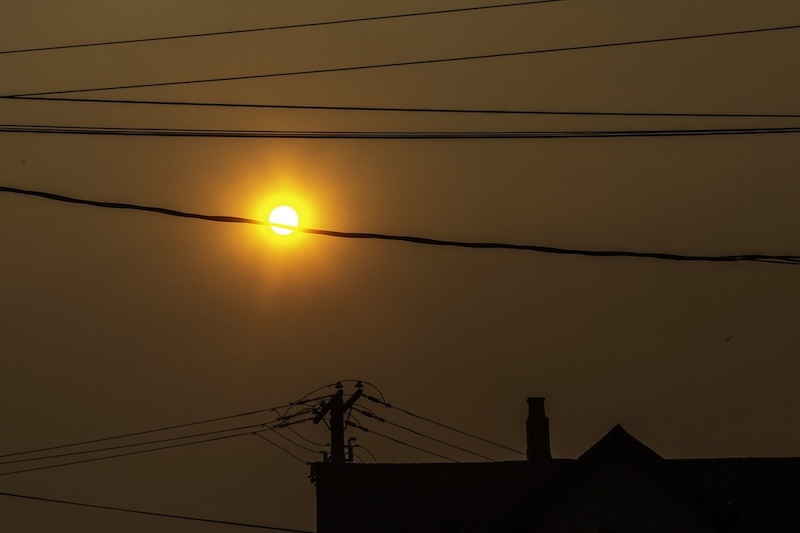
Top image credit: Sunset during the 2021 heat dome, with temperatures reaching close to 50 C – photo by Murray Foubister via Flickr (CC BY SA 2/0)

Sign-up for Cortes Currents email-out:
To receive an emailed catalogue of articles on Cortes Currents, send a (blank) email to subscribe to your desired frequency:
- Daily, (articles posted during the last 24 hours) – [email protected]
- Weekly Digest cortescurrents – [email protected]