
Click here to access part one of this series and here for part two .
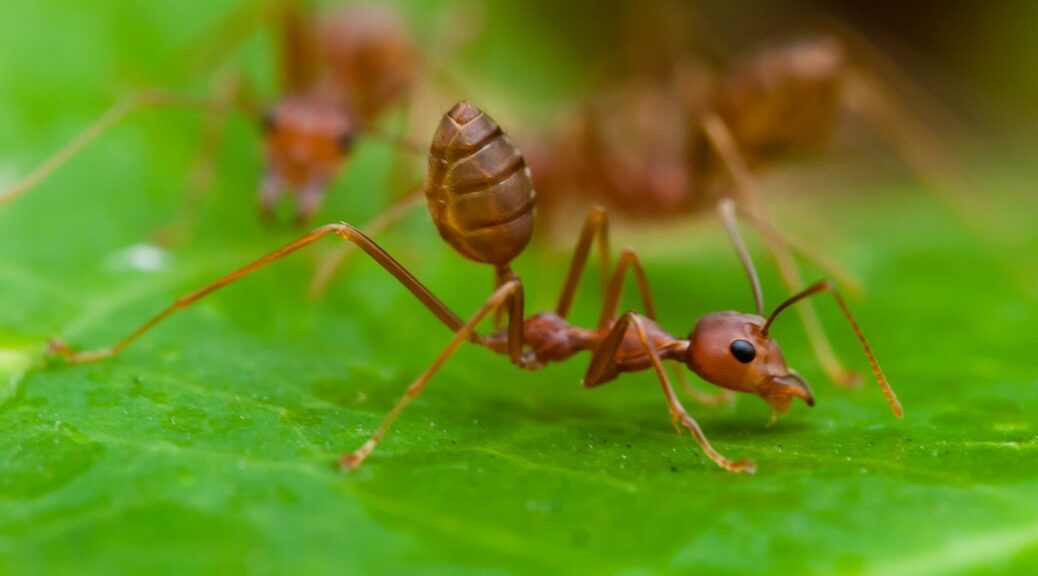
• A species of weaver ant found from India to northern Australia
(Oecophylla smaragdina) makes its nests by curling leaves into loops.
The leaves, however, are too stiff for any single ant to accomplish this feat. To solve this problem, the ants form a chain of up to 17 individuals. Using their mandibles, each ant grabs the abdomen of the previous ant, and they all pull together to bend the leaves. Using this tug-of-war strategy, the ants are able to pull up to 100 times their individual body weight (New Scientist, 23 August, 2025).
• Killer whales (Orcinus orca) seem to be offering dead prey to human divers. Jared Towers, a researcher for Bay Cetology, was filming a pod of orcas that were snacking on seabirds in Alert Bay in British Columbia. Two of the orcas, identified as Akela and Quiver, approached Towers, each dropped a seabird in front of him, waited a moment, then picked up the dead offering and swam away. Such an apparent offering has occurred before in at least 32 other instances involving 18 different prey species between 2004 and 2024 in places such as New Zealand and Norway. Orcas share prey among themselves during their entire lives, but this apparent gesture of sharing with another species raises some questions about their level of consciousness, their “generalized altruism, or kindness” and their ability “to recognize sentience in others” (New Scientist, July 15, 2025).
• An Australian moth (Agrotis infusa), to avoid the intensity of summer heat, makes an annual migration of 1,000 km from its southern range to cool caves in the Australian Alps. Until recently, no one knew how they accomplished this long migrational feat. Other moths are known to use Earth’s magnetic field for navigation. So to eliminate this factor, researchers used a special device to eliminate Earth’s magnetic field. Then, by simulating a starry sky, they discovered they could steer the direction of the moth’s flight. This is the first time that an invertebrate has used celestial navigation, although dung beetles are known to use the Milky Way to guide their direction of travel over short distances (New Scientist, June 28, 2025).
• Horsetails, plants that have been on Earth since the Devonian Period about 400 million years ago, manage to distil water to such purity that comparable samples can only be found on meteorites arriving from outer space. Almost all oxygen atoms in water molecules have 8 neutrons, but some heavier isotopes have 10 neutrons. Every time water evaporates and condenses, the ratio of isotopes goes down. To reach the top of the metre-high stem of the horsetail (Equisetum laevigatum), the water has been evaporated and condensed at every segment of the stem. By the time it reaches the top, the isotope ratio is the lowest of almost any water found on Earth (New Scientist, July 19, 2025).
• Researchers have discovered that the sapwood and the heartwood of trees contain two totally different microbiomes. We have long known that the outer surfaces of trees contain “a rich assemblage of bacteria, archaea, fungi, protists and viruses”, but the heartwood also contains a distinctive microbiome that eventually creates the “heart rot” that is essential to the recycling of old trees and their woody material. As the number of old trees decline, the microbiome that is unique to them also declines. Trees, which contain about 600 billion tonnes of carbon, are probably the single most important part of our planet’s biosphere because of the “carbon, hydrogen, nitrogen, oxygen, phosphorus and sulphur” that they provide to everything else that is living. Microorganisms do not usually get much attention from us, but they are the foundation of all Earth’s ecological systems (Graham Lawton, New Scientist, August 16, 2025).
• A species of dogbane (Vincetoxicum nakaianum) is a plant with a unique way of attracting flies to assist with its pollination. It emits a pheromone that mimics the smell of the discarded carcases of ants that have been half-eaten by spiders. The odour of these dead ants lures flies to the plant. They then land on the blossoms and distribute pollen. The strategy was noted by Ko Mochizuki, a botanist from the University of Tokyo, who observed flies swarming inexplicably around a dogbane plant. A chemical analysis of the pheromone revealed that it was of exactly the same composition as the scent emitted by dead ants (The Guardian Weekly, October 3, 2025).
Ray Grigg for Sierra Quadra
Top image credit: Oecophylla smaragdina – Weaver ant from Thailand – Photo by Rushen via Flickr ( CC BY-SA 2.0)