
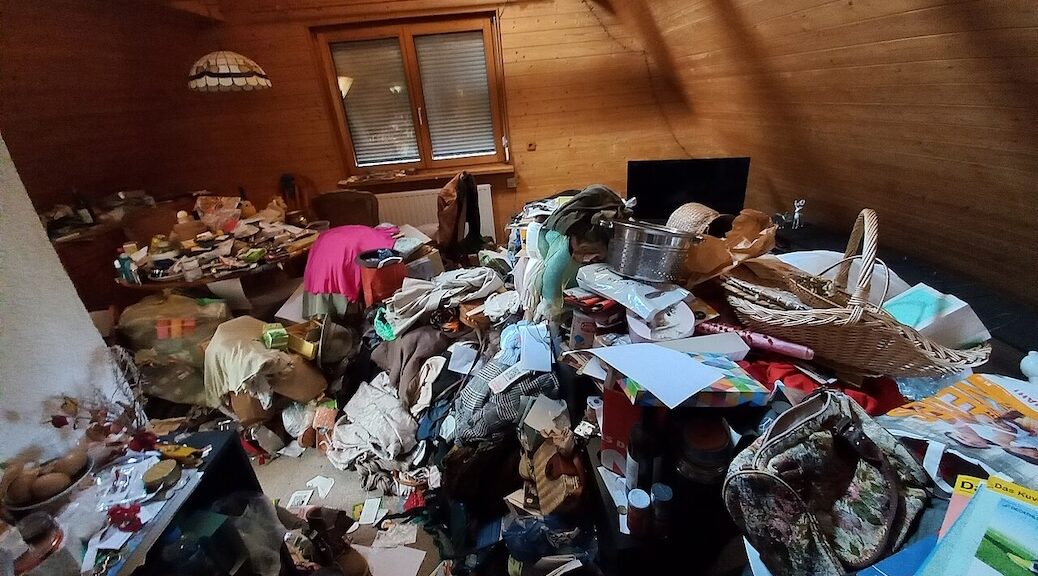
Our primordial history continues to haunt us. Try as we might, we can’t seem to escape the psychological dynamics that have so indelibly shaped us during our many millennia as primitive foragers and hunters eking out our precarious survival in an untamed nature. This vulnerability is so baked into our genetic memory that it subconsciously expresses itself in behaviours that are irrational and ultimately destructive. This subject is introduced by Jodi Wilson, an Australian health journalist and author, in an essay, Enough’s Enough: We Are Overwhelmed With Having Too Much Stuff (The Guardian Weekly, January 23, 2026).
“Simplicity,” Wilson writes, “is intriguing because it’s a radical choice in a world that promotes more. From a neurological perspective, it’s innately difficult because it goes against our primal instincts: ‘I better get this now because it might not be there later.’ How does it play out in a modern world of abundance? We’re gorging on food, stuff, and the infinite scroll of information and entertainment—our brain is full, which makes us feel overwhelmed and exhausted.” It also impairs clarity, and contributes to confusion.
The consumer does get a transient flush of satisfying dopamine that comes from buying anything. This is an ancient biochemical stimulus that we share with other animals—even with certain insects. It was once a crucial mechanism for our survival, but is now superfluous for those of us living in an age of abundance. What do we need when we have everything that we need? But, as Wilson contends, the biochemical addiction continues to drive us.
“There is a ghastly amount of stuff that already exists in the world,” she writes, “and the donation pile at charity shops in January is a pertinent reminder.” In the northern hemisphere, this is the month that follows the winter solstice, when people are primed by the threatening darkness and cold to combat their insecurity by spending lavishly. The subconscious will not be stopped from taking every opportunity to express itself, even though the planet is already full, overwhelmed and exhausted by the excessive products of our affluent consumer societies. Not only do we make and take more than we need, but we are also generating more waste than nature can process.
Amid the luxury of these contaminating things, we usually forget to notice the reciprocal relationship between owning and being owned. What we own also owns us. Beyond what is required for the basics that provide a comfortable existence, possessions become a burden that take
massive amounts of time and energy to acquire, and then immeasurable
effort to use, supervise, keep and protect. All this attention diverts us from the profound simplicity and existential treasure of merely being consciously alive. Owning stuff so easily becomes a distraction that displaces the essence of something far more valuable than anything else that we can possess. “I shop, therefore I am”—the title of a 1987 artwork by the American conceptual artist, Barbara Kruger—is a poor substitute for a universally unique commodity that can neither be bought nor sold, traded nor taxed, transferred nor appraised. It arrives free of any duties or penalties. It does, however, have an non-negotiable expiry date, which leaves even the most wealthy in an uncomfortable position.
Billionaires have more money than anyone could possibly spend on necessities in multiple lifetimes, so something else is motivating their lack of enoughness. Is it the quest for power? Control? Prestige? Authority? Perhaps, superficially. But all these motives can be linked to an incessant and fundamental hunger, to a deep and primal insecurity that cannot be satisfied by any amount of wealth. And in the process of trying to assuage this ghost of their primal past, they do more environmental damage with their yachts, private jets, helicopters, mansions and exploitive enterprises than most other human beings.
No one should deny another human being from having a comfortable and
secure life. But excesses that reach far beyond necessities are destroying the wellbeing of others and the ecological structures of our planet. Perhaps, if the affluent could curtail some of their hedonistic indulgences, everyone would have an opportunity to lead better lives, and the natural world, as we know it, would have a better chance of surviving.
Ray Grigg for Sierra Quadra
Image credit: Compulsive Hoarding – Photo by Asurnipal (Own work) via Wikimedia (CC BY-SA 4.0)