
In Goliath’s Curse: The History and Future of Societal Collapse, Dr.
Luke Kemp attributes the cause of civilizational failures in 400
societies over the course of 5,000 years of history to the
contaminating effects of leaders who possess the “dark triad” of
narcissism, psychopathy and Machiavellian manipulation. A related but
equally intriguing perspective comes from Dr. Leanne ten Brinke, a
professor of psychology and director of the University of B.C.’s Truth
and Trust Lab, who has done extensive studies on the behaviour of
convicted criminals (University of British Columbia Magazine,
Spring/Summer 2025, “The ‘Strongmen’ Who are Breaking Democracies” by Jared Downing).
This is explored in more detail in her book, Poisonous People. Dr. ten
Brinke adds sadism to Kemp’s “dark triad” to make a “dark tetrad”, an
added attribute that can be easily spliced into the other three. As a
psychologist rather than a historian, her conclusion about the
corrosive effects of this type of personality on social order offers a
more contemporary explanation that is useful in explaining what is
happening in our present world.
Because this dark personality is a spectrum disorder, about 20% of
people have noticeable traits of it, she contends, and about 1% are
psychopathic, so both types can be found throughout society. They are
“likely to strive for high positions,” goals that are often obtained
“through lies, manipulation, and intimidation.” These positions of
power tend to entice dark personalities, people who are inclined to
experience interactions as competition rather than cooperation. And
their quest for control and domination promotes conflict and reduces
the likelihood of social benefits.
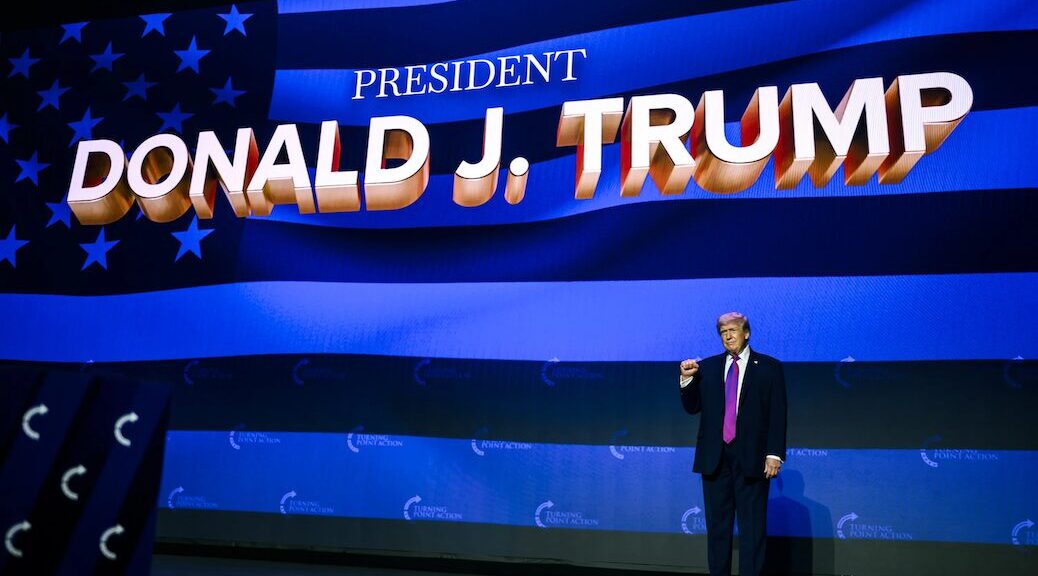
“I hesitate to make a definitive statement [about Donald Trump],” said
ten Brinke, “but if you think about what makes up psychopathy, his
behaviour would suggest that he’s high in many of these traits.” He
seems to act impulsively, manipulates by lying freely without apparent
guilt, demonstrates persistent antisocial behaviour by violating
accepted rules and etiquette, and makes grandiose claims to elevate
his sense of self-worth. Since psychopaths focus on themselves rather
than on others, they tend to be poor leaders. A study that ten Brinke
co-authored found that, “Psychopathic leaders can be charming and
persuasive, but are poor performers who mismanage, bully, and engage
in unethical behaviour.” Other historical studies have shown that
these “strongmen”, who are noted for sponsoring fear and bloodshed,
are not competent economists, either. They may organize competently
for their own purposes, but not for the protracted benefit of others.
Their indispensability is an illusion of their own invention.
Why, then, do societies keep getting these dark personalities as leaders?
The answer is in the trust that is inherent in people. Although this
is the human trait that allows societies to function harmoniously, it
is exactly the trait that dark personalities exploit. As ten Brinke
explains, “When people are uncertain and a little scared, if there’s
economic uncertainty or military conflict, and we feel like we need a
strong person to stand up for us, those kinds of conditions can
increase the likelihood that you get support for that person who
adopts a dominant approach to leadership, as opposed to a more
respect-based approach.” In such stressful times, the negative
attributes of “impulsivity, ruthlessness and deceit” in the dark
triad-tetrad get reinterpreted as “decisiveness, strength and
cunning”.
The consequence can become a downward spiral in social order,
cooperation, social cohesion, stability and affluence. The very traits
of the dark personality that were supposed to remedy a society’s
problems can actually make them worse. Abetting this collapse is the
tenacity with which dark personalities try to keep control and power.
This situation is made even worse by their resistance to being
changed. The psychopathy, narcissism, manipulativeness and sadism of
such leaders tend to counteract their receptivity to reform. According
to ten Brinke, some of their worst attributes can be adjusted by
rewarding them with what is considered “good” behaviour, but
significant change as an actual “cure” almost never occurs.
For societies and for entire civilizations, leadership by these dark
personalities commonly ends badly. So they collapse, either partially
or totally. Those who survive eventually reconstitute some semblance
of order with their inherent human inclination to trust, cooperate and
share. That is the happy ending to the human saga.
Unfortunately, as a psychologist, ten Brinke measures reality somewhat
differently. About 10 to 20% of the people who are on the dark
personality spectrum have a propensity for “eroding ethical standards
and sowing fear and mistrust” (Sally Adee, “Defence Against the Dark
Arts”, New Scientist, 7 March 2026). As for the remaining 80%, careful
studies have shown that many of them in “a culture of rot” can be
converted into “situational psychopaths”, and that “kind and
empathetic people are prone to infection by dark personalities.”
Extreme fatigue, heat, stress, fear and group dynamics can change the
character of most decent people—the term for a sports “fan” is derived
from the word “fanatic”.
Hopefully, our best defence against becoming “poisonous people” is
being aware of these personalities and how we might fall victim to
them. Sadly, our historical record is not promising. But maybe, with
awareness, we might improve.
Ray Grigg for Sierra Quadra
Top image credit: President Donald J Trump – courtesy the White House (Public Domain)