


The Quadra Island Salmon Enhancement Society grew out of poor salmon runs in the 1970s and 80s and has been a non-profit organization (and registered charity) since 1981. In this morning’s interview Lauren Miller, a director, talks about the 2025 salmon run, climate change and some of the projects her organization has undertaken.
(Photo credit: Lauren Miller – Photo by Paul Puddy)
Lauren Miller: “We are seeing changes in temperatures that are consistent with other measurements in British Columbia and we’re also seeing changes in temperature that are consistent with some of the climate change forecasts for the Pacific Northwest overall and for British Columbia.”
“So we have prioritized a response to climate change for Quadra salmon. Ultimately, we don’t know if salmon will survive climate change in this area, on smaller islands like Quadra and Cortes. Our watersheds are formed from rainfall. They’re not formed from snowpack, so that does create an additional vulnerability to temperatures. Of course, all watersheds have some vulnerability to temperatures. We are seeing temperatures on Quadra that we know are not optimal for salmon. We know they’re not healthy for them.”
“We have seen some evidence of salmon leaving areas that they would normally like to hang out in. For example, some of the Coho fry in Village Bay Lakes seem to be really interested in an area that we call the Reedy Passage. It’s a shallow area with a lot of reed cover. We see lots and lots of fry in the spring and lots of fry there in the fall. In the summer, when we were taking temperatures, we saw very few fry there during the hotter part of the year, during late July and August.”
Cortes Currents: Despite the challenges you’ve mentioned, the 2024 run was fantastic and you had a good run this year as well. Tell us about the 2025 run on Quadra Island.
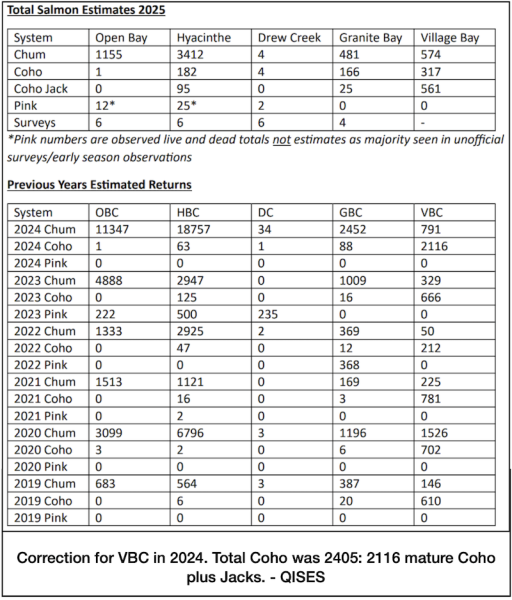
Lauren Miller: “These are all estimates except for Village Bay Creek, where the video system gives us an almost 100% accurate count, at least for the Coho.”
“I’ve have a 1,168 total in Open Bay Creek. Most of them are Chum—1,155. Only one Coho was actually observed in Open Bay Creek, but the Coho move at night, so there were probably a lot more Coho present.”
“We also saw 12 Pinks, and we did see a number pf more Pinks than usual. This year, people were seeing Pinks in a lot of other creeks.”
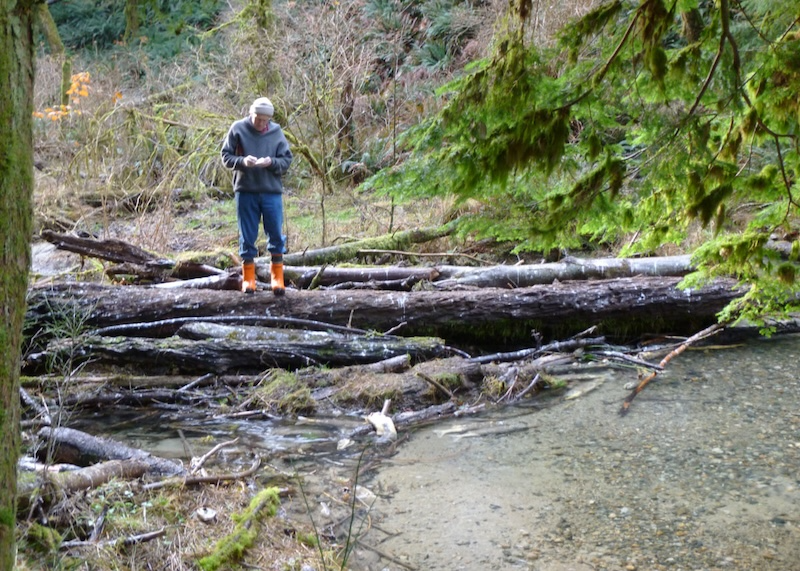
“In Hyacinthe Creek, we saw 3,714 fish altogether. Again, most of those were Chum. So just over 3,400 Chum and 182 Coho and 92 Coho Jacks. We’ll talk about the Jacks in a little bit. We saw 25 Pinks and there were probably a few more.”
“In Drew Creek, we only saw four Coho, four Chum, and two Pinks. And I think those maybe were dead Pinks, I’m not sure.”
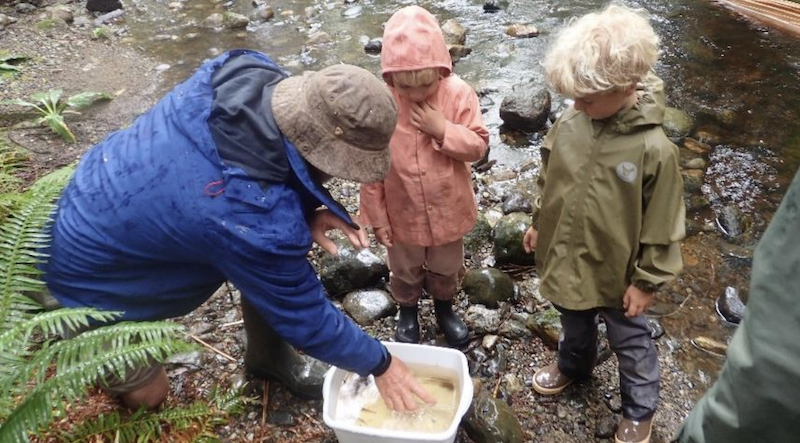
“In Granite Bay Creek, we saw 481 Chum, 166 Coho, 25 Coho Jacks, and we didn’t see any Pinks then.”
“I’m just going to pull up my numbers for Village Bay Creek. 1,202 was the total number of fish for 2025. Of those, 878 of them were Coho. Most of them were Jacks, which is unusual. Only 317 of those were what we’d call the big mature Coho.”
“For anybody that doesn’t know, a Jack is a salmon that returns a year or more earlier than it typically would. So they often call them precocious. They’re usually males. Most people think of Jacks as a mechanism for genetic diversity because they are returning in a different year than many of the rest of the fish.”
“If they are males, they’ll often sneak in when a female is spawning with a bigger fish. So the female is laying her eggs and then they’ll often pair up with a male who will spread the milt out over the redd, or gravel nest.”
“When we see this number of fish returning prematurely, we’re definitely hoping that some of them are female. We don’t know why we’re seeing this many Jacks. I did hear from DFO that a number of other creeks were seeing a large number of Jacks and we saw the most of them in Village Bay Creek.”
“One exciting thing that we discovered this year is the presence of Kokanee in the Village Bay Lake system. That was really exciting because we had heard that there were still Kokanee. We heard that people still caught Kokanee. For anyone that doesn’t know, Kokanee are the same species as Sockeye, and we had Sockeye in Village Bay Lakes up until 2006. It’s really not clear whether we lost our Sockeye run due to fishing pressure or due to water temperatures and water levels in the creek, but the presence of the Kokanee is a very positive thing. The Kokanee are simply Sockeye that do not migrate out to the ocean. They often tend to be genetically distinct, but conditions that are good for the Kokanee to spawn would be very similar to the conditions for Sockeye.”
Cortes Currents: Tell me about your collaboration with the ICAN Water Security team.
Lauren Miller: “Water has just become a forefront concern for many different groups in BC and really around the world.”
“On Quadra, the ICAN Water Security Team is interested in mapping out water patterns and looking at flow measurements. Ultimately they’re looking at doing a water budget for the island. Quadra Salmon has teamed up with ICAN to install a few hydrometric stations in Village Bay Creek, in Drew Creek, and I believe in Hyacinthe Creek. In the next several months we should have installed hydrometric stations in all the major creeks where we see fish on Quadra. These hydrometric stations will monitor temperature in the creeks and will also help us monitor flow. We are looking at how much water is moving and when it’s moving.”
Cortes Currents: You are also working with DFO to upgrade your fish counting fence on the Village Bay Lakes and the Pidcock Creek Restoration. Tell me about those two projects.
Lauren Miller: “Those are two pretty different projects on different ends of the island, but they’re both quite exciting to me. I’ll start with the Village Bay Fish Fence, because that’s the area that I’m most directly involved in. Quadra Salmon implemented a fish counting fence decades ago, certainly in the nineties, to get a more accurate count of salmon. In Village Bay Creek in particular, the water levels get a little bit high and the salmon can be difficult to see.”
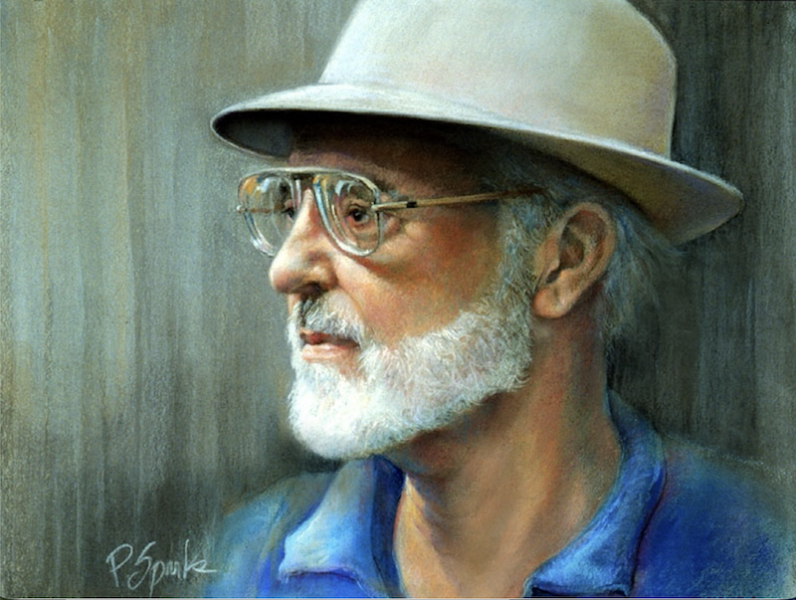
“It was very similar to many fish fences around British Columbia. It was operated by simply closing a gate, cutting off access for the fish, and then for periods of time opening that gate. So we would come a couple of times a day, which was more often than many fences around the province, and we would just open up this gate, stand there, and count fish. That was a high priority for me and Quadra Salmon got on board, especially with the encouragement of my former fish counting partner across the lake, Larry Hameister. Peter Calverly was also involved.
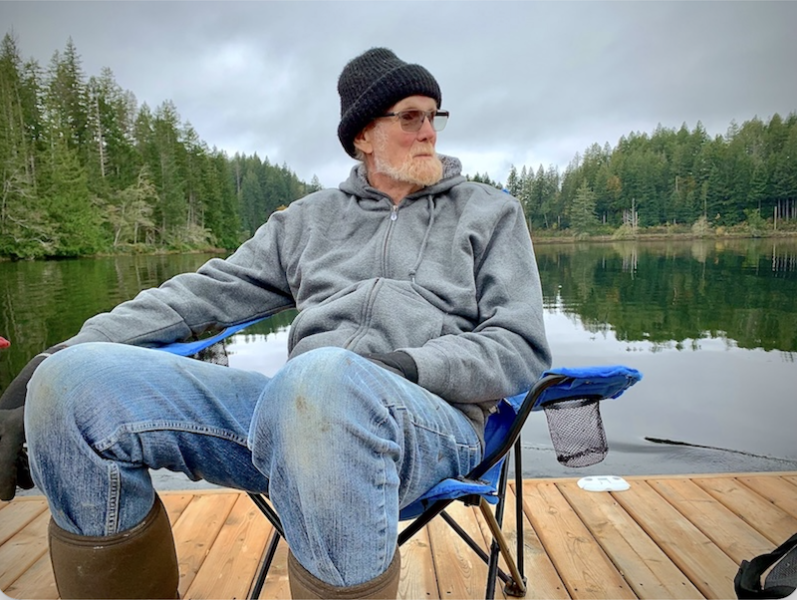
“Doug Biro created a lot of the design of this video system, and we implemented the video system in 2017.”
“A few things are important to upgrade by that point. For one, our batteries are starting to get a little bit old. The fence is still run by the daily operation of a generator because it is an off-grid site. We’re hoping to provide alternative power. It will probably be solar, and we’re also just hoping to upgrade the fence such that it will contain a little bit more water during really low times, and allow more water to escape during flood times. So we’re just trying to improve on the structure that is in place currently.”
“The videos have been pretty exciting to see, and they’ve inspired some other salmon organizations around BC to also implement video systems that allow the fish to move through at any time.”
“You don’t always see all of the Coho. They seem to be most influenced in this area by big rainfall events. So you often see a lot of Coho moving after a big rain, but they do seem to really like to move at night, probably influenced by avoiding predators. When we have a manual counting system that obstructs the fish, it means they have to wait for somebody to open it up. So we are pretty excited about that improvement.”
“Back to Pidcock Creek, which is the creek that in some ways is most at the heart of Quadra’s downtown population. It’s the creek that flows into Quathiaski Cove near where the ferry comes in from Campbell River. A surprising number of people don’t know that Pidcock Creek had a pretty thriving Coho run way back in the day. That Coho run was wiped out by a dam built by the local cannery. It was sometimes called the Pidcock Cannery or sometimes called the Anderson Cannery. Around 1900, they implemented a dam and that dam is still existent. It is slowly starting to fail. It is on SRD property, so it’s owned by the Strathcona Regional District.”
“Quadra Salmon formed the Pidcock Creek Restoration Steering Committee a couple of years ago in 2022 or 2023. It has been a perennial topic to see if we can restore that creek a little bit. It does have cutthroat trout still living in it. So that gives us a good indication that we could have a salmon run again if we were to somehow provide access.”
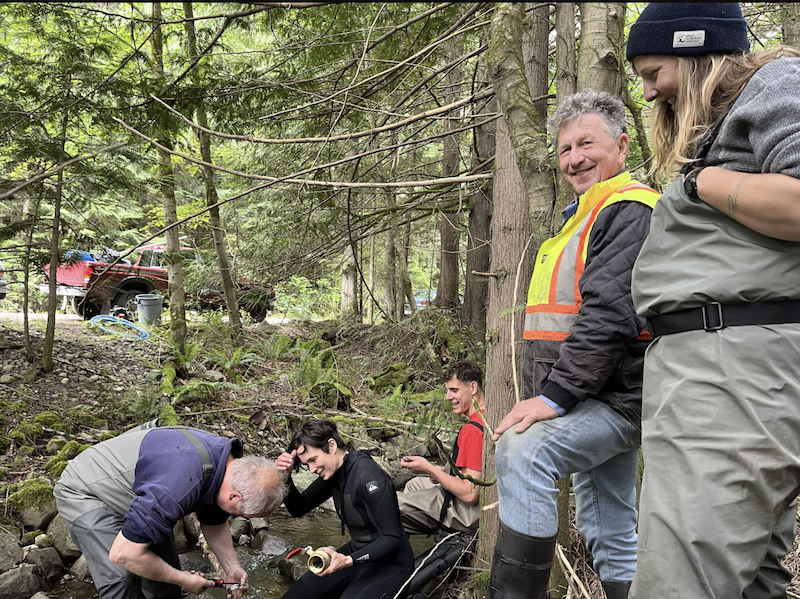
Cortes Currents: Have you asked the SRD about the possibility of removing the dam?
Lauren Miller: “We have entered into that discussion. It’s unclear at this point whether the best option would be to fully remove the dam or maybe to provide some type of fish access that goes past the dam. Shaun Koopman from the SRD has applied for a couple of grants to assess whether fish passage might be restored and to do an environmental assessment of whether removing the dam would be a positive thing to do.”
“We have not received any grants yet. It is a bit of a slow process because this is a very residential area. Some tributaries of Pidcock Creek are really just large ditches that periodically have to be maintained. So it may not be a very quick process, but there has been some interest in the project.”
“There has been some interest in Pidcock Creek from the We Wai Kai as well. Shane Pollard with the We Wai Kai Guardians has expressed a lot of interest about mapping the creek. So we’re probably doing a watershed assessment of Pidcock Creek. It could be that that happens the following year as well. It is really exciting because it is just so symbolic that this creek that’s right in the heart of Quadra, whose salmon run was wiped out by a historic salmon cannery. It would be so meaningful to the community to see salmon in that creek again.”
Cortes Currents: I’m also noticing a number of places that people can go for more information. For example, your YouTube channel, a lending library, and I’m assuming you have a website.
Lauren Miller: “Thank you for remembering that. Yes. Our website is quadrasalmon.ca and it is a place that we post some of our salmon counts and other news. I have just sent out newsletter number three for those interested, so people can subscribe to our newsletter and they can do that through our website.”
“We also just created a YouTube channel. It is very small, but after getting the video counting system, many people suggested that we share some of these videos with others. Many of them, at a certain point, become boring because it’s just fish after fish after fish coming into the lakes, but some of them are quite exciting.”
“There are some really cute little videos of otters, which do move up and down the creek and they are not intimidated by our camera box. So that YouTube channel is called Fish TV by Quadra Salmon. Because that’s what some people started lovingly calling it as we did our fish counts, and there is one surprise that we had never seen before. I’m not even going to tell people what that is, but I will say that it is 600 meters above the ocean. So people can subscribe to that if they’d like, they can ask for requests, and they can also subscribe to our newsletter.”
“We do also have a Facebook page. Despite not being a big fan of Facebook, you can go there and get some news articles shared, and I actually did create a Blue Sky account for Quadra Salmon just to be optimistic about other forms of social media.”
Cortes Currents: Tell me about your lending library and how people can access it.
Lauren Miller: “It is only on Quadra and it is located at the Vancouver Island Regional Library, right there at Quathiaski Cove. We decided to do this because we have a number of reports that are pretty fun to look at in hardcover.”
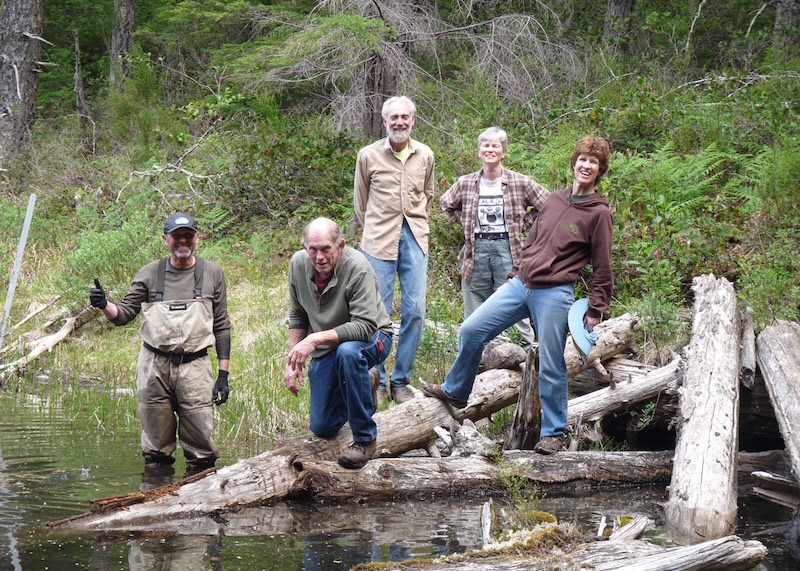
“Some of them are older stream assessments. Some of them are reports on different projects we’ve done, like our drought proofing. It’s not a huge library, but it is some really interesting documents that we wanted to not just have at the Eco Centre but to share with the public. We are going to digitize more of these documents and, over time, get more and more of them on our website.”
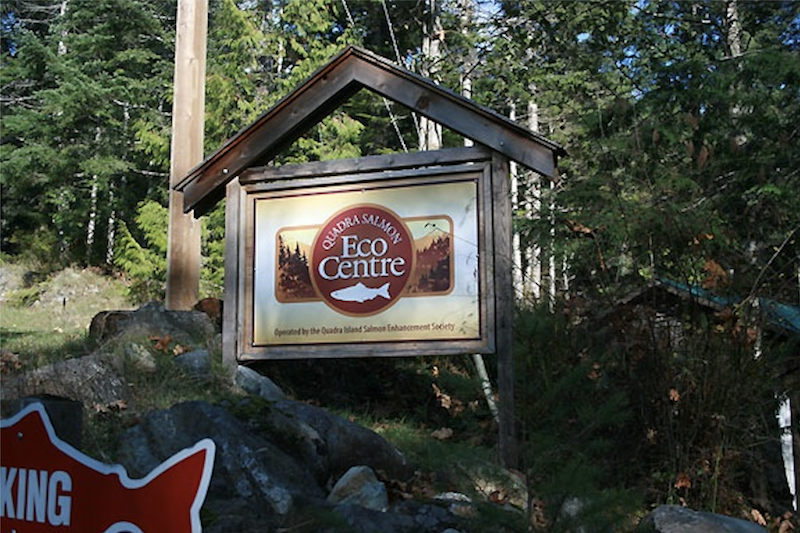
Links of Interest:
- Quadra Island Salmon Enhancement Society (QISES)
- Fish TV by Quadra Salmon – YouTube
- quadrasalmon.bsky.social
- Quadra Salmon Eco-Centre – Facebook
- Articles about, or mentioning, the QISES
Top image credit: Chum in Hyacinthe Creek – Photo by Jim-Smith; All photos and Salmon count chart courtesy QISES
Sign-up for Cortes Currents email-out:
To receive an emailed catalogue of articles on Cortes Currents, send a (blank) email to subscribe to your desired frequency:
- Daily, (articles posted during the last 24 hours) – [email protected]
- Weekly Digest cortescurrents – [email protected]