


More than 11,000 Pink Salmon are said to have returned to the Ahta River this September. This is more fish than the river has seen for many years and Alexandra Morton believes this is because Glacier Falls and Burdwood salmon farms were removed from their migration route.
She is not the only one suggesting that this year’s numbers are a result of removing salmon farms from the Broughton Archipelago. In August, Chief Bob Chamberlain of the First Nations Wild Salmon Alliance told the Vancouver Sun they haven’t seen these numbers in decades.
Ruth Salmon, Interim Executive Director at the BC Salmon Farmers Association, calls this statement a mixture of ‘misrepresentation’ and ‘speculation.’
She said, “There is no causative link, let alone a correlation, related to salmon farm activity and salmon returns. Pink salmon returns are very volatile, so much so that one can cherry pick a single river in any year and make up a story to support their belief.”
Her press release states that Pink Salmon return in two year cycles and
- “An average of 19,291 pink salmon have returned to the Ahta River over the last decade in the ‘even’ years.”
- A total of 11 salmon farms were active during the outmigration for this year’s (2022) return (March 2021). Returning populations for this year have yet to be confirmed by fisheries experts, but early reports suggest strong returns of Pink and Sockeye salmon may occur in many regions of B.C.
So Cortes Currents asked Morton and the BC Farmers Association for their sources. As might be expected, they are using different databases.

Morton emailed a report from the Mainland Enhancement of Salmonoid Species Society, which contained data from 2016 until 2022. She said there has been ‘a lot of softness in the data on wild salmon returns.’ People sometimes fly over a river, or walk a portion of the river, then make guesstimates. The Mainland Enhancement Society walk the entire portion of the river that salmon are in and do an actual count.
An industry spokesperson sent Cortes Currents a link to the DFO’s NuSEDS database, and wrote, “We don’t know where and how the Mainland Enhancement of Salmonoid Species Society got there returns, but it is different.”
The NuSEDS data base does not have a figure for 2022 yet, and has not reported more than 6,000 Pink Salmon in the Ahta River return since 2015. The last three years reported were all less than a thousand fish.
The biggest returns during the decade in question were between 2012 and 2015. The second highest run took place in an ‘odd’ year, when more than 22,000 Pink salmon returned in 2013.

The Mainland Enhancement Society numbers are invariably smaller than NuSEDS, but show 11,436 Pink Salmon returning this year. This is almost ten times the size of the next highest run, in 2018 and far greater than anything seen in the other five years in their report.
Morton and the BC Farmers Association also disagree as to which salmon farms would have impacted the Ahta River run.
Ruth Salmon states that the outgoing migration of Pink Salmon from the Ahta River 2021 would still have encountered fish farms in the Broughton Archipelago.
Morton agreed, but pointed out that the first farms the outgoing migration normally encountered were gone.

“When the juvenile pink salmon come out of the Ahta River, they go west. I have followed them every single year since 2001. They are tiny. There’s masses of them and they look like little tad poles. They weigh approximately 0.3 of a gram. It varies, some of them are 0.2, some of them are 0.5. But they are so small that some of them don’t even have their bellies completely buttoned up as we call it, which means that the yolk sac that was nourishing them after they hatched hasn’t completely disappeared from their bodies. They have no scales, and so they swim along the coast,” she explained.
“It is incredible that they are able to make such progress at such small sizes, but we see them every year arrive at the site where MOWI was operating the Glacier Falls Farm. There’s a bay there, and so these little fish would collect there and rest, and we would watch them be infected with larval sea lice, first stage of sea ice. You know that the lice got on right there because first of all, they were not infected a kilometre to east of that site. But also we know that that life stage of lice, molts and changes body shape within hours of getting on a fish.”
“The little pinks that survived that infection would then carry on and they would get infected at the Cermaq farm in the Burdwood Islands. Now the Burdwood Islands is this beautiful little group of islands with these tiny little shallow white shell beaches. The little salmon love those beaches because they’re shallow, they’re protected from the larger fish that would feed on them, and they stop in those bays to grow. It’s so important that these little fish grow as fast as possible and they would get infected with the sea lice at the Burdwood farm.”
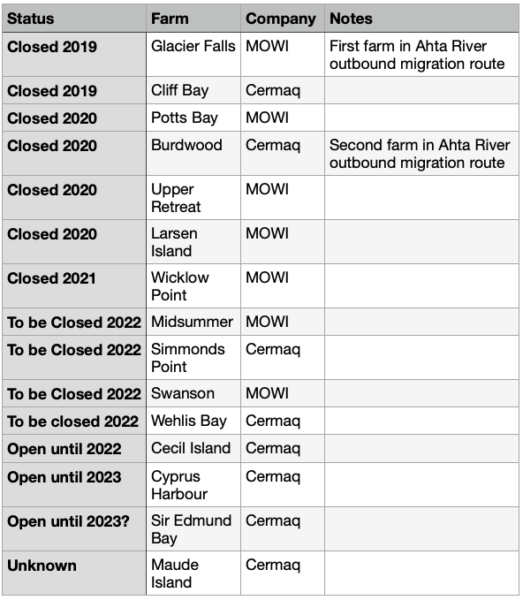
Morton says the companies know this. First Nations in the Broughton Archipelago insisted that Glacier Falls and Burwood be among the first fish farms to be removed, so this migration could be protected. Now the Pink Salmon from the Ahta River are getting a chance to grow and ‘put on some scales, which is basically their coat of armour.’ That gives them a fighting chance when they swim by the rest of the fish farms in the Broughton Archipelago.
She said this is not the first time we have seen wild salmon populations rebound after fish farms are removed from their migration routes.
Morton was one of the co-authors of a 2001 study that found that fish farms frequently killed over 80% of the annual wild salmon returns to the Broughton Archipelago.
“I predicted a 98% collapse and we got a 99% collapse even as the rest of the coast did very, very well,” she said.
Consequently, in 2003 fish farms in the Broughton Archipelago were ordered to either ‘get out’ or only put in fish straight from the hatchery where they have no lice.
“That generation of pink salmon survived better than in the history of studying pink salmon. This was reported in a paper by Dr. Dick Beamish of DFO, senior scientist, who is really not on side with this issue at all, but he had to report these numbers, and in his paper, which is titled ‘Exceptional Survival of Pink Salmon,’ he says, ‘There must be something wrong with these numbers.’ We’ve never seen a survival this big, and yet it happened again this year. When those salmon farms were removed,” said Morton.
She concluded, “So any way you look at this, the salmon farms have had devastating impact, and the salmon farming industry is refusing to own up to it. They could have helped themselves years ago when they saw this first study and said, ‘You know what? Okay, all right. We don’t think we are the problem, but clearly we need to get the farms away from places where the young salmon are this small,’ but they didn’t. They dug in the province of British Columbia, removed the entire pink salmon action plan from their website and the information.”
Top image credit: screenshot from Alexandra Morton’s video
Sign-up for Cortes Currents email-out:
To receive an emailed catalogue of articles on Cortes Currents, send a (blank) email to subscribe to your desired frequency:
- Daily, (articles posted during the last 24 hours) – [email protected]
- Weekly Digest cortescurrents – [email protected]