


Over 100 people came to the Quadra Community Centre on December 7, to learn about the acoustic dialects and social connections of Orca, Humpback and Fin Whales. Sierra Quadra invited Janie Wray – CEO and co-founder of the North Coast Cetacean Society, BC Whales, and the manager of the BC Hydrophone Network – to share from her more than two decades of research.
“One thing that we’ve recognized is that if we want to understand and protect whales, we have to listen them. That is why we think hydrophones are so important. It’s a non-invasive way of trying to understand whale communication and how communication between whales has changed over the years. There’s so many different whale species along this coast that are communicating,” she said.
“The more we learn, the better our chances are to protect whales and the only way we can protect whales is to work in collaboration with other people along this entire coast of BC, especially with Indigenous communities.”
Cortes Currents: How did you come to study whales?
Janie Wray: “I was about nine years old. I had heard the recording of Humpback whales singing. It was the first time that I had an emotional response to a sound, especially the sound of another species. That pretty much put me on track. I was fascinated by whales and whale communication.”

“After school, I traveled a bit and then went to university. From there, I worked as an intern at a place called OrcaLab, which is near the top end of Vancouver Island. They have a large number of hydrophones in the water. A hydrophone is like an underwater microphone, it allows you to listen to the underwater marine soundscape. It was listening to a lot of different whales, especially Orca in those days. The more I learned about whale communication, the more I wanted to know.”
Cetacea Lab
“I met my partner at that point and we ended up purchasing a small live-aboard research vessel. We traveled up the whole coast of BC and ended up in the First Nations community of Hartley Bay. We asked the Hereditary Chief at that time for permission to build a whale research station within their territory. Not only did they give us permission, they shared with us their own historical knowledge of whales and also pointed us in the right direction concerning a great place to build a facility. So we built that in 2001. I’ve pretty much been working up there ever since.”
“We record and analyze every whale call that we hear, whether that be an Orca, a Fin Whale or a Humpback whale.”

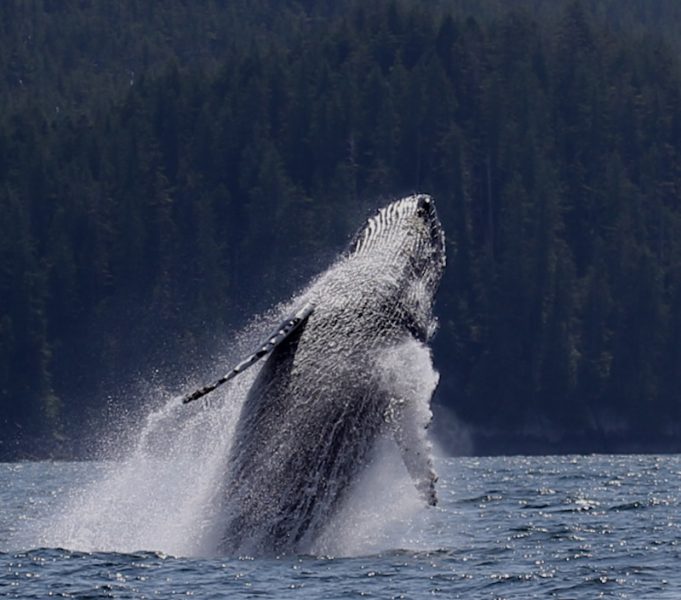
Humpback Whales
“In regards to Humpback whales, we have a heavy focus on this song display, which is a song that evolves and changes year to year. It’s only the males that sing this song, but when you listen to it, it really is a song. We’re trying to understand how that song is being learned between individuals within the community of whales along the coast of BC, but also how it changes from the North coast to the South coast. Then as they migrate towards Mexico and Hawaii, how is the song changing and evolving through time and from season to season?”

“The other call type we’re fascinated with is this bubble net feeding call. It’s a call that they only use when they’re bubble net feeding. So we can actually put a behaviour to a call type, which is unusual to do with whales. When we hear that call, we know they’re bubble net feeding, but even that particular call type has changed and evolved over the last 20 years. What these whales have actually done is they’ve taken a call type that was a bit complicated and they simplified it.”
“There’s a large number of Humpback whale social calls that are quite consistent. All of the Humpbacks within the Pacific Ocean use somewhat similar social calls. Up and down the whole coast, from Mexico, to Hawaii, we’re having lots of fun trying to catalog those.”
Cortes Currents: Do you have any whale stories from Cortes or Quadra?
Janie Wray: “I don’t personally, because all of my work has been up along the north coast from about Alert Bay northward, but just from doing that presentation the other day, I certainly heard some great stories and incredible interactions that people are having, especially with Humpback whales and Orca. How the Humpback population in that particular region has just increased substantially over the last years. That’s changing their marine soundscape. I got the impression from people around Quadra and Cortes, that they’re very careful when their boats are around whales. They’re showing lots of respect. I was really thrilled to hear that because that’s very important.”

Cortes Currents: How do you identify whales?
Janie Wray: “We take a photograph of every Humpback whale that we’ve sighted. The underside of the tail fluke is like a fingerprint to us. It allows us to ID the whale every time we see it. We’ve put all of these photographs into a catalog, which at the moment is the North Coast Humpback ID catalog. We’re also working with other researchers along the coast. Together we have put together what’s called the CPHC, the Canadian Pacific Humpback Collaboration, that’s working in collaboration along the entire coast to catalog every Humpback whale within BC waters.”

Orcas
Janie Wray: “Along the coast of BC, and especially around Cortes and Quadra, you have two different ecotypes of Orcas. You’ve got your transient or what’s referred to now as Biggs, but you also have resident whales.”
“What’s really important to understand with resident whales, especially the northern residents and the southern residents, is that this population is broken up into clans.”
“With the Northern Residents, there’s three different clans and each clan actually has their own group language. Within each clan, you have a number of pods or families, and these pods or families have their own dialect. So when we’re listening to whales, we can actually tell right away which clan it is, which pod it is, and sometimes even which family it is.”
What’s happened is because these families spend their entire life together, the oldest female of that family passed on her dialect to her daughter, and then her daughter passes on it on to her daughters. So what you end up with is a language that’s being passed on from generation to generation. That’s why there’s so much diversity within the resident communication and the amount of different calls that they use.
“What’s really interesting that is the residents feed on fish. They can be as chatty as they want, but Biggs or transients are feeding on marine mammals. They have to be quiet because they don’t want their prey to know they’re in the area. The opportunity for this dialect, or this language, to be passed on to multiple whales hasn’t really happened. Their language and the amount of calls they use is quite small in comparison to residents where the amount of different calls they use is quite large.”

Fin Island Research Station
Cortes Currents: Tell me about the Fin Island Research Station, which you built up in the Great Bear Rainforest area in 2017.
Janie Wray: “We actually built a second research station.”
“The work that’s happening from those stations is really quite remarkable because they were both built in real core whale habitat. What that means is that we’re able to do a lot of work from shore. We can actually photo ID whales from shore. We can do drone surveys of whales from shore. And of course we can listen to whales from shore. So we’re able to do our research without having an impact on the daily lives of whales because we’re not putting any noise into the water with our boat. Half the time I don’t even think they know we’re there.”
Links of Interest:
- BC Whales website
- whalesound.ca
- Articles about, or mentioning, Janie Wray
- Articles about or mentioning Humpback Whales
- Articles about, or mentioning, Biggs Orcas
- Articles about, or mentioning, Northern Pod Resident Killer Whales
- Articles about, or mentioning, Southern Pod Resident Killer Whales
All whale photos courtesy Janie Wray; top image is of December 7, 2024 presentation in the Quadra Community Centre (Robyn Budd photo)
Sign-up for Cortes Currents email-out:
To receive an emailed catalogue of articles on Cortes Currents, send a (blank) email to subscribe to your desired frequency:
- Daily, (articles posted during the last 24 hours) – [email protected]
- Weekly Digest cortescurrents – [email protected]