


On October 31st, the Cortes Climate Action Network (CCAN) hosted an EV forum at Manson’s Hall, attracting over a dozen people. The event began with a prepared presentation about the carbon/energy profile of EVs vs internal combustion engine (ICE) cars, followed by general Q&A in which local owners of EVs answered questions about their cars, usage patterns, and overall experience.
The last EV discussion and demo event to be held on Cortes was pre-Covid, on Earth Day in 2019. Since then the number of EVs on the island has grown considerably and many more brands and models are now available. E-bikes have become more common on our local roads than pedal-only bikes, and interest in “going electric” for our transportation needs seems to be growing.
EVs are definitely greener than Gas-Powered Cars
Barry Saxifrage presented a set of statistics showing that on balance, EVs are significantly less carbon-intensive than ICE cars. His presentation is available in PDF format; but some of its main points were:
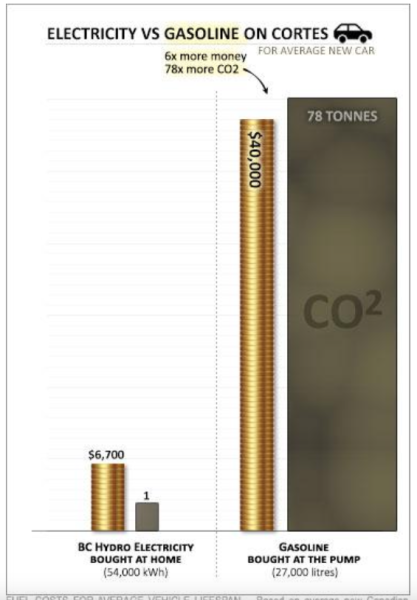
- The average Canadian ICE car burns $2250 worth of gasoline per year; if we compare fuel costs per same distance travelled, then running an EV on Cortes costs about “25 cents per litre”, or about six times cheaper than a gas car. (That calculation is based on charging at home, not roadside charging which can be more expensive).
- The electricity on Cortes Island is local and hydro based, not imported and fossil-based. BC Hydro offers good jobs to British Columbians.
- Emissions from a gas car (including fuel production as well as tailpipe emissions) are about 78 times higher than those of an EV. Emissions have measurable impacts on public health as well as climate.
- About 80 percent of the potential energy in gasoline is wasted, when the gasoline is burned to power a car. Even a coal plant is more efficient than an ICE car. Canada’s drivers collectively emit twice as much climate-damaging pollution each year than all the country’s coal-fuelled power stations.
- Most commercial EVs are about 90 percent efficient. That is, about 90 percent of the energy “pumped” into them is not wasted as heat, but is used to move the vehicle. Most use regenerative braking, so the vehicle when slowing down is generating a little electricity to feed back into the battery pack and extend its range.
- Currently the batteries in EVs are “retired” when their range declines, but are repurposed as stationary storage for electric generation facilities. When they are no longer useful in this capacity, they are recycled into component chemicals and elements. The resource recapture rate for these batteries is about 98 percent.
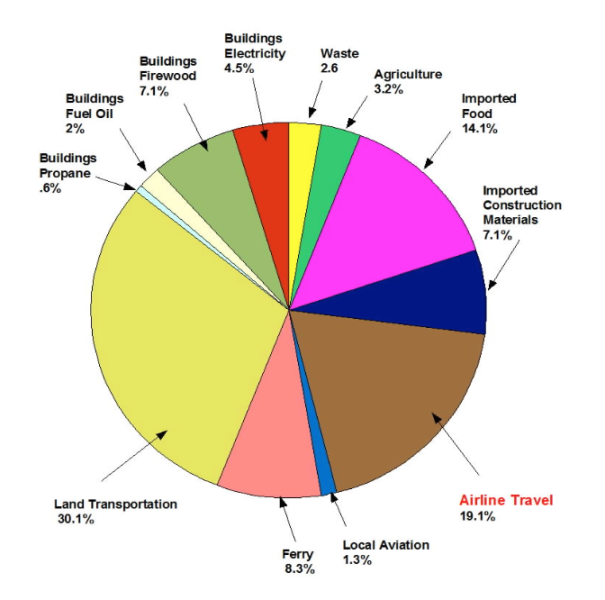
But EVs alone are not The Answer
Having heard this strong case for EVs as a more climate-friendly and less polluting transportation technology than gas cars, attendees raised several issues. Some acknowledged that the private automobile is a troubled technology regardless of its fuel source, and that in urban areas cycling and public transport are far “greener” than continuing to rely on the private passenger car.
Others raised questions about environmental costs of the underlying technology for EVs, such as lithium mining and the energy costs of battery production. What would be the impact of upgrading BC’s Hydro generating capacity to absorb the increased demand if a million drivers switch from ICE to EV?
Some of the answers were unexpected: for most users, their home EV charging has not added significantly to their Hydro bill. One attendee said her EV charging was taking less electricity than her standup freezer. The real challenge for BC’s power infrastructure is LNG plants, and for other provinces or countries the explosive growth of data centres poses a far greater demand than the transition to EVs.
For Cortes, though, with our limited Hydro service and increasing uptake of heat pumps, EVs, etc., attendees expressed concern for our carrying capacity in face of increasing demand. Mike Moore said that he charges his EV for free from solar panels in the summer; he sees local solar and wind power as essential to the island’s future:
It makes sense for me to produce my own [rooftop solar] power in the dry months of summer so we can leave more water in the watersheds and reservoirs, so we can let it out for the salmon in the Fall. And then when it’s winter and I can’t produce power, the rains are here and there is plenty of Hydro power. We need more place-based solar, place-based wind, and not as many mega hydro project that require huge transmission lines and huge damage to the environment. If we were to produce power locally, we could help stabilise the entire grid on this island.
Max Thaysen asked people to consider how many miles a year they really drive and how much difference to their carbon budget an EV would really make.
Rather than spend $20K on a used EV, maybe I would rather get a $5K used, fuel-efficient gas car and spend the other $15K on the kinds of systems change that we need, if we’re to survive the climate crisis. If you are a low mileage driver you’re not saving that much emissions, and maybe those funds could be put to better [environmental] use.
But EVs are a better technology, regardless of their other virtues
Having acknowledged that EVs are not a magic bullet that will solve the climate predicament, and that wider more structural changes are needed, attendees who now own and drive EVs remain pleased with them. This author, an EV owner (Chevy Bolt) and a forum attendee, said
I don’t see EVs as an environmental panacea; in many ways they are too little, too late, and the wrong focus for a lot of communities. In urban areas I would say that cycling and public transit should be a higher priority than just electrifying private cars. But in rural/remote places where it’s pretty arduous not to be car dependent, EVs are definitely a better choice than ICE. Still, honestly I don’t think how “green” they are is why they are going to win in the end. They’re going to win for the same reason that the calculator beat the slide rule: they are simply a better technology. I’ve driven mine for 7 years with nearly zero maintenance, and it outperforms a gas car. It has startling acceleration and good road-keeping ability, it’s fun to drive and it can haul quite a volume of cargo. It is reliable and clean and quiet. It does the car thing, and it does it properly, and is cheap to operate. So even if EVs were not environmentally better, people are still going to adopt them.
Other attendees who already own and drive an EV all agreed that they were pleased with their cars and found them very functional as well as economical to own. Not everyone found the “right” EV on the first try. Don Tennant was not happy with his attempt to purchase a Ford Lightning F150; he didn’t find the dealership helpful and there were minor issues with the truck. In the end he traded it in for a used Mercedes-Benz EQS which (because of the steep depreciation of new cars) was not much more expensive than the truck. He’s now so accustomed to driving an EV that a gas car feels strange.
Three times a year or so we drive my wife’s [gas] car, and it’s so damn noisy, it smells funky, and it doesn’t stop by itself [no regenerative braking].
Leona Jensen who recently bought a used 2024 Nissan Leaf, was very happy with her vehicle.
It’s a Nissan Leaf and it was a demo model so there was quite a discount for that. And there was a provincial rebate. The dealership was really nice. I love the one-pedal driving and the regeneration and it’s just really nice to drive.
Leaf owners Andy and Sue Ellingsen, who also bought a used model, were well satisfied with their choice. The Leaf’s limited range was mentioned as an issue, and it seems that most Leaf owners on the island consider it a “second” car for more local driving.
Mike Moore was very pleased with his Chevy EUV (a larger version of the Bolt with AWD). He certainly doesn’t feel restricted to local driving.
This year in May and June we did a trip to the Yukon, it was 7186 km and it cost us $176 for fuel; and $70 of that was at one of those expensive high speed chargers in Vancouver. We left with a full battery, free from our rooftop solar. And Northern BC has a lot of free chargers, in the Yukon they are all free! We never even had to wait in line. And you’ve got your regenerative braking; like [in a gas car] every time you go up Mt Washington and then come down again you smell those burning brakes, but in the EV you’re just turning that gravity into more electricity. Once you’ve experienced refuelling from going downhill, it’s really hard to go back to burning something just to slow down.
Maureen WiIliams was also pleased with her Chevy Equinox, which is the largest of the Chevy EV line.
We needed ground clearance and we needed all wheel drive. So we got the Chevy Equinox which is an SUV basically, the biggest car I’ve ever driven, but it’s the same size as the RAV4 or Honda CV. It’s been way better than I thought, actually fun to drive — it feels like it really holds the road and I have better control of the car. The biggest downside to me is the touch screen. I spend too much time looking at it trying to get my finger right where it needs to be, whereas if it was a real dial or switch then I could feel it without having to look, and that would feel safer.
Several attendees expressed skepticism about “all the high tech stuff” and wished that there were more basic, affordable EVs with manual window mechanisms and simple buttons and dials instead of complex touch screens and voice controls. There was strong agreement that the world needs an electric quarter-ton pickup, and mention was made of the forthcoming Slate modular EV which will be offered in both pickup and sedan versions.
Almost all the EVs being discussed were automobiles, but Michael Taylor was fairly pleased with his electric motorcycle.
At the price point it was a good choice for me. It’s about like a 125-250cc dirt bike. Mostly it draws about 1500 watts, but for about 30 seconds you can get almost 13kw out of it. So you can climb our hills pretty easily. And I can’t complain about acceleration or cornering. It behaves like a real motorcycle. For about 50 cents in electricity I can circle the whole island twice. Or it takes about 15 percent of full charge to go from Whaletown to Mansons. So that works for me. No ferry lineups. And it does have regenerative braking.
Concern over new BC Ferries EV policy
Attendees were not so happy about a recently announced BC Ferries policy affecting EVs. Although there have been no incidents of EV battery fires aboard BC Ferries, nevertheless the company has made the controversial move to ban the transport of damaged or disabled EVs. Tow companies can no longer use BC Ferries to take a disabled EV to a dealership for repair. BC Ferries today will not carry any EV that can’t drive on and off under its own power.
EV-owning residents of a two-ferry island such as Cortes were of course alarmed by this development, as alternative transportation (by barge) can be extremely expensive. Attendees asked what would happen if the car was disabled for a reason that had nothing to do with the traction battery or if there was no collision damage. There was general agreement that BC Ferries will need to figure this out, as the uptake of EVs continues and they become a larger percentage of all road traffic.
One attendee asked if BC Ferries was unaware of the recent successful demo in Sweden of a quick and effective technology for extinguishing lithium battery fires by injecting water directly into the pack. Since Sweden’s new vehicle registrations in 2025 were over 60 percent EV, it would hardly be practical for their ferry system to discriminate against the new technology.
To contact BC Ferries about their electric vehicle policy, EV owners can call their customer service at 1-888-BC FERRY (1-888-223-3779) or visit their website for more information.
Price: the main stumbling block
The biggest barrier to EV adoption is the price tag. That was a pretty strong consensus among the owners present, as well as those who were thinking about making the switch from gas to electric. No one who had bought a used EV seemed to regret it, so that was one way to reduce the price tag. Depreciation of new EVs may even be a little steeper than for gas cars.
Expanding on the theme of affordability, Max Thaysen pointed out that protectionism and US-friendly tariff structures prevent many low-cost, smaller Chinese EVs from reaching the Canadian market. Attendees speculated on possible closer trade relations in future between Canada and China, and whether this might lead to the arrival of affordable Chinese EVs in Canada.
The high price of car ownership in general also came up for discussion, with several attendees arguing persuasively for car-sharing as a more environmentally responsible and inclusive model whether for ICE or EV.
Several attendees noted that Canadian road and highway regulations prohibit the use of low-power, affordable, low-speed “neighbourhood” mini-EVs. These are vehicles similar in size to golf carts, recognised under US and Canadian law as a regulated class. A couple of attendees suggested that Cortes Island’s posted speed limit should be lowered to 50kph to as to make these low-speed, short range mini EVs legal for use on the island. This change might not be so popular with those who listed the fun of driving their unexpectedly sporty and fast EVs as a side benefit of going electric — but it would certainly make EV ownership possible for far more islanders.
Although the intent of the organisers was to offer information to the general public, more than half of the attendees turned out to be already owners of EVs. Cold and rainy weather discouraged any extended “show and tell” session in the parking lot such as attendees enjoyed in 2019, but the EV owners enjoyed comparing notes and the “questioning” attendees who are thinking about switching to electric got answers to many of their questions.
Links of Interest:
- Articles about, or mentioning, EVs on Cortes Island
- Articles about, or mentioning, BC’s EV Infrastructure
- Articles about, or mentioning, the Cortes Climate Action Network
[Inline images credited in captions; feature image generated by Midjourney, prompt by the author]