
Humanity’s attempted dominance over nature is becoming a
problem—attempted because we think that we are in control whereas, in
fact, we are disturbing natural ecologies to such an extent that we
are creating biological and biophysical systems that will be hostile
to our survival as a civilization and as a species.
This illusion of control and its consequences have been the concern of
Daniel Lim, the principal of a consulting firm that specializes in the
“advance of social justice through nature-based whole systems change.”
Lim is not worried so much about biological systems as sociological
ones, and how some cultures rise to such power that they dominate and
obliterate smaller ones. History is replete with examples of these
“supremacy cultures” and the social injustices that they create as a
result of exercising their power and influence. But what is the
alternative?
As a model, writes Lim in Qualities of Regenerative and Liberatory
Culture, “I immediately turned to nature. There is no need for humans
to invent an alternative culture blindly when we can just turn our
eyes and ears to the living world around us. Nature provides the
blueprint for a culture that is liberatory and healing. The domain of
life is a place where no supremacy culture exists, because life
operates by a completely different set of motivations.”
Lim goes on to explain that, “All living things are inherently
sovereign. Bee colonies and mycelial networks are the inventors of
democracy, not the Ancient Greeks. Forest ecosystems are made up of
cooperative relationships among living things that regularly engage in
mutual aid and generative conflict. Organisms are infinitely
experimental and creative in their pursuit of survival. Living
systems, in short, are life-affirming and regenerative—everything that
a supremacy culture is not.”
Lim’s objective is to create societies that are more egalitarian,
creative, dynamic, inclusive, fair and just, so he has turned to
nature as a model for what he calls a “regenerative culture”. But it
is his notion of nature as a democracy that is particularly
fascinating, and becomes increasingly so, the more we think about it.
Nature has no supremacy culture. Everything is enclosed in a
self-regulating system in which each part is dependent on every other
part. The rise of any species to power soon discovers that its
influence is curtailed by the exhaustion of the parts on which it
depends. Should an empty space develop in the ecosystem, the
creativity of nature fills in the blank with a new and useful species
or an appropriate variant of an old one. This allows organisms to be
“infinitely experimental and creative in their pursuit of survival”, a
dynamic process that allows species to be continually moving toward
the development of their full potential—a trait that would also be
ideal for both the individual and for the collective in a social
system.
Or consider Lim’s mention of “generative conflict”. Nature is not
simply a network of sharing and cooperating. Survival of the species
and the health of the entire system is dependent on a competitive
component. This is the other part of nature’s dynamic. But this
competition is constructive rather than destructive. The success of
each species raises the sophistication, the intricacy, and the
viability of the entire system. Winning is a win for all components.
And the longer the ecosystem lasts and the further it evolves, the
more finely tuned, complicated and resilient it becomes.
All the components in an ecosystem, in Lim’s words “are inherently
sovereign”. That is, they are each equally fundamental and important
to the functioning of the whole system—each imbued with status,
dignity and integrity. Here is nature resolving a classical
philosophical and sociological paradox. As sovereign entities, each
part is equally key to the functioning of the entire ecosystem, but
each is also completely disposable because of the resilience of the
system. The ecosystem is dependent on all parts, but should any of
them cease to exist, then the vitality and the creativity of the
system reconfigures around this absence.
The democracy of nature is yet another reason why we should protect,
study and learn from its dynamics. It has much to teach us, if we
could get beyond our anthropocentric obsession. Indeed, nature is an
old sage that has been refining its wisdom for at least 3.5 billion
years. If we were just open enough to receive what it is offering, we
would benefit immensely.
Ray Grigg for Sierra Quadra
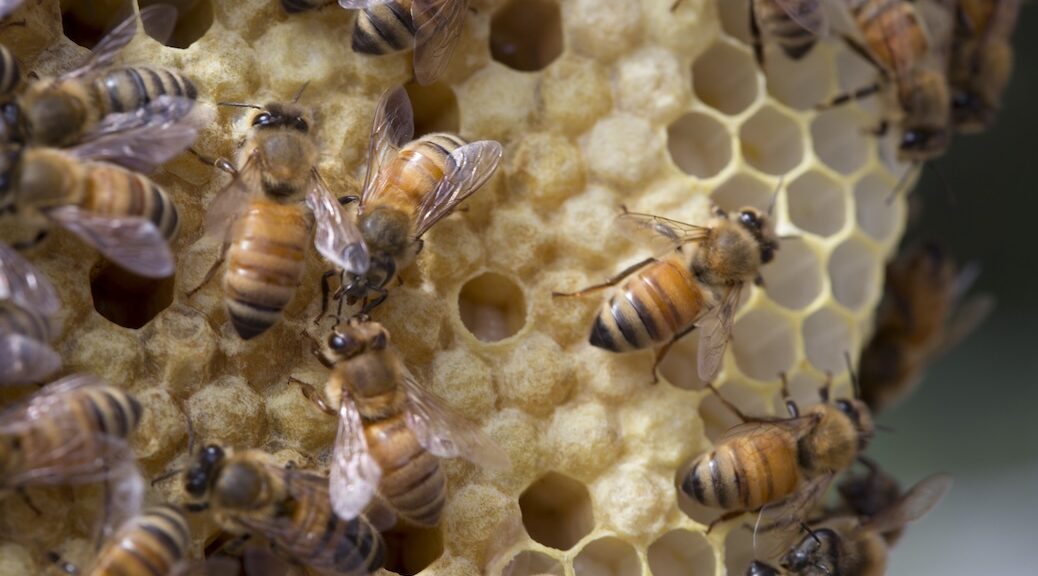
Top image credit: Bees practised democracy for over 100 million years – Photo by gr8what via Flickr (CC BY-SA 2.0)