
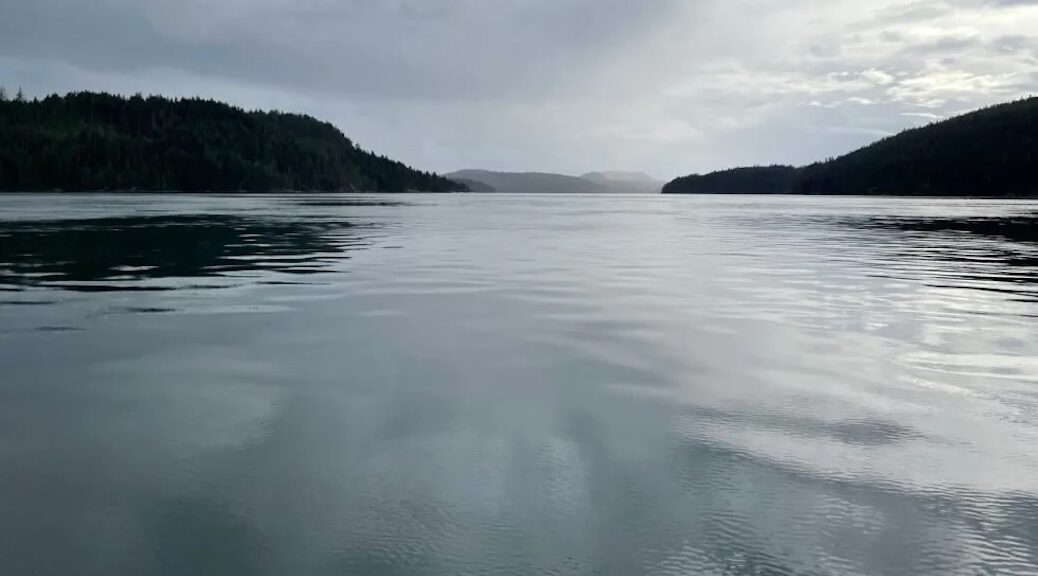
(Interview by Manda Aufochs Gillespie; written version by Roy L Hales)

In the conclusion of a two part story, Manda Aufochs Gillespie interviewed Renate Harvey and Renée Desautel from Sonora Island, as well as Sheila Hollanders from Read Island, about life on their islands. In Part 1 they talked about their daily lives, the seasons and community life. This segment deals with community support and future sustainability— the Surge Narrows Community Association and funding, land access/emergency preparedness, relationships with Homalco First Nation, youth and schooling challenges, and hopes for the next decade.
(Renate’s kids about to come back home to Owen Bay after another day at the Surge Narrows School – Renate Harvey photo)
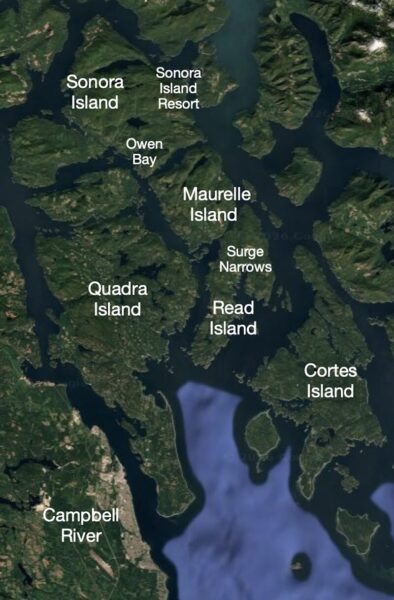
Surge Narrows Community Association
Manda: You’ve mentioned a little bit about some of the organizations that help support community life. Can you talk about those organizations—what they are, what your relationship is like with the Strathcona Regional District, and whether it’s been supportive, etc.?
Sheila: “The main organization is called the Surge Narrows Community Association (SNCA), and I believe it was formed in the 1970s. Back then it was more about helping open the school and keep the school going. In recent years, it’s shifted toward maintaining the community buildings.
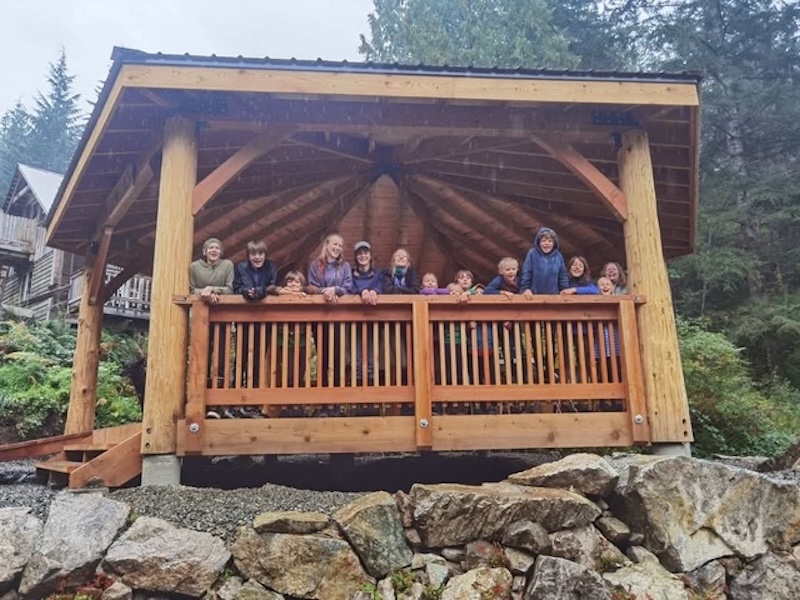
“They own the buildings I mentioned before: the Quonset Hut, the Zone, the gymnasium, and the Bunkhouse. Even though they’re on school board property, the community association owns them.
“We did, at one point, have a Read Island Access Society—but it just became too much to maintain two organizations. There aren’t that many people out here involved, and we all end up sitting on all the different boards. It became too much. Also, times changed with SNCA. The board members were more willing to take on the different access issues the Access Society was dealing with—like docks, roads, and working with the SRD. So the Access Society became redundant, and SNCA took on everything.
“I was on the board for many years, and Renee and Renate have served on it as well.
“I would say they have a pretty good relationship with the SRD. They often act as a liaison between the regional district and the community—but maybe Renee could speak more to that, since she was on the board more recently than me.”
Funding / Staff / How It Works
Manda: Renee, do you have staff? How do things get funded, etc.?
Renee: “I was the treasurer of the Surge Narrows Community Association for four years, and I just stepped down at the last AGM.
“As far as funding goes, there’s a wonderful group of people on Read Island who are really good at applying for funding from other foundations. One of the large grants they received was from the Vancouver Foundation—the Resiliency Grant. They also do get a bit of funding from the SRD, which has been helpful. They ask SNCA to review properties like the John Kim Ecological Sanctuary and the Hoskins Channel Dock, things like that.
“There are no employees—everyone’s on a contract basis. For example, Sheila is the Bunkhouse coordinator. We also pay a gentleman right now as the maintenance coordinator. He makes sure the Bunkhouse is okay and the Quonset Hut is okay. There are a few odd jobs that come up, and it’s all contracted out.
“There’s a large number of members, and they all pay yearly membership dues.
“There’s also a wonderful lady—Sally—who is actually stepping down. Her replacement works with the Vancouver Island Health Authority. They provide money to support a couple of young women who go to visit seniors and people who need assistance in the community. They help them with food sometimes, or bring in their firewood, or whatever they need.”

The Need for Community Land in Owen Bay
Manda: Does it basically fall under SNCA?
Renee: “We do fall under SNCA. However, I and a few members of the community have applied for—and have been given—our designation as a nonprofit society. We are the Owen Bay Community Association. As time allows, because there are steps you have to go through, we’re going to become a charitable organization.
“There are some elderly people with property here who don’t know what to do with it—and maybe they live out of the country, and their children that live out of the country don’t want it. They can donate it to our organization, and then it can stay the way it is—forested or whatever. It won’t be sold for development. It won’t be taken over by a group or turned into a regional park.
“We’re also looking at applying for funding to do a little bit of infrastructure—like a freight shed or other things that we need.”
Renate: “What’s really problematic about our Owen Bay area is that we don’t have any community land. That’s the biggest issue we have. If we had that, then we could build something or apply for a grant to start building something.
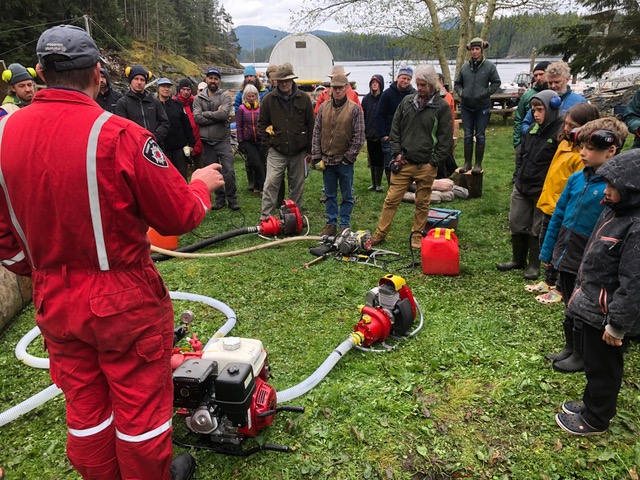
Fire practice in Owen Bay after fire went through community – courtesy Renate Harvey
“We’re starting to talk more about emergency preparedness—getting more first aid equipment out here and fire pumps. The summertime is getting drier, as everyone knows, so we need more fire equipment because we’re not part of any fire-fighting community.
“The BC Wildfire Service will come sometimes, depending on how high of a priority we are. We had a big fire here five years ago, and it gave us a big push to get more gear and equipment and training. We’ve been trying to see if we could get some of that funded by the SRD, but there’s just nowhere to store it at the moment.”
Community Spaces and Land Access
Manda: It’s something that we struggle with even on Cortes, which has been working for many, many years around creating our community centres, etc. When I think about Sonora, it feels like there’s so much land there. Is all of that privately owned? Is some of it Crown land? Do you know anything about the process of being able to access that for community use?
Renee: “A lot of the island in Owen Bay is private lots. There’s also a lot of the island that’s provincially owned—tree farm license-type land.
“Access is a big issue. We have a road from the government dock that goes about a kilometre—roughly. That’s basically it. There’s no other access. Everything is either waterfront—you have your own dock—or you’re off Sonora Road. The lots there are all privately owned. There’s one lot owned by the provincial government because someone didn’t pay their taxes, but it’s basically a cliff.
“We do know a few people who are aging out and have no children. If we can make our society charitable, we’d be in a position to accept ownership of the lands, and then we could do community buildings or something.”
Manda: I think it’s something that maybe people in cities take for granted. All these things were done so long ago that it’s not something they necessarily have to think about now. I think it’s what binds people in rural and remote communities—this constant awareness and effort and work to maintain community spaces—even though we’re known for having such welcoming, rich communities and community spirit.
Relationship with Homalco First Nation
Manda: Speaking of community spirit and land—what is your community’s relationship with Indigenous peoples? I’ve heard that Homalco has been working on things on Read Island, and I’m curious whether any of that is coming to fruition.
Sheila: “Our community has a good relationship with Homalco. They recently joined Partners on Title, I believe. Actually, Renée might know a bit more about that, but overall there’s a really good relationship. They’ve come several times to visit.
“As well, our school’s teacher has a really good relationship with some of the educators from the Ayajuthem language camp. We actually hosted a language camp at Surge Narrows, using the Bunkhouse, and it also served as a bit of a base camp for them. There may be some more exciting things in the mix, but we’re not ready to announce anything big right now.”
Renée: “I think Sheila’s right—there are things in the works, but nothing has been signed off.”
“The only other thing I know is that here in Owen Bay, on the north side of the bay, the Homalco Corporation purchased a large piece of land and subdivided it three years ago. Nothing’s been done with it. We haven’t heard anything, so we’re not sure what’s happening.”
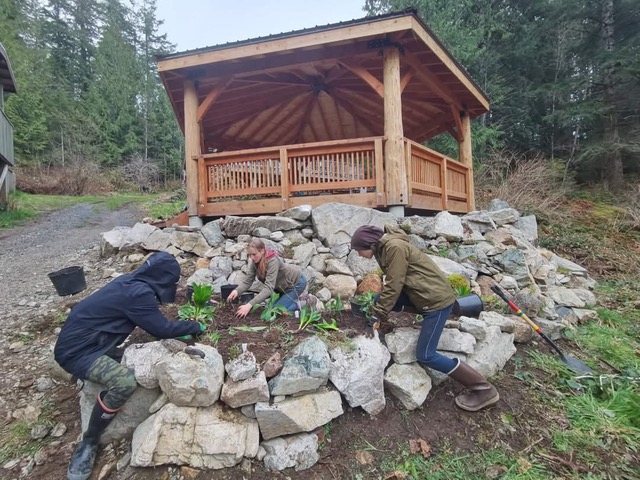
Planting a rockgarden at the zone and school -courtesy Renate Harvey
Schools & Youth
Manda: One of the things I’m really fascinated by is what it’s like for young people growing up in these outer communities. As someone who raised my children here on Cortes—and who was one of the founders behind the Cortes Island Academy—I’ve been struck by how amazing it is to raise kids in these intact island communities.
But I’ve also been struck by the challenges that are there. Most people take for granted that you can just jump on public transit and get a kid to school, and you can live at home while you do that. Those aren’t everyday experiences for people who live in remote communities.
Renate: “One of our kids just turned 18, and another is 16. They’ve attended the Acedemy for the most years—this is year number four for him. It’s been great for them. We were never sure what we were going to do. We weren’t sure if we’d end up going to Campbell River and renting a house there, like some people do.
“Also, there doesn’t seem to be as much home-stay availability anymore—families don’t seem to have space for kids to stay with them. I’ve been trying to work out something for Dylan in high school for next year, but I’m not really getting anywhere. So Dylan is going to attend the Cortes Island Academy again.”
“They’re also doing a lot of online schooling, and that has worked well with Partners in Education (PIE) in Powell River. So it’s been a combination of different things. Like everything else out here, you have to be flexible and creative about how you make it work.
“Maybe there was another option, too. I’m from Holland originally, so they also have their Dutch passports. I was playing with the idea of going to Europe for a year and having them do high school there.”
Manda: Sheila, I’m really curious about your story. Since you grew up on Read Island, managed to get a university degree, and then found someone who wanted to come back with you—can you talk a little about how things have gotten easier or more difficult, and what you’re seeing with your own children?
Sheila: “The question of what to do after Surge school is becoming more important now, because my daughter is 13 and going into grade eight. She’s starting to get interested in some different teachers and different experiences.

“It’s tricky, because the Cortes Academy doesn’t start until grade 10.
“She’ll definitely do at least one more year at Surge School, and then we’re thinking about our options. Online learning seems interesting, but it’s also important for them to have social interaction.”
Availability of “Bigger” Schooling Options
Manda: *One of the things we’ve seen on Cortes—especially for kids who either don’t go to the academy, or who want to get a little taste of Carihi High or something a bit bigger—is that those self-organized options have pretty much dried up. In the past, parents were sometimes able to afford buying a place or renting a place there. Now it’s much harder.”
“I’m wondering, Sheila—does that feel different now than it did when you were younger? It sounds like the whole world is getting more expensive, and that makes all of these things harder. It sounds like that’s why many of you chose to be where you are. How are you seeing that play into the possibilities for youth?
Sheila: “When I was going to high school, it was very common for young kids to go live in a boarding house. Back then, maybe the boarding allowance was sufficient, but I don’t think the amount has gone up at all in the last 25 years.
“It was just very normal. On Sunday night, we all went back to Campbell River on the ferry. We were a bit of a crew—both the Cortes kids and the Outer-Island kids. Then we all went home on Friday afternoon.”
Young People Coming Back & Buying Property
Manda: Increasingly, we find it’s hard for our kids to get back to the island. It’s also hard to find work that allows them to afford houses and property, etc.
Sheila: “In terms of coming back, I was lucky. My parents had a big property and welcomed us to come and live there. Not everybody’s that lucky. There are a handful of people who squat—who stay on property that isn’t theirs—which is unsettling and not guaranteed.
“On Read, it’s tricky because we have a 10-acre minimum zoning. That’s a lot of property, and it does help maintain the rural atmosphere—plus people need larger lots to keep their privacy. At the same time, there isn’t a lot of opportunity to create more lots for younger people to come back, or to attract more young families to our community. We’d really like some more young families here.”
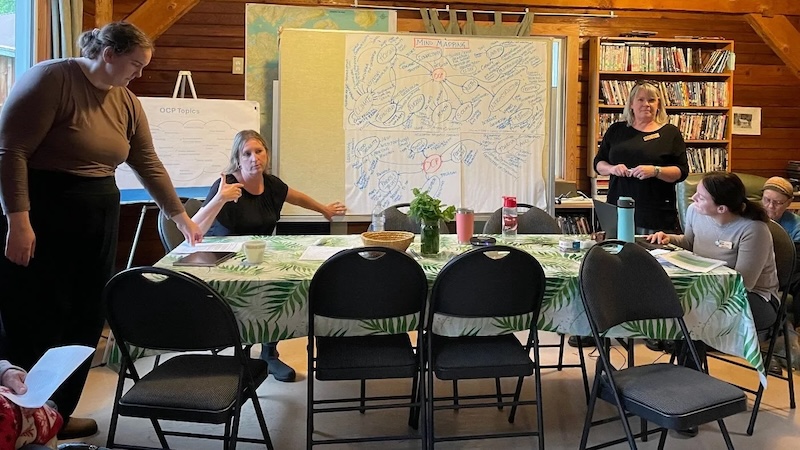
Renate: “Surge Narrows and Quadra have the same OCP, but we’re separate. Some younger people on Sonora want smaller property sizes. The older generation may not want that as much, because they like it the way it is.
“Smaller property sizes would make things more affordable, so people wouldn’t have to share—because that doesn’t always work. Sometimes it does, but most of the time it doesn’t. It’s a contentious issue right now.
“We all attend the Surge Narrows meetings at the Bunkhouse—a bunch of us from Owen Bay.
“We also just had the Regional Director, Robyn Mawhinney, and the two planning staff come out and do a tour of Owen Bay itself. It’s so different from Read Island. We have about 50 full-time people living here now, while Read Island probably has about 75. There’s a big difference in how the community is spaced out. On Read Island, everyone is spread out across the whole island. On Sonora Island, it’s mostly concentrated in Owen Bay. We don’t have to drive to our neighbours—everything is within walking distance. To walk to your neighbours on Read Island, sometimes you have to walk for hours.”
Future Hopes for the Next 10 Years
Manda: As a final thing—what do you hope the community will look like in 10 years?
Renate: “I think our community is pretty good as it is—there’s a mixture of older folks and younger ones.”
“I really hope our kids can buy property here if they want to. One thing that’s really hard is that being out on the Outer Islands requires a big down payment. We’re off-grid and we don’t have fire protection or insurance, so it’s a lot of money for people to put down.”
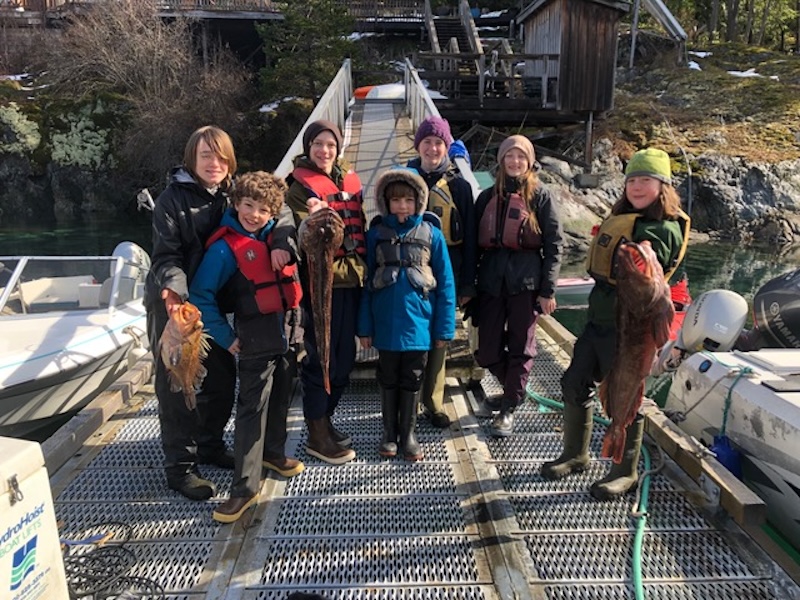
“I also hope there will be a bit more activity around these areas—around Sonora and also Read Island—to help keep the school open. This is an amazing place for kids to grow up. They can go out in their own boats, they can go fishing, and they have so much responsibility from a young age—and it seems like they thrive with it. There are lots of chores to be done: cutting firewood, for example.”
“The biggest plus in growing up here is that everybody’s invested in the kids. When my daughter goes to school on Read Island—if a big storm came up—there are lots of people she can stay with. They invite her often to stay over and play cards. They’re her friends, but they’re also around 70 years old. We’ve got a big extended family out here, and they’re not blood-related—just community-related.”
Renee: “I also find our communities are very, very safe. Because we’re isolated, you can spot a stranger a mile away. Everybody knows everybody. You can keep your doors unlocked unless it’s bear season. Then you don’t want the bears coming in. But generally, things like that—everybody knows everybody’s dogs. If a dog gets loose, people notice right away.
“If you heard someone yelling for help, everybody would come running. It’s great that way.”
“I’d like to see a little more infrastructure, and that’s why we’re working with the nonprofit charitable organization. If we could have a community building to store fire protection and first aid equipment—it would be wonderful.”
“Everyone is so great about hosting events at their own homes. But it would be nice if we had something like the Bunkhouse on Read, where on Sonora we could share the hosting duties instead of everyone having to invite people into their homes all the time.”
“But overall—everything is good, and I think we’ve got a wonderful supportive, safe community. I think it’s a great place.”
Sheila: “I’d also like to see some more young people out here—hopefully a bit of an increase in density on Read Island. And some more young families—to add some kids to the school, and also to balance out the ages in our community, because we do have a lot of older, retired folks.
“And I’d also like to see some different job opportunities, and maybe a little bit of tourism—though that’s got to be balanced and appropriate for the style of our community, and for the ecosystem and nature around us. We don’t want tourism to have a big impact on that.
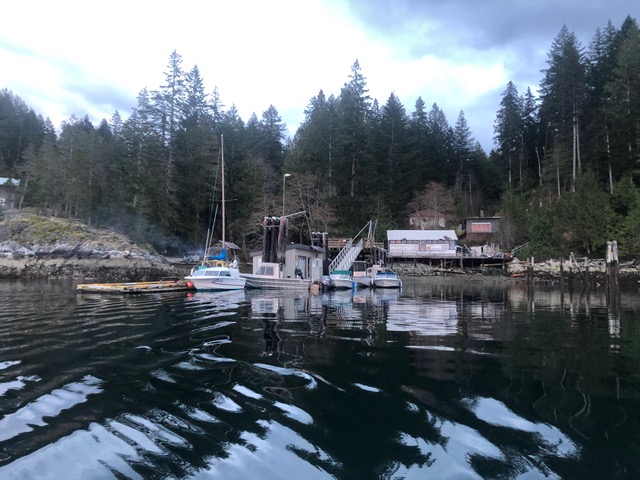
“So, yeah—some more jobs, some more people. And one project we didn’t mention was down at Surge Narrows. The Strathcona Regional District brought in a new dock to replace the old Surge Narrows dock. There’s another bigger project called the Surge Narrows Marine Revitalization Project where the old store is located. They’re actually planning to build a new community building—which may include some kind of store, and the post office will be located there as well.
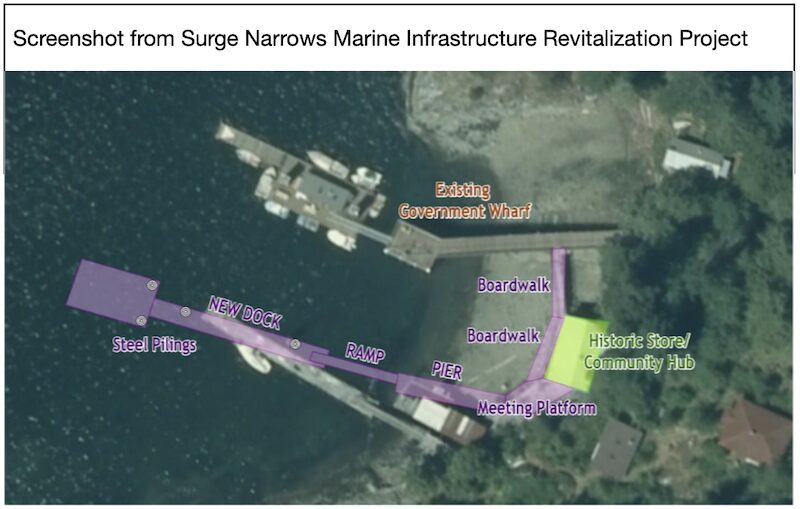
“They’re also going to build another big dock there, and that will be where the float plane comes in. That will give more space on the dock too.
“So I’m hoping that the project might add a couple jobs, and that the new community building will be a place—not just to gather, but to give a space for local people to sell their art, and hopefully some garden produce and crafts. We have quite a lot of history out here—not just settler history, but also Indigenous history and natural history. We have a lot of different ecosystems here, and a lot of different science and mapping projects going on as well.
“So it would be really nice to be able to showcase all of that, and to help facilitate education for visitors when they come. And, yeah, I think that kind of summarizes my feelings on that.”
Where to Learn More
Manda: You guys have been wonderful storytellers and great neighbors—introducing your communities. If people wanted to go online and just sort of learn more, or get a sense of an appropriate way to be a tourist, is there a place you’d recommend them to go?
Sheila: “Yeah, we don’t really have much of an online presence. A lot of people out here really value their privacy, so I would say there’s not really somewhere public for people to turn to. Renee and Renate might have a different opinion, but I’ll leave it at that.”
Renate: “There’s a SNCA website, which has a little bit, also some links on what’s going on the islands. There’s also a calendar with events happening.
“And there’s the DIEM Project—dmproject.org. Like some great community members are volunteering on it, and it’s been going on for quite a long time. It’s a mapping system for the Discovery Islands, including Cortes. If anybody hasn’t heard of that yet, it’s a lot about Read Island, but there are also other islands in there as well. It has great maps with a lot of information.”
Renee: “There’s also a storytelling project happening that’s been funded through the Surge Narrows Community Association. It’s called Storytelling. There have been volunteers in the community who went and talked to elderly people around the community, and they got their stories. They digitized them, and they’re working with the Campbell River Museum to eventually produce a book of the stories.”
“We have one lady—her name is Zephyr—and she’s the head coordinator. She’s working with someone at the museum, I believe, to give direction to the project and, for right now, a place to store the stories they’ve acquired from the elderly people in the area.”
Wrap-up
Manda: Wonderful. Thank you all so much. This has been a really lovely, fun day for me, and I can’t wait to take Renate up on the offer and come out and spend a weekend—and see everybody in real time.
Renate: “That would be great. You can come out to one of our events. Thank you so much for having us on the radio and hearing our perspective. There are so many people on Quadra and Cortes who don’t know about the Outer Discovery Islands, so this is a good opportunity to give us an introduction.”
Manda: We should at least know each other, right?
Renate: “There’s a lot to learn about each other—and from each other.”
Manda: Thank you so much. I can’t thank you enough, and I’m so looking forward to next time, all being on the radio together.