
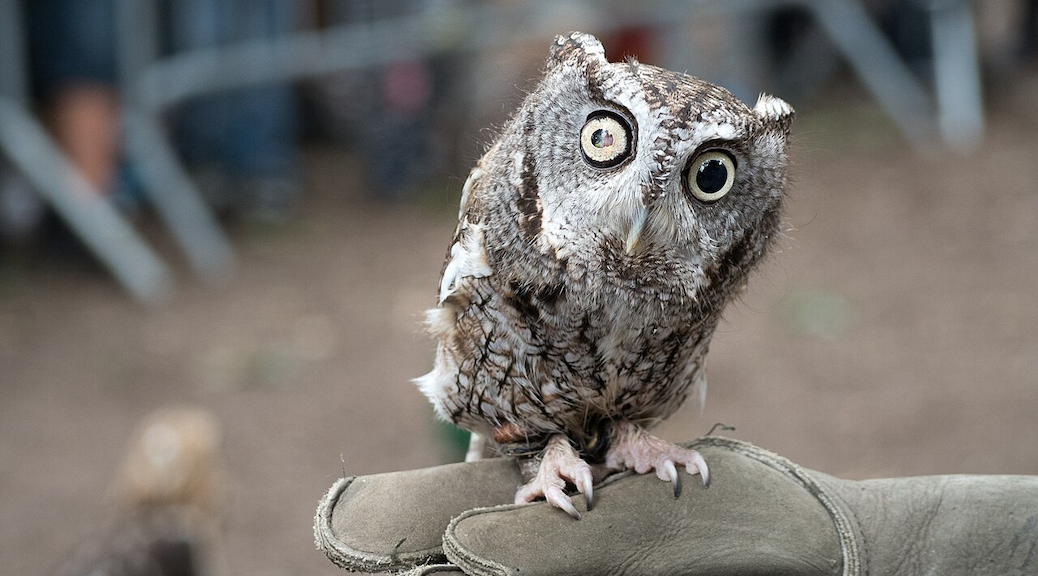
As Carl Safina’s book title suggests, Alfie & Me: What Owls Know, What Humans Believe should ostensibly be about the adventures of the author and his wife as they raise to adulthood a nearly-dead baby Eastern Screech Owl that they found on the ground. So it joined their larger family of non-humans, including two dogs, four chickens, a king snake, a parrot and a parakeet.
Alfie, a female, was eventually released to the back yard where she learned to hunt and live independently. But she remained a family member, visiting for extra mice, even establishing with her mate, Plus-One, a nest in a box on the side of the house where the pair successfully raised three chicks. Throughout the book, Safina closely documents the life of the owl and her family.
This close connection to a wild bird invited Safina to explore the root of the differences between its sense of reality and our human interpretation of it. Alfie, we can assume, is an integral part of nature and intricately connected to the web of relationships that make ecologies function with astounding complexities. Unlike humans, however, Alfie’s being is uncomplicated by mythologies, religions, philosophies, metaphors and the panoply of abstractions that have separated and distanced us from nature. These, in large measure, are responsible for the environmental mess in which we presently find ourselves, and are the root causes that Safina explores with remarkable insight in Alfie & Me.
Safina attributes the major problem to Plato, the Greek philosopher who is the one mainly responsible for creating the dualism that divided the mind from the body, inventing the notion—expressed in simplistic terms—that the world we experience is a shadow of an absolute reality of ideas and perfection that is not the natural world. This understanding is then adopted, amplified and popularized by the three Abrahamic religions in Western culture: Judaism, Christianity and Islam.
In Safina’s words, “Plato’s idealized abstractions valued the mind above matter, made disembodiment divine, and injected an estranged revulsion about flesh and physical existence. Abrahamic scribes incorporated Plato’s duelling duality [into theology], making the dissociation between body and soul—between human and the world—matters of faith. In this desiccated ground, Westerners nursed the seeds of their dogmas. Modernity’s faithful philosopher, Descartes, wiped spirit away from all creatures and body away from all mind, offering a world devalued for the secular as well as the sanctified.” Given this philosophical and theological foundation, we need not wonder why we treat the natural world so badly.
But Greek philosophy also had its empirical side, represented by Aristotle. A famous painting by the Renaissance painter, Raphael, The School of Athens, depicts Plato pointing up to the realm of heaven while Aristotle is pointing out to the realm of the world, a duality between belief and evidence that has been struggling to resolve itself for more than two millennia.
Although the Greeks knew the Earth was round—they had even calculated its diameter—knew it rotated around the Sun, and were impressive logicians, mathematicians and philosophers, their conclusions from objective observations were sometimes flawed. Aristotle, considered to be the definitive scientific authority for more than 1,500 years, concluded that birds did not migrate but merely changed plumage from season to season. Other conclusions were reached based on fanciful explanations totally unrelated to reality. Safina cites a 1555 woodblock print depicting “fishermen raising a net full of hibernating swallows from a lake,” an idea that had persisted for centuries. And, since many birds often migrate at night, the common assumption was that they went to the Moon. The Scientific Revolution of the 17th century had difficulty dislodging many of these old beliefs, and modern science still does.
Common sense may be common, but it is often not very sensible. History is replete with many examples of its nonsense, everything from witch burnings and slavery to racism and female oppression. Our treatment of nature as an object that is separate from us falls into this category. We, unfortunately, are learning belatedly that we are it and it is us. The extent to which we abuse nature is the extent to which we will abuse ourselves. As the landslide of history carries us from the past to the future, we need to understand how we got to where we are because it will give us a sense for what is coming and how we might avoid what we do not want. And owls, like all natural creatures, have something to teach us.
Ray Grigg for Sierra Quadra
Top image credit: A rehabilitated eastern screech owl, not Alfie – photo by Rhododendrites via Flickr (CC BY-SA 4.0)