


In yesterday’s broadcast, Jennifer Lash, a former senior advisor from Environment and Climate Change Canada, explained that the Prime Minister had to make an MOU with Alberta in order to bring that province on board to initiate further climate initiatives. The potential cost was building a pipeline across BC, but she believes the opposition in BC is too strong for this to become a reality. She also talked about other past and present Liberal environmental policies. Max Thaysen, a leader of the Cortes Island Climate Action Network and regional representative for North Island on the BC NDP’s Standing Committee on Economy and Environment, responds in this morning’s interview.
Max Thaysen: “It seemed like Lash was mostly discussing the success of the Liberal government in reducing emissions, and later she talked about the memorandum of understanding. First, I just want to question her framing of the situation. It feels like Canada strategically picked a starting point, a baseline target of 2005, because if you compare our progress to that date as opposed to the date that most of the world views, 1990, then it looks like you’re making more progress than you actually are. While Canada’s emissions are above 1990 levels, the EU’s are below that benchmark.”
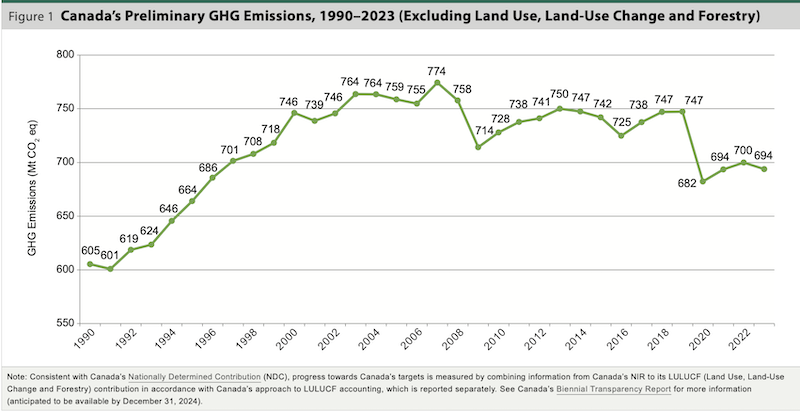
(Graph from Environment and Climate Change Canada)
Cortes Currents: Canada’s emissions were 605 megatonnes (million tons) in 1990 and 694 megatonnes in 2023, which is about a 14.7% increase.
Max Thaysen: We’re in a better position right now relative to a few years ago, but that is not because of government policy. That is because of a pandemic.
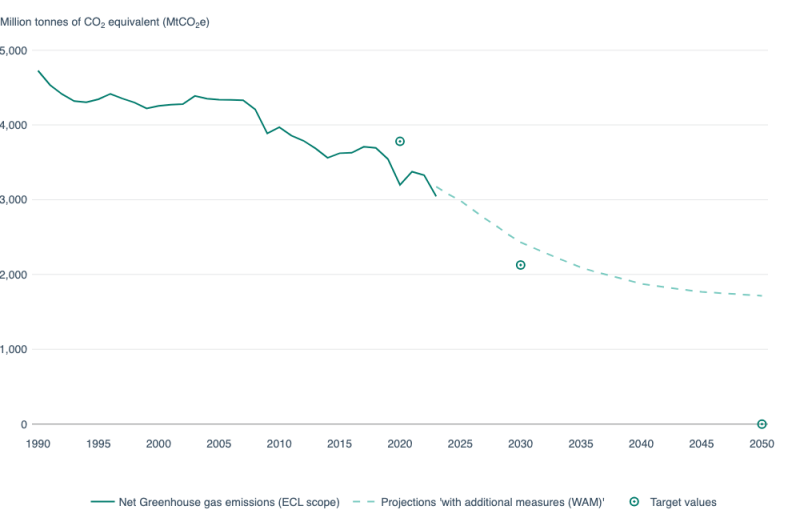
(Graph from European Environmental Agency)
Cortes Currents: While Canada’s emissions are above 1990 levels, the EUs are below that benchmark. According to the European Environmental Agency, in 2023 the EU’s emissions were 37% below 1990 levels. They intend to be 55% below by 2030.
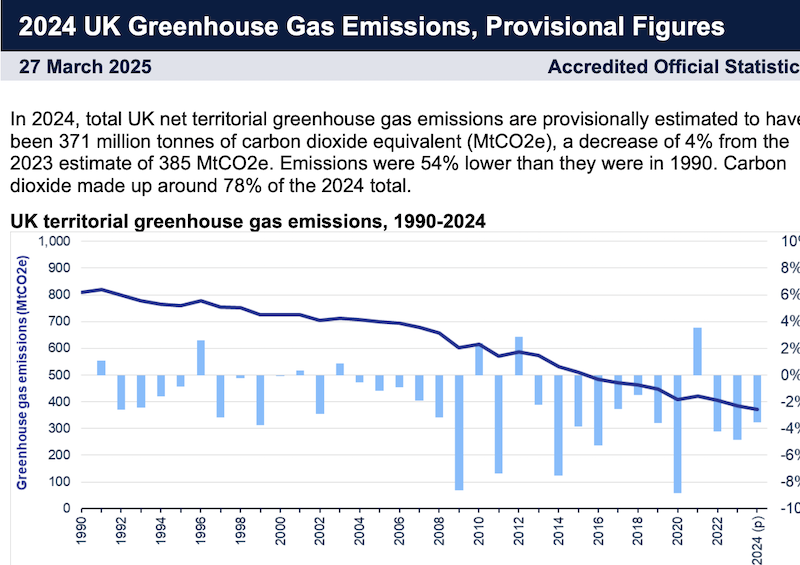
Max Thaysen: “Europe is doing much better. I have UK in front of me here and they’re at 53% below 1990 levels and they just set their target for 2035 to be 81% below 1990 levels. They recently decided to leave a bunch of fossil fuels in the ground.”
“It’s embarrassing for anyone who has previously worked for the Canadian government to say that we’ve done well because we’re so far behind, and I did not hear her acknowledge that.”
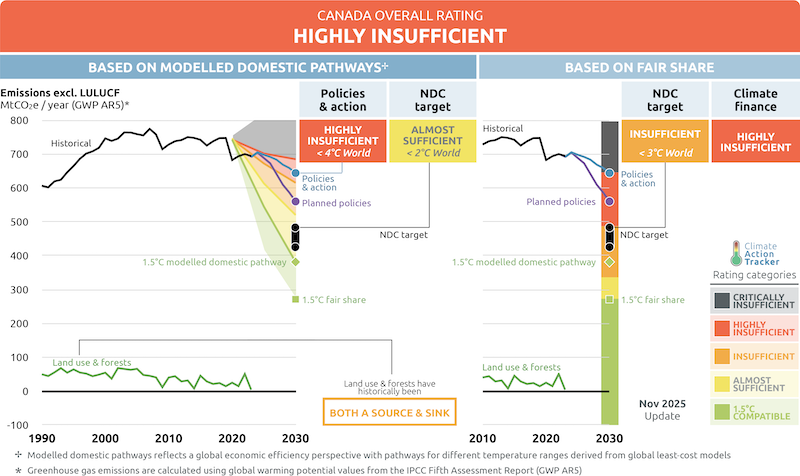
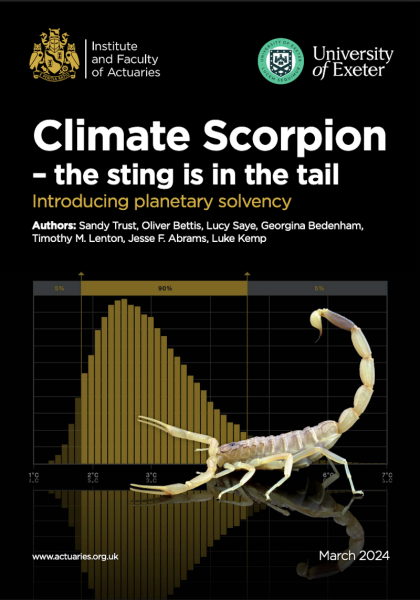
“If you look at the Climate Action Tracker, which is a pretty authoritative source evaluating countries’ commitments, progress, and their policies, they label Canada’s actions as ‘highly insufficient’ for a livable future. Basically, they say that our current policies and actions are taking us to somewhere below a 4.0℃ world.”
“So, above 3.0℃, which is an absolutely horrific level of warming that we’re currently headed for at our current levels of ambition. That fact is missing, and that Ms. Lash wants to talk about success, I find quite embarrassing.”
“I really want to be polite to everybody, and I get the desire to look for wins, and we do need to acknowledge smart policies. I think the Liberal government had some policies that were helpful. They did bring in a carbon tax that was set to ratchet up, which got destroyed by the Conservatives, but none of it was enough to fulfill our obligations under the Paris Agreement. We should have been at zero emissions already by now.”
“So, anyone who’s talking about any semblance of success is just horribly confused about what the Paris Agreement states. It says that we need to limit warming as close as possible to 1.5℃ , and we need to do that with a sense of fairness between nations, which means looking at historical emissions and the capacity to pay for transitioning away from fossil fuels and leaving them in the ground.”
“That fairness piece is pretty big and is often ignored by people working for countries that wish to continue to profit from fossil fuels.”
“Understanding what the Paris Agreement means is where I’ve spent a lot of my time as a climate thinker. It’s just really clear that planning for a mid-century net-zero target of emissions by 2050 is decades away from what we should be aiming for. Something more like minus 140% by 2030 is what I think the reasonable experts are recommending. For practical purposes, that looks like a 60% reduction at home and another 80% reduction overseas, such as offsets. The fact that none of that analysis is in Ms. Lash’s comments as she measures the success of the Liberal government over the past decade or so makes it difficult for me to take her seriously.”
“It’s hard for me to even get past that and look at her other arguments when we’re not even on the same playing field. She doesn’t want to, or she’s not aware of where the boundaries of the playing field are, what the goals are. The goal is limiting warming to tolerable levels, and we’re doing the opposite of that. We’re warming the planet more than we can handle.”
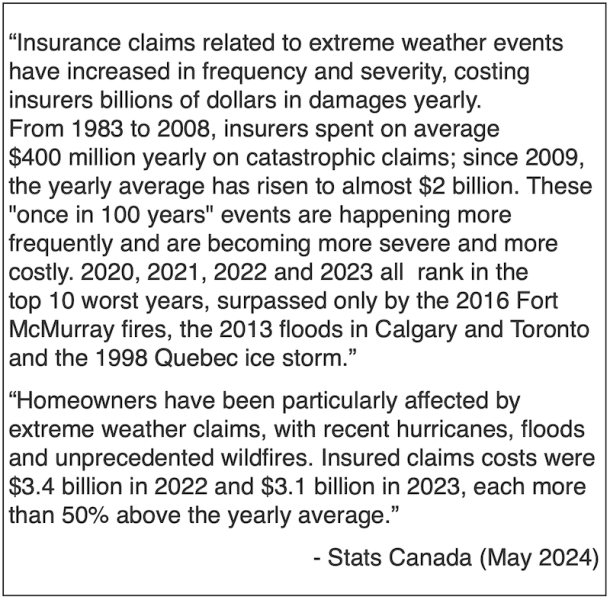
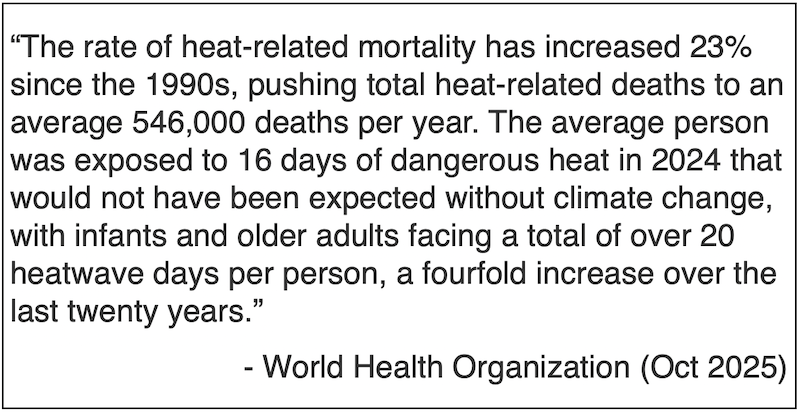
“The other thing that’s missing from an assessment of Liberal success or failure is the harm that’s already been done. Just in this province, people have died, some of them buried alive by climate impacts. Our resources are going up in smoke, and our infrastructure has been eroded—billions and billions of dollars and countless lives lost. How can you talk about success without at least acknowledging the harm and the tragedies that we’re already facing? That also makes it hard for me to take the conversation about success seriously. Let’s keep the goal in mind and acknowledge the failures that we’ve already seen and been through.”
Cortes Currents: What do you think about the fact that we basically have two big political parties in Canada, one of which is totally in favor of pipelines and anything else we can do to promote industry, while the other seems to be caught between trying to respond to the climate crisis and the demands of the fossil fuel sector?
Max Thaysen: “The fossil fuel industry has done a really great job of making people think that our livelihoods and the things we consider normal for wealthy Canadians require fossil fuels. One of the failures of the Liberal government was to provide a credible alternative to that worldview. We could have been ambitiously building clean transition and non-polluting industries that would provide for people and undermine the power of the fossil fuel industry, thus changing that political calculus. When a politician says we’re stuck because these provinces and the fossil fuel companies that support them are so politically influential and don’t want to give up their profits, that’s just another way to describe the problem. If you fail to solve the problem, then you fail to solve the problem. If you didn’t overcome it, that was the issue with your climate policy.”
“I don’t think it’s a very hard argument to make that we have better options. You’re not putting the impacts of climate change on the ledger. Even if the rest of the world does nothing, reducing emissions pays for itself in reduced impacts.”
“It’s a false dichotomy to say we can either be poor or rely on fossil fuels. This is an economy-collapsing problem that we’re facing. When people talk about the economic impacts of not using fossil fuels without acknowledging the economic impacts of doing so, they’re just reshaping the playing field.”
“It’s a form of climate denialism. There’s a term called “neo-denialism,” where you technically accept that climate change is real and caused by humans, but you deny basically everything else about it—what it means for our world, human health, and economic impacts. When those things are denied, that is possibly more serious than an actual climate denier who denies scientific consensus because it’s insidious. It makes people like Ms. Lash sound responsible when they’re actually denying some basic facts about what the science implies for our lives and what we need to do.”
Cortes Currents: What about the argument that Canada is basically splitting apart, and you have to appease Alberta? You have to give them their pipeline in order to get them onside, which is the same argument I think Trudeau made with Notley when we got the Trans Mountain.
Max Thaysen: “I don’t know enough to say whether the country would fall apart or whether we would actually have some kind of separatist movement in Alberta.”
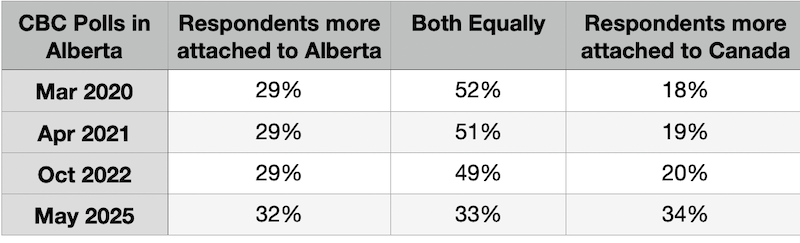
Cortes Currents: Alberta definitely has a separatist movement, but whether they would actually separate is something totally different.
Max Thaysen: “When slavery was ended in America, a Civil War was fought over that because there were enough people who wanted to maintain their power and privilege over the lives and safety of others because it benefited them. That conflict is a part of the problem. It’s not something we can avoid facing. The solutions are to take some ambitious action, like banning fossil fuel advertising, reducing the influence of fossil fuel manipulation in our governments and culture, and actually suing them for the harms they’ve already done in misinforming and disinforming the people, creating this culture war that is tearing our country apart over something that should be simple. We all want to live in a healthy world and be able to continue to make a living and take care of each other. It just seems basic and should be something we can all agree to do, but there’s some real insane misinformation.”
“If leaders are worried about the political power of fossil fuel companies and the people who currently depend on them, they can do a lot to empower those fighting for a brighter future. They should provide resources to the people willing to engage in conversations and build the public will that they say they need to counteract the power of fossil fuel companies. If that’s the problem, then let’s work on that.”
“Speaking of interesting and positive Liberal policies, we see some small funding now for a Youth Climate Corps, and that has been super well supported as a win. You’re getting young people who are looking for a job and want to be part of building a better world for their future. You give them an inspiring place to be in our society where they can be part of this mission. It’s just a fraction of the funding that it should have, but it’s a good start and an inspiring project that speaks to the need for cultural work and momentum building. I think most of the Youth Climate Corps activities will focus on preventing wildfires, among other things. But it should also involve training communicators and organizers to build power and combat the influence of the fossil fuel industry.”
“The other framing issue that I think is missing from Ms. Lash’s assessment is the use of a carbon budget. When we put carbon dioxide pollution in the atmosphere, it basically stays up there. So, every year that you don’t bring emissions down should make your target more stringent. If the goal is to reduce warming and you’ve added a bunch of pollution that you weren’t planning to, then your target has to change. A carbon budget is a way to track your progress and stay within warming limits.”
“There aren’t that many countries that do this, but certainly some in Europe have a carbon budget because they acknowledge this accounting issue. If Ms. Lash wants to talk about successes, but then in her explanation of that success she mentions starting to see a decline in emissions in 2024, that means we’ve spent seven years pumping tons of emissions into the atmosphere. That’s really different than if you had started measuring from whenever she joined the Liberal Party or whenever Trudeau initiated his climate program. It’s not the same as decreasing in a straight line toward your goal. When she talks about meeting our targets, those targets don’t become more ambitious because of our years of failure. Then you’re just moving the goalposts. This raises the question: are you actually a serious person trying to solve this problem? If you don’t understand that basic accounting issue, I’m happy to show you some graphs that visually illustrate just how much more pollution can accumulate if you don’t move in a straight line toward your target versus if you increase emissions and then drop them significantly later.”

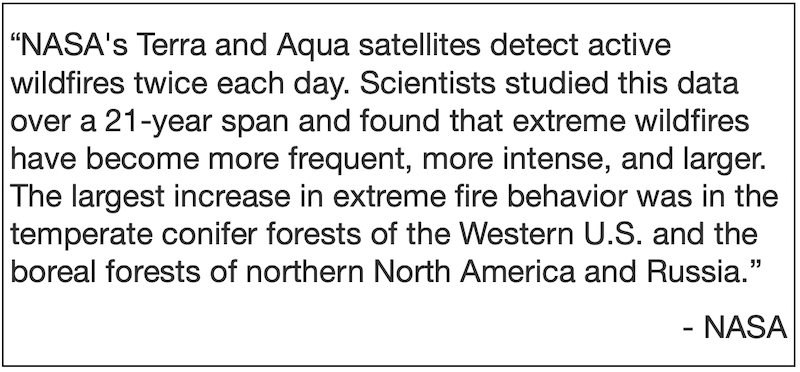
Cortes Currents: The problem I have with these graphs about emissions is I don’t believe they count forest fires, which is probably our worst source of emissions.
Max Thaysen: “We’ve had years in the recent past where emissions from forest fires were something like five times more than our total other human-caused emissions in Canada. That’s a major issue that’s also missing from an analysis of success or failure. We don’t know where tipping points like forest fires lie or when we’re going to start warming the planet enough that it begins producing its own emissions. Every little bit of warming brings us closer to those tipping points. It’s an extremely dangerous situation, and those factors need to be included in anyone’s assessment of success or failure.”
Cortes Currents: Do you know if they count them in Europe?
Max Thaysen: “I don’t know that. I think the norm is to keep those emissions off the ledger because they’re a bit different from the ones that we’re more directly responsible for.”
Cortes Currents: That means that all this talk about our emissions going down for some nations could be totally out. It’s worse overall for the whole planet.
Max Thaysen: “To the extent that these emissions are caused by climate change, then they are indeed caused by everyone’s emissions. Wildfires are also impacted by the kinds of land use policies we have, such as replanting logged land with conifers exclusively in large swaths of the same age and growing them as closely together as possible. This practice creates major fire hazards. Additionally, we dry out the land by digging roads and creating ditches, which channel surface water to the nearest creek, leaving everything drier. This, combined with the hot and dry conditions caused by warming, exacerbates the situation.”
“That reminds me of another issue that’s missing from Ms. Lash’s assessment. The goal isn’t really emissions reduction; that’s an indirect goal. The real goal is to stop the impacts. Over recent years, we’ve been noticing that the impacts are occurring at lower levels of warming than we were expecting. What we’re truly worried about is the consequences of warming. Anyone who’s serious about addressing climate change needs to take the evolving situation seriously. I don’t understand how you can have a conversation about success or failure without acknowledging the reality on the ground.”
Links of Interest:
- Liberal Environmental Policy for Dummies – Cortes Currents
- Climate Action Tracker page for Canada
- Climate Scorpion – the sting is in the tail – University of Exeter
- Are we planning to fail on climate change? – Max Thaysen
- Five bold policies for a stronger Canada – Elbows Up for Canada
- Articles about or mentioning the Cortes Island Climate Action Network
Top image credit: Photo of flooding in Abbotsford 2021. – Felipe Fittipaldi / B.C. Government
Sign-up for Cortes Currents email-out:
To receive an emailed catalogue of articles on Cortes Currents, send a (blank) email to subscribe to your desired frequency:
- Daily, (articles posted during the last 24 hours) – [email protected]
- Weekly Digest cortescurrents – [email protected]