

On Monday a new study confirmed what environmentalists have been saying for years, sea lice have developed a resistance to SLICE the treatment fish farms most often use against them.
“In many ways, this paper mark’s a new era. First Nations are very keen to manage their territories. One of the extraordinary things about this paper is two First Nation Chiefs are co-authors,” explained independent biologist Alexandra Morton. “They didn’t write the science, but they made it possible for this science to occur, which is one of the measures of whether you can be an author of a scientific paper.”
The scientists who worked on ‘Salmon lice in the Pacific Ocean show evidence of evolved resistance to parasiticide treatment’ said this paper would not have been possible were it not for the Namgis, Mamalilikulla and Kwikwasut’inuxw Haxwa’mis Nations. This is the first time they have been given access to raw bioassay data and it occurred because First Nations were given a monitoring and management role over fish farms operating in the Broughton Archipelago.
“In a province with a long history of industrial exploitation of resources in Indigenous territories, these agreements and their outcomes represent a compelling example of Indigenous self-governance that may become more prevalent as First Nations endeavour to gain more control over industrial operations in their traditional territories,” wrote one of the authors.

Brian Kingzett, Science and Policy Director for the BC Salmon Farmers Association, was on the road and emailed, “Despite activists trying to paint this as a conspiracy the information has never not been confidential and has been reviewed and discussed with regulators for a long time.”
In the recent BC Salmon Farmers report about sea lice monitoring in the Discovery Islands, Kingzett claimed, “Five years of sea lice monitoring has demonstrated that sea lice levels have been low with most out-migrating salmon not infected by sea lice. Additionally, we did not see sea lice levels change after decreased production of salmon farming in the region.”
Morton said, “Wild salmon in the Broughton Archipelago have been in a population nose dive since salmon farming moved in and we all know why. Yes, climate change is catastrophic but these little fish are not making it to sea. They are covered with sea lice and we also now know they have been infected.”

“These nations in the Broughton have hired some of the best scientists: pathologists, sea lice researchers.”
Cortes Currents has previously interviewed both lead author Dr Sean Godwin, a Liber Ero Postdoctoral Fellow at Dalhousie University, and co author Dr Andrew Bateman, from the Pacific Salmon Foundation. Both are directors of the Salmon Coast Field Station, in the Broughton Archipelago, with extensive lists of peer reviewed articles. (Click on their names in the paragraph above.)
There was not time to contact the remaining scientists listed as co-authors, but Cortes Currents did reach out to co-author Kelly Speck of Namgis First Nation, who has yet to reply.
The paper’s findings are clear.
Emamectin benzoate, or EMB, is the active ingredient in SLICE.
The authors wrote, “Our results suggest that salmon lice in the Pacific Ocean have recently evolved substantial resistance to EMB, and that salmon-louse outbreaks on Pacific farms will therefore be more difficult to control in the coming years.”

They go on to suggest, “it seems quite likely that industry and the federal regulator have been aware of this emerging issue for some time.”
EMB tolerance was reported as a localized and short-lived phenomenon in one farm in 2013 and again in 2018. EMB was used almost exclusively up until 2019.
The authors conclude, “The three least effective treatments all occurred in 2021, and all three resulted in higher counts post-treatment than pre-treatment, suggesting treatment failure.”
Kingzett emailed, “Industry has been aware that this was slowly happening for almost a decade and has been requesting alternate solutions that are approved in other jurisdiction. Farmed salmon introduced into the ocean become infected by sea lice from returning wild salmon and as a result the development of “tolerance” has been slow to occur.”
“In general the decline in efficacy of this single treatment method is not news to BC’s salmon farming sector. We have warned the federal government for a decade that we need access to a broader range of environmentally safe and effective tools for sea lice management. Integrated pest management, employing a variety of preventative and responsive measures, is the most effective way to help support the government’s objectives in sea lice management and our shared objectives to support the health of wild salmon stocks.”

The report mentions three alternative methods (i.e., freshwater baths, hydrogen peroxide baths, and jets of pressurized water), but adds each has its own drawback,’some of which will worsen with climate change, necessitating a diverse set of strategies for louse control.’
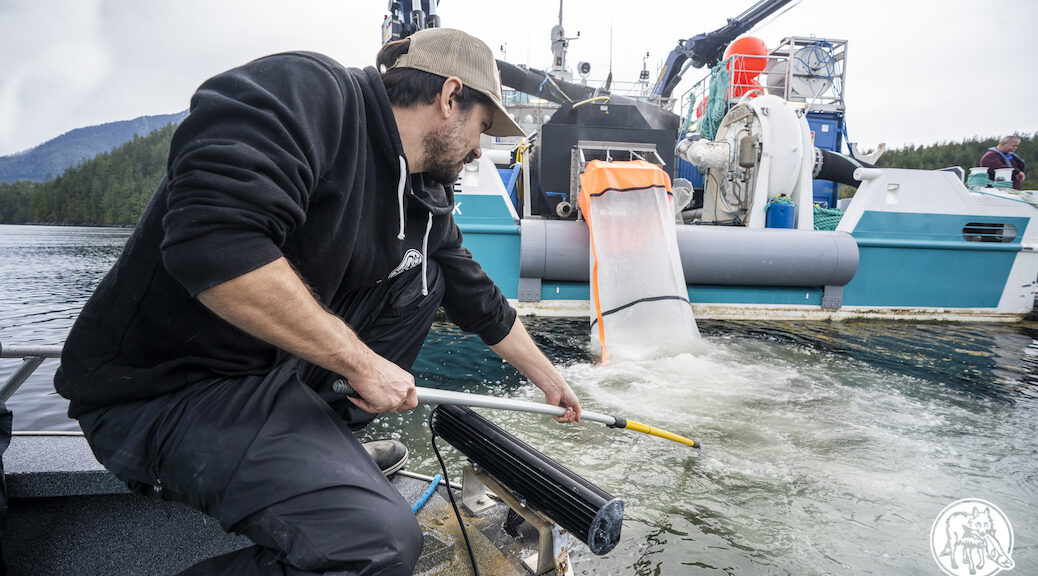
Dan Lewis of Clayoquot Action said his organization has been taking samples of the effluent coming out of a boat called the hydrolicer.
“They suck the fish out of the pens and then they power wash the lice off of them. So lice are of course designed by evolution to hang on for dear life, to whatever they find as a food source, a salmon, and it’s not easy to get them off these fish. So the power wash causes a lot of damage to the fish. We go out every week and sample the fish farms,” he explained.
“they have filters to capture the lice and where the effluent is coming out, they have a sock. You can see all the lice that got through the filters. We’re using a plankton net and we sample what’s coming out of that that sock. Then we send it off to a biologist who looks at it in a microscope and identifies all of the lice in there.”

A couple of weeks ago they found the remains of 33 lice covered dead herring floating beside the hydrolicer and on its deck.
“It looked like they had literally been sucked out of the pen and run through the power washer. Their eyeballs were blown out and a lot of their heads were removed …”
Kingzett wrote, “Sea lice are NOT being spread by peroxide and freshwater treatments. Filtration systems are in place on the new systems that producers have invested in and they are very effective. Also the alternative treatments themselves (freshwater, mechanical delousing, and H2O2) are highly effective and used as part of a comprehensive integrated pest management plan.”
“There are many factors that veterinarians consider when implementing treatment plans within an Integrated Pest Management Strategy. Bioassays are just one tool that veterinarians use as a predictor of the sensitivity of lice to EMB,but there are other, more reliable predictors that they consider as part of a holistic health management program. That’s why licensed, practicing veterinarians are best positioned to make Heath management decisions on BC Salmon farms.”

Alexandra Morton has been studying the sea lice problem for two decades, first in the Broughton and later both the Discovery Islands and Nootka Sound.
She said the EMB initially worked well. Sea lice levels dropped to the point that Morton thinks the majority of the wild salmon passing through farms survived in 2006-08.
“Then in 2015, that turn began to reverse in the Broughton. I co-published a paper on this, discussing how something had gone wrong. We didn’t know what, because the salmon farming industry is not transparent. You really never know what is going on inside, but they are in public waters, so there’s a lot of work being done on what goes on outside,” said Morton.
She subsequently obtained access to internal DFO staff conversations about drug resistance through the access to information act. That’s how Morton came to known that some DFO staff were informing their superiors about a serious drug resistance problem.
In the podcast, Morton talks about a senior DF veterinarian, Dr Ian Keith, who was writing both the companies and his superiors.
“He said when the companies can’t kill their lice, what they’re offering to do is harvest them. That doesn’t work because harvesting is such a slow process as opposed to culling the whole farm. So do you have a full staff we’re trying to deal with this? DFO enforcement staff said their hands were tied and there was nothing they could do because all the fish farmers needed was a plan. But there was no rules about that plan actually working.”
She said this has been an ongoing problem since 2015.

Morton has been observing an ongoing battle that six fish farms in the Quatsino area have been having for months.
“They have been treating those fish for sea lice steadily since December 1st. They’ve used hydrogen peroxide, fresh water, and the hydrolicer, which sucks the fish through this chamber and basically tries to power wash the lights off and still. Today, they have an average of 26.9 juvenile lice at one of the farms. So there’s five farms over the coast-wide the limit that DFO set to protect young wild salmon. This is where it’s posted on their website. So it’s not my work, I’ve just looking at it,” she said.
“Quatsino is an example of something that is going very wrong. Those lice are resistant to everything. So back to the paper that just got published, DFO is very shy about talking about the impact of salmon farms and they definitely don’t want to talk about this drug resistance because it means the salmon farmers are losing control.”
Morton pointed out that the licenses for these farms all expire at the end of June. Industry is working with First Nations to shield themselves. Some nations are going along with this. Others, like the Broughton Nations, ‘know it’s a serious problem and they’re doing everything they can to get these farms out of there.’

This will be the second year that juvenile salmon will not encounter fish farms as they swim past Campbell River.
“This summer, we are going to see the first return from that because the Pink Salmon that went to sea through the Discovery Islands with no fish farms are going to be returning in July and August of this year. I’m very curious what their numbers are going to look like,” said Morton.
“DFO is very shy about talking about the impact of salmon farms and they definitely do not want to talk about this drug resistance because it means the salmon farmers are losing control.”
Thirty of BC’s salmon farms have now been closed and the licenses for another come up for renewal at the end of June. If they are not renewed, there will be only 7 active farms left in the province. They are all in the Broughton Archipelago.
Fisheries Minister Joyce Murray says she intends to continue with the plan to take this industry out of the ocean by 2025.

A spokesperson from the BC Salmon Farmers Association emailed Cortes Currents, “If temporary licences are reissued, it puts the entire industry at risk. The companies work on 5 year cycles, and if there is no certainty that licences will be renewed beyond a year. It wouldn’t make much sense to continue operating if you cannot complete the life cycle of the fish.”
She claimed that DFO was making the right call when it said salmon farms offer only a minimum risk to wild salmon.
Lewis pointed out that most of the world’s leading salmon farming nations – Norway, Scotland, Ireland, Chile – no longer possess abundant salmon runs. That is something that BC still has.
“When you come to BC, suddenly you’re in a place where you have millions of fish coming back every year. And that’s what’s being put at risk by this industry here,” he said.
“Wild salmon are key to everything in British Columbia: from cultures to feeding the wildlife, to providing the nitrogen that grows these trees to such massive sizes. For years scientists were trying to figure out how are these trees getting so big? And it wasn’t until the mid nineties that the papers started coming out stating that it is the salmon who are bringing the nitrogen back into the rivers and the bears and all the other animals are spreading that nutrient all through the ecosystem.”
“It’s what they call the nitrogen pump and it’s one of the few examples in nature where you see nutrients moving uphill against gravity. It tends to be that everything goes down to the sea, but in this case, the salmon go out to sea, gather all these nutrients and bring them back. They lay their eggs, offering another generation of salmon and then they leave their bodies to feed the bears and all the wildlife entries.”
When he visited Norway seven years ago, one of that nation’s leading salmon scientists told Lewis, ‘you have to choose, it is either or, you cannot have both in the same place’ – which is why people are saying get them on land.
“When you put salmon farms in the water, you are choosing to sacrifice your wild salmon,” said Lewis. “It is either a handful of jobs, or the continuity of the biological foundation of the ecosystem.’

Morton added, “The decision whether to renew the salmon farm licenses on this coast is going to have a profound impact on British Columbia. If some First Nations and the minister decide this industry is going to stay, well by the time the decision comes up again we will have lost many wild salmon runs. Because when you have a salmon run that’s supposed to be 50,000 and only 80 come back you don’t get a second chance. That is your second chance.”
“So if anyone is interested in protecting this coast, you could write to Joyce Murray, our Minister of fisheries, and just let her know that you’ve got her back because I’m sure she’s hearing from the fish farmers hard and steady.”
Correction: Cortes Currents initially stated that Drs Godwin and Bateman were employees of the Salmon Coast Field Station. This was incorrect, they are members of the board of Directors.
Top image credit: Clayoquot Action taking effluence samples from a hydrolicer at Cermaq Canada’s Bawden fish farm in Clayoquot Sound – Photo by Jérémy Mathieu, Clayoquot Action
Sign-up for Cortes Currents email-out:
To receive an emailed catalogue of articles on Cortes Currents, send a (blank) email to subscribe to your desired frequency:
- Daily, (articles posted during the last 24 hours) – [email protected]
- Weekly Digest cortescurrents – [email protected]