

Canada’s National Observer, Local Journalism Initiative Reporter
Surging numbers of free-floating logs are scouring BC’s coast, threatening marine creatures from barnacles to seabirds, a new University of Victoria study shows.
Barnacle populations, which play a critical role in ocean ecosystems, suffer declines of up 80 per cent in key rocky areas pounded by drift logs mostly from forestry operations, compared to colonies tucked in crevices protected from wood debris, the research suggests.
It’s a worrisome finding, said UVic biologist Tom Reimchen, one of the study’s authors, stressing that barnacles may be small, but their loss has a big ripple effect.
The filter feeders comb plankton, algae and other organic debris from ocean water, clarifying it for other marine life while providing a protective habitat for a huge range of invertebrates, such as crabs, mussels, sea stars, marine worms and snails, along with a host of other sea creatures.
Barnacles are also a key source of food for foraging shorebirds like black oystercatchers or rock sandpipers, while the crustaceans’ larvae feed fish or shellfish. Even terrestrial animals like bears and otters rely on barnacle habitat for food, Reimchen said.
The loss of barnacle populations due to log abrasion — compounded by climate impacts, such as recent heatwaves that baked an estimated billion tidal creatures to death — has likely contributed to dramatic shorebird declines, with some populations dropping by half since 1970, the study suggests.
Drift logs cause persistent and cyclical damage to rocky tide zones, increasing over the course of the past century as industrial logging occurred, he added.
The study used high-resolution satellite imagery from 202 sites on Vancouver Island and Haida Gwaii, as well as archival photos and on-the-ground surveys to determine the extent of the impacts of drift logs — with an estimated 60 per cent found to be “saw cut” or shaped by human activity.
Once the logs land on one beach, they don’t often stay there: more than 90 per cent of drift logs stranded at the high-tide lines or rocky shores are repeatedly displaced by tides and storm surges to wreak havoc on other distant shores, the study showed.
Researchers also determined there’s been a 520 per cent increase in drift logs since the late 19th century.
The forestry sector has decreased the rate that logs escape from transport and storage in recent decades, but the volume of wood debris cast adrift is still staggering, Reimchen said. Operational improvements, such as transporting logs by barge rather than towing log booms by water to distant locations and sorting logs on land rather than sorting them in the ocean, have had some positive results.
However, there are likely 450,000 logs littering the shores of Vancouver Island alone, the study suggests.
The ecological impacts of rogue logs tearing up eel grass beds, mudflats or estuaries in intertidal areas has been the focus of scientific attention, Reimchen said, but their impact on rocky shores that make up the majority of shorelines on the West Coast have been overlooked.
Log densities on sandy beaches are even higher than on rocky shores. But there’s a greater likelihood that logs tossed up on those shores during extreme weather or tides often remain stranded, offering more positive outcomes like permanent habitat for wildlife or limiting erosion, he said.
More needs to be done to find ways to reduce or recover human-caused drift logs from continuing to damage the shore environments, Reimchen said, noting embedding loss surcharges or cost recovery measures into industrial operations is a possible option.
But most importantly, there needs to be a societal mind-shift on the West Coast, where the accumulation of vast amounts of shoreline wood debris has been normalized, Reimchen said.
Accepting loggy beaches as part of the scenery ignores the vast ecological toll exacted as drift logs pummel the “bounty of intertidal systems,” he added.
““This is not just [happening] in a few bays around Vancouver Island. This occurs along the west coast of British Columbia,” he said.
“I don’t think one can overstate the geographical and biological breadth of this observation.”
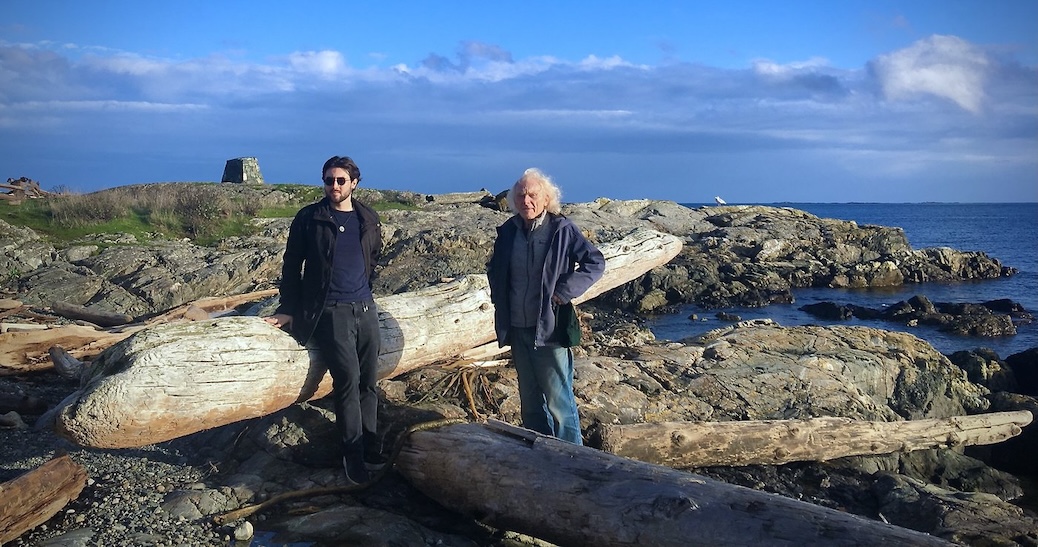
Top image credit: UVic Researchers Esteban Pérez Andresen and Thomas Reimchen studied the impacts of drift logs damage to intertidal areas of BC’s rocky beaches. – Photo courtesy UVic.

Sign-up for Cortes Currents email-out:
To receive an emailed catalogue of articles on Cortes Currents, send a (blank) email to subscribe to your desired frequency:
- Daily, (articles posted during the last 24 hours) – [email protected]
- Weekly Digest cortescurrents – [email protected]