

The recent Investigative Journalism Foundation exposé on lobbying, prior to Mark Carney’s first budget, fits a familiar pattern. Industry logged hundreds of hours of consultation with government officials. By way of contrast, the environmental sector has little representation. They are not even mentioned in this report! What does this mean? Cortes Currents asked Jennifer Lash, who has been both the founder of a non-profit society and a senior government analyst, for her insight into why the system is important and how it works.
Jennifer Lash: “The term lobby comes from the area around the House of Commons where the different parties gather when they’re not actually in the House. That’s where people used to go and meet with them to share their perspectives on things. They were meeting in the lobby, so these people became known as lobbyists. That’s where the term comes from, and anyone is lobbying if they’re meeting with an MP or a bureaucrat and advocating for something.”

“If I was working for a not-for-profit organization and went to meet with the Minister of the Environment and was advocating for certain policies, I would be lobbying them. Quite often we use the term lobbyists to mean people who are paid to do this. Large lobbying firms specialize in government relations; they know all the people to meet with, and they often have relationships with people in government. Organizations and companies will hire these firms to help get access to people.”
“It’s a very common thing that’s done. Anybody can hire a lobbyist. Not-for-profit organizations will hire lobby firms, and companies will hire lobby firms.”
“Where it gets a little bit more controversial—and where people have concerns—is the fact that hiring lobbyists can be expensive. Usually the only entities that can afford to hire lobbyists are companies, such as oil and gas companies, where they have a lot of profit and there’s a lot at stake financially. So they’ll invest a lot of money in hiring a lobby firm to advocate for what they want, whereas not-for-profit organizations like climate advocacy groups don’t have that budget and can’t afford to hire lobby firms. They have less time and capacity to be able to advocate for what they want.”
“Quite often it’s interpreted that if the government has met with far more people from the oil and gas industry, they are going to reflect the position of the oil and gas industry. I’m just picking on the oil and gas industry in this example. It could be mining companies; it could be any companies that have more money. Quite often we’ll see reports that say the government met with lobbyists from natural resource development companies far more than they met with environmental groups; therefore, they’re leaning that way.”
“That’s, of course, very possible. Ultimately, it’s up to the politicians and the bureaucrats to make the right decisions and to listen to the information and make the decisions that are right. In a perfect world, it wouldn’t matter if you meet with one company 10 times and another organization one time; that shouldn’t shift the weight of the decision. You should still be making the decision in the best interest of Canadians. Unfortunately, it doesn’t always work that way. Sometimes, if you have had more time with some groups over others, you will tend to lean in that direction. It gets a little bit more difficult.”
“Lobbying as an act itself is part of how our government functions. They need to listen to stakeholders. Government should be meeting with industry groups, not-for-profit organizations, and civil society, and listening to all the different perspectives and not cutting people out. It’s good that they listen and get that information. The challenge is if they tend to go with the perspective of the companies or organizations that get more meetings with them, and that is where it becomes a little bit more difficult, because the bigger companies have more money and can hire more lobbyists.”
Cortes Currents: It sounds almost impossible to control.
Jennifer Lash: “It’s controlled through transparency. You can’t stop a company from hiring a lobby firm, but everything is registered. So if you meet with a government person to advocate for a policy—whether you are an individual, a paid lobbyist, or a company vice president—you have to record that in the registry. That’s all public information.
“When we see articles in the media that say the Prime Minister met with X number of companies more than others, it’s because it’s transparent. That’s the accountability mechanism. Could it be better? Possibly, but that’s how the system works right now.”
Cortes Currents: A similar question would be campaign donations. We find industry often supporting particular candidates over others, and they’ll pump lots into their campaigns, but that doesn’t necessarily mean that the politician is crooked.

Jennifer Lash: “One of the really great things about the Canadian electoral system is that we have caps on how much a person can donate. A company can’t give $200,000 to a candidate and hopefully buy their vote. That does happen in the United States. That is one of the fundamental problems with the U.S. electoral system. In Canada, there is a cap and that has to be to just one candidate or to the national party or whatever.”
“There is third-party advertising, which is when a company or an organization starts doing advertising, advocating for certain things in an election, but they’re paying for those ads themselves. They’re not giving the money to the party, and to do that you have to register as a third-party advertiser. So it is transparent; the money does not go to candidates.”
“You can still have industry coming out and advocating for certain candidates. That can happen, but it doesn’t necessarily mean they’re giving them money.”

Cortes Currents: What do we do when you’re aware that, for example at a community level, a city is very much in an industry’s pocket. They’re listening to the industry, but not the environmental side?
Jennifer Lash: “There’s probably not a lot you can do day to day except call that industry or that government to account. That can be through writing letters, communicating, meeting with them.

“It can be through presenting—I don’t know what council meetings they have—and really making sure that public voices are heard through council would be a very good way to show another side. Ultimately, any elected official is accountable to the public. That’s why elections are so important. For example, if you had a council that was leaning in favor of one industrial sector and not paying attention to the environment, you can participate in the processes in the three years leading up to an election, making all the council members aware of the growing concern from civil society. Then when it comes to election time, hopefully they will be called to account. If they are not listening to the people of the community, then they will lose in the election. So it’s why elections are so critically important, and it’s why it’s so important that civil society express their concerns to the council all the time. It may not be that you can change things in the short term, but that’s why we have regular elections.”
“It’s very easy to say lobbyists are bad, but it’s important to remember that advocating your views to government—whether it’s municipal, provincial, federal, or within an Indigenous government—is a critical part of what makes democracy work.”
“Lobbying is not a bad thing. Lobbying is a very, very important part of democracy, and I really encourage people to find out how they can be most effective—how they can engage, how they can share their views with their elected officials—to ensure that they understand what’s going on and make sure that they’re sharing with government what they think is the right thing to do.”
“It’s government’s responsibility to listen to that, because a government is trying to solve a lot of problems around the economy, the environment, social justice, and reconciliation, and to do that, they need to hear from people and hear their views on what the problems are and what some of the solutions are.”
“It’s actually a really good part of the democratic process to share your perspectives with decision-makers and governments.”

Cortes Currents: Lash had seen, but not yet examined, the Investigative Journalism Foundation exposé when Cortes Currents interviewed her. Nevertheless, she made some general comments.
Jennifer Lash: “I’m not surprised that companies such as Pathways and those in the oil and gas sector are lobbying. They have large budgets to hire lobbying firms, and they are constantly trying to get meetings with the government. They do this all the time.”
“When Carney was elected as our Prime Minister, he had to overcome a challenge: the natural resource sector was being cut out from government, and the government wasn’t paying attention to them. I could see him wanting to meet with these companies to try to calm the mood in the country. There was a real division happening. Alberta was—and is—threatening to leave the country. There are fights between Alberta and Saskatchewan and the federal government, and that was tearing the country apart. It just wasn’t a good atmosphere for people to be living in.”
“I can see why he’s trying to tone that down and try to unify things again. I am a firm believer in the need to address climate change; I also feel that we need to keep the country unified and not have those tensions, because we don’t get anything accomplished when the country is fighting like that and becoming more polarized.”
“I can understand why there would be meetings with these sectors. At the same time, I think that the Prime Minister, the Minister of the Environment, and the Minister of Natural Resources also need to meet with civil society and hear other ideas and perspectives. It’s been a strange year—with the election, the Liberals back in, the tariffs with Trump, and efforts to kick-start the country’s economy.”
“I hope that in the next year we’re going to see this government engaging more constructively with civil society on key issues such as climate change and protecting nature. That’s something we will all be looking forward to seeing, and it’s something by which we will assess this government.”
Links of Interest
- Our Communities, Our Country – Federal politics in North Island Powell River (Jennifer Lash’s website)
- Articles about, or mentioning, Jennifer Lash
- Here’s who lobbied for key measures in Mark Carney’s first budget – Investigative Journalism Foundation
- Articles about, or mentioning, lobbyists in BC
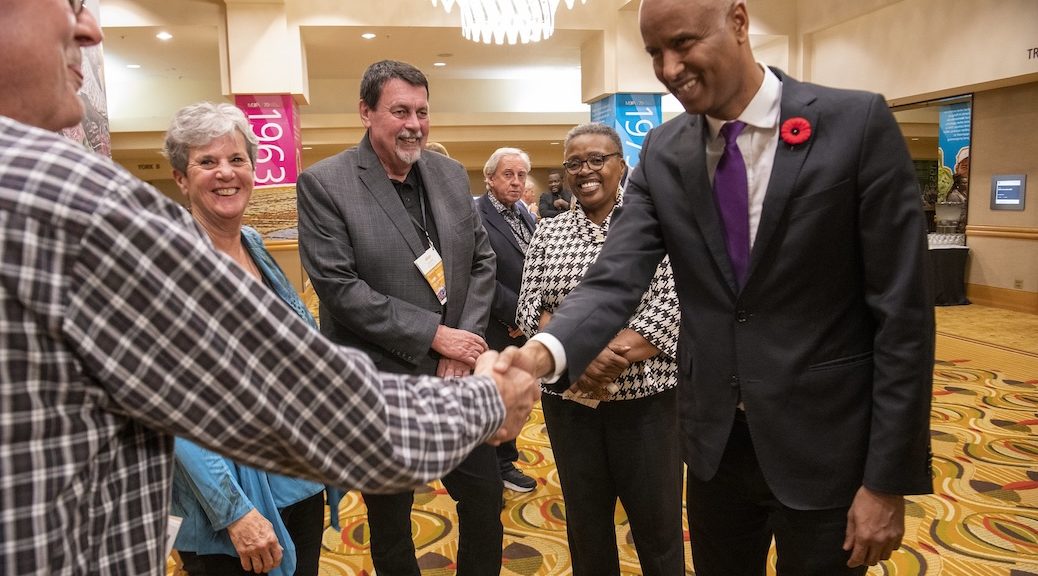
Top image credit: Lobbyist at a 2023 convention in Toronto – Photo by Michael Swan via Flickr (CC BY-ND 2.0)
Sign-up for Cortes Currents email-out:
To receive an emailed catalogue of articles on Cortes Currents, send a (blank) email to subscribe to your desired frequency:
- Daily, (articles posted during the last 24 hours) – [email protected]
- Weekly Digest – [email protected]