
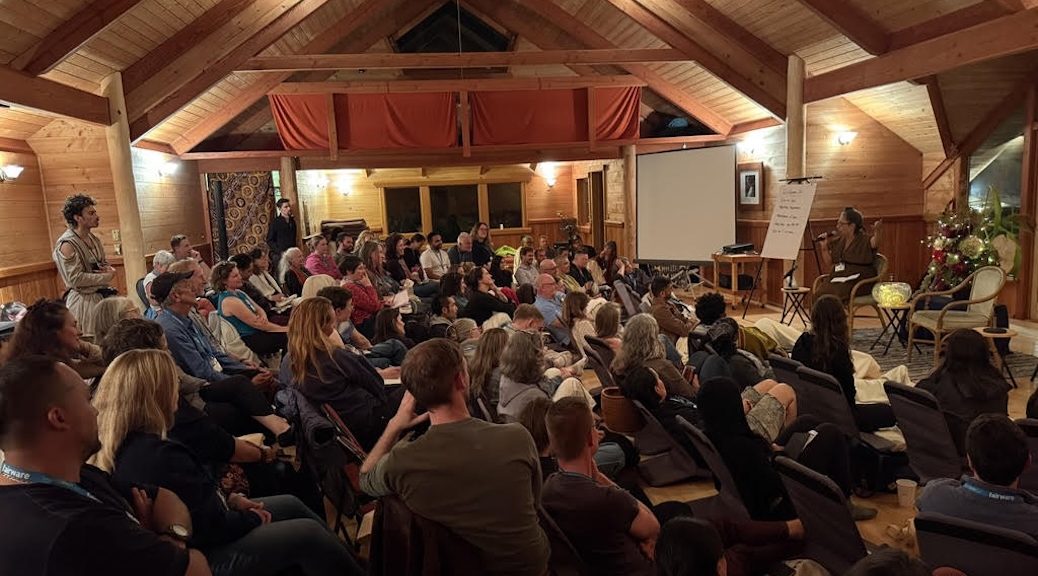

It has been nine months since Katia Sol took over the helm as Hollyhock’s CEO. She has also had more than two decades of experience working with nonprofits, starting as a volunteer in a Bolivian Indigenous community and going on to co-direct the Ecology of Leadership at the Regenerative Design Institute, founding her own coaching and leadership development business, and teaching at Stanford University. In today’s interview she talks about this past year at Hollyhock and what lies ahead in 2026.
Cortes Currents: So you’ve been at this since you were 16 years old. How many organizations have you been connected to and directing programs with?
Katia Sol: “I’m not totally sure because a lot of it has been part-time this, part-time that. This is my first time actually as a CEO. I have run my own small organizations before, but Hollyhock is up to 80 employees in the summer and it’s definitely a new learning curve for me.”
Cortes Currents: You’ve also just told me that Hollyhock has grown. The last number I’ve heard was 60.

Katia Sol: “In the summer, I think it’s up to 80 seasonal included employees and we’re certainly still the largest employer on Cortes. We actually just participated in something called the Shore Fast Economic Nutrition Pilot, and we could look at how much of our spending stays on Cortes About 35% of our spending stays on Cortes and the majority of our salaries actually stay on Cortes.”
Cortes Currents: Of those 80 people, how many of them are Cortes people?
Katia Sol: “The year round staff is a different statistic than the seasonal, then people come and they stay on Cortes for the summer. If you’re looking at year round, I’d have to ask Tiana, who’s our campus director to get those stats. I want to say 60%, it’s more than half for sure. We’re focusing on trying to get our full-time and our year round employees to really be based on Cortes as much as possible too. We’ve been making more hires on the island and I’m moving there.”

“I’m moving from California, from the Bay area, and so when I was reached out to apply for this job, I wasn’t even looking for work. I have three kids. They’re 7, 17, and 20. The 17-year-old still has one more year of high school this year. I was thinking we would leave maybe after this year, but then Hollyhock approached me, and I decided to take the job.”

“I always knew I would be in an 18 month transition, going back and forth from California to Cortes. I made 10 trips this year back and forth. My family came up in July and we stayed July through October, full-time on the island. Right now we’re in California and then the plan is to move there full-time next summer.”
“My son did two months at the elementary school and he loved it. He actually really didn’t want to leave. I didn’t want to have to take him out because he liked it more than his school in California.”

“We arrived in July. My husband and I joined a band with Rex Weyler and another woman. We performed at Cortes Day, a week after we landed on Cortes, and we went to Love Fest. We went to a lot of the summer events that were happening, so I felt like we arrived at the height of the season. I actually didn’t want to leave when we left at the end of October because I could feel the sweetness of being there when things quiet down and it starts to be more just the community.”
“I’m seeing things happening at the hall and a Christmas celebration and a Gala and I’m wishing I could be there to go because it all looks so sweet. I’m really looking forward to when we can be there and participate more fully in community life.”

Cortes Currents: What was it like being the CEO when you’re half in California?
Katia Sol: “There is a good percentage of the team that’s remote. Heather Deeth, the interim CEO, was been in Toronto the whole time. She only came to Hollyhock one time this year. On one level it’s fine because there’s a lot of the team and a lot of the meetings are remote. There’s Zoom even when you’re on campus, but it’s so much more fun and I would say nourishing to be there on Cortes.”
“A friend of mine said when you’re doing the job remotely, you’re doing the job, but without all of the support of the land because so much is about the land there on Cortes. It feels harder to do it remotely. It feels much more supportive and nourishing to do it there on Cortes. When you’re remote, it feels more like a job, like any job. When you’re there, then you connect with the magic of the land and the people and the island and the community, and so it feels it’s a lot more fun to actually be there.”

Cortes Currents: I should ask about the themes last year?
Katia Sol: “For me, a highlight was when Hollyhock hosted a gathering called Kindred. It wasn’t one of our programs, it was more of a private group, but there were just amazing young people doing incredible work from around the world that came and I got to be a participant in that. So that was my first time being a participant. I even stayed next door to Hollyhock instead of going home, so that I could have the full experience.”
“Another highlight for me is that I ran a three day leadership pilot that was just for the staff of Hollyhock ’cause one of my visions is to have the people who work at Hollyhock not feel like they’re just serving people from outside, but for them to have an opportunity to experience the work. 80% of the staff stayed on campus and they were like guests. They got to eat, they got to go to the spa, they got to just spend time on the land and to have more of a guest experience, but also for themselves to be in and enjoying the work. We had 25 staff members do that program that I facilitated. At least 60% of those people were from Cortes. We partnered with the Cortes Island Community Foundation in doing that. So that was a highlight for me personally.”

“We also had a ‘Women In Climate’ gathering. We had young female climate activists from around the world come together with seasoned climate activists and people like Tzeporah Berman and Kairn Mahon – or Carrington I guess is her last name now. So you had the mix of the people who were really involved in the Great Bear Rainforest protection with young women of colour from South America and different countries coming together. So that was exciting. I participated in that.”
“Then we have all of our core programs, which are like the creativity workshops , mindfulness workshops and writing workshops. So it was a very full season for us and all new to me ’cause it’s my first time experiencing it.”

Cortes Currents: You also hosted all the social profits.
Katia Sol: “Yes, I was there for that and, more, we want to be a place of resource for the Cortes community. When I was first applying to this job, I was asking questions like, could we build housing on the land at Hollyhock to have more of an intentional community? As I moved to Cortes, what I realized is we have an intentional community. Cortes is our community.”
“So how can Hollyhock see itself as more closely knit and in relationship with and in service to the Cortes community? I have a lot of ideas that I just couldn’t do this year ’cause I’m not there, but next winter, like how do we open the campus? How do we have co-working spaces? How do we have weekend brunch? How do we have coffee houses and arts nights and music nights?”
“Right now a lot of our presenters come from outside of Cortes, but there’s so many people with so much wisdom on Cortes. I want local Cortes people to become part of our faculty.”
“I was talking with someone named Duane Hanson. He’s from the Klahoose nation and he’s been doing workshops for the Cortes Island Academy on local Indigenous traditional ecological knowledge. I was like, ‘why aren’t we doing that at Hollyhock?’”
“There’s so many possibilities once I’m actually there and can help to host some of those kinds of gatherings and Manda Aufochs Gillespie’s a good friend of mine and so I think we’ll scheme up lots of good things.”

“Hollyhock’s final staff party we had all these little games we played. One of them was a don’t spill the tea golf cart race. So you race the golf carts around a loop and one person drives, the other holds two cups of tea. Dwayne partnered with my 7-year-old. They were a team and Dwayne drove the golf cart and my 7-year-old, I couldn’t believe he was holding these two little like China teacups and saucers. Somehow they managed to do the race and not spill very much tea. They didn’t win, but they participated, which was very sweet that they were a team.”
Cortes Currents: What are the highlights you’re looking forward to this season coming up?
Katia Sol: “For 2026 our program team is really excited. Some of our core programs are doing really well. Heather Wolf, who’s been coming to Cortes for a long time, has a workshop. We have Merlin, Cosmo and Rupert Sheldrake teaching another workshop and theirs is filling up really quickly. There’s some younger presenters who are drawing a lot of interest. Jeff Warren does some innovative mindfulness work. He did a program this year, got a lot of interest and his program is already filling up for next season.”

“My vision for Hollyhock is that we really become a living leadership practice center, where the people who work at Hollyhock as a community are practicing the teachings that we’re putting out into the world.”
“My vision and my background is in transformative leadership and adult learning. I want to help us start to really shift Hollyhock from being more of a retreat center into a living practice center for how to become the best humans at this time on the planet? How do we be of service? How do we practice regenerative principles? How do we make some campus infrastructure innovations, bringing in more solar and gray water and permaculture systems to transform the campus itself to be a regenerative demonstration site for what’s possible.”
“How do we plan for the apocalypse? When it happens, how do we become self-sustaining?”
“How do we not be so dependent on outside visitors? If no one came anymore, what would be the purpose of Hollyhock? How do we flip the model from ‘we’re here to serve the outside’ to ‘we’re here to live and breathe and embody these teachings and to be practicing them.’ Then people come because we’re doing such a good job of that. They’re really compelled by it and they’re interested and they want to learn from it.”
“That’s the vision I’ve carried for a long time, 20 years before I even heard of Hollyhock.”
“I had always thought I had to create my own centre that would be doing that. When I got the call about Hollyhock, I was on a sabbatical. I thought I had to find the land to purchase. I thought I had to find the people to do it with and start from scratch. Then Hollyhock contacted me and so I was like, ‘oh, there’s this beautiful Island.’ I’d never heard of Cortes Island. I’d never heard of Hollyhock before.”
“When I visited, I felt a lot of resonance and potential for us to be doing this since the roots of Hollyhock have all of that same vision of integrating the inner and outer work.”
“The roots are there and people like Rex Weyler and Shivon Robinsong who founded Hollyhock. I feel excited to both take us forward into a new vision, but also really honour the roots. I’ve been feeling very blessed to have time with Rex and Dana Solomon. I had time with many of the original community members of Hollyhock. I’m feeling blessed by these long-term community members who have so much wisdom and that feels really important to me. To bring in the wisdom of the past generations as we move toward the future.”
Cortes Currents: Is there anything else you would like to mention?
Katia Sol: “Just that I come into this very, very humbly. I know that for all the experiences I’ve had in my life, I am very new to Cortes. I’m very new to Hollyhock and so like the first season I really just came in with an intention as much as possible to listen, to watch, to observe, to not try to make changes right away.”

“With Hollyhock, since I am the CEO, I do need to start to make some changes, but I’m just a baby in relation to the community and it’s going to take time to develop relationships and develop trust but my family and I are really excited to move there.”
“I also feel like we’ve been welcomed with a lot of warmth and love, and we’re coming from California, specifically from the Bay Area, where a lot of people talk about community, but I don’t feel like they really live and practice it. From the little I’ve experienced in Cortes, I feel like people there really do act like a community, even when you might have different views, different perspectives, different political beliefs that they do depend on each other and support each other. It’ll be really exciting to live someplace that has that interdependence that’s being practiced on a daily basis.”
Links of Interest:
All photos courtesy Katia Sol
Sign-up for Cortes Currents email-out:
To receive an emailed catalogue of articles on Cortes Currents, send a (blank) email to subscribe to your desired frequency:
- Daily, (articles posted during the last 24 hours) – [email protected]
- Weekly Digest cortescurrents – [email protected]