

By Hope Lompe, Gabriola Sounder, Local Journalism Initiative Reporter
Ahead of the Nanaimo City council meeting on Dec. 15, B.C. Minister of Forests, Ravi Parmar, sent a letter to council requesting a motion for a staff report be rescinded.
The window for the motion to be rescinded would have been at the next council meeting on Dec. 1, 10 days before the minister’s dated letter to council.
“Is it typical? No, but it’s also not typical to see the actions of a councilor and council that have significant implications on British Columbia’s forest sector and on workers and their livelihoods,” said Parmar during a phone call with the Sounder.
The motion in question was put forward by councillor Paul Manly, which narrowly passed on Nov. 17. The original motion was for a heavy industry bylaw zoning amendment, but was changed just before the meeting to a staff report with options to exclude emissions intensive industries from industrial (I4) zones. These would include waste energy incinerators, chemical plants, thermal electrical generators, petroleum refineries and liquid natural gas (LNG) export facilities. If amended as Manly intends, I4 areas would be classified as site-specific zoning, meaning land use decisions would go to council to determine if it is in the best interest of the community.
Manly says there are no projects of this nature incoming that they know of, however if there were to be a proposal submitted under the current bylaw to build an incinerator then Nanaimo, Cedar and Gabriola residents would be forced to accept it.
The intention of the amendment is to give the city more say over what heavy-emitting operations can be in Nanaimo, especially those that produce “volatile organic compounds, nitrogen oxides, sulphur dioxides or other compounds that negatively affect human health or the environment,” like an incinerator.
“Should local residents not have a say through public hearings? Should council not have a democratic process and a vote on proposals like this?” writes Manly in a text-message to the Sounder.
“It is not typical for a minister to intervene in this manner. It seems that the minister was reacting to a letter from Harmac asking that the bylaw be rescinded,” writes Manly. “It is not clear that the minister read the motion or the background document or understands the local government act and what municipalities have the authority to do or not do.”
Parmar says he was aware the motion was for a staff report, and agrees this is within the jurisdiction of the city, but says he also has a responsibility to raise concerns when it comes to protecting the forestry jobs.
Harmac Pacific Pulp Mill in Duke point, which classifies as a chemical plant, produces pulp and biomass power generated and sold to B.C. Hydro. They are an employee-owned company employing 350 people in Nanaimo. In addition to sending a delegation speaking against the motion at the Nov. 17 meeting, two representatives were also present on Dec. 15 asking for the staff report motion to be rescinded.
The company says this motion would negatively impact their ability to diversify their operations and remain competitive, although they have not disclosed imminent expansion plans. The same was said to Minister Parmar, prompting his request for the motion to be rescinded.
“This is a really challenging time for our forest sector,” said Parmar, referring to the mill in Crofton, B.C. that announced it is closing its doors resulting in approximately 350 job losses.
“I felt it was a duty, not only as in my role as a minister of forests, but as someone who cares deeply for those workers, to be able to reach out directly to the mayor and council and ask for them to reconsider,” Parmar said.
The zoning amendment motion, to be voted on when staff gets a report back to council, would exclude facilities that “utilize biomass or gases created on-site as byproducts of production or manufacturing processes for cogeneration purposes,” the specific type of operation Harmac does. Manly adds they cannot legally change a current use through bylaw.
“That certainly gives me comfort,” Parmar said. “At the end of the day, I think it’s an issue that’s been raised, and I hope the council will keep in mind those pieces when they move forward.”
Manly says forestry operations including saw mills, laminate plants and cross-laminated timber mass timber manufacturing, are not emissions intense manufacturing processes, and would not be prohibited under his motion.
If Harmac expands to use similar waste materials, or if they salvage wood that is currently burned in the forest as waste slash, then that would be also exempt from the proposed bylaw change, he says.
As for the other categories Manly wants prohibited from I4 land, Northern Forest Products board member Frank Crucil, speaking on behalf of Harmac on Dec. 15, said they do not plan to venture operations like petroleum or LNG. Speaking to a garbage incinerator specifically, Crucil says it’s not a viable economic decision.
His concern is that they are changing the rules for I4 land after 75 years of operation.
“My concern is you’re changing I4 in the middle of the game. I mean, Harmac’s been there 75 years,” Crucil said. “… There’s no talk of the garbage incinerator at Harmac. It doesn’t make sense and it doesn’t make financial sense,” he said.
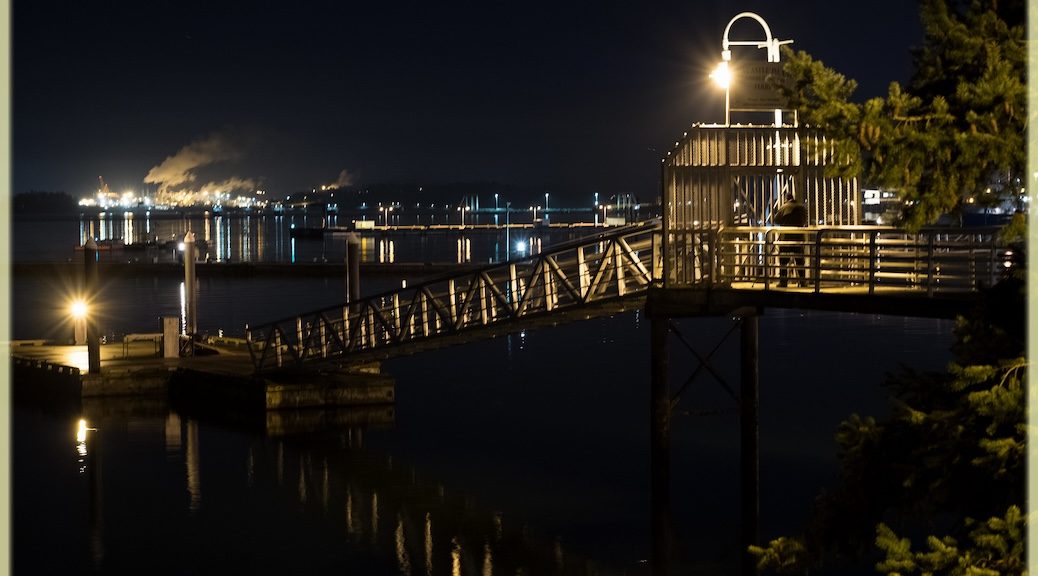
Top image credit: Nanaimo waterfront – Photo by marneejill via Flickr CC BY-SA 2.0)

Sign-up for Cortes Currents email-out:
To receive an emailed catalogue of articles on Cortes Currents, send a (blank) email to subscribe to your desired frequency:
- Daily, (articles posted during the last 24 hours) – [email protected]
- Weekly Digest cortescurrents – [email protected]