
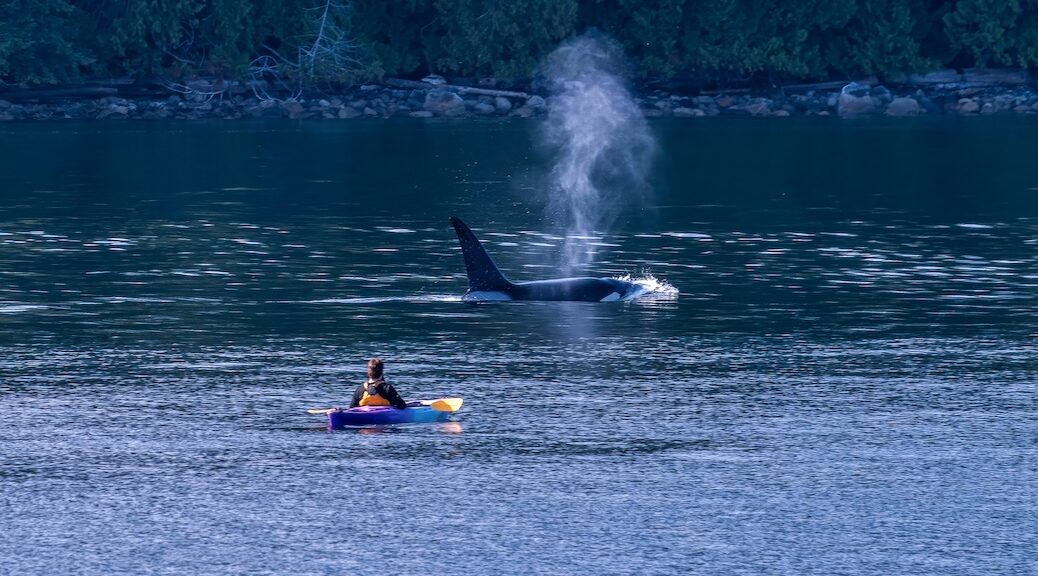

There have been a lot more killer whales and Humpback whales in our waters lately. According to a new study from UBC, the inside waters off Vancouver Island are critical habitat for West Coast Transient, or Bigg’s killer whales. The return of Humpback whales has been heralded as a success story, and there are now also reports of gray whale sightings. Last week, Cortes Currents interviewed two of the scientists involved in this research.
(Image: An orca swims near seals – Credit Andrew Trites, UBC Marine Mammal Research Unit)
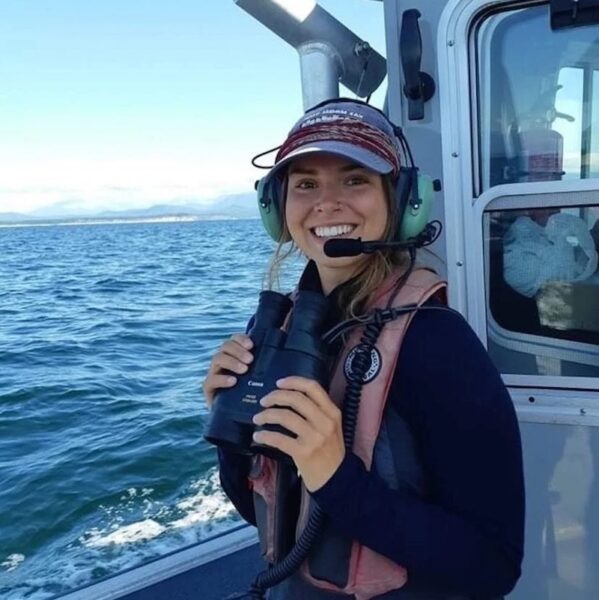
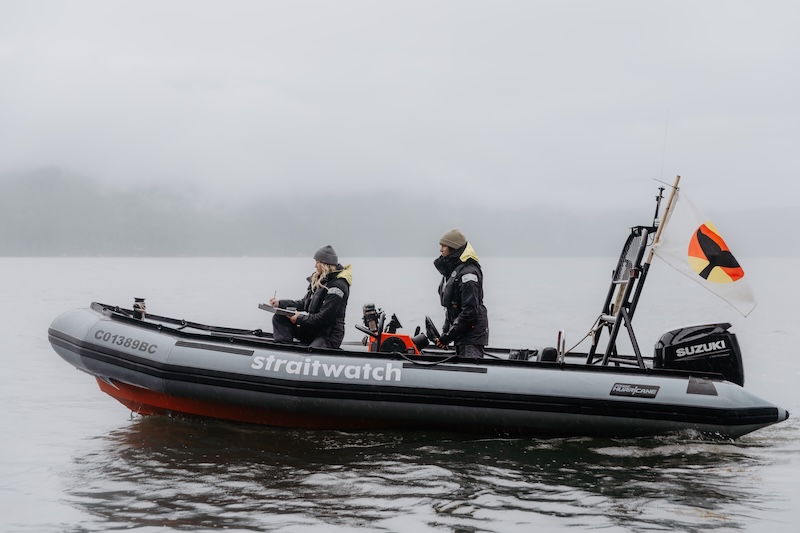
Emma Shuparski from Straitwatch
Emma Shaparski is a Quadra Island resident, coordinator for Straitwatch Quadra, and one of the organization’s vessel operators. She holds a B.Sc. in Geography, with honours, from the University of Victoria, where she specialized in Geographic Information Systems (GIS) to enhance understanding of cetacean habitat use.
She was out on one of the boats when I found her, but agreed to an interview the following evening.
Emma Shuparski: “Our study area extends all the way down to Powell River and all the way north to Kelsey Bay. This is my sixth season on the water doing research in this area. We have a field season that runs from early June to the end of September, but I work year-round doing all the data analysis, report writing, and that kind of thing.”

Taryn Scarff, Lead Author of the UBC Study
Taryn Scarff is the lead author of the UBC study currently making headlines in the news.
“As part of my Master’s Degree at UBC, I looked at the abundance and distribution of transient killer whales in what I call the inside waters of Vancouver Island.”
Cortes Currents: How did you conduct your study?
Taryn Scarff: “I collected killer whale sighting reports from a number of different groups. I used data from whale watchers. The Government of Canada has a BC Cetacean Program and they collect studies, so I used their data as well as Ocean Wise’s whale spotting—along with all of their sightings. Then also some publicly available databases. The Wild Ocean Whales Society is based out of Powell River and they have a website where people report sightings, so using their database, and then Orca Network for some sightings.”

Cortes Currents: Did you get out on a boat as well?
Taryn Scarff: “I was fortunate to get out on a boat, though not as part of my Master’s. I actually worked on a research project in the year before I started my Master’s, and the first year of my Master’s, looking at prey availability and behavior of Northern resident killer whales and Southern resident killer whales. So I was able to get out on a boat for those two years. But my actual Master’s itself was just me on a computer at home, going through all these sightings—databases of thousands of pictures.”
“I separated it into the Salish Sea and what I called the North Island Waters. The Salish Sea was from Campbell River down, and the North Island Waters was from Campbell River up to the tip of Vancouver Island.”
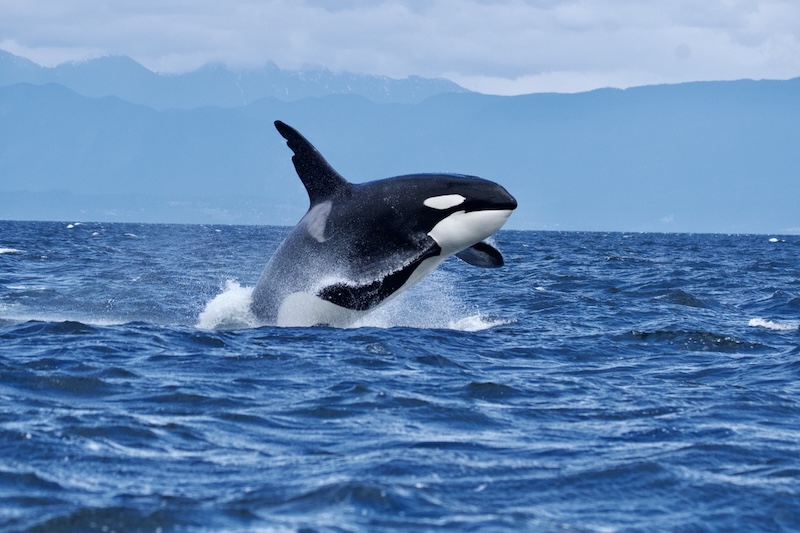
UBC Study: Transient Killer Whales in Our Area
Cortes Currents: Tell us what you found. I’m interested in Vancouver and the general study, but especially any details you have from the Campbell River area—Discovery Islands area. I’m on Cortes Island, which is right in the middle of it.
Taryn Scarff: “Yes, you’re right in it. We looked at the North Island waters to see how many individuals were spending time in that area between the study periods. From 2016 to 2023, about 50% of the entire West Coast transient killer whale population would be seen in and around that area—anywhere from one to two days up to two weeks at a time.”
“From the sightings that we used, about 25% of the year they would spend their time there, with the caveat that there aren’t as many sightings—especially up in the northern end, more toward Queen Charlotte Strait. So there’s definitely a possibility that there are actually more whales.”
“We have a lot of food for the transients because they’re not a fish-eating population. They eat other marine mammals. Especially in this area, they primarily eat Harbour seals and Steller sea lions, California sea lions, and especially farther north, where there’s a lot more porpoises—they’ll prey on them as well.”
Cortes Currents: Has there been an increase in seal and sea lion populations?
Taryn Scarff: “Throughout the past 40 years, they’ve increased a lot. Throughout that same time period, we’ve had a huge increase in the number of Transient killer whale sightings in the area. I mean, the first official Transient killer whale study was done in the 1980s and 1990s, and there were just a handful of sightings and individuals. Now we’re having hundreds here every year. There’s so much more food. The seals and sea lions were culled up until the 1970s. Their populations have since rebounded and have continued to increase year after year. With that, there are more and more transients preying on them year after year—so it acts like a natural cull program for them.”
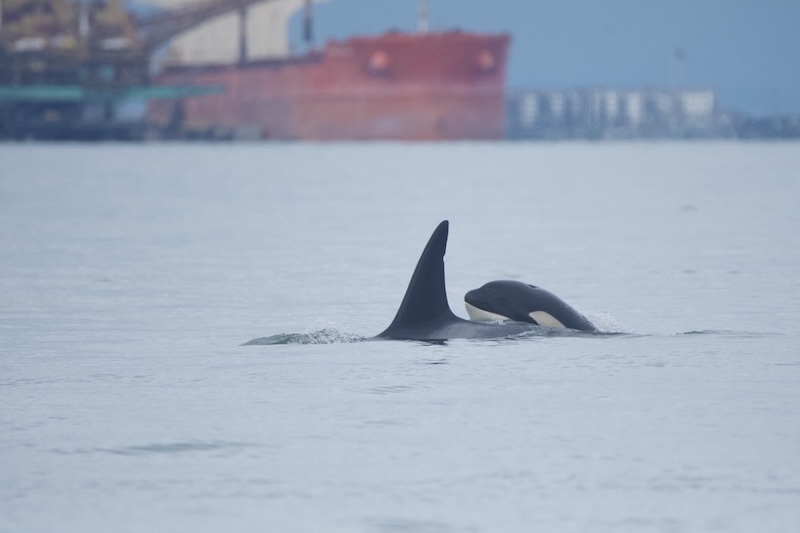
Cortes Currents: Do you have any idea of how many whales might be in the area on a given day?
Taryn Scarff: “Let me pull up my study. The lowest total number per year was around 100. So, looking at the number of individuals on any given day, I would say at least a few groups—probably 15-ish on average. We get them a lot more during the summer months, when they’re spending the most time here.”
“The transients travel in much smaller groups compared to what we’ll see in the residents. Especially in the Campbell River area, you’ll sometimes get northern residents coming down in those huge groups, whereas the transients are usually in groups of three to five. Especially in summer months, there’s always a handful of individuals in the area per day.”
Cortes Currents: So you found there was an increase in the number of killer whales coming through?
Taryn Scarff: “From 2016 to 2023, the number increased every year, going from about 80 individuals in 2016 up to 130 by the end of the study period.”
Straitwatch on Transient Killer Whales in Our Area
Emma Shuparski: “Transient killer whales have been increasing slightly every year. This area has always been a great place to see them, just because we have such a bounty of other marine mammals like harbour seals, Steller sea lions, Harbour porpoises, and Pacific white-sided dolphins. Transient killer whales only eat marine mammals, so this is a great spot and has lots of opportunity for them in terms of their prey. So the population, on average, is increasing by a couple percent a year—but sightings here have always been quite numerous.”

More Northern Resident Killer Whales
Emma Shuparski: “However, for Northern resident killer whales—which are a different ecotype—we’ve actually begun seeing quite a lot more northern residents in this area, particularly driven by one family, the A42s, who previously had never come this far down south, at least in the summer. Now we see them almost every day for two months straight, from July to August.”
Cortes Currents: How many Orcas would there be in this area, for example, on a day like today?
Emma Shuparski: “I would say that on any given day there’s at least one matriline in the area. And a matriline is an eldest female and all of her offspring—so you can think of it like a pod. There was one there today, and they were out by Prideaux Haven today. Sometimes we have as many as three pods in the area, and a pod or matriline can range anywhere from 2-3 individuals up to 15. So it really depends on the ecotype and on the family.”
Return of the Humpbacks
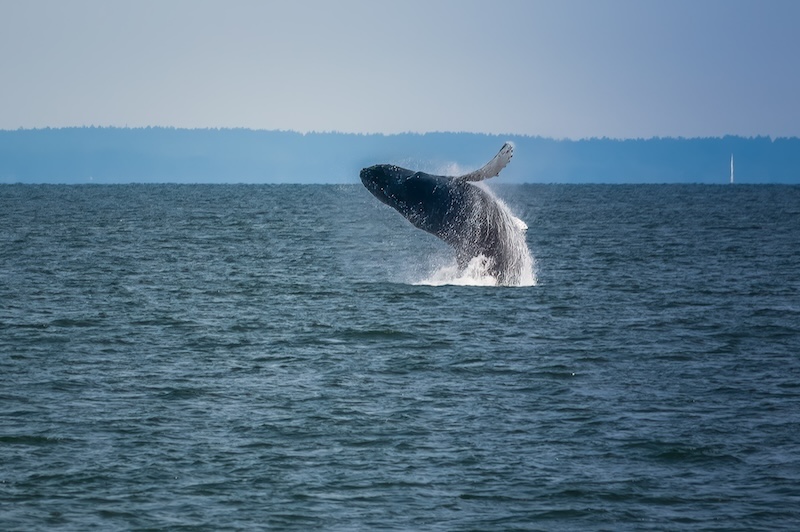
Emma Shuparski: “There’s been a bigger change in Northern resident killer whale activity in the area than in transients, and Humpback whales have also increased massively here in the past decade.”
Taryn Scarff: “I don’t have the specific numbers, but there are quite a few Humpbacks coming back into that area, especially in the Salish Sea.”
Emma Shuparski: “I grew up coming to this area when I was younger, and we would never see a Humpback whale. If we saw one in the summer, we were lucky. We were out in the water today, and we saw half a dozen in an hour. So the Humpback whale presence here has increased largely just because the population has recovered, and as the population has recovered, individuals have slowly begun to explore other parts of their ranges and slowly return to these areas.”
“A hundred years ago, there used to be a whaling station in Whaletown—that’s how it got its name, I believe. Those whales that were exterminated from this area, their ancestors are coming back and rediscovering it because you have so much richness and diversity, particularly krill—which is what Humpbacks are after here.”
Gray Whales Arriving
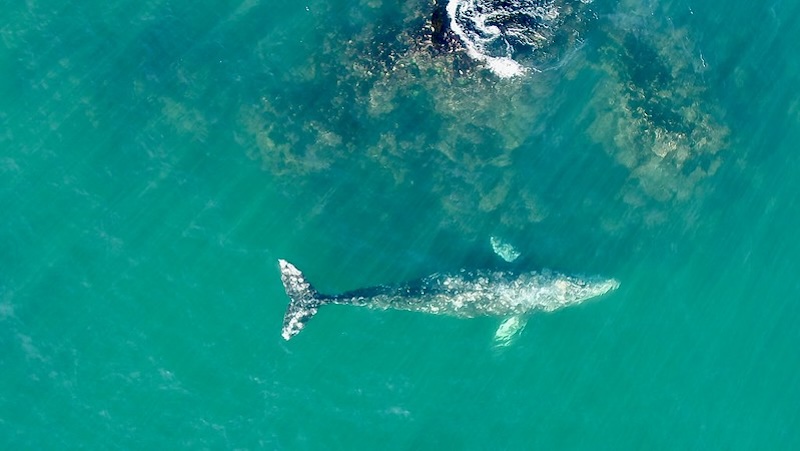
Cortes Currents: Taryn’s mentor and a co-author in her study, Dr. Andrew Trites, recently told UBC News that gray whales are starting to visit our area: “Which is unusual. They’re usually seen along the outer coast of Vancouver Island.”
Taryn Scarff: “I believe gray whales would be more rare up in that area. Even off Vancouver, we only get a handful each year, and I think it’s even more rare for them to be seen up at Campbell River, Fort McNeil, Port Hardy, up there. Puget Sound gets quite a few more than we do.”
Emma Shuparski: “We do get gray whales here, but not frequently. We get about one a year. We had one cruise by town two weeks ago. Two years ago, we had one hang out for about a month in Gowlland Harbour, which was quite unique. That was in October. But usually they’re pretty transient visitors—they’re coming up the Inside Passage trying to get to Alaska as fast as they can.”
Our Area is an Important Feeding Ground
Cortes Currents: Is there anything you would like to add?
Taryn Scarff: “The overall takeaway from the study is how important this whole area is for not just transient killer whales, but all whales in general. It seems to be a huge feeding ground for them, and they are coming back in bigger groups and more numbers year after year.”
Regulations for Marine Viewing
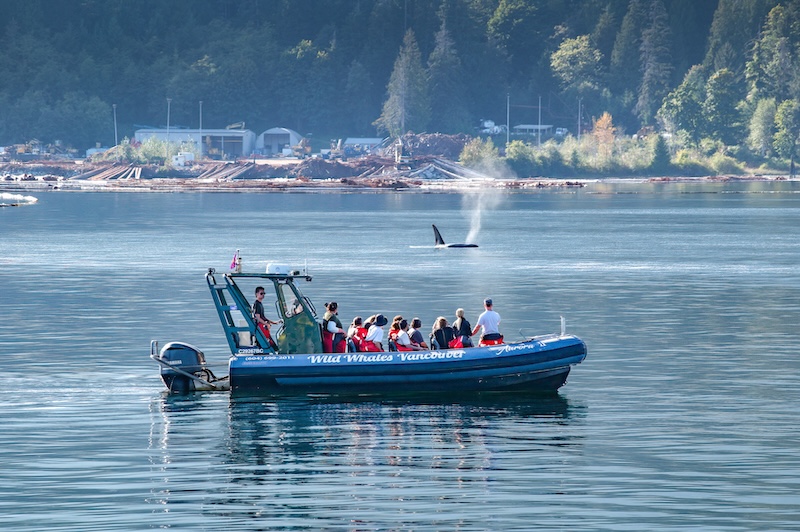
Emma Shuparski: “I would love to share that the regulations for marine mammal viewing have changed this year. It used to be that you had to be 400 meters from all killer whales south of Quadra Island and Cortes, and now it’s 200 meters—with this exception: in order to have cross-border consistency with the US, we’ve changed our regulations, so we now have to be 1,000 meters away from southern residents.”
“DFO is relying on members of the public to be able to distinguish between ecotypes. We have our southern resident killer whales, which are very endangered, our Bigg’s killer whales, and our northern resident killer whales.”
“The vessel traffic around orcas in our area has been increasing every year. So we’ve been collecting vessel traffic data in this area since 2018, and we’ve seen a measurable uptick in vessel presence, as well as the rate of incidents and violations of the marine mammal regulations.”
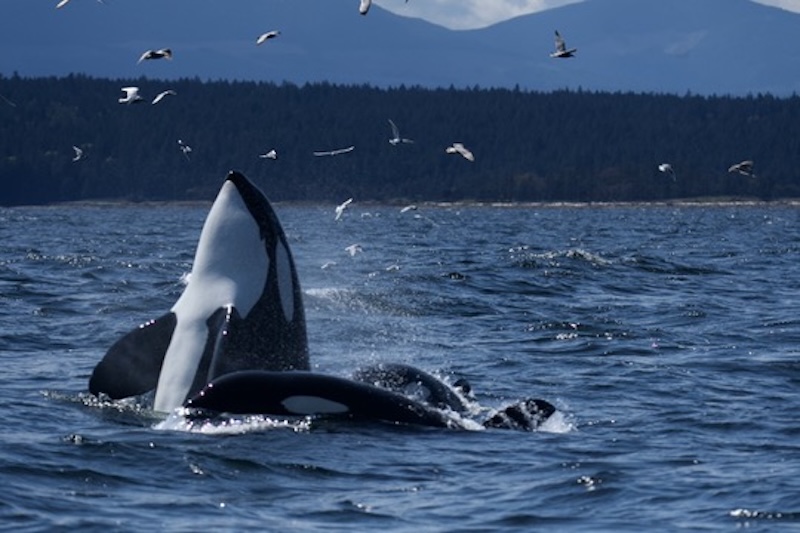
Cortes Currents: Do you notice if the orcas, Humpbacks, or any other whale species is feeling confused by all this traffic?
Emma Shuparski: “It’s hard to say anecdotally, but studies have shown that any vessel presence within 400 meters can be the source of a behavior change—particularly with resident killer whales, especially female resident killer whales. That’s why these distances are so critical. At Cetus, we always advocate for a 400-meter distance for all killer whale ecotypes. That seems to be the distance shown to have the potential to cause disruption in foraging and social behaviours.”
“Anecdotally, it’s really difficult to tell from the surface if a whale is being bothered or disrupted. That’s why people often say, ‘If whales are so disrupted by vessels, then why do they go into Discovery Passage, or why are they foraging in Willoughby Shoals with all of these boats around?’ When you look at behavior change across many different events, you can see the likelihood of disturbance if a boat is within 400 meters.”
Cortes Currents: What do you mean by behavior change?
Emma Shuparski: “Like a stop from foraging. Switching from foraging to traveling is a really common one you’d see, or switching from resting to traveling, socializing to traveling. Traveling can be seen as an avoidance behavior, to get away from boats.”
“Killer whales rely a lot on echolocation to find food, particularly resident killer whales. So if there’s too much vessel noise around, they can’t properly hear the echolocation clicks—and they’re not going to waste their time foraging if the success isn’t going to be worthwhile.”
Links of Interest:
- Why so many whales are in Vancouver waters—and how to (legally) spot them – UBC News
- The Inside Waters of Vancouver Island Are Critical Foraging Habitat for West Coast Transient Killer Whales – Taryn M. Scarff, Jared R. Towers, Andrew W Trites, Marine Mammal Science
- Where Killer Whales and Dolphins Hunt Cooperatively – Cortes Currents
- Straitwatch: the Discovery Island’s ‘whale police’ – Canada’s National Observer
- How Whaletown Got It’s Name – Cortes Currents
Top image credit: An orca travelling between Gambier Island and the Sunshine Coast in Howe Sound – Credit/ Andrew Trites UBC Marine Mammal Research Unit
Sign-up for Cortes Currents email-out:
To receive an emailed catalogue of articles on Cortes Currents, send a (blank) email to subscribe to your desired frequency:
- Daily, (articles posted during the last 24 hours) – [email protected]
- Weekly Digest cortescurrents – [email protected]