
Editor’s Note: Four of the 17 First Nations supposedly belonging to the Coalition of First Nations for Finfish Stewardship asked that their names be removed when this organization was first announced. They were the Mamalilikulla, Namgis and Kwikwasutinuxw Haxwa’mis First Nations (collectively referred to as the “Broughton First Nations”) and the Klahoose First Nation. This was apparently not done.

By Sonal Gupta, Canada’s National Observer, Local Journalism Initiative Reporter
Some BC First Nations want Ottawa to cancel its ban on open-net salmon farms and hand them the reins of a reformed system that could better protect both wild salmon and jobs in their communities.
In 2024, the federal government announced it will phase out open-net salmon farms by 2029 over concerns about disease, sea lice and pollution harming wild salmon. Farms are expected to move to closed containment or land-based systems.
Environmental advocates and First Nations groups, including the First Nation Wild Salmon Alliance with 120 member groups and the Union of BC Indian Chiefs, have long pushed the federal government to end open-net farming saying that pathogens, lice outbreaks and escapes from net pens threaten the long‑term survival of native wild‑salmon stocks.
But the policy is already triggering a wave of job losses and increased food insecurity in remote coastal communities, some First Nations residents say.
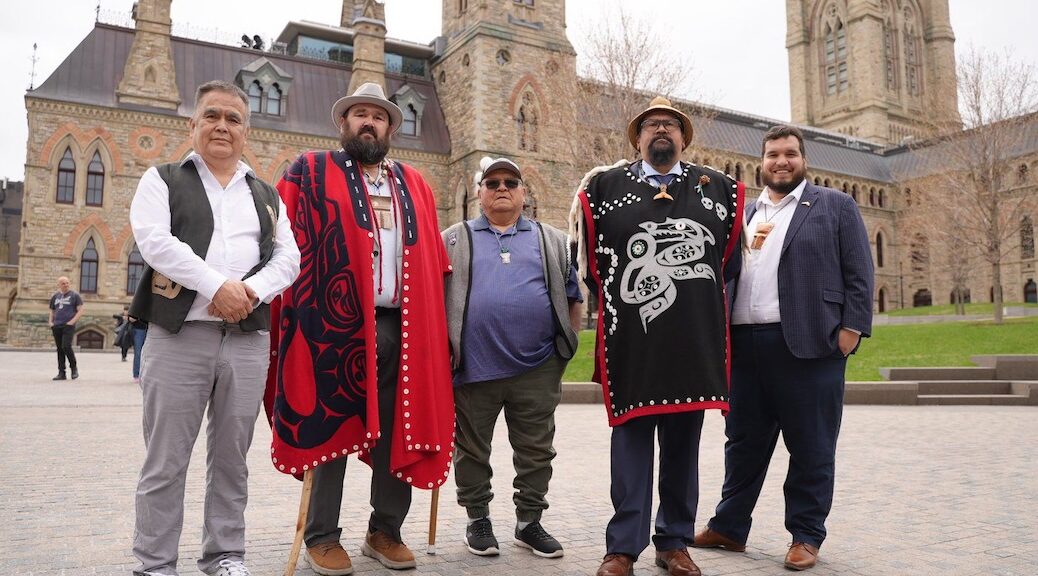
Members of the First Nations Finfish Stewardship Coalition — a group of 17 First Nations from the central and north coast of BC, as well as western and central Vancouver Island, travelled to Ottawa recently and held a press conference on Parliament Hill to call for an immediate change in federal direction.
On the same day there was another presser in Ottawa, where the First Nation Wild Salmon Alliance called on Ottawa to keep the 2029 deadline and fully implement the phaseout.
Dallas Smith, of the Tlowitsis Nation, told Canada’s National Observer the federal government made a dangerous and irresponsible decision to ban net-pen salmon farming because of political pressure from urban Vancouver activists. Ottawa made the decision without transition or mitigation plans, risking thousands of jobs in remote First Nations communities, he said. Now, many places that are accessible only by plane or boat lack job alternatives.
“We can’t just go to Walmart or just go to the next available job place in remote communities. These are career, family-supporting jobs, and to just simply take them away without any kind of transition plans or opportunities is irresponsible as well,” Smith said.
Smith noted the salmon aquaculture sector in BC has already shrunk by about 40 per cent since the 2029 net‑pen ban was announced, leading to roughly 1,000 job losses.
Communities want more control over how farms operate in their territories, said Smith, who is also a spokesperson for the coalition.
At a press conference in Ottawa, the nations proposed a five‑pillar plan that would continue salmon farming past 2029. As part of the plan, the nations are requesting a shift toward an Indigenous‑led aquatic health science centre, a Nation‑led stewardship fund financed by industry payments, greater government investment and territory-specific siting and implementation of new barrier and monitoring technologies. They are also seeking increased First Nations equity in processing and harvesting and, by 2029, the option for First Nations to issue their own salmon aquaculture licences on their own waters.
First Nations have already started their own research and introduced systems to address conflicting concerns from activists, government and industry, Smith said. They are tracking sea lice, testing technologies and monitoring waters in their territories. Guardian programs are ensuring community members watch farms daily to enforce licences and standards, Smith said.
In Ahousaht territory, Smith said bubble-skirting and site-specific technologies slashed sea lice levels without mechanical delousing, dropping from 1.93 motile lice per fish in 2022 to 0.30 last cycle under Indigenous standards that are stricter than federal rules.
“If we thought wild salmon were being harmed by this industry, we wouldn’t be involved in it,” Smith said. “We’re working to make sure the industry is accountable and we’re using some of the benefits to invest in wild‑salmon restoration and habitat protection.”
Smith said June is the make-or-break moment when salmon-farming companies must decide whether to stock new fish for a six-year grow-out cycle. Without clarity on the ban’s future, companies risk investing now only to later cull millions of healthy fish or shut production down early.
“It’s just as time has gotten closer and the job losses are starting to pile up,” Smith said. “The lines at the food bank are growing from jobs that used to be in place. And now the drop‑off is going to be quicker.”
Isaiah Robinson, deputy chief counsellor of Kitasoo Xai’Xais Nation, said the nations have partnerships with aquaculture companies and long-standing contracts that limit project harms and ensure communities share economic and social benefits. Before the farms arrived, his community — which is situated on the central coast of BC — faced high unemployment and social challenges, including addiction and mental‑health crises. The jobs and training from the salmon industry, he said, have helped stabilize the community.
“This industry has been able to give our membership a purpose, to get out of bed… it keeps them happy [and] focused,” Robinson said.
He is worried a full ban would be devastating to his community, where the industry represents 51 per cent of the economy. Its collapse, he said, could cause a resurgence of those social issues.
Smith, who was one of the architects of the Great Bear Rainforest agreement that brought together First Nations, environmentalists, forestry companies and government, said that deal worked because all parties sat down and negotiated a middle ground, protecting the environment while allowing economic development.
But when he and other nations pushed back on salmon farming because “we still need an economy,” he said, “that’s where some of those relationships start to get fractured.”
Smith said they will continue working with the federal government, but communities are prepared to take independent action in their territories if needed.
Canada’s National Observer contacted Fisheries and Oceans Canada but did not receive a response before publication.
Links of Interest:
- 102 BC First Nations call for fish farms to be transitioned onto land – Cortes Currents
- The First Nations calling for a renewal of fish farm licenses – Cortes Currents
- First Nations Calling for Finfish Stewardship
Top image credit: Members of First Nations for Finfish Stewardship Coalition, a coalition of 17 BC coastal First Nations in Ottawa on April 29, 2026. – Photo submitted by Dallas Smith.

Sign-up for Cortes Currents email-out:
To receive an emailed catalogue of articles on Cortes Currents, send a (blank) email to subscribe to your desired frequency:
- Daily, (articles posted during the last 24 hours) – [email protected]
- Weekly Digest cortescurrents – [email protected]