Tag Archives: DFO

Billions in federal buildings, roads and other assets at risk from climate change

By Natasha Bulowski – with files from Rochelle Baker, Canada’s National Observer, Local Journalism Initiative Reporter 

Canada’s auditor general wants to know whether the federal government is doing a good job protecting its assets — including dams, buildings, vehicles and more — from the increasingly severe impacts of climate change.

The Department of National Defence received a notification letter — obtained by Canada’s National Observer through an access to information request — that the auditor general is launching a performance audit of “Protecting Federal Assets From Climate Change.”

The audit is for the government-wide Greening Government Strategy but pays special attention to three key departments — Fisheries and Oceans Canada, National Defence and Public Services and Procurement Canada — to assess their progress on protecting their assets, services and activities from climate change.

Continue reading Billions in federal buildings, roads and other assets at risk from climate change

DFO ‘legacy of neglect’ leaves North Coast salmon to flounder

Canada’s National Observer, Local Journalism Initiative Reporter

Fisheries and Oceans Canada cut the monitoring of salmon streams along BC’s North and Central Coast, leaving critical stocks uncounted at the height of spawning season.

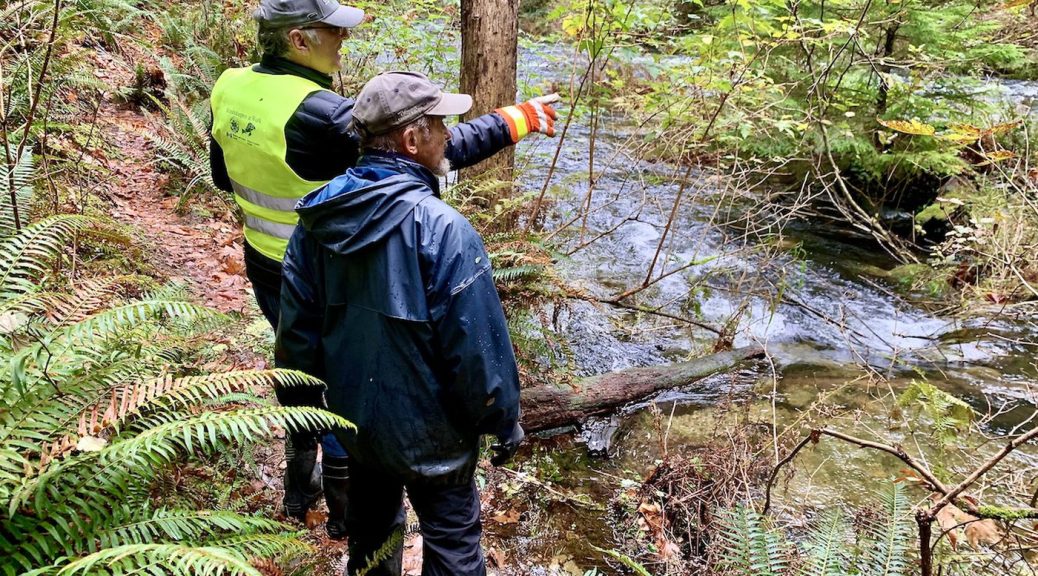
Seasonal “creek walkers” — contractors for the fisheries department (DFO) who trek along streams to record salmon returns — haven’t been hired as stocks return along the coast from Bella Bella to the Alaskan border, including major watersheds like the Skeena, Nass and Kitimat systems, says a coalition of conservation groups

Continue reading DFO ‘legacy of neglect’ leaves North Coast salmon to flounder

European Green Crabs Reach Cortes Island

Originally published, as part 4 of the Cortes Island Resonance series by the Cortes Community Radio Society.

An unwelcome visitor has arrived on Cortes Island’s shores, triggering alarm among scientists and conservationists. The invasive European green crab (*Carcinus maenas*)—considered one of the world’s most damaging marine invaders—was confirmed in Mansons Lagoon in 2024, marking the first documented sighting in the Discovery Islands. The species’ appearance has set off a coordinated response from Fisheries and Oceans Canada (DFO), the Klahoose First Nation, and Friends of Cortes Island (FOCI).

Continue reading European Green Crabs Reach Cortes Island

Q&A With NIPR’s Green Party On Some Key Environmental Questions

While the Canadian government likes to think of itself as a leader in environmental stewardship, there have been a number of concerns: 

  • A lack of urgency in addressing climate change
  • While the number of extreme weather events continues to increase in both size and magnitude, so does Canada’s production of the fossil fuel products that are the leading contributor to our emissions. In 2024, Canada’s oil production reached a record 5.7 million barrels per day, with  the oil sands accounting for approximately 57% of this output.
  • Weak enforcement and monitoring of environmental laws and regulations
  • According to COSEWIC, there are now 850 Canadian wildlife species at risk, but the government is very slow to respond to this growing crisis.

Cortes Currents emailed the Conservative, Green, Liberal, and NDP campaign headquarters in North Island Powell River (NIPR) a list of questions designed to get to the heart of this matter. So far only Mark de Bruijn, Campaign Manager for the Greens and a former Green candidate in 2019, has answered.  

Continue reading Q&A With NIPR’s Green Party On Some Key Environmental Questions

Wilkinson warns Poilievre’s resource approval plan will end ‘in court on an ongoing basis’

By Natasha Bulowski, Canada’s National Observer, Local Journalism Initiative Reporter

Conservative Leader Pierre Poilievre is pledging to create a “one and done” system for resource project approvals and rapidly approve 10 projects he says are stuck in the “slow federal approval process.”

To achieve a maximum approval wait time of one year, Poilievre said he will eliminate the Impact Assessment Act and create one office and one assessment process to handle all regulatory approvals across all levels of government.

This proclamation comes a few weeks after Prime Minister Mark Carney announced his intent to streamline the approval process for big infrastructure projects in response to the trade war with the US. Carney said his plan, with a similar slogan to that of Poilievre’s — “one project, one review” — would aim to get projects approved within two years. 

Continue reading Wilkinson warns Poilievre’s resource approval plan will end ‘in court on an ongoing basis’