


Friends of Cortes Island (FOCI) recently had its AGM. This is also Helen Hall’s seventh year as Executive Director. So Cortes Currents asked her for an overview of this past year and how the organization has changed during her tenure.
Helen Hall: “That’s a big question, FOCI has always been doing a lot of different projects. I act as the central point for FOCI, but there’s a lot of work going on with volunteers and our contractors.”
“The lake project started when I first started. In 2014 there was a big algal bloom on the lakes and that started our lake program. For the first few years we were monitoring the lakes to see what was going on, and that then enabled us to apply for a grant to investigate what we could do about the nutrient issues in the lake. We got a grant to investigate the feasibility of using bioremediation, for plants to take up nutrients. This led to another grant, which was the creation of the Dillon Creek Wetland Restoration Project that went in last year at Linnaea Farm.”
There are three aims for that project:
- To attract more wetland wildlife.
- To try and use the wetlands is a filter to take the nutrients out of the water coming through Dillon Creek into the lake.
- To really provide a wonderful resource for the community to learn about wetland ecology.
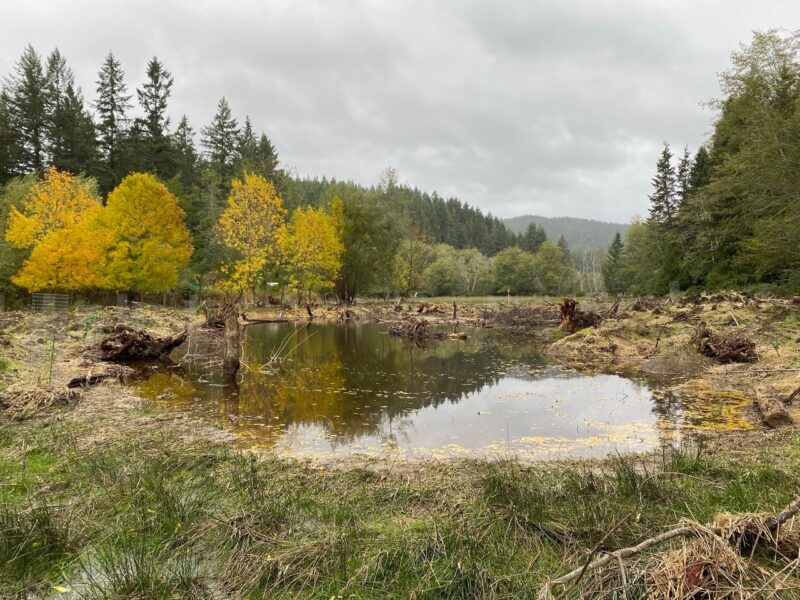
Helen Hall:“This project’s been run by Autumn Barret Morgan and Miranda Cross, and they’ve been running a lot of different work bees.”
“Some of our projects have grown over the years like that.”
“We’ve always been running marine monitoring programs. Our forage fish project, which we took on a few years ago, is helping to identify beaches where forest fish are spawn. Those projects are really important for providing data to scientists and also tells us more about our local environment.”
“I think we’ve got more adept now at working with bigger organizations when we do our monitoring work. And that probably goes through all our work, through our ‘Species At Risk’ work.”
“One of our new projects that we started was to look for Western Screech Owls on Cortes and our neighbouring islands: Read, Maurelle, and Sonora Islands. The reason we’ve chosen that project is because it’s a species at risk. It’s numbers have declined dramatically in the last 20 years. We’re hoping we’ll find some, but the research we’re doing here is contributing to larger scale research being carried out by scientists based on Vancouver Island, so we’re contributing to their knowledge of the owl. I understand you’re going to be doing a radio interview soon with Sabina Leader Mense about that, so I won’t go into too much more depth. I’m just thrilled we got three years of funding from the government for that project because it shows that they’re taking us seriously as an organization, and we’re doing some In depth research on a species at risk.”

“We also partnered with the Hakai Institute on a couple of marine monitoring projects. One was called the Sentinels of Changed Light Trap Project. What that was about was putting light traps into the water throughout the Salish Sea, trying to monitor for Dungeness Crabs. Their lavae is attracted to light and we have a light trap in Cortes Bay. Mike Moore and Kate Madigan were coordinating that project. We did find some larvae, but we also found a bunch of really interesting other marine life. Very small critters, everything from a Quill Fish through to Bobtailed Octopus. We actually had the highest number of other species in our light trap in the Salish Sea.”
“We were approached by Department of Fisheries and Oceans, who wanted us to help them monitor for the invasive European Green Crab. it’s spreading throughout the Salish Sea and does alot of harm to coastal ecosystems. We know it’s in the Campbell River Estuary. DFO is trying to get into locations to see if it’s spreading and came over in the summer. We did some traps in Coulter Bay and Mansons Lagoon. It was funny because it’s one of those things where you actually don’t want to find something and we didn’t find them, so that was good, but we’re going to carry on that project now every year. DFO said if we do find the green crabs, they’ll send a team over to trap out the area to remove them.”

“Our Streamkeepers project is run by Cec and Christine Robinson. They do spawner accounts in the fall to count the salmon returns and then this year they did some stream incubation where they put chum eggs into incubation boxes at Basil Creek and Whaletown Creek and then did a fry release in those creeks. There was a bit of an issue with the Basil Creek incubation box, sadly, because it got washed out in the storm, but that’s really great work that’s going on with the stream keepers.”
Cortes Currents: I know the Streamkeepers work closely with DFO and the Klahoose Hatchery.
Helen Hall:“Those projects are really important for providing data to scientists and also tell us more about our local environment. We’ve probably got more adept of being, I don’t know if I want to use the word professional, but I feel that we’re getting more recognized for our research work that we’re carrying out.”
“I’m determined that every time we do any monitoring work that we do it with project partner organizations so the data can go back to another organization to analyze it and to use it.”
“We’ve always been concerned about climate change, but we haven’t really had the resources to do much about that in terms of an actual project.”
“We’ve taken on a climate change project from the Climate Hope group. We’re trying to decide on the name, but I think we’re going to call it the Cortes Climate Resilience Project. At the moment we’re working with three university students to assess climate change risks on Cortes and determine best practices for community climate change planning.”
“At the same time, we’ve been promoting home energy assessments to help get energy retrofit funding to make the homes more energy efficient. That’s a new thing for us, but that’s really exciting and I think that project’s really going to grow as we go forward.”
“We’re also trying to get more engaged with the community. This is something we want to work for in going forward. We try and run events and activities in the summer. What we’re trying to do now is look at how we can expand that throughout the year. Something we’d like to do is enable other people to take action for wildlife.”
“A lot of people think FOCI is doing all the environmental work on the island, but actually what we want to do is enable other people to do that, which I guess we do through our volunteers, but we’d love people to take action at home for nature.”
“Our summer assistant Shannon Hogan launched two blog series for us on our website and on our Facebook page. One is called Small Acts of Conservation Kindness, where we’ve been trying to encourage people to do something where they live for nature. That’s anything from putting in a frog pond, to putting up a bird box. So that’s a blog series that is now carrying on every month through the year. The other one we did was highlight common species that people see, like the Douglas Squirrel and Ravens rather than species at risk. That’s been a popular blog series, so we’ve been doing that as well.”
Cortes Currents: FOCI also does a lot of maintenance work in the community.
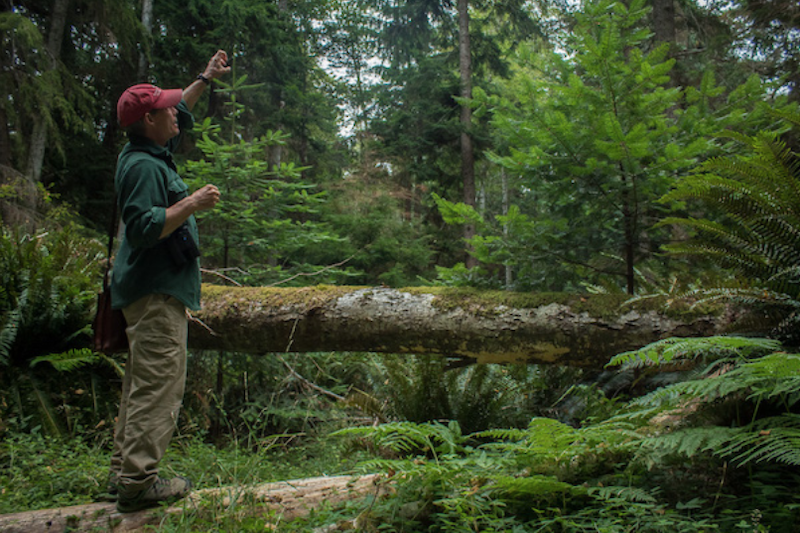
Helen Hall:“We manage nine regional parks and beach accesses for the Strathcona Regional District. That’s everything from Carrington Bay through Kw’as Park. This work is carried out by Alex Bernier and Ryan Harvey. They actually walk each trail of every park once a month, cutting back vegetation, removing fallen trees. They also do repairs and some infrastructure projects. One of the things we’ve just done is put a new wooden bridge at the beaver swamp entrance into Kw’as Park.”
Cortes Currents: Tell us about a couple of volunteer work bees.
Helen Hall:“We did our annual Broom bash at Manson Spit. We’ve been doing that now for six years and the goal of that was to try and get the broom originally out of the coastal sand ecosystem, which is the grassy ecosystem you see growing along the beach,and is is actually quite a rare habitat. We go back every year just to cut back the regrowth.”
“I think you came along Roy, to the our beach cleanup between Seascape and Hollyhock Beach. We collected a bunch of garbage from the beach and that was very kindly sponsored by 10,000 Whales, a project that Leslie Mumford’s running, where she sells 10,000 products and money from that goes into marine conservation. That was a really lovely partnership and it was a good day. I remember we were getting really big bits of styrofoam off the beach. We are trying to do that every year now.”
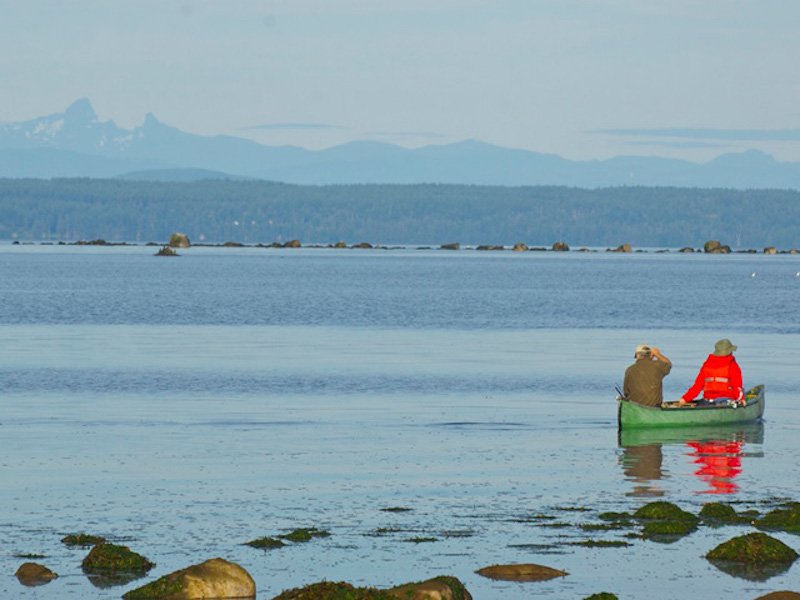
“Another thing I should mention is that we produced a new marine sign about the marine life in the lagoon at Manson Spit Provincial Park. So that was a good partnership with BC Parks.”
“We want to definitely work more with the community and engage community going forward.”
“We’re very lucky where we’re living on such a beautiful island with such an amazing range of different ecosystems and species here.”
“There are a lot of threats out there to the natural world, not just climate change. It’s quite alarming what’s happened to nature in the last 30 years. There have been massive declines in species and habitats. There’s a big conference going on in Montreal at the moment, looking at biodiversity targets and what we can do for nature.”
“it’s good to remind ourselves that we are lucky to be where we are. And it’s good to remind ourselves the natural world is really under threat and organizations like FOCI are very important in doing what we can to look after the natural world.”
Top image credit: Violet-green swallow feeds her nestlings in nest box – Photo courtesy Jim Paris via FOCI website
Sign-up for Cortes Currents email-out:
To receive an emailed catalogue of articles on Cortes Currents, send a (blank) email to subscribe to your desired frequency:
- Daily, (articles posted during the last 24 hours) – [email protected]
- Weekly Digest cortescurrents – [email protected]