In early July, I conducted an in-depth interview with Eli, in which we discussed wildfire risk in greater detail. I had a lot of questions: Why and how has this risk intensified over the last twenty years? How is our fire department responding to the growing hazard? What can Cortes Islanders do to protect themselves and their homes?
Eli stood by his comments at the emergency preparedness workshop:
In my own opinion, it’s our biggest risk on Cortes, overall. Well, there’s earthquake scenarios and that kind of stuff as well — which we should be aware of and planning for — but the risk of catastrophic wildfire, to me, is the big one.
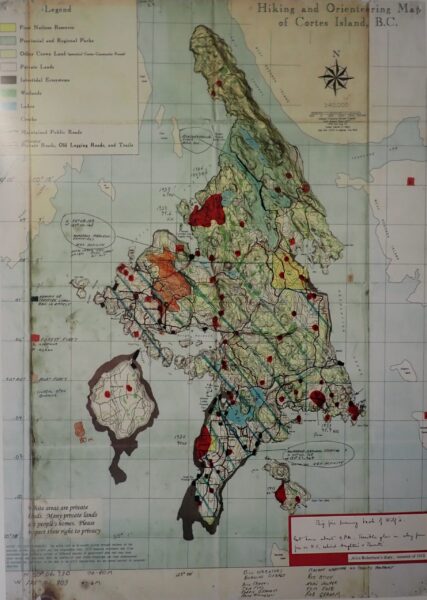
Historical map of wildfires on Cortes Island (at Fire Hall)
How Things Have Changed
For many residents of the Strait of Georgia, catastrophic wildfire seems like something that “happens someplace else” — in the interior, up on the plateau, or in the far north. And as Eli explains, once upon a time this was so.
Historically pretty much the entire coastal fire center, which is, you know, the lower mainland all the way up the coast on the west side of the Coast Mountains and Vancouver Island, has been considered to be fairly low risk for catastrophic wildfire. We do get a number of starts — the average for beginning of July is about 174 starts for the whole fire centre. But basically the entire BC coast is historically considered to have a low fire risk. We do get fire starts, but they generally stay small and are easily contained.
But over the last decade, we are definitely seeing warmer, drier temperatures here. And we also see decades of buildup of forest fuels due to current forest management practices. So we have a lot more light fuels and denser regrowth , and in many areas poorer forest health, that contribute to a higher fuel loading and more flammable fuels than, say a climax coastal rainforest would typically have.
Clearcuts followed by dense ‘pencil farm” planting result in a shrubby understory and closely spaced young trees, rather than the spacious, cathedral-like structure of a climax rainforest with an almost clear mossy floor and widely spaced giant trunks.
Pancil Farm
Replant density is very high because it’s planted to maximize timber production. And one of the really critical metrics for fire spread in the FireSmart world is stem spacing. When you have 100% crown overlap, and you have lots of thin stems closely spaced, with a lot of ladder fuels and so on, you tend to get much higher fuel consumption when you do have fire — and faster spread. So our climate changing has — in concert with the increase in forest fuels and the increase in development in interface and intermix areas — quite significantly, in my opinion, increased our fire risk in pretty much the whole Coastal Fire Centre, but specifically on Cortes.
And we see that with things like, our summer in 2023 when [we had] I think it was close to 120 days with no rain. And temperatures in the 30s and so on. Which is pretty atypical for Cortes in the past.
Experienced firefighters are now finding that fires don’t behave in the ways that tradition and conventional wisdom would lead them to expect.
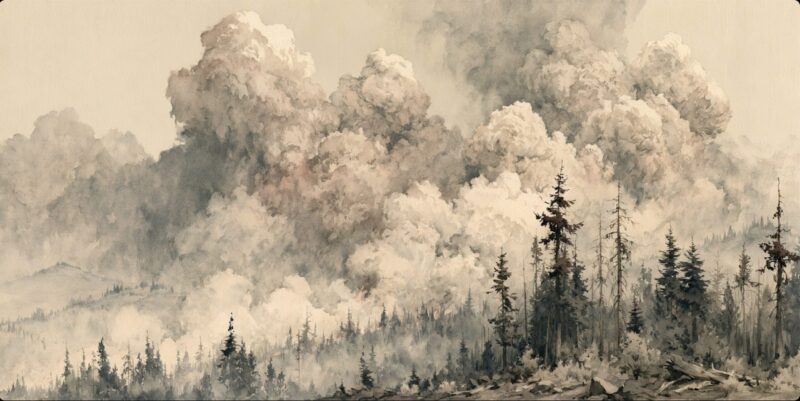
One of the pieces of conventional wisdom has been that you don’t see rank four and five and six fires in the Coastal Fire Centre. So a Rank Five fire is like a fully running crown fire, where trees are burning ground to crown, and you have a fast-moving, organized, highly destructive fire front. And Rank Six is like firestorm behavior, where you have pyrocumulus clouds and all that kind of stuff.
Pyrocumulus forming
So typically these are seen in the interior and in northern BC and all, but not in coastal. But last year, there were two fires, Mount Underwood and Wesley Ridge, that had Rank Five fire behaviour! To me the silver lining is that now we can point to that, and say “It does happen in coastal.”
Why is it important to be able to point this out? According to Eli, the traditional methods of risk assessment are not keeping up with the changing climate and fire behaviour.
Typically, the risk assessments for an area are based on historical data, and it’s a sort of a 30-year retrospective look at climate conditions and all of the indexes and so on.
And , they only use up to the 95th percentile. So the most extreme weather conditions over the past 30 years are not included in the modeling ’cause they’re considered to be outliers. My sense is that we’re spending a lot more time in that worst 5% than we used to. And I am concerned about whether current risk assessments from the province and local government and so on adequately take this change into consideration.
Eli emphasises that the Province is starting to update their methods:
I do know that as of this year, they have some new and fairly powerful real-time modeling tools. So I think this is changing. BC Wildfire sent three people out to do a training exercise with us this spring, which was really successful. And we got great compliments from them as far as our level of preparedness and training, which was gratifying for everyone. And they used those tools to model our exercise scenario based on the fuel types — which they ground- truthed before the exercise to make sure it matched what’s on their maps. And then they took actual weather data from 2023 and applied that to the scenario and picked sort of an arbitrary wind value, and were able to model some fairly alarming fire behaviour for us to conduct the exercise around.
We discussed how the Fire Department is trying to adapt to the changing face of wildfire in the Coastal Fire Centre region: by increased training and practise, acquisition of specialised equipment, and the formation of the Wildfire Brigade, a group of auxiliary volunteers specifically dedicated to fighting wildfire on the island. The Brigade now includes enough people to nearly double the size of our firefighting force if called on in an emergency. But despite all our best efforts, Eli says, wildfire at a certain intensity is beyond our capacity to contain:
In any crown fire, like rank four and up really, it’s really dependent on aircraft. There’s not much you can do on the ground — unless you’re able to get kilometers ahead of it and cut machine guard, and then burn off what’s in between your guard and the fire. And that’s a hard thing to imagine being particularly feasible on Cortes.
Air Support
So in the event of a major wildfire, we would be really dependent on BC Wildfire for fire suppression. And we’ve been told by BC Wildfire that we are high priority — if we have a fire that’s threatening homes and so on, that we would most likely receive assistance from them quite quickly. But our big piece, and something that the fire department has been working on extensively, is increasing our sprinkler protection capacity. BC Wildfire and the fire service in general has in recent years put a lot of focus on structure protection in addition to traditional wild land firefighting.
Protection of Homes and Other Structures
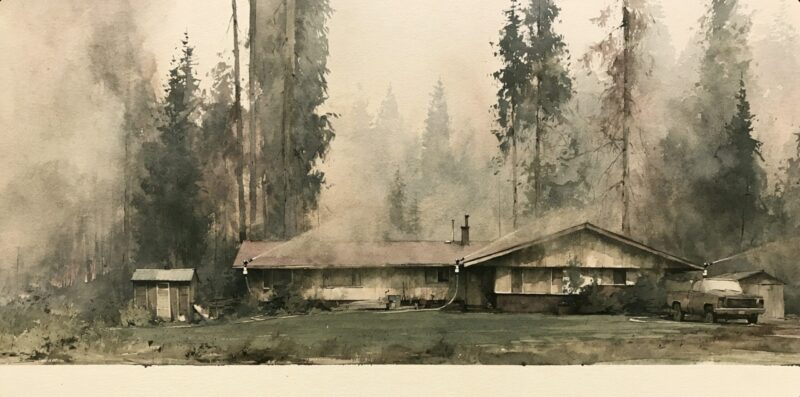
We discuss the little-known fact that most structure fires result, not from the passage of the highly destructive fire front, but from embers and sparks being carried on the wind; and this means that using sprinklers to wet down buildings and their surrounds is quite effective in saving habitation and infrastructure.
Sprinklers are a part of it. The bigger piece really is FireSmart. So as far as community actions, people taking the initiative to FireSmart their homes and properties is, is the biggest ask from us.
Roof Sprinklers in Action
Eli explains that “FireSmarting” your home reduces risk in a couple of different senses. It makes your home less likely to catch fire, but also more likely to be on the list of “saveable” structures as the Fire Department assesses practical priorities in the event of a nearby wildfire.
If there’s an approaching fire and we have, say, a neighbourhood threatened, the first thing that we or BC Wildfire — depending on who’s in charge of the incident at that point — will do, is to basically triage the neighbourhood. That means we go through, we assess the homes and properties, and we determine first off which properties are safe to operate on.
So we need to have enough clear space that we’re not putting ourselves in danger, and we need to have good access and egress. And then we also need to see that properties are in a state where they are protectable. So if you have, say, a house which has got overhanging cedars growing up against it, and it’s got a cedar shake roof and shingle walls and piles of debris around it, and the brush is right up to the house — we could throw the entire department at that and fail to save it… meanwhile losing the rest of the neighbourhood, while there may be homes in the neighbourhood where a quick check and a couple of sprinklers is all they need.
So in a major event, we are gonna prioritise our resources and start with the easy wins.
Firefighter dragging hose into position
In the full interview (episode 2) we discuss the FireSmart programme in much more detail; Eli reiterates that it’s the single most important thing the Fire Department wishes Cortes Islanders would do, to reduce the island’s exposure to wildfire risk.
Have a Plan
Eli also talks about the importance of having a household emergency plan — at least a “go bag” plus a list of supplies and other essentials to make packing easier in the event of an evacuation. He also recommends that islanders particpate in the Neighbourhood Emergency Preparedness Programme.
We would really like to see people engage with the Neighbourhood Emergency Preparedness Program, which is supported by the Regional District — but is a very loose framework and allows people to find what works for them in their neighbourhood. The idea is, basically, get to know your neighbours and talk about what you would do in an emergency, and come up with a plan for checking on each other and sharing resources and all that good stuff. And to me, it also builds community. I like to see actions that have a ongoing value beyond just emergency preparedness, because I think they last better…
So I think there’s real potential for social value in the Neighbourhood Emergency Preparedness Program. Looking out for each other, through things like power outages — given the fact that the telephone system goes down so quickly when the power’s out — knowing who has a generator or water that still runs when the power’s out, all that kind of stuff.
And the regional district will support Neighbourhood Emergency Program meetings: they’ll bring snacks and pamphlets and suggestions and help organise things too. So there is support for helping to organise neighbourhoods, for people who are interested.
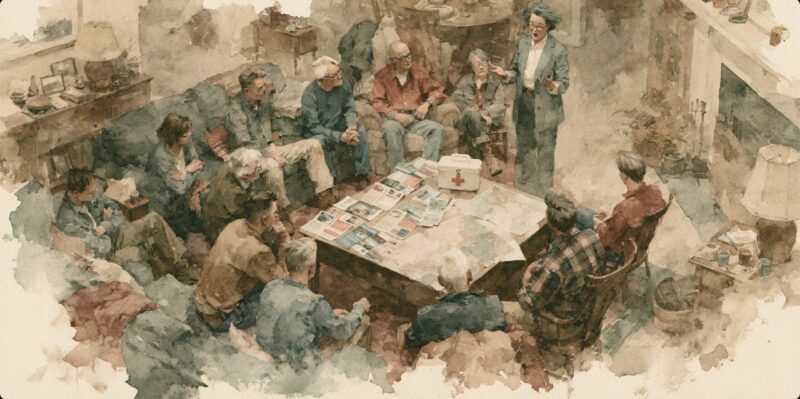
Neighbourhood Emergency Preparedness Meeting
In subsequent radio episodes we not only discuss the details of the Fire Department’s tooling-up and training, and the praise it has received from visiting experts, but also some aspects of fire protection that get less consideration than they should… like the close relationship between community fire protection services and insurance underwriters and premium costs, and the proliferation in recent years of lithium battery packs both small and large. The full interview (all 4 episodes) will be added to this article as they air, as playable links; or for those who prefer reading to listening, a lightly edited full transcript will be added soon.
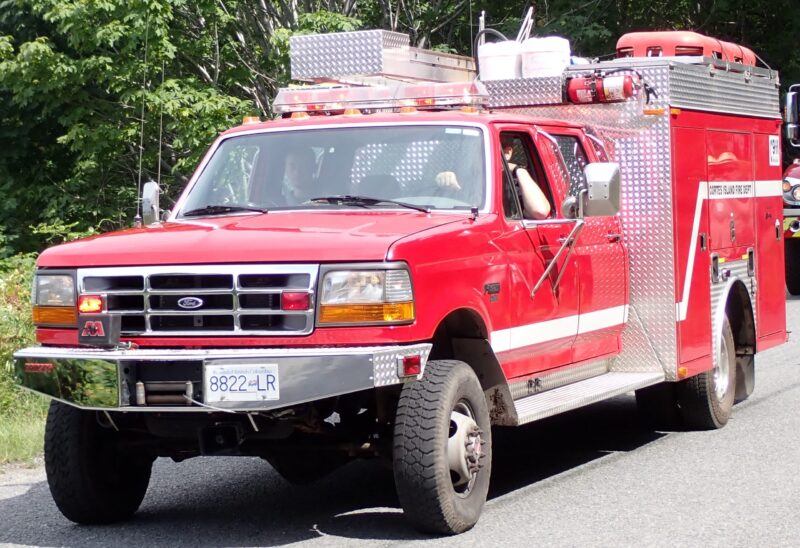
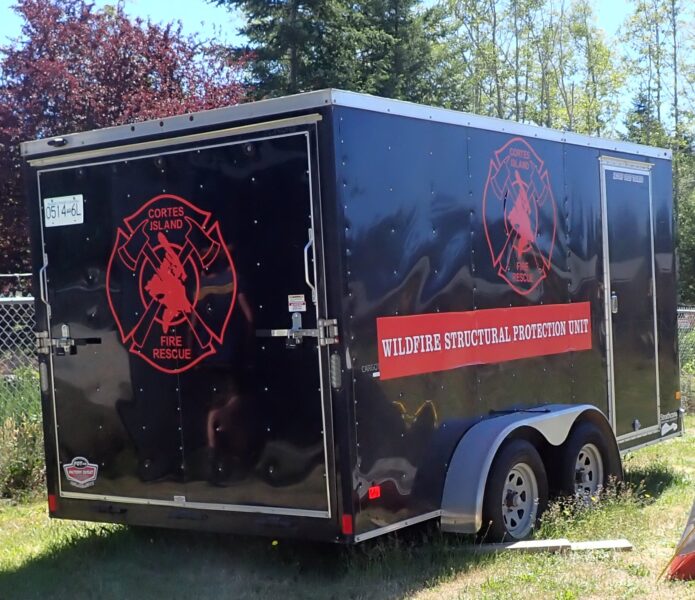
Some of the Fire Department’s Assets:
The Rescue Truck
Engine 101, off-road capable and fairly recently acquired
Engine 202, a reliable old friend
The new SPU trailer
High capacity water canks at the Mansons Fire Hall
High volume gasoline-powered water pump mounted on truck
The Fire Department also has two tenders (water tankers) capable of shuttling water to the site of a fire to support the pumps and hoses; what seems like miles of hose; several portable “swimming pool” reservoirs for storing water where needed; and a command truck for coordinating fire fighting efforts.
[All illustrations (watercolour sketches) by MidJourney, prompts by author. Photographs by author. The theme music for De Clarke’s Cortes Currents radio segments is “It Ain’t Necessarily So” played by Burnett Thompson on his album Uncertain Times.]