


It has been twelve months since billions of marine animals along the West Coast of British Columbia perished during a record breaking heat wave. Temperatures of between 35°C and 40°C were recorded at the Cortes Island School during the last five days of June.
The initial die-off reports from Cortes were relatively small in scale. There were several hundred dead cockles in front of Hollyhock; perhaps over 100 juvenile Dungeness Crabs at Smelt Bay; a ‘persistent stench’ lasting for days from the dead oysters in Squirrel Cove.
Cortes Radio broadcast two accounts of the die-offs on July 8. One consisted of accounts gleaned around the island. The other was an interview with Dr Chris Harley, a marine biologist at the University of British Columbia.
“We had some of the hottest weather we’ve ever had and it happened to be on days with very low tides and that combination was pretty lethal for a lot of things,” he explained.
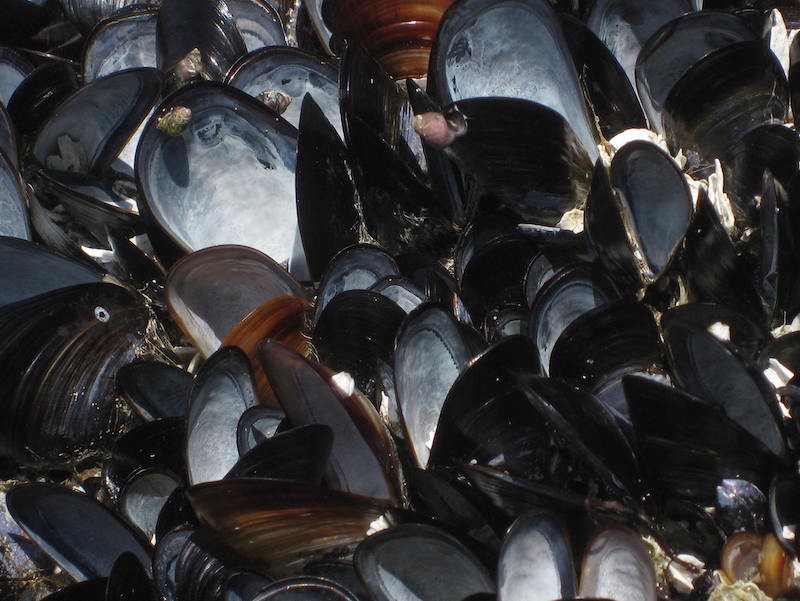
I subsequently emailed Harley several photos of dead mussels from Smelt Bay. There appeared to have been thousands. Snails were attached to some of the mussel shells.
Harley responded, “Yes, you do have some snails in your photo. Those guys are apparently pretty tough. I’ve seen them on other beaches, where other species didn’t make it through the heat wave. One of them in the upper-middle part of the second photo has glued itself onto the edge of a mussel shell with a little blob of mucus. They do that so that as little as possible touches a hot surface.”
He suggested returning to Smelt Bay. This time, I should lay out a series of plots and put a metre stick in the images to indicate the scale.
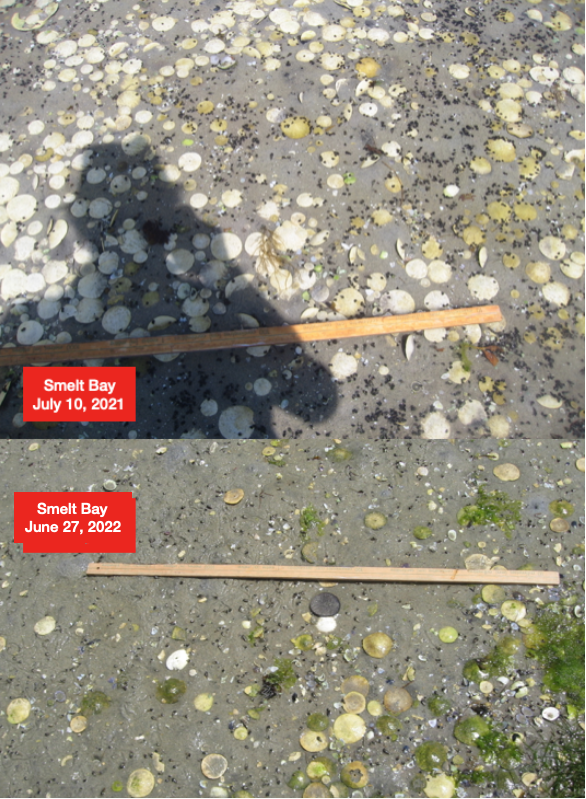
Most of the dead mussels had washed away by the time I returned, but there were also what appeared to be thousands of dead sand dollars.
‘Wow!’ emailed Harley, looking through the subsequent images from sand dollar plots.
Dr Harley initially believed a billion marine creatures may have perished.
When I interviewed him again, three months later, that number had grown to possibly as many as 10 billion casualties.
“Looking at the map of where the high temperatures were the highest, the north end of the Straight of Georgia is one of the places that got the hottest — for coastal communities at least,” he explained.
“We know from some work the Hakai Institute is doing on Quadra Island, there are other places in that area where muscles have died off. They are no longer on the rocks where they used to be. In my own sampling – I made it not quite as far north as Comox and Campbell River – there were certainly still a lot of dead barnacles in evidence.”
On Monday June 27, 2022, I returned to the part of Smelt Bay where I had taken photos.
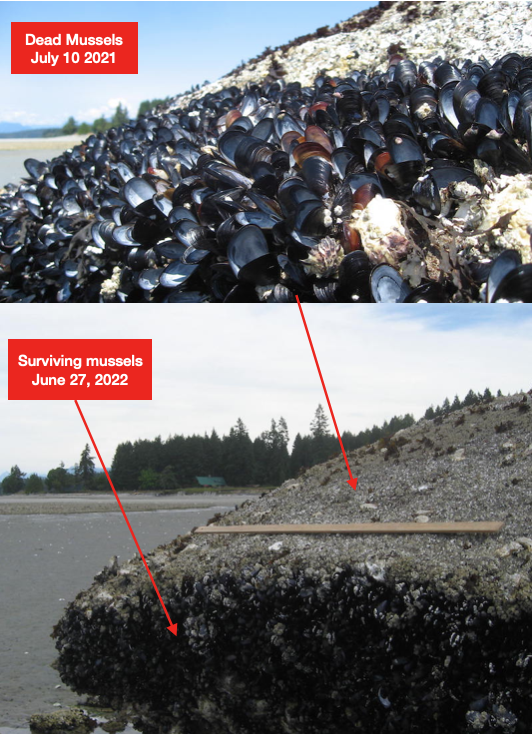
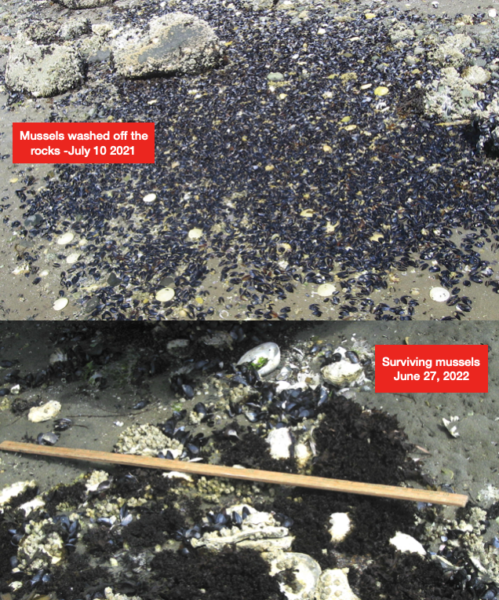
One of the most striking images from last year is a large boulder where hundreds of mussels died. They were swept away by the time I did my ‘plots.’* I can vaguely remember there were also mussels lower down on the side, where there would have been some shade. They survived. There are probably hundreds of mussels on the side of that boulder today.
There were also some survivors in the rocks where I laid out plots a year ago, but so few that I did not repeat the procedure.
Looking back through the year-old images of sand dollars, I see that there were actually a few scattered survivors.
Yesterday, I tried to see how many survivors there were within one metre of each other. Most of the 10 images I took display a solitary sand dollar, but there were 3 in one picture and 5 in another.
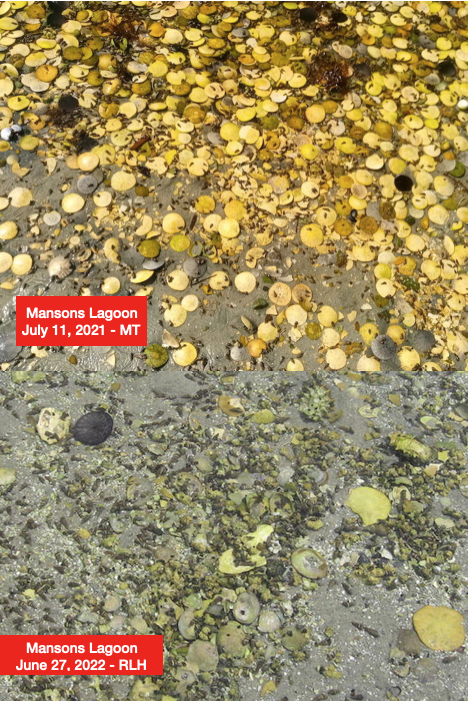
Last year, on July 10, local biologist Deb Cowper discovered that as much as 85% of the sand dollars in Mansons Lagoon may have perished.
The devastation looks much worse in some of the photos taken at that time, but there also appear to have been relatively intact patches of sand dollars that survived.
A picture of one of these surviving patches, beside one of the islands in the lagoon, is at the top of this page.
Dr Harley recently told CTV News,“If we have another heat wave this summer, it would be a problem. An ecosystem might be able to handle a big heat wave once every few decades — there’s enough time for recovery — but if it starts hitting every four or five years, the species that we’re used to just can no longer persist.”
Top photo credit: A surviving patch of sand dollars in Mansons Lagoon – Photo taken July 27, 2022, by Roy L Hales
Footnote
* I took a series of photos with a metre stick in them. A proper plot would have been laid out in 1 metre squares. The number and precise location of all the marine creatures within each square would have been recorded and individual specimens bagged for shipment to a lab.
Sign-up for Cortes Currents email-out:
To receive an emailed catalogue of articles on Cortes Currents, send a (blank) email to subscribe to your desired frequency:
- Daily, (articles posted during the last 24 hours) – [email protected]
- Weekly Digest cortescurrents – [email protected]