
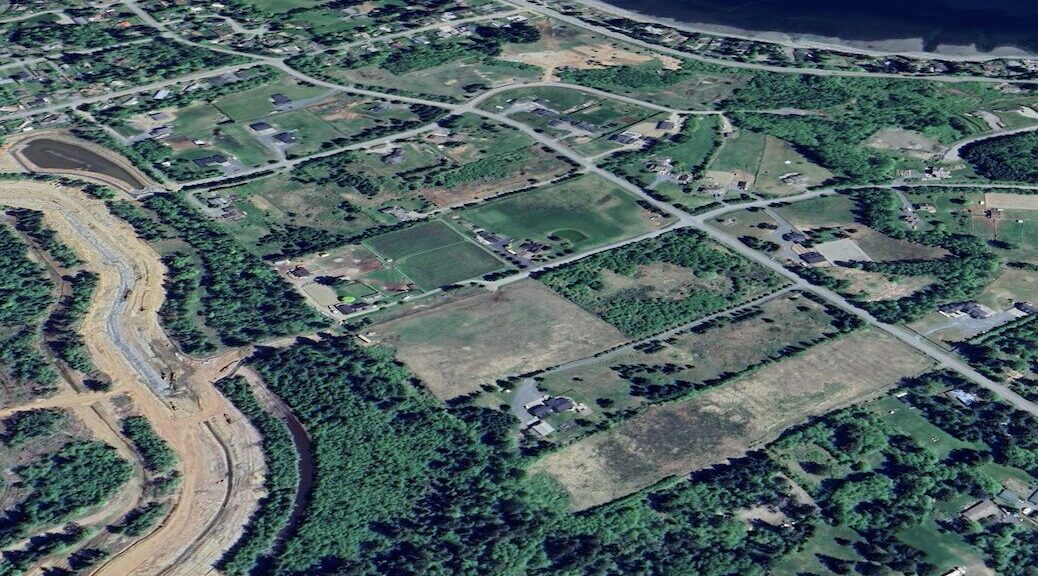

At the May 27 SRD Board Meeting, Mayor Kermit Dahl of Campbell River accused Regional Directors Mark Vonesch, Robyn Mawhinney and Gerald Whalley of bullying Regional Director John Rice:
“For example, when Director Rice was outvoted on a development in Area D by three electoral area Directors who wanted to show him, ‘Stay in line or else we’ll show you.’ They could stop him from succeeding in moving Area D forward.”
This is not the first time Campbell River Directors have made this allegation.
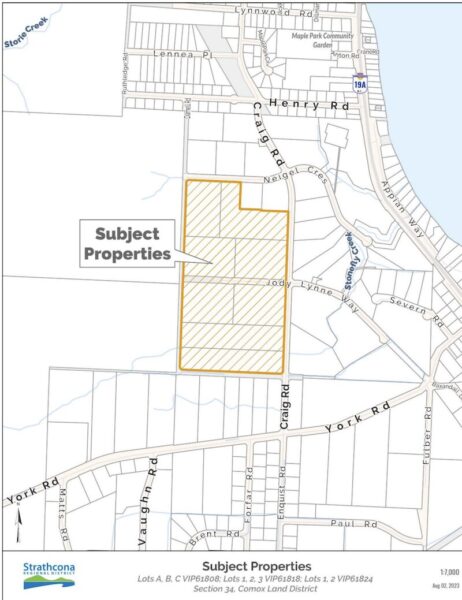
(Map of bylaw 519 Area from associated SRD staff report)
The OCP called for 2 ha; Project was for 1 ha
Directors Rice and Whalley also discussed the matter in the chatter from the opening of this Board Meeting’s YouTube video. It is difficult to make out what Director Rice was saying, but Regional Director Whalley clearly states he was supporting Area D’s Official Community Plan (OCP):
Director Rice: “The point being that … ( his words were lost in the surrounding noise).”
Director Whalley: “Well, I don’t agree with that and that’s fine.”
Director Rices’s reply is muffled.
Director Whalley: “No, we were trying to support your community plan because it included 2 hectares and you had 1 hectare; that was wrong. Then the community plan was revised, and I said, ‘Okay, now it’s right,’ and now that’s history.”
Survey of 16 Projects in Area D
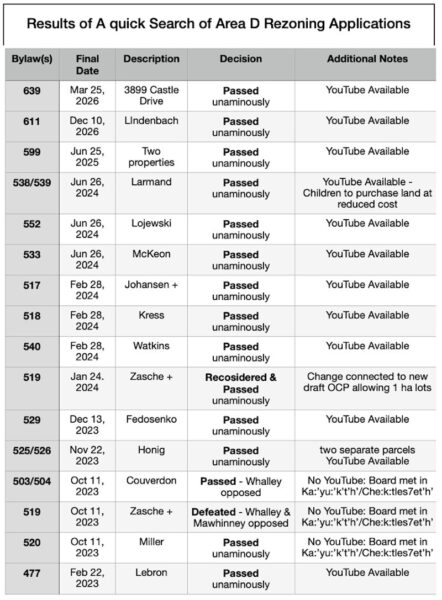
It was relatively easy to find the application they were talking about. A search of SRD minutes found 16 applications since February 2023; 15 of these passed the first time through. In all but one of these 15 cases, there were no opposing votes.
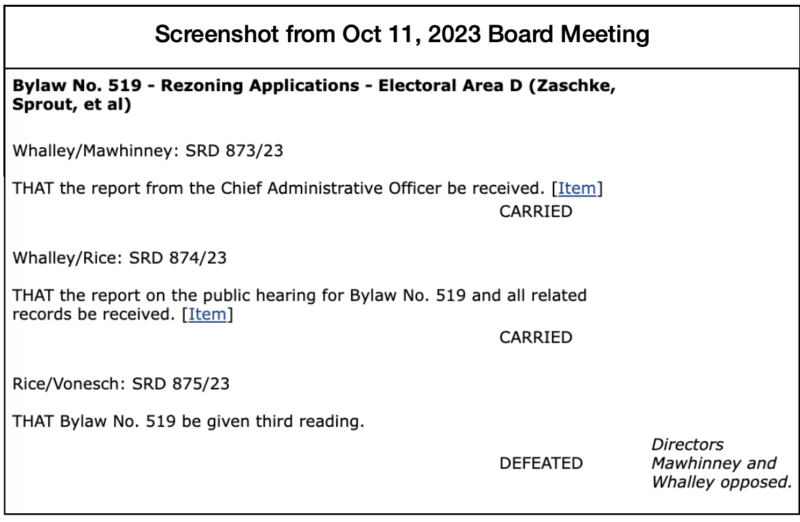
The accusation of ‘bullying’ arises from the rezoning application associated with Bylaw No. 519, submitted by Peter Zaschke and seven other Area D residents, which was turned down at the October 11, 2023 Board meeting. This was an electoral-area-only decision and far from the situation Mayor Dahl described. Directors Rice and Vonesch voted for the application, while Mawhinney and Whalley opposed it.
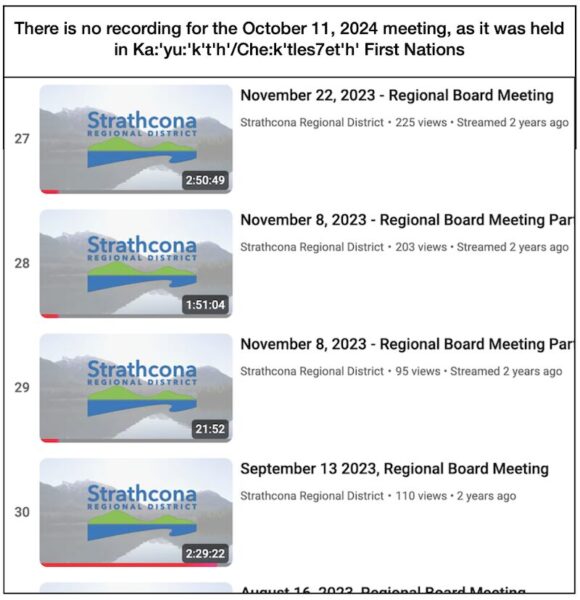
As it was held in Kyuquot, there is no YouTube recording.
When the topic was reintroduced at the November 8, 2023 Board meeting, Director Whalley explained that his opposing vote was cast in support of Area D’s Official Community Plan (OCP):
“It says, new lots shall have an average minimum lot size of 2.0 hectares. Just that simple, applicants (in this proposal) wanted lot sizes of 1.0 to 1.3 hectares. In my view, that wasn’t right.”
That statement was made later in the meeting.
There was a great deal said at that Board meeting, little of which spoke to his concern.
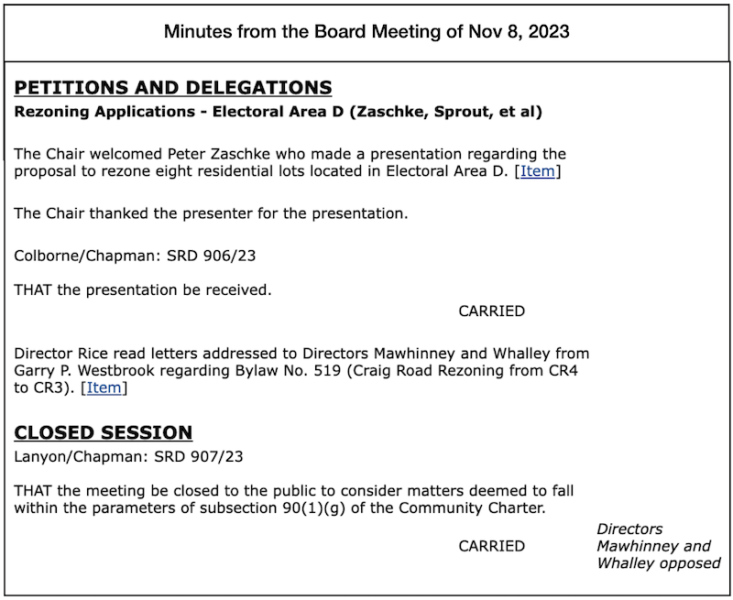
Peter Zaschke’s Presentation
Peter Zaschke made a presentation to the board, at the end of which he asked the two opposing Directors to reconsider their decision. As Chief Administrative Officer David Leitch explained, when motions are defeated, the Directors who voted against it can reverse their decision:
“A reconsideration motion must happen at the next meeting, and those that voted against it are the only ones that can do the reconsideration.”
Zaschke stated, “Most of the property owners out there have been out there since the subdivision’s inception. Most of us are older, and we have grown kids. The reason for much of this is because moving forward, some of our children may like to move onto the property or build, and as we get older, we may want to change things.”
He also said, “I would like to understand the reasoning behind the rejection, and there was little opposition through the entire process. There were two other applications for the rezoning at the same meeting, and both of those were passed.”
Director Rice’s Comments
Director Rice informed the board, “There were 16 written submissions that supported this entirely. There were 7 written submissions that supported the subdivision without the extra density. There were three written submissions that did not support this at all. When I take a look at the mail-out, what I’m talking about is the public notice mail-outs; those mail-outs went out to 21 of their neighbors. Only three of their neighbors responded with a written submission. The other 18 did not. I want to highlight that of the 18, one is the First Nations village, so potential homes for about 125 households over the next little while had no comments, so they supported this. I do want to clarify that for the public record.”
“I also want to clarify what C4 zoning is to them. Without having to go through a public hearing, they could have gone ahead and applied for development permits and built two full-scale houses. The issue with the R-A-D C4 zoning is you cannot separate the titles of those two homes. That’s why they were seeking a different zoning. And as we can see from the correspondence that they sent in, having that extra 538 square feet is quite critical to these applicants. One was going to be used for a grandmother, one was going to be used by somebody else to live in. So again, I’m trying to understand how it was that the decision was made.”
He also read out a letter in which Garry P. Westbrook asked Directors Mawhinney and Whalley, “As one of the owners of the properties I would like to appeal this decision as I believe this would be the best outcome for future families wanting to assist their children to be on same property, as it is known that young families cannot afford to join the Housing Market due to high prices and high interest rates. Also this would definitely help in the lack of Rental Properties. It would be appreciated to receive a detailed explanation as to the reason behind the decision of this Zoning change was denied.”
The Campbell River Directors’ Comments
Some of the Campbell River Directors were also asking questions.
Susan Sinnott said, “I don’t know if people discussed the reasons for the decision. I’m just wondering if we can have some enlightenment on that. It sounds like, from Director Rice, there might not have been any reasons.”
Mayor Dahl declared, “I’m a little confused by how we would try to stop a development that’s supported by the community. That doesn’t make any sense. But the other thing that I heard was the speaker say that we voted against our own OCP, which opens up the SRD to liability if we’re not supporting our own bylaws or voting against them. So I’d like to hear why we would not be supporting our bylaws and OCP, because that puts the entire SRD at risk.”
“I, as well as nearly all of the directors from the City of Campbell River, were unable to attend the West Coast meeting. so I wasn’t there to hear any discussion along with Councilor Sinnott, Councilor Lanyon, and Councilor Kerr because we had commitments to our community for the whole meeting and city council meeting. Only Director Chapman was able to get away.”
Director Chapman, the only Campbell River Director to actually attend the previous board meeting, seconded the motion to receive Peter Zaschke’s presentation, but did not offer any comments or ask questions.
At this point, three directors have asked for an explanation as to why they opposed Bylaw 519, but neither Whalley or Mawhinney have replied.
Then Ben Lanyon suggested, “I think this might be worthy of an in-camera discussion because this is awkward, and there are a lot of unanswered questions about this.”
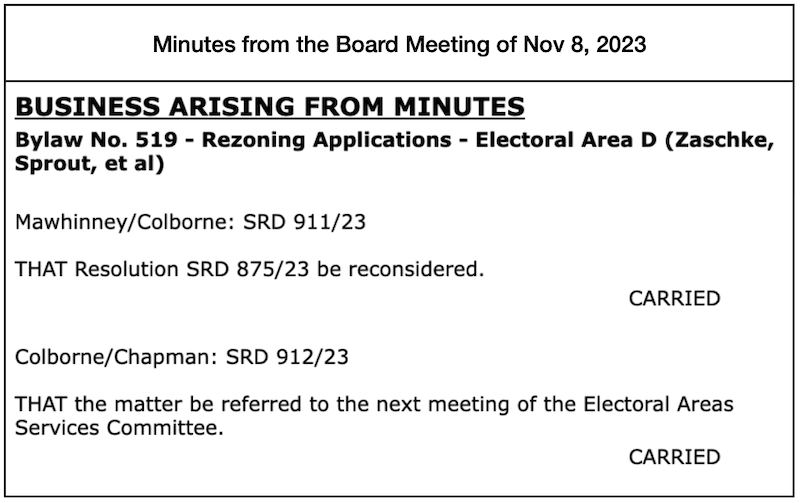
Directors Whalley and Mawhinney Respond
The situation changed after the in-camera session. It is not clear when Directors Whalley and Mawhinney were given access to Area D’s new draft OCP, but it changed their decisions.
Whalley told the board, “I’m going to change my vote today, and there’s a reason for it. Not because you guys are upset; I couldn’t care less. My reason for changing my vote is the new OCP that Area D is approving says ‘country residential’ – lot size requirements will be regulated through the zoning bylaw as a general guideline. New lots serviced by on-site septic disposal will maintain an average lot size of 1.0 hectare. This perfectly fits what the applicants want. Plus, in the future, there’s going to be zoning bylaws under this OCP that will change. Speaking with staff, they’re going to support this. So why would we oppose it now?”
“None of this information was available to me beforehand. That was the reason why I voted that way. I’m disappointed that you would belittle the role of elected representatives.”
Director Mawhinney also reconsidered her vote: “My original decision was weighted considering the feedback and concern of neighbours about moving from something that currently, from the application, looks like it has five homes to something which would have 32.”
”Similarly to Director Whalley, since then I’ve had a chance to read the draft official community plan for Area D. It states, as an objective, to encourage infill to existing developed areas. I appreciate the opportunity that we have had to see the new draft OCP, because I feel like that’s been really helpful in this.”
Afterward
If Peter Zachke had not been allowed to make a presentation at that meeting, the board could have passed Bylaw 519 then, but he offered new information and that triggered the need for another public meeting.
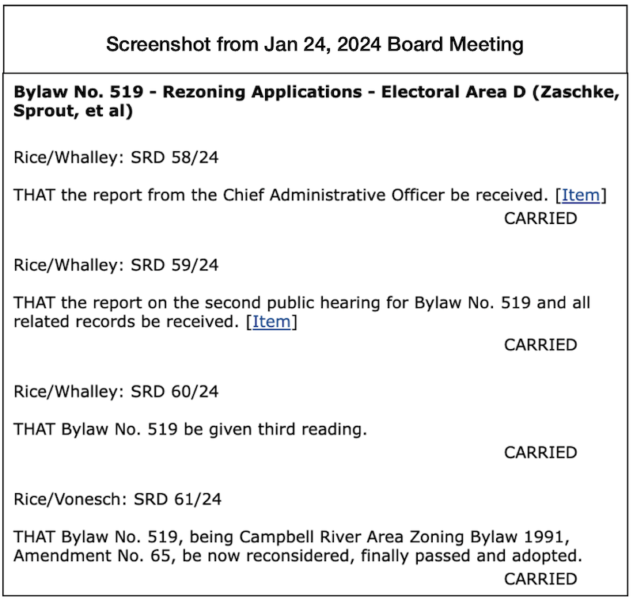
As a result, Bylaw 519 was not passed until January 24, 2024.
In the recording for that meeting, Director Whalley reiterated, “The reason why I am supporting this is because Electoral Area D has a new OCP which allows a minimum lot size of one hectare, where the previous one – when the first public hearing was attended – had a minimum size of two hectares. That’s why I opposed it in the first place. That’s changed now, so now I can support it.”
Who bullied who?
This also means that all 16 of the Area D applications found in this study eventually passed, but the accusation that Rice was ‘bullied’ was still being discussed as recently as the May 27 Board meeting. That’s when Rice’s conversation with Whalley was accidentally recorded, and Mayor Dahl accused Directors Mark Vonesch—who actually voted for the project both times — Gerald Whalley, and Robyn Mawhinney of bullying Rice.
At one point during his response to the board on November 8, Director Whalley said, “You can’t expect electoral areas to be a rubber stamp. If we were just a rubber stamp for every application that came along in land use, why even bother with a public hearing and a rezoning application? It’d be a total waste of time. No, we’re supposed to look at these, examine them, figure out what is proper for the area, and vote accordingly.”
Of the remaining 15 projects in this study, there was only one that had a single opposing vote – and that project passed anyway.
All four Regional Directors were given the opportunity to comment, none have responded in time for this story.
Links of Interest:
- Recording of Nov 8, 2023 Board Meeting Part 1 (Up until the decision to meet in camera)
- Recording of Nov 8 Board Meeting Part 2 (After the In Camera Motion)
- Recording of Jan 24, 2424 meeting (When Bylaw 519 was finally passed)
- Mark Vonesch Removed; Susan Sinnott New Vice-Chair of the SRD – Cortes Currents
Top image credit: Screenshot of lots in and surrounding area – courtesy Google Earth
Sign-up for Cortes Currents email-out:
To receive an emailed catalogue of articles on Cortes Currents, send a (blank) email to subscribe to your desired frequency:
- Daily, (articles posted during the last 24 hours) – [email protected]
- Weekly Digest cortescurrents – [email protected]