

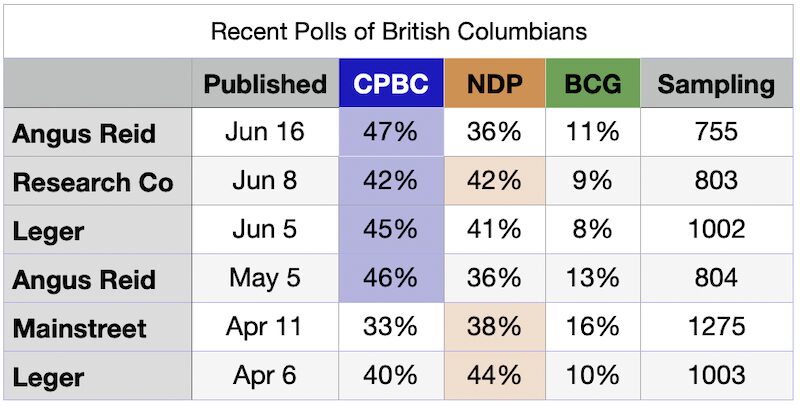
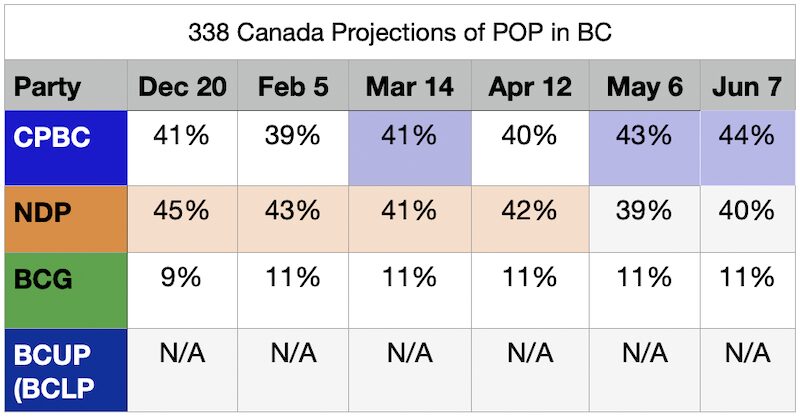
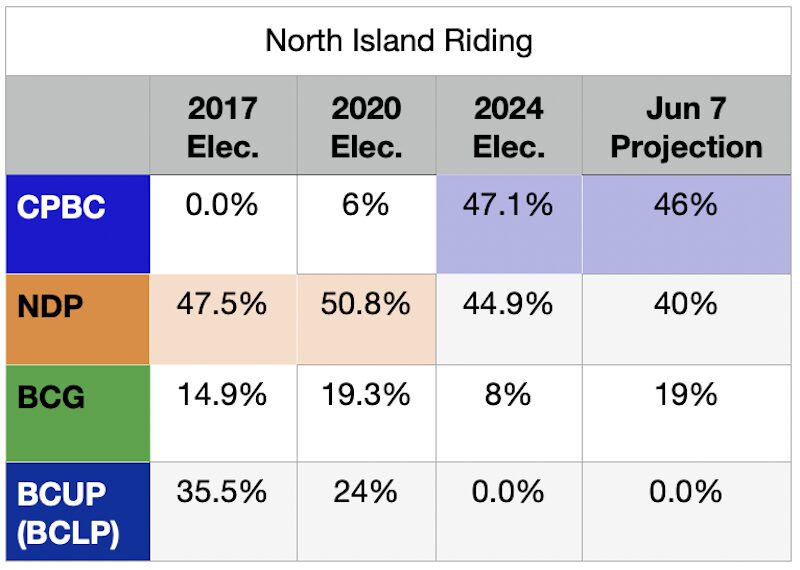
Sixty percent of the respondents to a recent Angus Reid poll said the province is on the wrong track. If there were an election today, they gave the Conservatives an 11-point lead. This is similar to what 338Canada’s projections have been showing for the past month. Yet nearly 90% of the poll’s respondents also said they know little or nothing about the new BC Conservative leader, Kerry-Lynne Findlay. In this morning’s interview, we discuss these matters with Anna Kindy—MLA for North Island—and also play a clip from Kerry-Lynne Findlay’s Twitter feed.
The Polls
Cortes Currents: Firstly, what do you think of the BC Conservative Party’s recent surge in the polls?
Anna Kindy: “Well, it doesn’t surprise me, to be honest, because we’ve been going in the wrong direction for a long time. When you’re looking at the fiscal mess that we’re in as a province right now, Premier Eby came in with a surplus, when he became premier, and here we are with $13.3 billion of deficit this year.”
BC’s Operating Deficits
Cortes Currents: She is referring to the province’s operating deficits. According to the Vancouver Sun, “When Premier David Eby took over in 2022, B.C. was on track to post a $5.7 billion surplus for the 2022–23 fiscal year.” Instead, the government spent that money trying to address problems like the housing crisis, homelessness, and the opioid crisis. Since then, Eby’s government has consistently prioritized issues like these over the budget. Aside from the two COVID years, B.C.’s previous premier, John Horgan, generally posted balanced budgets.
BC’s Provincial Debt
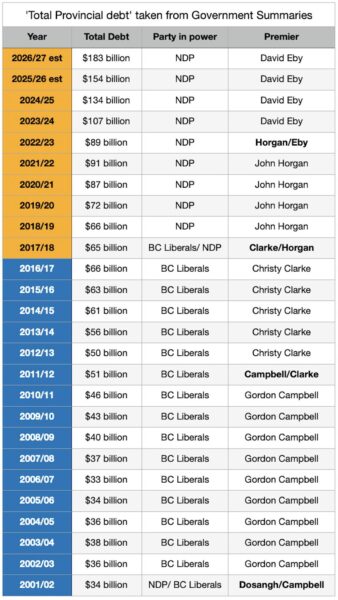
Personally, I’m more concerned about total provincial debt, which is roughly five times larger today than it was in 2001. Under the BC Liberals, it almost doubled—going from about $34 billion in 2001 to around $65 billion by 2017. It has almost tripled under the BC NDP, moving from about $65 billion in 2017 to an anticipated $183 billion this year.
Kindy correctly stated that most of the growth under the NDP occurred while David Eby has been premier. This year, the government expects to spend $6 billion on interest charges.
Apologists for government spending point out that provincial revenues have also grown— from $28 billion in 2001 to an anticipated $88 billion this year. Thus, as long as the economy remains strong, BC is in a better position to service a large debt.
Comparing the government’s expenses to those of a typical homeowner: operating surpluses and deficits are like monthly cash flow, while debt servicing is like a mortgage payment—and total provincial debt is comparable to a mortgage.
Challenges
Anna Kindy: “We’re doubling our total deficit, and our interest payment this year alone is over six billion—and that would build a lot of care homes and hospitals and fund a lot of services that we need. That’s just the interest. The interest is the third biggest portfolio.”
“That fiscal mess translates to having to cut back on a lot of things. So I mentioned care homes being canceled, Burnaby Hospital expansion being canceled. I’m seeing things in the healthcare domain getting worse. The affordability crisis is continuing—in terms of being able to afford your groceries, your rent, getting ahead—especially for young people and seniors.”
“Even with this budget, seniors were hard hit. Not only with the cancellation of long-term care homes, but you know how seniors can borrow against their home to survive or to live. Now if they borrow against their home, they’ll be paying 2% above prime, compounded interest. So that’s a lot for seniors. And there are going to be taxes now on landlines—who has landlines? Seniors do! You do, and me. We’ve got a landline too. Yeah, we’re old school – but we’re seniors!”
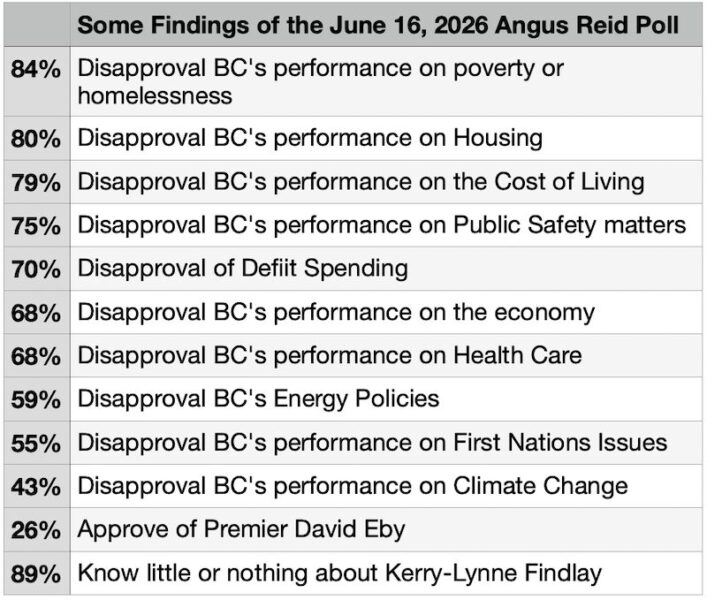
“Things are not going in the right direction in a lot of ways, and that’s what’s being reflected in the polls. There’s a healthcare crisis getting worse, an affordability crisis, fiscal mismanagement, and still safety issues.”
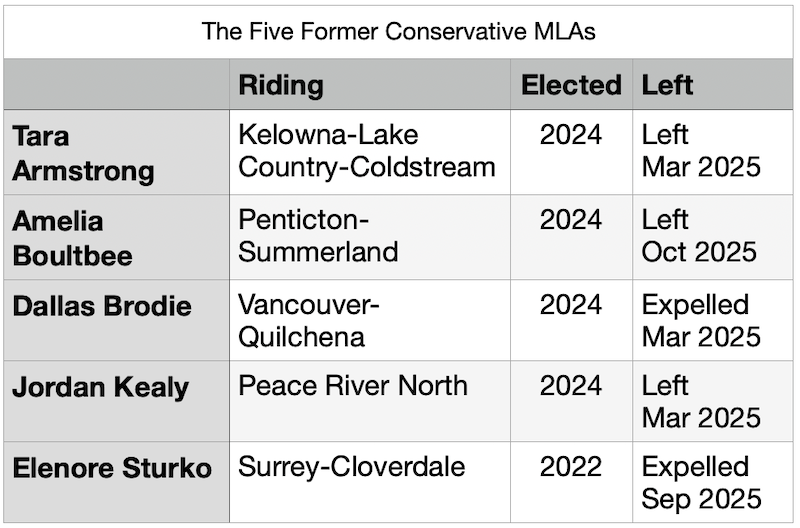
Cortes Currents: The Angus Reid poll suggested, “The near-term test (of the Conservative party) will be whether Findlay can consolidate a 39-member caucus and resolve issues with five other past Conservative members who left the party under her predecessor, John Rustad.”
Anna Kindy: “This decision will be made with the input of caucus, and I haven’t been privy to the decision yet.”
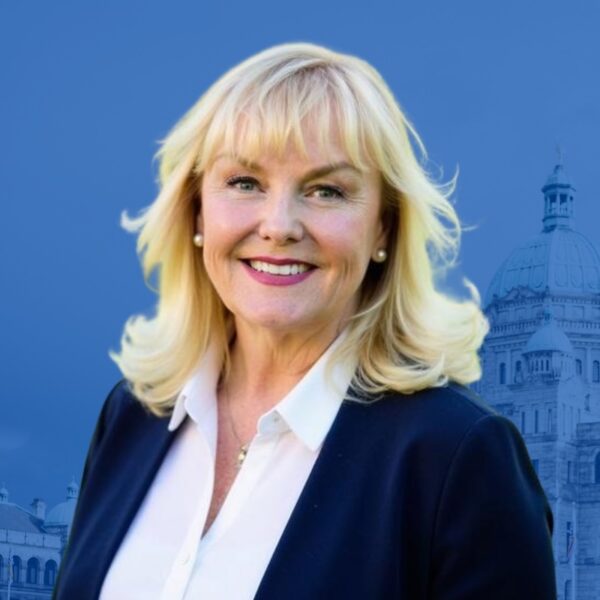
Kerry-Lynne Findlay
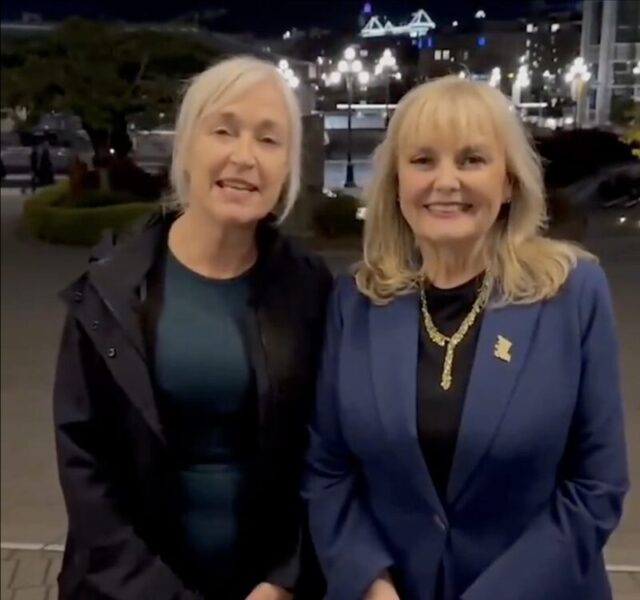
Cortes Currents: What can you tell us about the new leader of your party, Kerry-Lynne Findlay?
Anna Kindy: “I’ll be honest—I started very neutral when the leadership campaign started. I hadn’t made my mind up as to who I was going to support, and I talked to every single leadership candidate. As time goes on, you see their behavior and learn more about them. I ended up supporting Kerry-Lynne Findlay, and she ended up winning.
“The reason I ended up supporting her are multiple fold. Unlike what the media says, she’s what I call a unifier. She gets people together. She says, ‘We can agree on 80% and move forward with that.’ She has experience in politics. She was a whip for the federal Conservative Party. This is for a caucus three times our size, and that’s a big role. She had ministerial positions as well.”
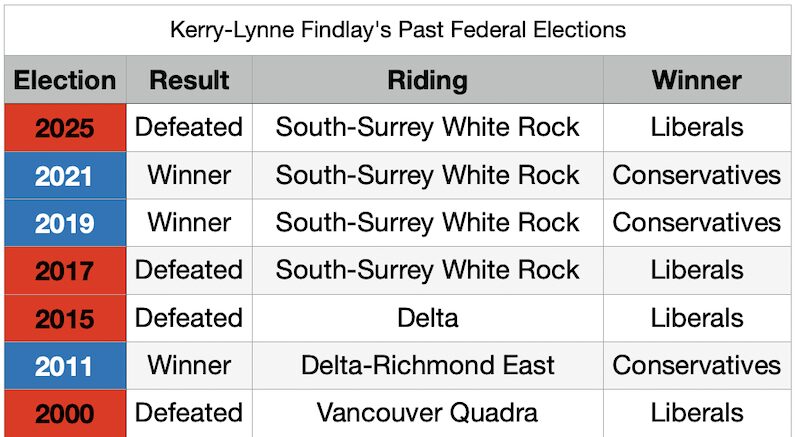
Cortes Currents: Kerry-Lynne Findlay was a Vancouver Island girl who went on to open her own law practice in Vancouver. She was first elected to Parliament in 2011 and was Stephen Harper’s Minister of National Revenue from July 2013 to November 2015. Prior to that, she served as Associate Minister of National Defence and parliamentary secretary to the Minister of Justice.
I've put a lot of thought into this decision.
— Dr Anna Kindy (@DrKindyMLA) April 23, 2026
I am proud to support Kerry-Lynne Findlay for the leadeship of the Conservative Party of BC.
She has experience.
She has integrity.
She has intelligence.
She is a unifier.
She is in it for the right reasons. pic.twitter.com/TJRUpoKBBH
Anna Kindy: ““When I talked to her, I was really pleasantly surprised at her depth of knowledge—and also that she has a vision of where we need to go. And she’s a doer, and this is what we need. We need somebody with experience who’s a unifier, who has a vision for where British Columbia needs to go. So I was actually quite excited that she ended up winning.”
Cortes Currents: Can you give me an example of how she’s a unifier?
Anna Kindy: “I see it in her history. For example, she was a whip. To be a whip, you have to be a unifier. What she says is she always takes input from every single candidate—or MP, or in our case it would be MLA. She has done this, and she’s reached out and talked to every single MLA. When she got elected, her work wasn’t done that day. Since then, she’s been talking to every single one of us.
“We all have different beliefs. You don’t try to change people’s beliefs—you bring them together on what the consensus is on the big issues. And the big issues in this province that we need to fix are: we need to fix our fiscal situation so we can afford to pay for our services, including healthcare. We need to fix the affordability crisis. And we need to fix the safety crisis.”
Findlay on the Musqueam Decision
Cortes Currents: Kindy alluded to Findlay’s experience as a homeowner lawyer in the Musqueam decision (2000). Findlay actually described this in her Twitter feed:
In the late 1990s, as a young widow with small children, I bought a leasehold property on Musqueam land in South Vancouver. It had been a peaceful neighbourhood for 24 years.
— Kerry-Lynne Findlay (@KerryLynneFindl) April 19, 2026
Then the federal government changed the taxing authority to the Musqueam First Nation without any… pic.twitter.com/2Ojca5vj8l
“In the late 1990s, as a young widow with small children, I bought a leasehold property on Musqueam land in South Vancouver. It had been a peaceful neighbourhood for 24 years.”
Kerry-Lynne Findlay (from Twitter video): “A year after we moved in, the federal government, without consultation, without prior warning, without any discussion, changed the taxing authority from the City of Vancouver to Musqueam.
“The problem there is that’s taxation without representation. You are not allowed to speak to chief and council unless you are a band member. So it’s not like we’re used to where—Not that it always gets us very far, but you feel if you had a neighbourhood issue or a personal issue—you could go to a council meeting and bring it up. You have certain rights and representation. When I complained about that, they said, ‘That’s an American concept.’
“So immediately you start thinking of things that aren’t in Canada. You start thinking of tea bags in the Pacific Ocean and stuff, but it’s a little late for that. So Musqueam is now the one you’re paying your taxes to. Then the BC government jumps in. The BC government said, ‘Musqueam, you do not have to remit the portion of the taxes that the city does.’ So they didn’t have to give 50% to the schools and they didn’t have to give what was then 8% to the regional district. They got to keep it all. Then the BC government jumps in again and says, ‘We are going to change the BC Assessment Act.’ And this is still the way it is to this day. They started assessing leasehold properties on Aboriginal land as though they were fee simple, or full ownership off reserve.
“All of a sudden, instead of paying your taxes based on your fair market value, it became double and then triple the amount—with no representation. We tried to put together a little advisory group, and the meetings were canceled. They never met with us. It just didn’t work at all.
“Anyway, then the next thing that happened was that we had a dispute over a yearly amount. Most leaseholds on Aboriginal land today—and they’re everywhere now. You’ve got them here on the island, Sechelt, West Bank, Okanagan. They’re all over. They’re also in Ontario around cottage country.
“At the time of this lease, though, it was the first one that was ever done in Canada. Later on, the market would only go for fully prepaid leases. But these leases—the idea had been that you’d put a substantial down payment as a partial prepayment, most of a prepayment—and then you would pay so much a year, which would give the band revenue and would be sort of an ongoing payment.
“We got in a dispute about that payment because we offered at a renegotiation point $8,800 a year on average, and the band demanded $36,000 a year. Wow. Well, how many people even today—and we’re talking 25 years ago—how many people even today can add $3,000 a month expense after tax on top of tripling your property taxes and your mortgage and just living?
“When we resisted paying that amount—which was more out of ‘we can’t’—as much as we don’t want to—they sued us. We had 75 homes, about 200 people.
“We’re just neighbours like anyone else. You like your neighbour, you don’t like your neighbour. I don’t know my neighbour; another one’s my best friend. That’s kind of a normal neighbourhood. Now we’re all thrown together into a major lawsuit. The people that are suing us are backed up by the provincial and federal governments, and we’re on our own.”
Cortes Currents (quoting Findlay):“As a lawyer, I helped lead our legal team through an intense and costly battle that went all the way to the BC Supreme Court, the BC Court of Appeal, and finally the Supreme Court of Canada. I won then—and I will win now.”
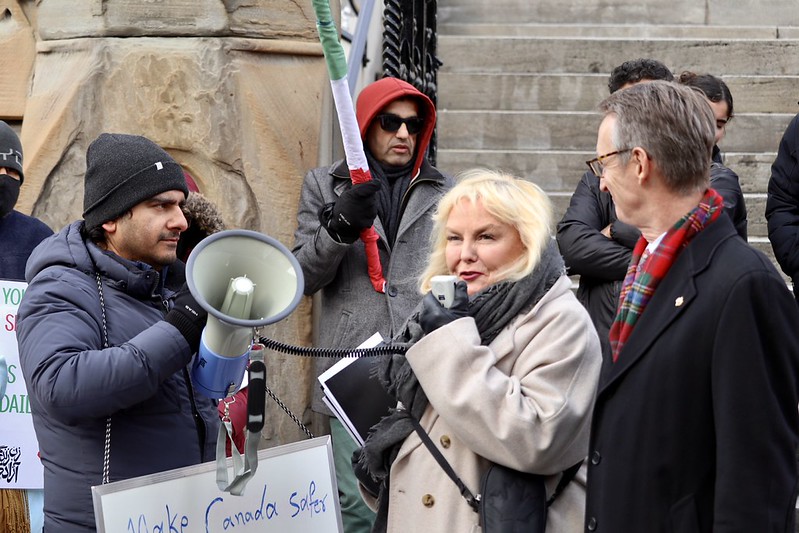
Anna Kindy: “So she has a knowledge of politics, but also of law, and I think law is important right now with everything that’s happening with DRIPA. How do we continue with reconciliation but also make sure that we don’t forget about the rest of B.C., and that we end up with a united British Columbia, as opposed to a divided British Columbia.
“She’s lovely, and she cares about people.
“Politics is not easy—you have to have thick skin because you get attacked. To go back into politics—in her case—is because she wants changes. She understands processes, and you need somebody who understands the process to be able to change things quickly. We can’t afford, right now, to be going where we’re going in so many ways, and I think she’s got the fortitude to be able to move B.C. in the right direction. We’re going to leave British Columbia for the next generation.
Links of Interest:
- About Kerry-Lynne Findlay – Conservative Party of BC website
- B.C. Politics: New Conservative leader largely unknown, but her party leads in vote intention – Angus Reid
- Articles about, or mentioning, the Conservative Party of BC
- Articles about, or mentioning, Anna Kindy
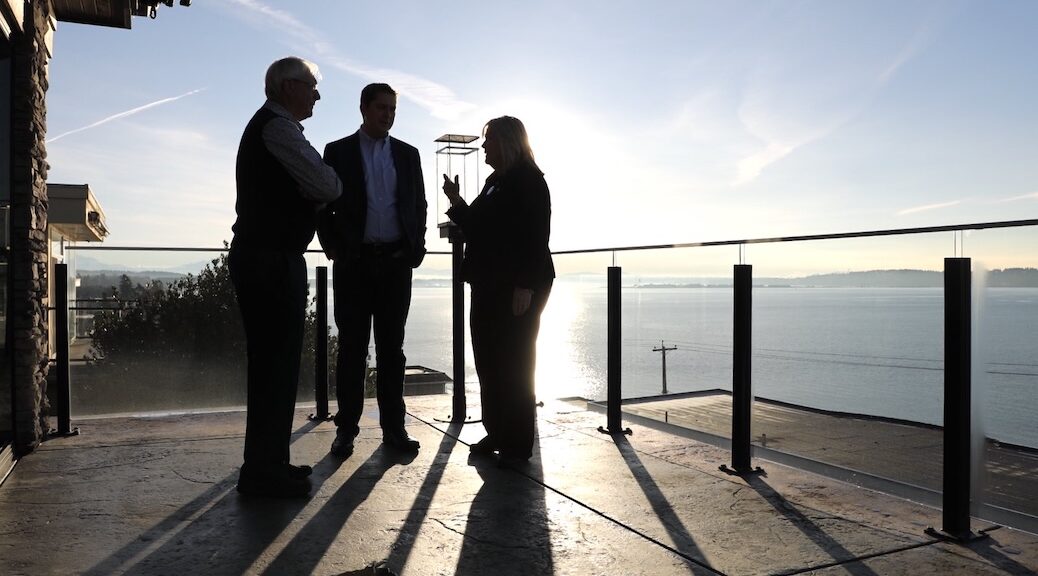
Top image credit: Kerry-Lynne Findlay (r) with Andrew Scheer and the Mayor of White Rock during the 2017 election – Photo courtesy Andrew Scheer via Flickr (Public Domain)
Sign-up for Cortes Currents email-out:
To receive an emailed catalogue of articles on Cortes Currents, send a (blank) email to subscribe to your desired frequency:
- Daily, (articles posted during the last 24 hours) – [email protected]
- Weekly Digest cortescurrents – [email protected]