
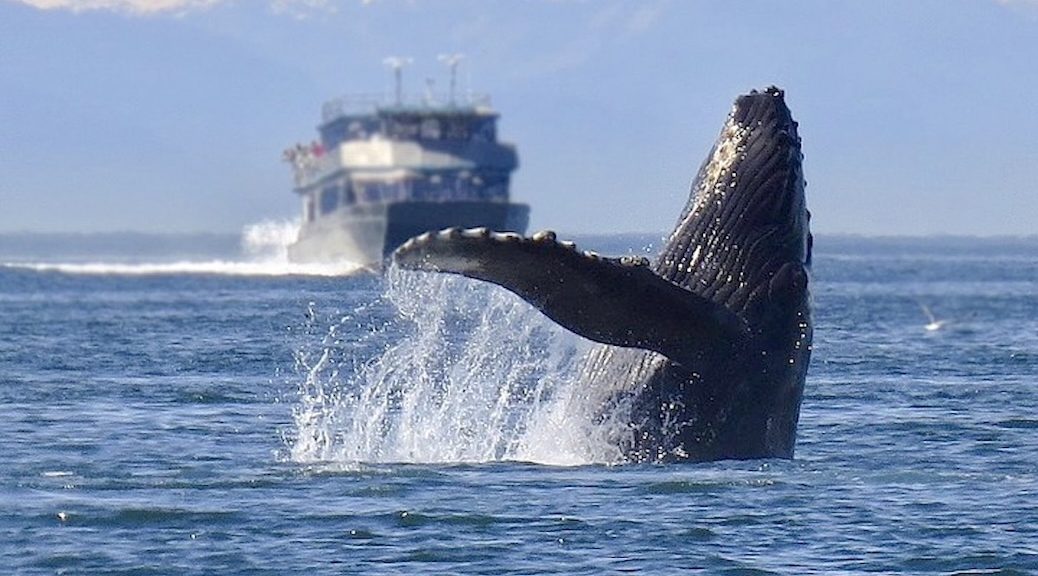
Editor’s note: The Orcas that visit Cortes, Quadra and the Redonda Islands are mostly members of the northern resident pod, but there also get visitors from the southern pod.

Canada’s National Observer, Local Journalism Initiative Reporter
The Salish Sea is one ecosystem but Canada and the US are playing by different rules when it comes to protecting threatened whales, experts warn.
Endangered southern resident killer whales and at-risk humpbacks are blind to borders when transiting the transboundary waters in southern BC and northwestern Washington State that encompass the Strait of Georgia, Juan de Fuca Strait and Puget Sound, said Chloe Robinson, director of whales for Ocean Wise.
But an inconsistent patchwork of protection measures on either side of the border means the two whale species are increasingly vulnerable to ship strike, vessel disturbance, pollution, underwater noise and diminishing food sources, she said.
“The threats don’t change just because whales have crossed an invisible line,” Robinson said.
Problematic discrepancies exist between regulations around whale distance rules for boats, fisheries management, habitat protections and pollution standards, said Robinson, who led a comparative study of key conservation measures on each side of the border.
Both countries, along with provincial and state governments, need to align regulations, close protection gaps and reduce confusion for mariners, whale watching operations and vessels transiting the region to reduce cumulative stresses of whales, Robinson said.
There’s a dizzying mix of vessel approach distances and speed regulations for whale watching operators and recreational boaters on either side of the border depending on the type of whale and, in some cases, what they are doing, she added.
Canada should mirror the US and increase the approach distance for vessels to 1,000 metres for southern residents — a population on the cusp of extinction with only 74 members remaining. Doing so will help reduce the underwater noise disturbing the orcas and hindering their ability to hunt for food.
Regulation distances for other whales including other types of killer whales and humpbacks should also be harmonized, Robinson said. Additionally, a unified whale-watching regime with a shared permit system, training and regulations needs to be developed.
Canada doesn’t have a permit system, like Washington State where operators must get an annual licence, undertake mandatory training and meet certain on board technical requirements, Robinson said. A Salish Sea permit system would go a long way to establishing common understanding of vessel behaviour around whales.
“Laws and regulations are only effective if people are following them. Unifying them simplifies the messaging,” she said.
Operators generally tend to avoid whale watching southern residents and have voluntary best practices when it comes to other species, Robinson said.
However, there are no rules about how many boats can trail other types of killer whales or humpbacks, or for how long. Nor are there any limits on the number of operators in the Salish Sea, where whales already experience heavy traffic from vessels of every kind, including ferries, transport ships, tugs and recreational boats.
Ecotourism operators try to be stewards for whales, but as the sector continues to grow, so does the fleet and size of vessels, Robinson said.
“What is the cumulative impact of seven, eight, nine boats in a row following whales?” she asked. “That’s hard to measure.”
Humpbacks need help too
Protected critical habitat has been set aside in the Salish Sea in the US for humpbacks, but there isn’t any in Canadian waters, despite their status as a species of special concern, Robinson said.
The whales have made a heartening recovery on the BC coast over the past two decades after being decimated by commercial whaling. But the population is still extremely vulnerable to new dangers posed by ship strikes, entanglement with fishing gear and warming oceans, Robinson said.
Three humpbacks were found dead in the space of a couple of months this fall in the Salish Sea — likely from collisions with vessels. And many humpbacks risk death or starvation if ensnared by fishing gear, a threat so prevalent that 50 per cent of the whales in BC water show scars from entanglement.
Humpbacks frequent similar areas to southern residents in the region, which is a primary feeding ground for the great whales in summer and fall before most migrate to warmer waters for winter, Robinson said.
Without much extra effort, Canada could offer greater protections to humpbacks by tweaking or extending some of the temporary summer measures already in place for the endangered orcas, such as slow down or sanctuary zones in critical habitat, she said.
“They have fantastic co-benefits for humpbacks,” Robinson said.
However, it’s still necessary to set aside key pockets of protection that don’t necessarily overlap with orca territory, she said.
“We have a lot of science out there,” Robinson said. “It wouldn’t take much to identify where those hotspots are in the Canadian Salish Sea for foraging such as we’ve seen in the US.”
Both countries need to create or adapt bilateral agencies or agreements, such as the Pacific Salmon Treaty, to build a cooperative framework for the entire Salish Sea basin and manage fisheries and habitat for endangered Chinook salmon, the primary food for southern resident killer whales, Robinson said.
Southern residents drowning in noise

Ginny Broadhurst, Director of the Salish Sea Institute at Western Washington University, agreed — adding US Tribes and Canadian First Nations need to be involved in the creation and management of conservation initiatives.
Vessel noise also poses an ongoing and rising concern for southern residents in particular, Broadhurst said.
The orcas use echolocation to hunt Chinook salmon, but increased underwater noise in the Salish Sea significantly interferes with the whales’ ability to communicate with one another and find their prey.
Setting concrete noise pollution caps in southern residents’ critical habitat across the Salish Sea is key to the recovery of the population, Broadhurst said.
Reducing underwater noise pollution by 50 per cent, along with increasing Chinook stocks by 15 per cent, could help the endangered orcas reach a population growth of 2.3 per cent over three decades, research suggests.
Tackling noise and threats to fish habitat and whales in the shared sea must include calculating the cumulative effects of new development or mega-projects, such as Canada’s Robert Banks Terminal 2 expansion [RBT2] project, Broadhurst said.
The extensive research into RBT2’s environmental impacts was limited to Canada, though the project lies just miles away from the US and the associated surge in shipping traffic will cut right through transboundary waters and key whale habitat, she noted.
Underwater noise pollution in the Salish Sea is already understood to be too high, she added.
“One of the big flaws of our regulatory system is each project is looked at on a case-by-case basis and is limited to its individual impacts,” Broadhurst said.
Authorities on both sides of the border need to come up with cooperative mitigation measures that protect whales across the entire Salish Sea, she said.
“In an ideal world, their protection would be the same, whether they’re on one side of the border or the other.”
Top image credit: Threatened whales including southern resident and humpbacks need Canada and US to align protections from underwater noise and ship strikes in the Salish Sea. – Photo courtesy: Ocean Wise

Sign-up for emails:
To receive an emailed catalogue of articles on Cortes Currents, send a (blank) email to subscribe to your desired frequency:
- Daily, (articles posted during the last 24 hours) – [email protected]
- Weekly Digest cortescurrents – [email protected]