
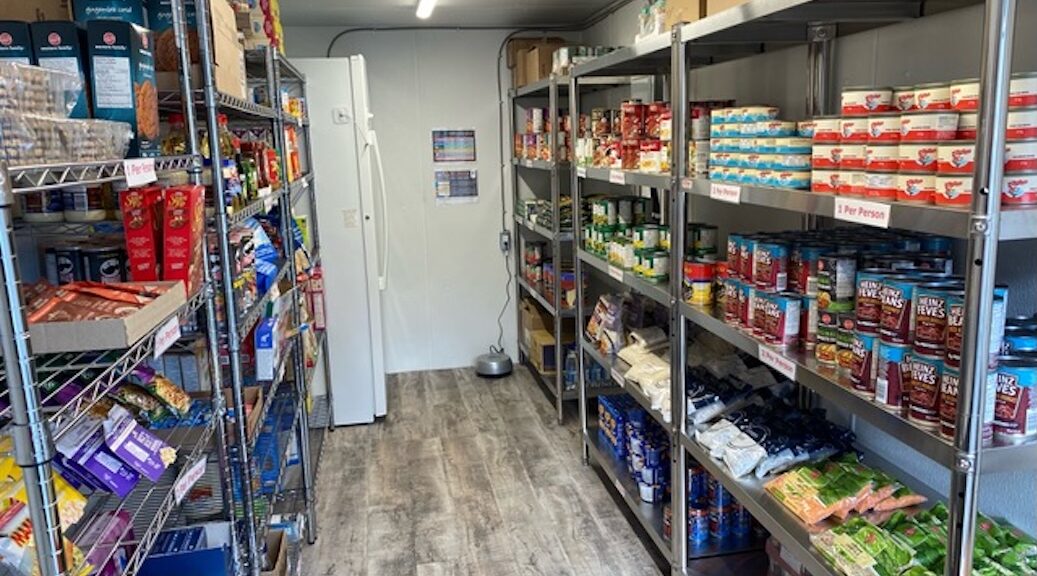

The Cortes Island Food Bank has a new Executive Director. Filipe Figueira retired last November, and Angelica Raaen has been at the helm since then. In this morning’s interview, she responds to five myths about food banks and also talks a little about her new role.
Angelica Raaen: “I think it’s really important that the stigma around food banks and food assistance be addressed, and that everyone who needs to access the food bank—or could use help—feels comfortable doing so. We’re here if anyone needs us.”
(Food Hamper – courtesy Cortes Island Food Bank)
The Myths
#1: Is it true that everybody misuses the food bank?
Angelica Raaen: “No, that’s not true. People tend to underuse the food bank. They usually exhaust all of their other resources first before reaching out, and the stigma surrounding food bank use tends to make people wait even longer. They may feel they don’t deserve it, think other people need it more than they do, or worry about what community members might think.”
#2: Why don’t they just go out and get jobs?
Angelica Raaen: “A lot of people who use the food bank already have jobs, but minimum wage often isn’t enough to cover the cost of living. Some people also face extra expenses that they can’t manage with their income alone. For those who don’t have jobs, there can be many barriers to employment, such as disability, intermittent work, seasonal work, or other challenges. You never know someone’s full story or what they’re going through.”
#3: Can’t they just learn how to budget their money?
Angelica Raaen: “Telling people to budget their money assumes they have extra money left to budget. So much of people’s income is taken up by rent, medical bills, clothing, and other essentials. For Canada’s lowest-income earners, shelter alone now consumes two-thirds of their disposable income. That leaves only one-third for everything else: food, transportation, clothing, medicine, and so on. The total ends up being 123% of their income, which is obviously more than they have. No amount of budgeting can fix that deficit.”

#4: Aren’t food banks part of the problem? If you didn’t have this crutch, people could take steps to leave food insecurity behind.
Angelica Raaen: “Food banks have a very high turnover rate, which shows that people use them and then, in many cases, no longer need them. Having that extra time or financial relief can help people free up energy to address health issues, settle into a new living situation, or earn credentials for a job. Food banks allow people to take those steps and move out of whatever difficult situation they’re in.”
#5: If we didn’t have food banks, wouldn’t society have to address the problems that cause hunger in the first place?
Angelica Raaen: “It’s part of our mandate as a food bank to recognize that food banks aren’t a long-term solution to hunger—we’re just a band-aid for a much bigger problem. We know food banks aren’t a permanent answer, but they are definitely a necessary emergency service. All the food banks I know of are working to address the underlying causes of food insecurity, mostly by advocating for government policy change.”

Executive Director of the Cortes Island Food Bank
Cortes Currents: I also wanted to ask a little about your new role. What’s it like to be the executive director?
Angelica Raaen: “That’s a big question. It’s a learning process. It takes up a lot of my brain space—more than any other job I’ve had—because it’s so constant and so important. I feel like there are so many things that need to be worked on.”
Cortes Currents: What’s a typical day like as the new executive director?
Angelica Raaen: “It depends. Sometimes I’m ordering food, sometimes I’m applying for grants, sometimes I’m installing shelving in the new food bank, and sometimes I’m educating myself on how boards and nonprofits work. I’m also trying to create a good work environment for our staff, among many other things. Yesterday, one of our distribution staff was sick, so I filled in for her. I also often make deliveries for people who can’t get out to the food bank.
“I didn’t know very much about food banks when I joined, I just knew that food security was important to me. I worked for the food bank for a while, and I learned a lot as I went. It’s inspiring work, and it’s also shown me in more detail what problems we’re facing on the island and what challenges people are dealing with in the economy.”
“I have lots of support from the board and from the community. I’m happy to be able to do this work.”
Links of Interest:
- Cortes Island Food Bank (website)
- Cortes Island Food Bank – Right to Food
- Articles about, or mentioning, the Cortes Island Food Bank
All undesignated photos courtesy the Cortes Island Food Bank
Sign-up for Cortes Currents email-out:
To receive an emailed catalogue of articles on Cortes Currents, send a (blank) email to subscribe to your desired frequency:
- Daily, (articles posted during the last 24 hours) – [email protected]
- Weekly Digest cortescurrents – [email protected]