
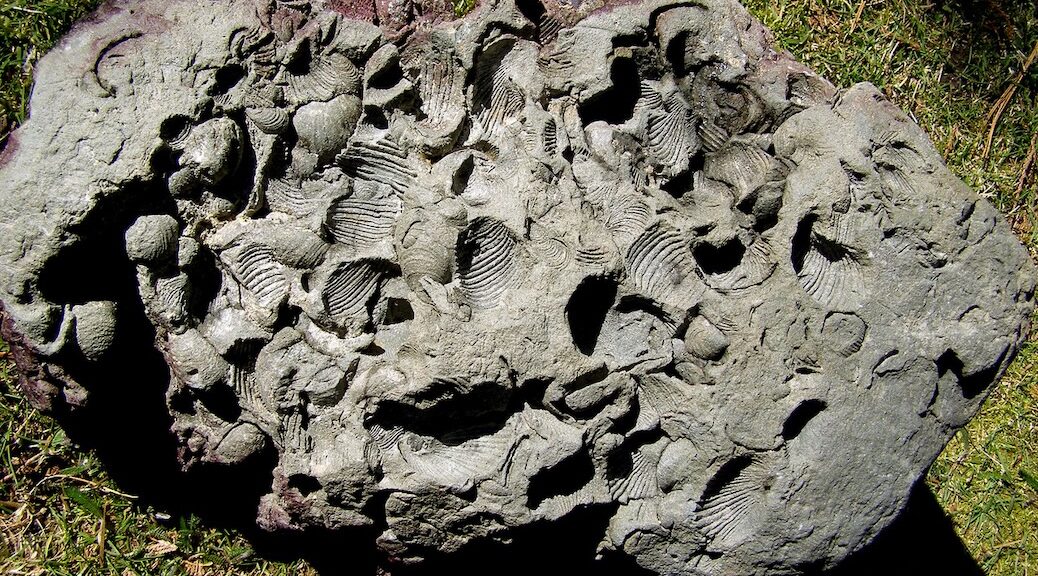

The story of fossils left during the last glacial period is currently on display at the Cortes Island Museum. They are Buchia mussels, Belemnites, and Ammonites—creatures that lived in the Chilcotin region at the same time as the dinosaurs. The rocks containing their fossils were relatively undisturbed for nearly 130 million years. Then, during the last glaciation period, fragments broke off and were carried to Cortes, Read, Sonora, and other Discovery Islands.
In this morning’s interview, Christian Gronau, a retired geologist and Cortes Island resident, tells their story.
(Christian Gronau examining specimens at Shoal Bay, East Thurlow Island – Photo by Aileen Douglas)
About Christian
Cortes Currents: First, tell us a little about your background
Christian Gronau: “I’m from Germany. I went to university in Germany, studying palaeontology and geology. Then I decided I would like to leave Germany. I was graciously accepted by the Canadian government as a landed immigrant, and I became a citizen eventually.”
“Of course, if you’re a geologist of any sort in Canada, your job opportunities are pretty much industrial. It’s either mining or the oil field. So I ended up on Texada Island working for the old iron mine there when it was still open. Then I went to the Northwest Territories and worked for a silver mine there, which was very interesting—the whole landscape and the mine itself. Silver veins in ancient rock. It was quite fun.”
“Up there I met Aileen Douglas, my wife—she’s from Scotland. So that’s a bit of a winding path: Germany and Scotland had to meet in the Northwest Territories. We came to Cortes Island, and we’ve been here for about 50 years now. So that gives our age away. We’re old-timers by now.”
Where these Erratic Fossils Come From
Cortes Currents: Now tell us about the fossils
Christian Gronau: “The very first fossil that came to our attention is in the exhibit, and it was found a long time ago. The question it raised was: How come it’s here? How did it get here? Are there any fossiliferous rocks on Cortes Island?”
“It turns out that that particular type of fossil and rock traveled about 200 kilometres down Bute Inlet, the Homathko River , and all the way from the Potato Range up in the Chilcotin. We have collected—with quite a bit of effort—the decisive pieces of evidence that confirm that origin.”
“If you visualize Bute Inlet, it’s a very steep-sided fjord. Not too many beaches along its shoreline. There are few places where you can stop and look for the rocks that glaciers may have left behind.”
“Bute Inlet, of course, is a fjord. It used to contain its own pretty impressive glacier, and it was the main vehicle of transport for these rocks—rocks we find not only on Cortes Island, but throughout the Discovery Islands except Quadra, which adds another little wrinkle to the story.”
“So we went up Bute, looked for a long time, and we did find a total of five specimens high up. They couldn’t have moved in the opposite direction. They must have come down that valley. Since the Potato Range has the appropriate formations—and even mentions on the geological maps the occurrence of these particular fossils—that is our conclusion and the answer to that long story.”
Types of Fossils
Cortes Currents: What kind of fossil was it?
Christian Gronau: “The fossil content of these erratics is actually quite boring. It’s the same type of mussel-like creature. It can really be compared to the blue mussels we have covering shorelines in our area today.
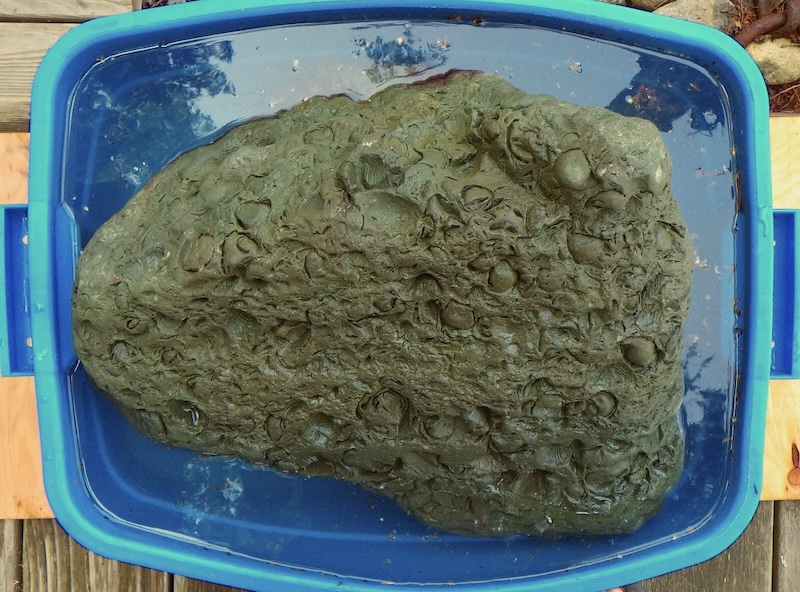
“And that’s how this particular bivalve, Buchia, is preserved. They were attached the same way the blue mussels were, and they must have been there in the millions and millions. Some of the fossil rocks we find are literally packed bivalves—what is called a coquina, a shell-supported coquina. There’s almost no room for sediment because there are so many bivalves stacked on top of each other.”
The Last Glacier Period
Cortes Currents: Where did the story go from there?
Christian Gronau: “Our pursuit—at the beginning strictly collecting these specimens and mapping their occurrence—quickly turned into a pursuit in the field of glaciology.”
“The timeline offered by the technical literature is that the last major glaciation event, the Fraser event, began about 29,000 years ago, peaked at about 14,500 or 15,000 years ago, and then the melting back of the glaciers was very quick. It was basically done 11,000 years ago. Certainly by 10,000 years ago, there were no glaciers except for some in the higher valleys. There are still some, of course, on the mountaintops now.”
“So the main period of movement—when the glaciers started out up on the Potato Range and began moving toward the coast—would have been around 18,000 years ago, when the glaciers were actively moving: sliding down the mountain slopes, through the valleys, and scraping up whatever they could along the way.”
“Once they exited Bute Inlet, these glaciers—large, sort of tubular sausage-like entities—came into the more open area of the Discovery Islands and spread out. The glaciologists like to use the word pancaked. They spread out, then sat there and melted. As they melted, they dropped whatever rock load they had incorporated into their ice—especially the rocks they had pushed ahead of them, but mainly the central moraine contained by the glacier body.”
“We’ve been as far north as West Thurlow Island, and we found plenty of evidence there. The southernmost occurrence is Smelt Bay. I’m speculating something might have reached Mitlenatch Island, but that’s a very small location, and we haven’t seen any evidence there.”
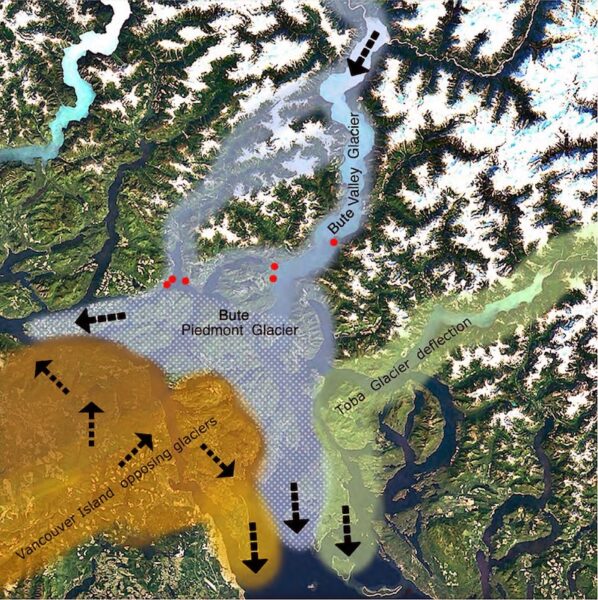
“There were other glaciers involved in the dynamics, too. There is the Toba Glacier. It came through Lewis Channel, and the east of Cliff Bluff was covered by the Toba Glacier. It pushed over the Bute Glacier, so this part of Cortes Island has absolutely no fossil evidence. It’s strictly the Bute Glacier that has delivered the stuff—from the Potato Range. The Toba Glacier didn’t encounter any similar rock formations on its path.”
“The same is true for Quadra Island. We’ve looked pretty hard. We’ve not found any evidence at all—in fact, we’ve found counter-evidence. There you find rocks that come from Vancouver Island, volcanic rocks like the Karmutsen Basalt. We also have a map at the museum that shows these conflicting glacial movements. The Bute Glacier was constrained, and one large tongue made it across Cortes Island—definitely as far as Smelt Bay.”
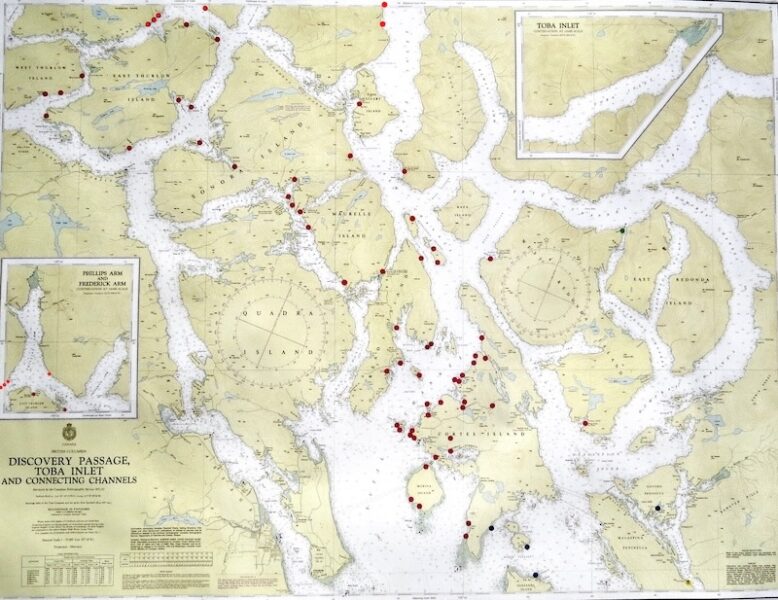
(Fossil distribution: red dots are Bucchia; black dots are other fossils; the total number of fossil erratics documented to date is 162)
Cortes Currents: Did any of these fossils reach Read, Sonora, Maurelle?
Christian Gronau: “I would say they reached all of what are known as the Discovery Islands—everything south of Blind Channel. Blind Channel was one of the last northwestern areas where we did find these fossils.”
“As I said, the southernmost point is Smelt Bay, where three pieces have been found, and they’re dutifully mentioned in the museum show.”

“The first one ever found, from Gorge Harbour, is in the exhibit. The southernmost fossil—a tiny pebble found by David Ellingsen—is also in the show. The significant ones found in Bute Inlet, which helped answer where these erratics actually came from, are in the exhibit as well.”
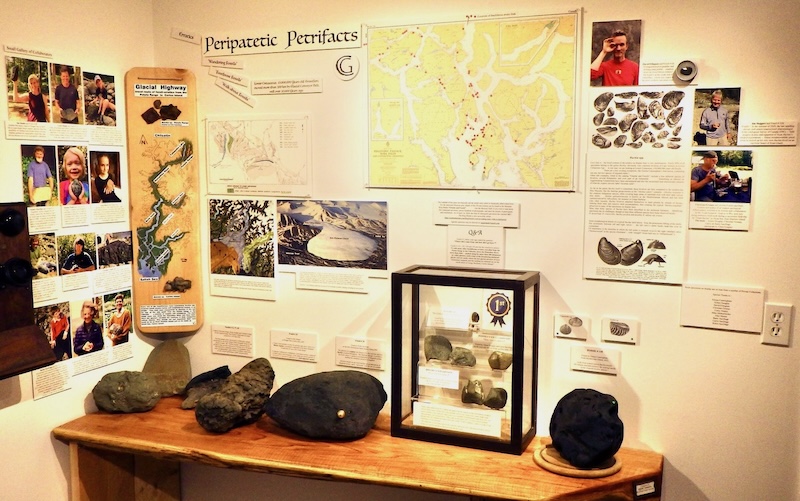
“The show covers the story quite well. There are specimens that illustrate the variety of rock formation and the variety of preservation of these fossils. Some are very nice classic pieces—hefty enough that they won’t fit into anybody’s pocket.”
“Below the display platform is a mock-up beach, like you might encounter anywhere around Cortes Island: full of cobbles, pebbles, a couple of boulders, and two fossil-bearing rocks among them. This is the kind of experience you might have if you look for fossils when walking on our rocky beaches.”
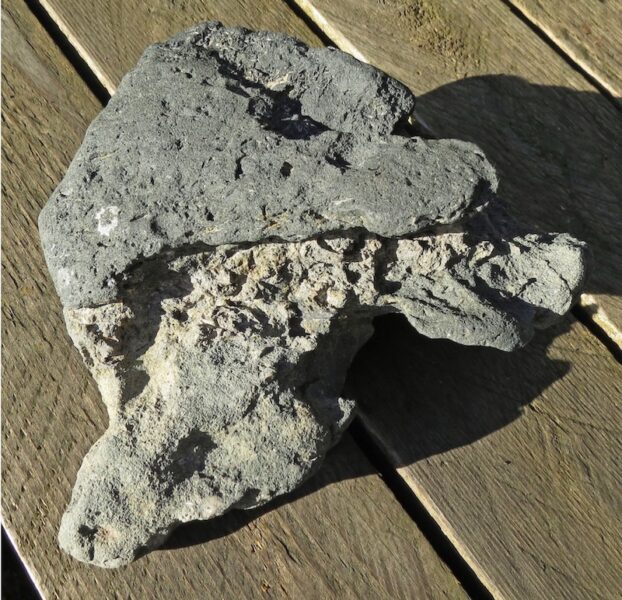
“The rocks can be quite different—from black to pale beige. They can be packed full of these mussels, or fairly barren, with just two or three in evidence.”
Cortes Currents: Is that the whole exhibit?
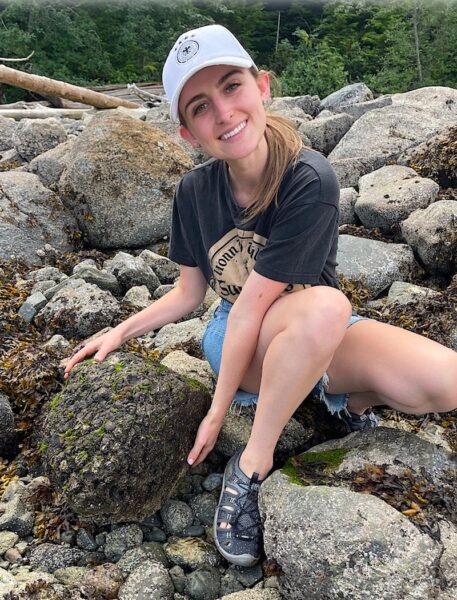
Christian Gronau: “We have a little gallery of contributors—colourful photographs of various people holding their finds, looking in varying degrees very proud and pleased with themselves. The age range there is from five years old to their 70s. It’s a good effort, with many, many contributors, also listed by name.”
“There are some maps that illustrate the pathway, and there’s a large chart showing every location where these erratics have been found. Of course, the highest density is near Cortes Island because that’s where more people have looked more often—so it’s not entirely representative of where fossils actually occur, but it gives you the range.”

Cortes Currents: The museum’s map shows a strong concentration of finds on both the Cortes and Read Island sides of Sutil Channel. As Christian said, there are finds throughout much of the western Discovery Islands, except for Quadra Island.”
Tell me about your favourite find
Christian Gronau: “I couldn’t say there is a favourite. There are some specimens that are more spectacular than others, and some of them are actually exhibited. It’s always exciting to find something that isn’t just the monotonous reoccurrence of another Buchia mussel.”
“There are a couple of fragments of Ammonites—five different species of bivalves. Maybe the second most common fossil, besides the Buchia itself, are the Belemnites. They’re squid-like fossils that had an internal skeleton like the cuttlefish, only torpedo-shaped. So what you find are these strange long bullet-like or torpedo-like impressions.”
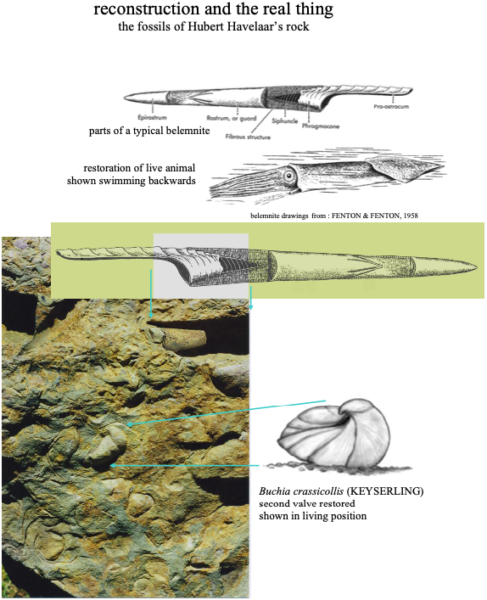
“Sometimes the actual shell part is preserved. That’s a typical Mesozoic fossil that went extinct at the end of the Cretaceous, together with the Ammonites and the dinosaurs.”
Cortes Currents: I was going to ask you about the range of dates for these fossils
Christian Gronau: “They are pretty much all about 130 million years old. They’re Lower Cretaceous—and fairly well constrained. The Buchia did occur towards the end of the Jurassic already, so it makes a pretty good index fossil.”
“If you find them, you do know where in the stratigraphic column in the geological ages you are. So it’s not super old compared to other geological events, but it’s still Mesozoic. It’s part of the dinosaur age. So you can imagine that maybe some dinosaurs lived along these beaches where the mussels grow and munched on them.”
“We’re looking at antiquity, compared to when the actual glacial event took place that brought these fossils here: 13,000 years compared to 130 million is quite a difference. So they haven’t been on Cortes for very long—but they have been in the Potato Range for a considerable amount of time.”
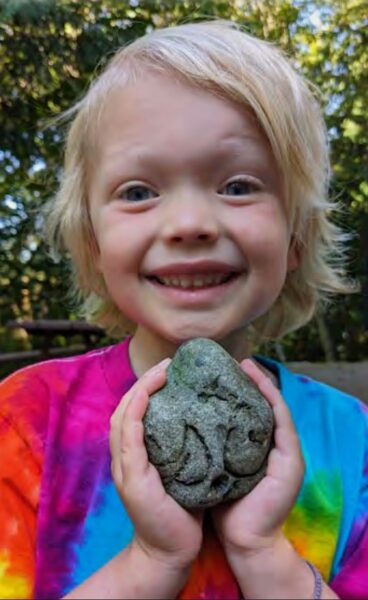
Cortes Currents: Tell me a story about how one fossil was found
Christian Gronau: “A couple of years ago, a young family from Vancouver—visiting Cortes Island—went to the museum with their then five-year-old little boy, Rowan. He was quite impressed by the big rocks sitting on the museum porch with fossils in them.”
“Nancy Kendal was at the museum, and she noticed his fascination. She said, ‘You know, you can find rocks like this on our beaches. These are all from local beaches.’ And he said, ‘Wow, that’s great. I’m going to go and find a fossil.’”
“His mother was there. She smirked, waved at Nancy, and said, ‘Yeah, let’s have some fun on the beaches.’”
“A couple of days later, Nancy encountered the mother and the little boy again on a beach near Smelt Bay. The boy came running up to Nancy and said, ‘I found one! I found one!’”
“The mother signalled in the background and mouthed the words, ‘It’s a kid’s fossil—be nice.’ The boy showed Nancy the rock he had found, about the size of a fist. Nancy looked at it and said, ‘Wow. This is a real— the real thing. This is a fossil that you found. Congratulations.’”
“The mother was absolutely nonplussed, and the kid was beaming. He was so happy. And we have a photograph of him holding the fossil and smiling like only a five-year-old can.”
Cortes Currents: Was it real?
Christian Gronau: “Absolutely. And he found it in the vicinity of Smelt Bay, where fossils aren’t that common. There are about a total of three finds attributed to that area—so it’s quite astonishing that he did find the real thing.”
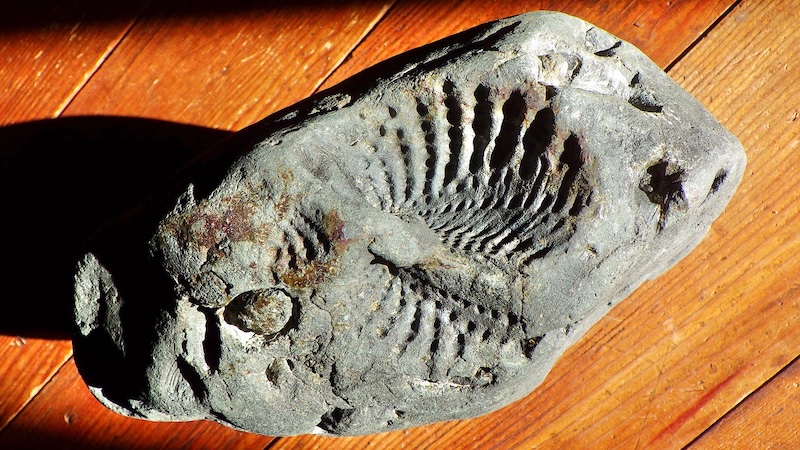
(Fossil #145)
Keep Looking
Cortes Currents: Do you have anything you want to say to the people listening to this broadcast?
Christian Gronau: “I would encourage everybody who walks the beach to once in a while take their eyes off the horizon and look at their feet, and see if they can’t find some more of these fossils. There’s never enough information or enough data available, because the picture can still be added to and filled out.”
“I encourage everybody to find, photograph, and report fossils on our beaches here—especially the location. Location information is very important.”
Cortes Currents: Who do you report it to?
Christian Gronau: “You can email me at [email protected]. You can find my email address on Tideline, because I occasionally contribute photographs to the image gallery, and my email is attached to that.”
The fossil exhibit is at the Cortes Island Museum, which is currently on winter hours: Fridays and Saturdays, noon to four PM. On Tuesday, June 23, they switch over to the summer schedule: Tuesdays through Sundays, 10 AM to 4 PM.
Links of Interest:
- Fossils – Never-ending Story – with Conclusion (part one) – Cortes Island Museum
- Fossils – Never-ending Story – with Conclusion (part two) – Cortes Island Museum
- Glacier-borne fossils in the Discovery Islands – Cortes Currents
- How fossil #144 came to the Cortes Island Museum – Cortes Currents
- Cortes Island aquifers: Rainwater, wells, salinization and climate change (Also: What the Last Ice Age means for Cortes Island’s Aquifer) – Cortes Currents
- The Ice Age settlement of Vancouver Island and the Discovery Islands – Cortes Currents
All undesignated photos courtesy Christian Gronau
Sign-up for Cortes Currents email-out:
To receive an emailed catalogue of articles on Cortes Currents, send a (blank) email to subscribe to your desired frequency:
- Daily, (articles posted during the last 24 hours) – [email protected]
- Weekly Digest cortescurrents – [email protected]