
(Part 1 of 2)

Canada’s MOU with Alberta, a proposed new pipeline in British Columbia, and the possible lifting of the tanker ban have been hot news items over the past few days. Steven Guilbeault resigned from cabinet over his opposition to the way Prime Minister Mark Carney is handling these issues. In the first episode of a two part series about the MOU, Cortes Currents asked four local leaders for their take on these events.
- Green Party leader Elizabeth May;
- Jennifer Lash, a former senior analyst with Environment and Climate Change Canada and the 2025 Liberal candidate for North Island–Powell River.
- Shelley Luce, Associate Director and Campaigns Director at Sierra Club BC;
- Max Thaysen, a leader of the Cortes Island Climate Action Network and regional representative for North Island on the BC NDP’s Standing Committee on Economy and Environment.

I want to start this broadcast by pointing out something the proposed pipeline is not. Aaron Gunn, the MP for North Island-Powell River, recently told the House of Commons that the proposed pipeline ‘could end the US monopoly on Canadian oil and bring billions of dollars into Canada.’ If this is true, it will not happen right away.
According to one suggested timeline, construction of the proposed pipeline could start “as early as 2029.” Donald Trump’s current term in office ends at noon on January 20, 2029. The 22nd Amendment of the US Constitution states, ‘No person shall be elected to the office of the President more than twice.’ We do not know if Trump’s tariffs will survive his presidency. As the proposed pipeline would probably not be finished before the late 2030s or 2040, it is not an immediate solution for Trump’s 10% tariff on energy products coming from Canada.
What it potentially could do is reduce the Canadian oil sector’s future dependence on American markets. However, this begs two questions:
- According to its CEO, Mark Maki, the Trans Mountain pipeline was running at 87% capacity during the summer and 90% or higher since then. If there is such a lucrative market for Canadian oil in Europe and Asia, why has it not yet reached full capacity?
- Given that the new pipeline may not come online until 2040, what kind of market will the proposed ramp-up of the oil industry’s most heavily emitting sector find in a world attempting to phase out reliance on fossil fuels?

(Graph courtesy the Pembina Institute)
Cortes Currents asked its guests for their reactions to the MOU.

Jennifer Lash (Former 2025 Liberal candidate): “This is really hard for everybody right now. I’ve been reading a lot of the comments from environmentalists, climate activists, First Nations, and political leaders, and this is a really hard moment.”
“When the tanker moratorium was put in place, there was a collective sigh of relief that so much of this coast was protected, and now that’s at risk. When we started to see climate policies come in, I think we all felt like, ‘Oh, okay, maybe we’re starting to make progress on this monster of an issue that we need to wrestle with,’ and I think we’re all feeling right now that that’s being rolled back. But I think we also need to look at the time and place we’re in right now—the pressures on this government to deal with the trade war that’s happening with the United States, which is very real. We need to ask ourselves: What is the right path forward?”
“I sympathize with the MPs who are wrestling with this. It’s going to be a hard couple of years, and we’re going to have to find our way through this. Ultimately, we need to make sure we are improving our climate policy, and in my world there will not be a pipeline proponent and we will not have to deal with a pipeline.”
“There are two ways to look at this. One is: what are the terms of the MOU (Memorandum of Understanding)? The other is: what are the politics that led to this decision?”
“So first I’ll touch on the terms of the MOU. Basically, it says that the federal government is willing to consider a pipeline that would result in one million barrels per day to the West Coast. It does not say where it would go. Everyone is assuming that any proposal will be to Prince Rupert or Kitimat, but the MOU does not say where it goes; it just says that they will consider it. Contingent on that is Alberta going ahead with the Pathways project, Alberta agreeing to strengthen its industrial carbon pricing, and implementation of the methane regulations. There are also some aspects around the Canadian Energy Regulations that are a bit murky to me, and I don’t quite understand exactly what they’re trying to do there.”
“In essence, the trade-off they are proposing is potentially reducing emissions from oil and gas while building a pipeline that would allow for the expansion of oil and gas and getting oil to the West Coast. Those are the terms of the agreement. Part of it also includes getting support from British Columbia and First Nations. In particular, as we all know, coastal First Nations are very opposed to this pipeline.”
“I have a bit of concern, because the way it’s worded right now suggests that if they can ensure the nations receive money from it, the nations will sign on to it. I don’t think it’s fair to the nations to assume that their support can be bought, because quite often their support for protection of the environment goes far deeper than monetary value. I don’t want to speak on behalf of any of the nations, but I feel that was an unfair assessment. I also feel it’s really unfair, because these nations have fought to protect this coast from offshore oil and gas and from tankers for decades, and now we’re putting it back on them again.”

“I find that disappointing. At the same time, I’m not convinced that a pipeline will ever be built. The International Energy Agency says we will reach peak oil by 2030. It takes a long time to identify a route and then identify how you’re going to build along those routes. If, in fact, a proponent comes forward and they want to route it to Kitimat, you have to go through mountains and over numerous salmon streams. It’s a lot of work. I don’t think that, even if there were a proponent right now, a pipeline would be up and running until after 2030.”
“From my perspective, it’s questionable whether there’s a business case. Two of the reasons I don’t think a pipeline will be built are the First Nations defending, yet again, their territory—from which we all benefit—and my lack of conviction that there is a market case for it.”
“If that’s the case, I think the question is: Why would the Prime Minister sign this MOU? I think that’s a really important point that we have to look at, even when we’re disappointed with the decision.”

(chart courtesy Jennifer Lash’s website)
“The Prime Minister has what I call his hierarchy of needs, based on Maslow’s hierarchy of needs for self-fulfillment. What are the priorities that the Prime Minister has to work through? I break it down into economy, security, national unity, and democracy. When those four factors are addressed, they get an ongoing mandate to govern.”
“When you look at it through that framework, one of the key things is national unity. Alberta was very seriously threatening to separate. Whether they would have done that is another issue, but we were not going to be able to avoid a fight with Alberta—which has been happening for a couple of years now—until we had something that broke that logjam. I wish it wasn’t a pipeline, but I can understand the politics of the Prime Minister and why he was willing to go down this road. Again, I don’t think a pipeline is going to be built, but I understand why he wanted to indicate to the world that it is possible. So that’s the situation we’re in right now.”
“There are a lot of concerns that he’s stepping back from the integrity of climate policies. I think, to some degree, that’s true. It is strengthening the industrial carbon price, which is one of the most effective climate policies we have. It is delaying the implementation of the methane regulations to 2035 instead of 2030, which is disappointing. And again, as I said earlier, Alberta is seeking a carve-out from the Clean Energy Regulations, but the MOU says it’s in abeyance. I’m not going to get into the weeds of how those regulations work, but we still have to see how that unfolds to determine whether there is really much walking back on that one.”

Shelley Luce (Sierra Club BC): “It’s getting clearer every day that exporting oil from anywhere is a terrible economic choice. We keep seeing headlines about nations around the world transitioning to clean energy far more quickly than we ever thought they would. So when I think about countries across the Pacific Ocean and the clean, renewable options they have in their own backyards—whether solar, wind, or geothermal—versus paying to ship bitumen across the Pacific to burn it there, it makes no sense to me.”
“Burning it would damage their air quality and public health when they have cheaper, cleaner options. So if we’re going to think about investing in a pipeline that might take 10 years to build, even if consent could be obtained from First Nations in the province of B.C., we should also think about where those countries will be in 10 years. They are already building solar faster than anything else. Last year, I believe, for every dollar invested in fossil fuels, two dollars were invested in renewables. Investors know where we’re headed for our energy future and our economy, and it is not the oil sands; it is not burning fossil fuels. Canada is really lagging behind. It’s shocking for me as a Canadian to accept this, but Canada, on the world stage right now, is a bad actor. We’re a fossil fuel supplier, and we’re banking on fossil fuels while the rest of the world moves ahead with renewables.”
“This MOU, in my view, is a pretty meaningless political stunt, because such a pipeline cannot be built without, first and foremost, First Nations consultation and consent. The coastal First Nations in B.C. have been extremely clear that this pipeline will never happen and that they will never allow oil tankers in North Coast waters, which they rely on for food security and for jobs. As for the negotiations with Alberta and Saskatchewan, I can only say that they may be scoring political points for some people—like the premiers of those provinces—but the argument doesn’t hold water here in BC.”

Max Thaysen (Cortes Island Climate Action Comittee): “A lot of us in the climate space have been twisting ourselves into knots to explain Mark Carney’s actions as some sort of 3D chess. It is true that, to some extent, we all have to adjust our messaging for different audiences and recognize that fossil-fuel-dependent provinces, industries, and workers all need some space and to be accommodated. There’s some understanding there, but since taking office, it has been rather relentless, with little indication on the other side that he is putting much energy into the positive things we need to do.”
“I think most people looking at it—and myself included—are out of patience for that rationale and are really confused and disappointed. It doesn’t look like he’s making some really smart plays, but it would be great if this turned out to be some sort of advanced negotiation.”
“Some people say that the pipeline will never be built. So for him to promise that—if it gets him some points with powerful people in Alberta and other fossil-fuel-dependent provinces—then maybe that will work in his favour; but he also inherited the platform of the LIberal Party, and they bought a pipeline (The Trans Mountain Pipeline). They really went for it and spent a ton of money on it. If we look only at the actual effects of the actions to tell us what the intentions are, it doesn’t look good, and it’s far from what needs to happen for a safe future.”
“The UN leadership has said that we don’t have space in our climate goals for any new fossil fuel infrastructure, and Mark Carney knows that very well—more than most. He has been reactive on climate change, and I think he was largely elected because of his history as someone who understands climate change and what it requires of us. So a lot of us are feeling a little confused and disappointed that he seems to be doing something very different from his past beliefs, and that is not in line with climate reality.
“The United Nations Intergovernmental Panel on Climate Change (IPCC)says we don’t have any space left in our carbon budget for new fossil fuel infrastructure. We have already built the extraction, transportation, and end-use infrastructure for fossil fuels that will take us past the level of warming considered compatible with safety and economic responsibility. We will have to stop using it before its expected lifespan.”
“Canada has already used up its fair share of the carbon budget under the Paris Agreement, the international agreement made in 2015. It sets out how much warming we agreed to limit, and how to share the remaining emissions space—the amount we can emit without exceeding those limits. By any reasonable calculation of Canada’s share of that space, we are already at zero or in debt to the world. Planning to contribute more pollution for decades to come is completely out of line with our commitments, with safety, and with economic responsibility.”

Elizabeth May (Green Party of Canada): “Sadly, the engagement of some governments and ministers—but not others—and the fundamental betrayal of many previous promises was surprising. Clearly, Premier Scott Moe of Saskatchewan was involved and Premier David Eby of BC wasn’t. The energy minister, Tim Hodgson, was involved and Steven Guilbeault wasn’t.”
“It is not just a pipeline deal. It is, at multiple levels, an affront to Indigenous rights and to our fiscal situation in Canada. It includes nuclear reactors for Alberta without talking to First Nations there about how they feel about becoming a nuclear province and being responsible for the nuclear waste. They specifically say “bitumen pipeline.” Isn’t that interesting? Bitumen is solid and can’t flow through a pipeline. They include various linkages, like making sure the so‑called Pathways carbon capture and storage project goes ahead—but it actually doesn’t have to go ahead; they just have to commit to starting it and getting financing.”
“It’s often misreported in the media, but at many levels what Mark Carney has committed to do is to help Alberta every way he can—shovelling money into projects; enabling one or more pipelines across British Columbia; and being prepared to—what they say—“adjust” the ban on oil tankers on the B.C. coastline. They say they will consult First Nations, but there is clearly no free, prior, and informed consent before they signed this deal with Premier Smith—whom I’m now tempted to call Prime Minister Smith.”
“If this is how Carney negotiates with Alberta, God help us if this is how he negotiates with Trump, because they gave Alberta everything. One could imagine we’re going to see no Clean Electricity Regulations for Alberta anymore; no oil and gas cap on production anymore. Industrial carbon pricing—yes, Alberta will do that if and when everything else is up and running, and then they start doing projects by 2027.”
“It’s a lot of money to Alberta to increase production out of the oil sands. That’s a really important point, and, as Premier Smith said in the press conference, there will be no veto for any province or other groups. So this is a clear violation of section 35 of the Constitution in terms of Indigenous rights holders. I think we all know, in this province, you don’t ignore the free, prior, and informed consent of UNDRIP, much less section 35 of the Constitution.”
“Then to assume—as both Prime Minister Carney and his energy minister, Tim Hodgson, told the national media—“We’re not worried about the First Nations because we’re going to make sure they make money,” I think it’s sickening. It’s a new form of colonialism. It’s what Grand Chief Stewart Phillip said about the Kinder Morgan pipeline years ago: that it was the 21st‑century version of smallpox‑infected blankets.”

“The whole MOU is not premised on Paris targets. I think it’s really important for anyone watching this to know that the Paris target is to stay as far below 2.0°C as possible. The Government of Canada’s “net zero by 2050” is not the Paris target; it is a sabotage of the Paris target, because if you make your deadline 2050 and your target “net zero by 2050” in 2025, you create the illusion that you’ve got 25 years to hit your target.”
“The reality of the Paris target is that we’re to hold as far below 2.0°C as possible. The window is closing on that being possible within the next year or two, for sure—not a 25‑year window; one or two years, if you’re an optimist. But this MOU is a techno‑fantasy that carbon capture and storage would work—which we don’t know if it ever would—plus a betrayal of what they had actually committed to in the budget itself: that enhanced oil recovery, where you use carbon capture and storage—in other words, injecting CO2 underground with the notion that you’re fighting climate change by keeping carbon dioxide out of the atmosphere—has a real goal that isn’t whether it stays underground, but rather using that gas to loosen more oil to increase production.”
“So it’s a direct subsidy to oil production. That was not in the budget, and I was specifically told the government had negotiated that so that I might be able to vote ‘yes’ on the budget. It was pretty hard to go along with them once they put this in writing; the budget didn’t allow for enhanced oil recovery to receive a subsidy, but then they added LNG subsidies, which was a shock to me.”

Elizabeth May: “I think the fact that Steven Guilbeault quit cabinet over this MOU probably says much more about how awful it was than all the details I can provide to Cortes Currents. It is a huge act of personal courage, and I would ask people who want to keep our oil‑tanker ban in place and who don’t want pipelines across British Columbia to write letters to the editor to support Steven Guilbeault.”
“It’s all too easy for the pro–fossil fuel crowd to cheer his departure, which they’re doing. It is not easy to walk away from a cabinet position. It is an extremely rare event in Canadian politics for someone to walk away from cabinet. Jody Wilson‑Raybould did. Now Steven says he is going to stay on as a LIberal backbencher. As you can imagine, I’m begging him to please join the Green Party caucus, where he can be true to his principles and not have to compromise. He’s made a lot of compromises since he joined Justin Trudeau’s cabinet. I think we all know that Justin Trudeau’s record as a climate champion was hardly a real record. I mean, they bought the Kinder Morgan pipeline and spent $34 billion of public money building it over the objections of First Nations and of British Columbia. I know for a fact that Steven Guilbeault nearly quit over Bill C‑5 in June—the Build Canada Act—the one that I was the only Member of Parliament to vote against.”

Jennifer Lash: “I’ve known Steven for a long time. I knew him when I worked in the environmental movement, and I later served as a senior policy advisor to him when he was the minister of the environment.”
“He is someone I have the utmost respect for, and he worked very hard to push the bounds of what Canada was doing. Under his guidance—along with Jonathan Wilkinson and Catherine McKenna when they served as environment ministers—we began to bend the curve on Canada’s emissions and start to bring them down. That is remarkable, and he should be celebrated for that alone. At the same time, we are seeing changes to the regulations he worked so hard on. I understand his frustration with that and his desire to distance himself from it, and not be perceived as approving those kinds of changes. I think it’s a loss to cabinet. I think it’s going to change the conversations, and I hope other cabinet ministers are willing to step up and fill that space.”
“I’m glad to see he’s staying on as an MP. I think he’ll play an important role in caucus. There’s a group within caucus called the Climate Caucus, which is the MPs working on climate, and I know he will continue to play a critical role in addressing climate change inside and outside government. So I’m really sad to see him leave cabinet, but I completely understand why he made that decision.”
“For nine years under Trudeau, Canada implemented ambitious climate regulations, and we really started to see some action; but the political fallout was quite strong. Alberta, Saskatchewan, and other provinces were very upset, and it caused real rifts within the federation. I believe Canadians want to see the federal government and the provinces working together. That’s really important for the long-term success of efforts to address climate change—and other priorities too.”
“The MPs who have put their names forward as LIberal candidates are going to be wrestling with this memorandum of understanding (MOU). There will be a lot of conversations in caucus—and hopefully with the Prime Minister—but I think they will stay, because they believe the LIberal approach to unifying the country, diversifying and building the economy, and helping Canadians is as important as addressing climate change. I believe they’ll continue to support the Prime Minister.”

Cortes Currents: This begs the question, will you run in the next election?
Jennifer Lash: “I’ve been asked that many times. I haven’t decided yet. I still support a LIberal government. I think having a Liberal government is our best chance of avoiding a Conservative government—and to be honest, that terrifies me the same way an 8.0°C temperature change does. I believe it would be catastrophic for our economy, our climate, our environment, and our social programs. It terrifies me, and I think the Liberal government has the best chance of winning.”
“I like the way the LIberal government is balancing economic development so that people have good jobs and can afford groceries. We’re also trying to address the housing crisis. I appreciate their approach to these issues. In that respect, I’m still very much in favor of what’s happening. But I’m watching closely to see how this prime minister handles things like climate action and environmental protection. That’s why this announcement has been difficult for me. Still, I haven’t ruled anything out yet. I’ll just continue to see how things unfold.”
Cortes Currents: In the concluding episode of this series, the same four leaders will speak about the specifics of the pipeline, the proposed lifting of BC’s tanker moratorium and an Angus Reid poll that suggests a slim majority of British Columbians may be in favour of the MOU.
Links of Interest:
- MOU with Alberta: The Poll, Pipeline, Tanker Traffic and Global Temperature Rise (Part 2 of 2) – Cortes Currents
- Canada-Alberta Memorandum of Understanding – Gov of Canada
- Canada and Alberta strike new partnership to lower emissions, unlock our natural resources, and build a stronger, more sustainable, and more competitive economy – Prime Minister of Canada
- Steven Guilbeault explains why he left cabinet
- Pipelines and the Prime Minister’s Hierarchy of Needs – Jennifer Lash
- Green Party condemns federal Alberta pipeline deal as a serious betrayal of climate commitments, Indigenous rights, and the people of British Columbia – news release
- Sierra Club BC reaction to the Ottawa–Alberta Pipeline Agreement – news release
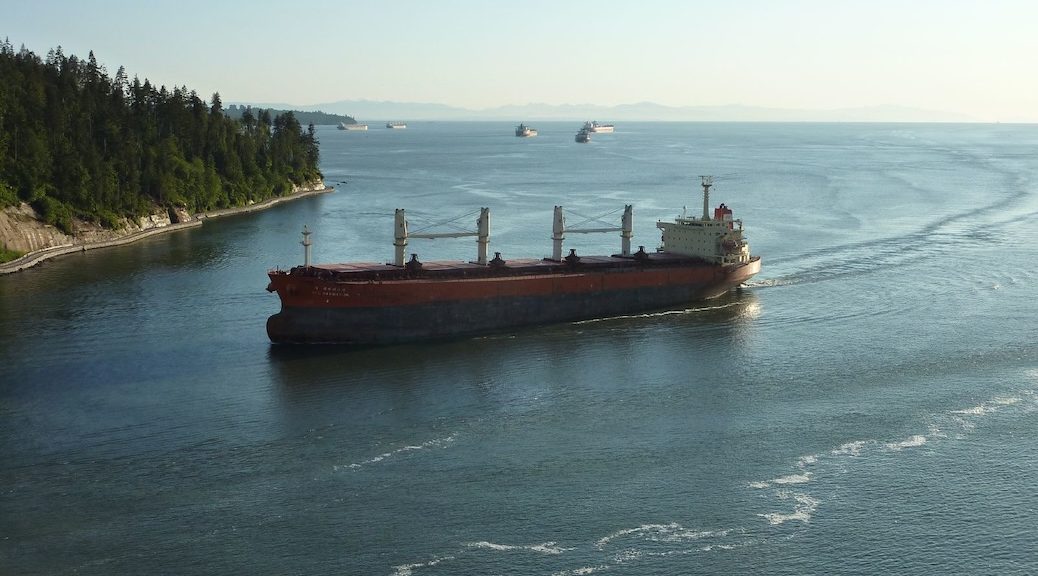
Top image credit: Oil Tanker off Vancouver – Photo by Mat Hampson via Flickr (CC BY 2.0)
Sign-up for Cortes Currents email-out:
To receive an emailed catalogue of articles on Cortes Currents, send a (blank) email to subscribe to your desired frequency:
Weekly Digest cortescurrents – [email protected]
Daily, (articles posted during the last 24 hours) – [email protected]