
(Part 2 of 2)

In the conclusion of a series about Canada’s MOU with Alberta, four local leaders delve deeper into specific issues: the pipeline itself; whether Canada needs British Columbia’s support; the proposed lifting of BC’s tanker moratorium; and an Angus Reid poll suggesting a slim majority of British Columbians may be in favour of the MOU.

What Does 53% Support In A Poll Mean?
I will also read some comments made by Aaron Gunn, the Conservative MP for North Island-Powell River, in the House of Commons on November 26, 2025.
He alluded to a recent Angus Reid poll that found 53% of British Columbian respondents conditionally support a pipeline, and nationwide, that number grows to 60%.
“Let us be clear: a majority of Canadians support this pipeline. A majority of British Columbians support this pipeline. As long as the world needs these resources, as long as the world needs oil and gas, until that last barrel comes out of the ground, as much of those resources as possible should come from right here in Canada.”
None of the leaders Cortes Currents consulted with agreed that the poll carried that much weight.

Elizabeth May, Leader of the Green Party, suggested, “Polling does nothing more than capture what people see in the news. So if Canadians see in the press every single day, ‘we need to do things together to confront Trump,’ that’s a very compelling argument. If I thought that shipping raw bitumen to Asia was a good way to confront Trump, it’d be hard to say we can’t do that.”
Jennifer Lash, the Liberal candidate for North Island-Powell River in the last election, stated, “I’m not going to hold that data as being hard and fast. I think we’re going to see that change over time. I think once the general public starts to hear from people who live and work on the coast who depend on a healthy environment, and who start to hear about the threat to the health of coastal communities and to businesses such as the commercial fishing industry, they will start to shift their perspective. I think once Coastal First Nations continue to express their concern around this, I wouldn’t be surprised if we started to see more people not supporting the pipeline. Then of course, from a purely political perspective, it’s what ridings are represented by the people who don’t want a pipeline.”
“The Liberals won 20 seats in British Columbia, and those are 20 seats they need to hold. So it’s not always what the views are of all British Columbians; sometimes it’s what areas they’re in as well. That makes a big difference. I’ve been rather crass, but that’s democracy in action.”
Shelley Luce, Associate Director of Sierra Club BC, explained, “People are worried about the future, and whether we acknowledge it or not, some of our worries about the future relate to climate change. I think a lot of people feel anxiety about these. Warmer winters, bigger fires, less snowfall, changes in animal migration patterns, changes in our agriculture, and relying on the natural cycles that we’ve relied on for millennia. Now, suddenly the stone fruit are missing for an entire year because of a strange warming, freezing pattern that we’ve never seen before that happened a couple of years ago in BC. So some of the anxiety and fear that maybe we’re not talking about is related actually to climate change, and things like burning oil and natural gas only make that worse.”

“At the same time, we’re inundated by messaging from industry and, unfortunately, from our own government telling us that we have no choice. We have to sell oil, we have to sell natural gas. It’s the only way we can survive, but that’s not true. I think the more people learn, the less likely they are to support these extremely damaging and dangerous, and very old-fashioned technologies and industries.”
Max Thaysen, from Cortes Island’s Climate Action Network, added: “I haven’t seen that poll myself, but my initial thoughts on it are that the framing of a question is really important.”
“If you frame the question as ‘do you want to be poor or do you want to build pipelines,’ people are going to get scared and want to build pipelines. I also think that when people are threatened in their pocketbooks, it makes them a little bit more conservative. People are worried, and it makes it harder to solve problems. This is a challenge as we face greater climate impacts as well. Some of the backlash that we see is just people trying to cling to what they see as normal, or tried and tested.
“It does take a little bit more effort, education, and support for people to accept a new thing in hard times, but I think that we can do it with the right leadership. If you asked people, given our current economic challenges, would you like to expand industries that commit us to a dangerous future or ones that solve the same economic problems, but using our wonderful, clean, renewable energies, I feel like almost all of them would choose renewables.”

Does Canada Need British Columbian or First Nations Support To Move Forward?
British Columbia has expressed reservations about the proposed pipeline, and local MP Aaron Gunn criticized the Prime Minister for transforming himself “into a helpless bystander, hiding behind the NDP Premier in British Columbia.”
“The Constitution is clear: National pipelines are the sole jurisdiction of the federal government. Failing to act is a betrayal of our national interests; it is a betrayal of our workers, and it is selling out to the Americans. Will they build the pipeline, yes or no?”
Cortes Currents: Does the Canadian government need BC’s support, or First Nations’ support, to build the proposed pipeline or lift the tanker moratorium?
Jennifer Lash: “Legally, no. This was tried with the Trans Mountain pipeline, because I’m old enough to remember when that happened. Premier Horgan tried to stop the pipeline, and the Supreme Court said no: you can’t use a provincial regulation for the sole purpose of stopping something that’s in federal jurisdiction. That’s what came out of that court challenge.”

“So legally, no, but politically – it’s a whole different matter. One of the reasons we’re having this conversation is because of the division that Alberta was causing within the country. If there is ever a pipeline proponent, and if it gets to the point where there is going to be a decision on it, it could cause just as much division in British Columbia. That’s really problematic, and that’s not nation-building.”
“So I think it’s really important that British Columbia continues to voice its opposition. The politics of it could make it hard for it to go forward, which has happened in the past, as we remember from the Enbridge Northern Gateway debate. I’m less clear on the law, but I know, again, with Trans Mountain, there were so many nations around the pipeline route that supported it that it justified going ahead with that pipeline, even though the Tsleil-Waututh and the Squamish opposed it.”
“I think some of the other nations opposed it too. Those are the two that I remember the most. But this Prime Minister and the Carney government haven’t really proven themselves yet on reconciliation. I think if one of the key things they do is override the Coastal First Nations and approve a pipeline, the political fallout could be quite serious for him. Coastal First Nations have been the protectors of this coast. Although I am not in the actual North Coast zone, my island (Sointula) is directly affected by anything that happens in that area. So I’m very grateful for the support that they’ve secured for the coast.”
Elizabeth May: “We’re on the planet’s side here; we recognize that solidarity with Indigenous rights and Indigenous nations is essential. Marilyn Slett and the Coastal BC First Nations—the Tsleil-Waututh, Musqueam, and Squamish First Nations—need our support. We need to show real solidarity against this new form of colonialism and exploitation by this new government. Federally, I’m really shocked. I don’t want to be partisan about it. I was, of course, hoping for more Green MPs to be elected, but I didn’t think a Liberal minority would be that bad, honestly. Ha—so live and learn. It’s a minority Parliament, so don’t give up. We can make a real difference. I’m hoping that Liberal MPs who are disillusioned with their own government will join us because they have their terms to serve, representing their constituents.”

”The growth in the oil sands is why we’re the worst performer in the G7 in terms of reducing our greenhouse gas emissions. This MOU is about increasing greenhouse gas emissions by increasing production in the oil sands and saying, ‘it’s all going to be all right because we’re going to get to net zero by 2050.’”
“I want to underline that ‘net zero by 2050’ is fraud. On top of it, by international law, we do have something called the Net Zero Accountability Act, which will require that the government by February of 2026, come up with a plan for hitting a 2035 target consistent with the Climate Accountability Act.”

Will Canada Meet Its Emissions Targets?
Cortes Currents: While the government believes the country needs to move forward with a consensus, the world’s average global emissions are rising. Is Canada on track to meet its upcoming emissions targets and have net-zero emissions by 2050?
Elizabeth May: “We’re not going to hit our 2030 target. I think we still have a chance of hitting the 2035 target because we have another five years. It’s going to take a very different approach, and everything that Mark Carney just agreed to with Daniel Smith will make it that much harder. The reality is, if we don’t hit the 2035 and 2040 targets, the 2050 target makes no difference because it will be game over for human civilization before we get anywhere near 2050.”
“We don’t talk about compliance with climate change nearly enough. It’s almost as if we missed holding to as far below two degrees as possible; we might go to two degrees, and somehow, mentally—certainly the media seems to think—okay, so it’s two degrees, but it’s not because we’re unleashing positive feedback loops all the time.”

“For instance, as the Arctic ice melts, it opens up more dark ocean water. We lose the albedo effect of solar radiation bouncing off the surface of the Earth because it’s reflected back away from the Earth by the white ice. So the more that ice melts, the more that the dark ocean water absorbs the heat, and the warmer the ocean gets. And the more the ice melts, the more we disrupt the global ocean currents, which shift and have other impacts. The warming of the Arctic also means that we’re losing the polar vortex.”
“Losing the polar vortex means we’ve lost the virtually horizontal mid-latitude, fast-moving jet stream. As we lose the fast-moving jet stream, we have more extreme weather events from a loopy and wavy jet stream that leaves low-pressure zones over some areas for a very long time, with deluge rain events lasting for weeks or months. On the other side of that wavy line, drought and heat occur. The positive feedback loops are extremely significant, and it means it’s not static. So climate change isn’t a switch or a dial; it’s putting in place events that are in the global atmosphere, results of global chemistry, atmospheric chemistry, and atmospheric physics that are irreversible.”
“We don’t talk about it very much because it’s scary and dark, but we have to think about it because this is why we have to keep fighting no matter how many targets we miss.”

“If the global average temperature goes above 2.0°C to 3.0°C , we don’t know where the tipping points in the atmosphere are, where we will not be able to stop 3.0°C from becoming 4.0°C, and 4.0°C from becoming 5.0°C, and 5.0°C from becoming 6.0°C to a point where mass human extinction is not a theoretical risk, but becomes nearer and closer to reality.”
“I don’t like to think that way because I’m a grandmother, and I’m going to fight like hell to hold to as close to below two degrees as possible because it matters to fight. It matters to shut down the fossil fuel industry. We’ve lived through forest fires in British Columbia, atmospheric rivers, heat domes, windstorms, and rising sea levels. We have to fight like hell, and what that means is making it clear to the media and government that Canadians care about the climate crisis.”

Cortes Currents: According to Berkeley Earth, as a result of worldwide governmental failure to act, the planet is currently heading toward a global temperature rise of 4.5°C , and Canada is heading for 5.2°C .
Jennifer Lash: “I don’t know the specific report you’re talking about. I have heard that emissions are starting to flatten, which is amazing. There’s a cup half full, cup half empty, right? I have to look at both so I can both not be terrified and also remain committed to doing this work.”
“When scientists first started looking at emissions projections, they considered an 8.0°C change. We talk about 2.0°C as being catastrophic. 8.0°C—I don’t even think there’s a word to describe that. We’re no longer on that projection. We are now looking at what you were saying: 4.5°C degrees as a global temperature is bad.”
Cortes Currents: That’s the worst-case scenario if we don’t do anything differently. We obviously can change that trajectory.
Jennifer Lash: “That’s right. They always model if we don’t do anything, if we do what we’ve said we’re going to do, and then they usually model what we’re actually doing. So it’s three different levels.”
“In the MOU, Alberta did commit to net-zero by 2050. They don’t have a pathway to get there, which is problematic, but they did commit to it.”
“We have a 2030 target and a 2035 target. Those targets are designed to keep us moving in the right direction and keep us focused on development. We need to look at reports such as the one you’re citing that we could be heading towards a 4.5-degree temperature change, and we have to use that as the warning sign that we need to keep taking action.”
“The Prime Minister and the Minister of the Environment, Julie Dabrusin, have committed to 2030 targets, 2035 targets, and net-zero by 2050. So we need to continue to find ways to make up for the emissions reductions, and if, in fact, a pipeline is approved and there’s greater production, that makes our emissions go up, and we need to be able to clean that mess up.”

A safer way to ship Bitumen
Cortes Currents: Elizabeth May pointed out that there is a safer way to ship bitumen than pipelines, and it does not require lifting the tanker moratorium.
Elizabeth May: “We could ship raw bitumen if that’s what they want, which is what they say they want. A bitumen pipeline in this MOU—I don’t know how many people listening know that bitumen can be shipped completely safely by train and loaded in containers on a container ship, as opposed to being liquefied as dilbit.”
“The only reason they add diluent to bitumen is to create something that will flow. So once you’ve built the infrastructure of the pipelines, it’s much cheaper for the fossil fuel industry to put dilbit in a pipeline and ship it, and then put it in a tanker and ship it than to put it on board a train and then move it from a train to a container ship. That’s much, much safer.”

“The Lac-Mégantic fireball that killed so many people was horrific, but that train wasn’t carrying bitumen. That train was carrying Bakken shale, which is explosive and flammable. If that train had been carrying solid bitumen, the damage done by the train losing its brakes and running into the town would have been the physical damage from the train hitting buildings. There could not have been a fire unless it hit a propane tank in town. The train itself and its cargo couldn’t catch fire because bitumen is a solid, it’s tar, and it doesn’t catch fire. There are various videos you can find on YouTube of people taking a blowtorch to bitumen to prove it doesn’t catch fire.”
“In fact, of the bitumen we’re shipping through the TMX pipeline now as dilbit, the first thing they do at the destination anywhere in the world is take the diluent out because the diluent is just there to make it flow. It isn’t an aid in upgrading it to synthetic crude or putting it through a refinery. So about a third of what we’re sending to China now is being used to pave roads because it’s just tar.”


The Pipeline & Tanker Traffic
Cortes Currents: What are the economic arguments for and against a pipeline and sending oil out through Prince Rupert?
Jennifer Lash: “From my perspective, it’s questionable whether there’s a business case. Two of the reasons why I don’t think a pipeline’s going to be built are the First Nations defending their territory again, and I’m not convinced there’s a market case for it.”
“Economics can be measured in many different ways. Obviously, if you build a port in Prince Rupert or in Kitimat, then you’re going to have local jobs, and there will be people saying that there is an economic case for it. You’ll have people arguing that there’s an economic case for exporting oil because it’s a diversified market. It’ll go to Asia, get a better price, and be less dependent on the United States.”
“I think what you put at risk in terms of the existing economy of fishing and tourism is critically important to communities on this coast, particularly small communities like Cortes and my community of Sointula. We can’t let that get swept under the carpet; that is of critical importance, and an oil spill would devastate us.”
“I think we have to look at economics not purely in terms of the number of jobs that come from building a pipeline, but we also have to look at the negative impacts on the communities that have existed on this coast for a long time. Even Prince Rupert—commercial fishing isn’t as much as what it used to be up there, but it is still an economic driver in Prince Rupert. So that would have a negative impact.”
“I think we need to be very, very cautious because the risk is simply too high if there’s an oil spill.”


Shelley Luce: “It’s one of the most dangerous areas to navigate in the world—certainly the most dangerous in Canada. Shipping out of Prince Rupert could go south through Hecate Strait or north through the Dixon Entrance, but either way, these are extremely rough waters, and oil spills happen. Most experts feel that if we are to ship massive oil tankers out from Prince Rupert, it will not be a matter of if, but when an oil spill occurs. It’s a combination of extremely strong currents, extreme high and low tides, deep water that becomes shallow very quickly, and, of course, the winds. We end up with some very large waves going through there. It is not safe to export oil from Prince Rupert via tankers, and that’s why the coastal First Nations have said very clearly that they will never allow it. It will never happen in their territories.”
Max Thaysen: “I was recently at the BC NDP convention, where NDP members send delegates to debate, discuss, and decide on policy matters. I saw David Eby declare emphatically that there’s a tanker ban, and he supports the maintenance of that tanker ban. There was a lot of support in the room for that position. There’s really strong support in this province for that tanker ban, even with the government that’s currently in power.”
There Are Better Ways To Do Things
Shelley Luce: “I was speaking with a member of Coastal First Nations two days ago, and he told me that they have 100% employment and often more jobs than people in his region of the Great Bear Sea, based entirely on fisheries and tourism. You know what no one can tariff? – Tourism. And you know what can be a sustainable job for generations to come? – A well-managed fishery that supplies protein to people up and down this coast and elsewhere because we do export fish products. So I understand that people are feeling insecure and they think we need to do whatever we can to develop some industries, but we don’t have to rely on dirty, polluting industries like oil and gas. We have so much more here in British Columbia.”

Max Thaysen: “Those of us who would like to see the necessary energy transition happening at a fast pace are pretty disappointed to see this pipeline development. There are so many great opportunities to build big things that put a lot of people to work and generate a lot of income for this country that also reduce our reliance on fossil fuels and help us fit into climate reality. It’s being offered as the only solution to our economic woes, but it isn’t. I don’t think we face a dilemma where we either go into a massive recession and lose a bunch of jobs, or we build these pipelines. The way that this is being talked about sets up that dilemma, but it eliminates a lot of other possibilities of things that we could build.”
“The renewable energy sector is a major job creation project, and from what I’ve read, those jobs are also more persistent. When you build a pipeline, you get a bunch of jobs for a little while, and then not that many in the long run, but with renewable energy, you get a lot more jobs in the long run.”

Working with the Government’s Limitations
Jennifer Lash: “A lot of people make demands on this government to do things like leave oil in the ground. That’s provincial jurisdiction, the federal government can’t do that. A lot of people don’t understand the limitations and how the federal government has to navigate in that space to ensure that the best protection happens while not causing these rifts with Alberta and Saskatchewan and now the rift that’s happening with British Columbia.”
“I’m still very much in favour of what’s happening, but I am watching to see how this Prime Minister rolls out on things like climate and protecting the environment. He’s going to have to navigate some hard politics over the next couple of years. Was there a better way to do it? I don’t know. I don’t think I can predict if we could have done things differently, but this is the situation we’re in, and he is going to have to really depend on his cabinet ministers and his caucus and really work hard on the politics of this, and it’s going to be tough.”
Links of Interest:
- Four Local Leaders React to Canada’s MOU with Alberta (Part 1 of 2) – Cortes Currents
- Canada-Alberta Memorandum of Understanding – Gov of Canada
- Canada and Alberta strike new partnership to lower emissions, unlock our natural resources, and build a stronger, more sustainable, and more competitive economy – Prime Minister of Canada
- Pipelines and the Prime Minister’s Hierarchy of Needs – Jennifer Lash
- Green Party condemns federal Alberta pipeline deal as a serious betrayal of climate commitments, Indigenous rights, and the people of British Columbia – news release
- Sierra Club BC reaction to the Ottawa–Alberta Pipeline Agreement – news release
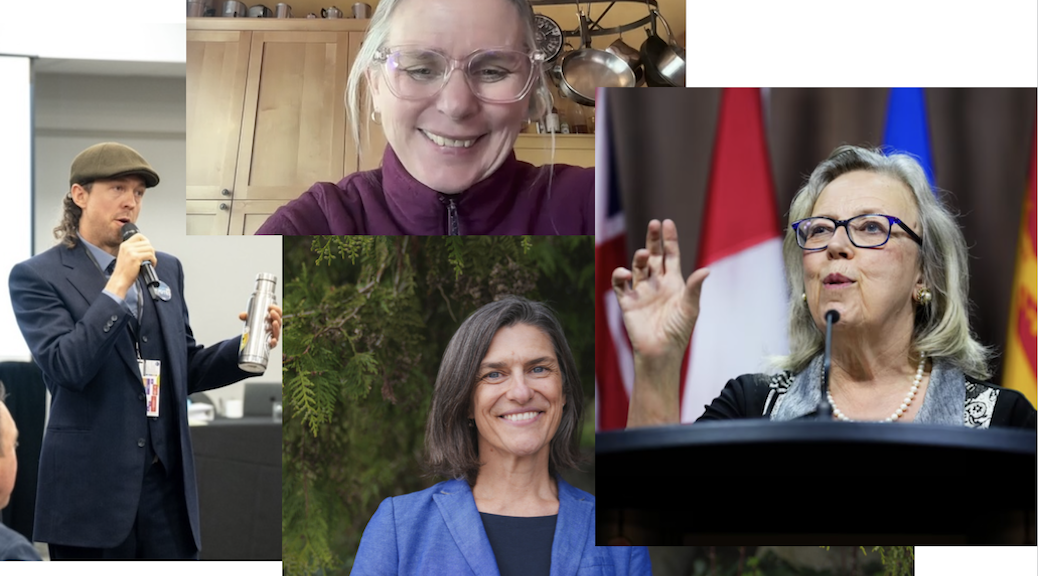
Top image credit – a compilation of photos from Jennifer Lash, Shelley Luce, Elizabeth May and Max Thaysen
Sign-up for Cortes Currents email-out:
To receive an emailed catalogue of articles on Cortes Currents, send a (blank) email to subscribe to your desired frequency:
Weekly Digest cortescurrents – [email protected]
Daily, (articles posted during the last 24 hours) – [email protected]