


Someone sent me a Facebook post in which North Island-Powell River MP Aaron Gunn points to a Petro Canada sign advertising gas for $2.09.9 a litre.
Gunn wrote, “Ridiculous. 4th-largest oil reserves on the planet. $2.09 per litre at the pumps. It’s time to build pipelines, refineries and an energy policy that puts Canada, and Canadians, first!”
My first response, when I calmed down enough to have a polite response, was ‘does he think a fully operational pipeline is going to drop out of the sky?’
So far, no proponents have stepped forward to build the proposed pipeline. Premier Danielle Smith of Alberta recently said there are some Middle Eastern and Asian investors who expressed interest in a minority stake. IF a proponent steps forward and clears all the necessary preliminary steps, it is still going to take years before oil flows through the proposed pipeline.

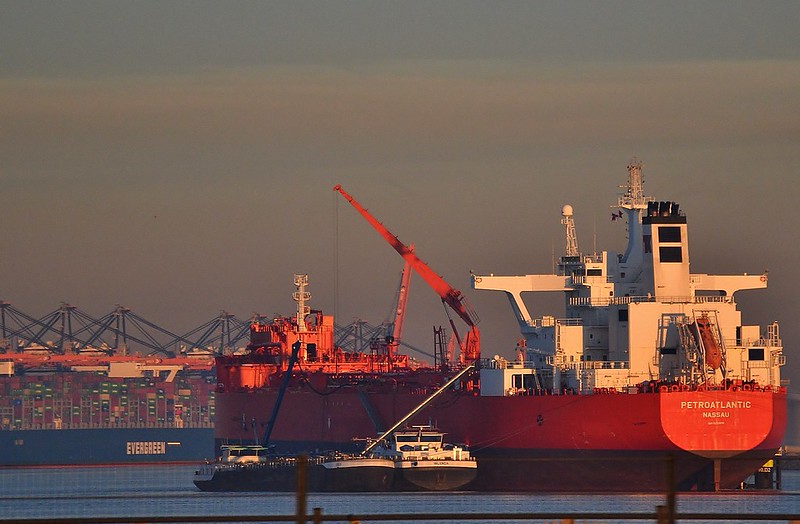
In the Midst of a Global Energy Transition
Will there still be a strong market for Canadian oil by that time?
As the Financial Times put it, “Peak oil is coming — but nobody seems to know when.” The IEA suggests the ‘demand for oil, coal and natural gas set to peak by 2030’; World Energy Outlet ‘by the early 2030s’; OPEC forecasts prices will continue to rise through 2045.
China, the principle Asian recipient of Canadian crude, views importing oil as a weakness and seeks to both develop its own sources and hasten the adoption of renewable energy. As the US-Israeli war on Iran continues, Indonesia is facing increased pressure to accelertate its transition to renewables. India would also like to switch, but is currently too heavily reliant on coal, oil and gas.
Overall: there should still be a need for Canadian oil after 2030, but it may be lessening and the world is transitioning to renewables.
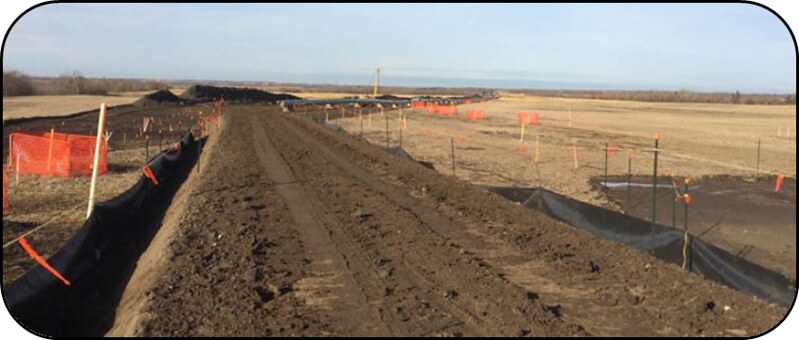
‘Big Oil’ is ‘Big Renewables’
Some of the biggest evidences of this comes from fossil fuel companies. In fact, ‘Big Oil’ is often ‘Big Renewables.’ They have the capital needed to undertake large projects.
As Mr Gunn likes to talk about pipelines, let’s look at some of the companies that have operated in Alberta’s Oil Sands.
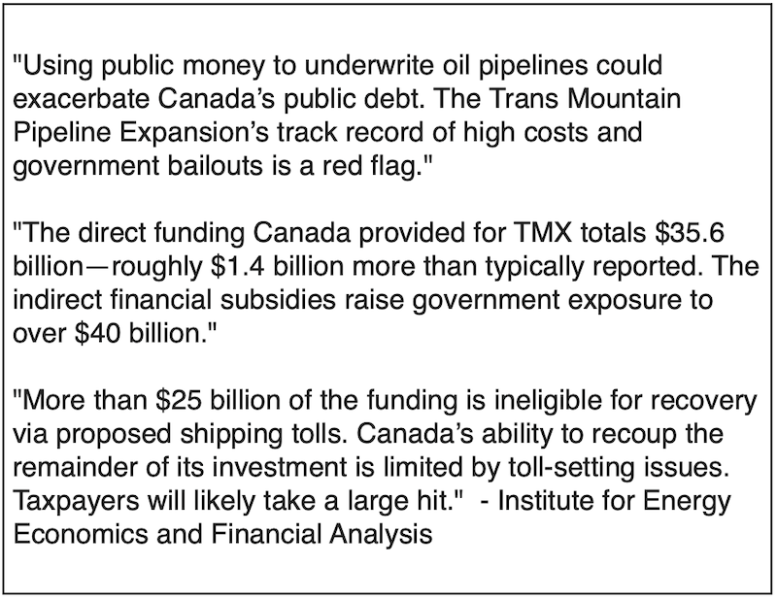
The debt ridden Trans Mountain Pipeline is owned by the Canadian government and does not have a renewable arm.
Diluted bitumen from the oil sands flows through the pipelines of two Calgary based companies:
- According to its website, TC Energy also generates “approximately 4,650 megawatts of power-generation capacity, over 75 per cent of which is low carbon emission electricity from nuclear and renewable power sources.”
- Enbridge has 23 wind farms (4,871 MW gross capacity, in operation or under construction), 17 solar energy operations (2,345 MW gross capacity) and a geothermal project (22 MW gross capacity).
Three European corporations that pulled out of the oil sands in recent years are:
BP (British Petroleum) a gas and oil company that divested itself of its oil sands assets in 2022. It’s also big into offshore wind as well as utility scale onshore solar plus battery projects.
The French energy giant TotalEnergies sold its oil sands assets in 2023, and is now pursuing a two prong strategy. They view LNG as ‘key to the energy transition’ and are ‘constructing a competitive portfolio of renewable (solar, onshore wind, offshore wind) and flexible (CCGT, storage) assets so that we can provide our customers with low-carbon electricity available 24 hours a day.’
Shell exited the oil sands in 2025, but has a 40% interest in LNG Canada, as well as investments in carbon capture, offshore wind, utility scale solar with battery, EV charging and aviation biofuels.
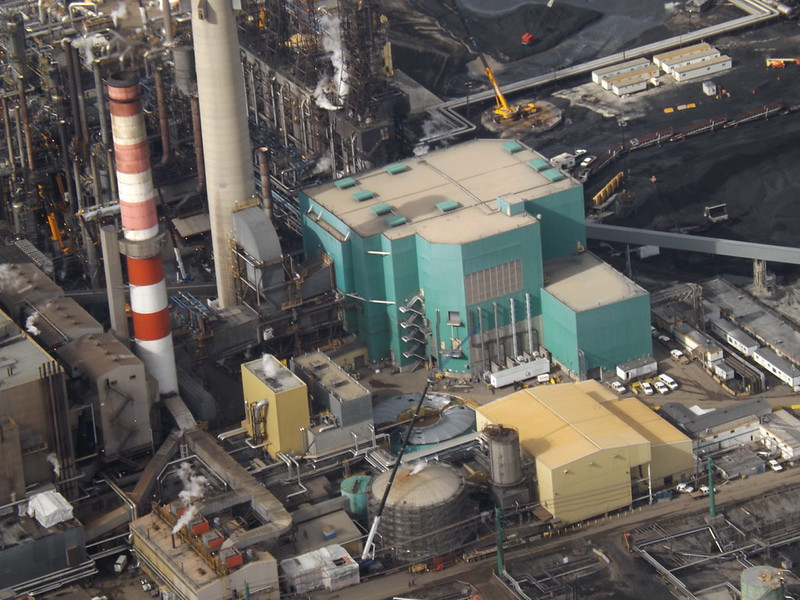
The two biggest players in the Oil Sands are Suncor and Syncrude.
Suncor is based in Calgary, and while its principal focus is diluted bitumen, it also operates one of Canada’s largest ethanol plants and partnered with with ATCO on a world-scale clean hydrogen project in Alberta.
On their website, Suncor states, “We hold a 58.74% interest in the Syncrude joint operation, which has a gross bitumen conversion to synthetic crude oil capacity of 350,000 barrels per day (206,000 barrels per day, net to Suncor).”
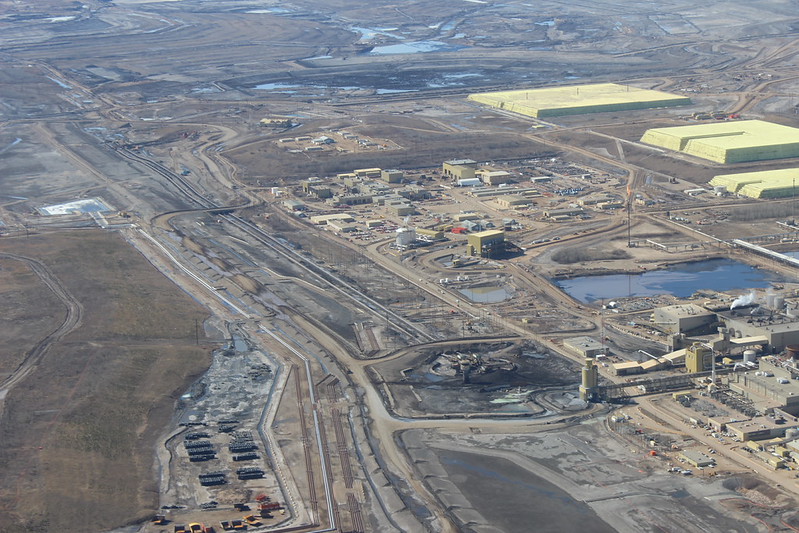
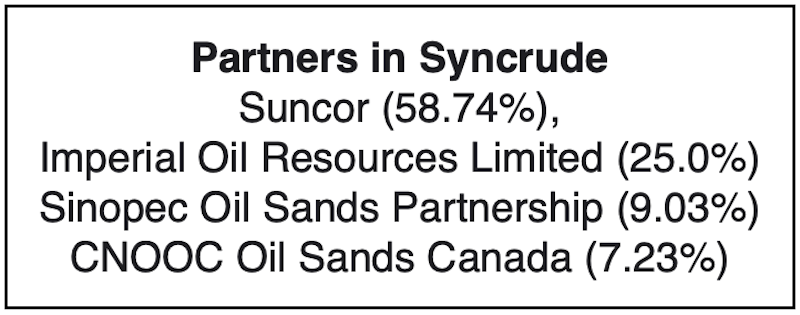
Syncrude is based in Fort McMurray, Alberta.
Its second biggest stakeholder is Imperial Oil, which also produces renewable biofuels, lithium for EVs and another of its focus areas is carbon capture research.
In addition to fossil fuels, China Petroleum & Chemical Corporation (Sinopec) is a major producer of geothermal energy, pioneers hydrogen production innovation in China and launched China’s first commercial floating offshore solar plant.
The China National Offshore Oil Corporation (CNOOC) is a global player in the oil sands, offshore drilling and fixed and floating wind farms.
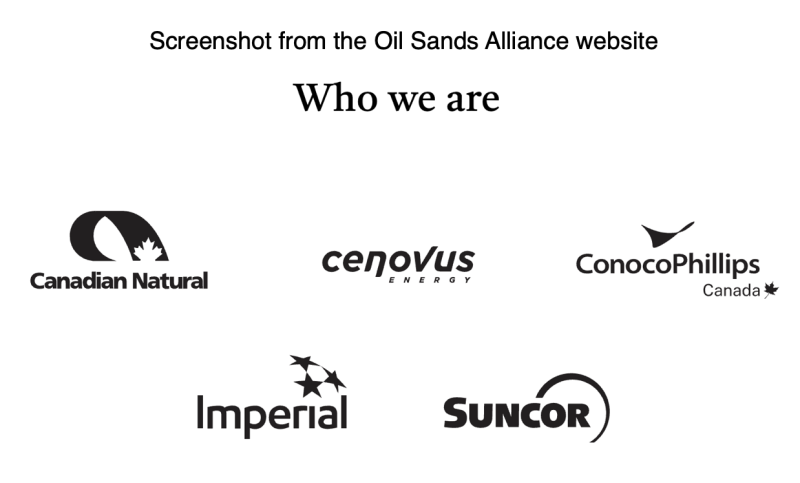
Three of the five partners in the Oil Sands Alliance, whose primary focus is the Pathways Carbon Capture and Storage project, are not in the list above:
- Calgary based Canadian Natural “is a senior crude oil and natural gas production company, with continuing operations in its core areas located in Western Canada, the U.K. portion of the North Sea and Offshore Africa.”
- ConocoPhillips Canada’s focus is the gas and oil sector, but its Houston based parent company has solar farms in the United States and offshore wind projects in Asia and Europe,
- Cenovus Energy is a Calgary based natural gas company which “has been investing in renewable energy projects, including wind and solar initiatives, with the goal of reducing its reliance on non-renewable resources.”
With the possible exceptions of Canadian Natural and the Trans Mountain Pipeline, all of the oil sands, and former oils sands, corporations listed above have renewable projects.
Some European companies like Ørsted (Denmark), E.ON (Germany), and Neste (Finland) have gone further. They divested themselves of fossil fuels and are now 100% renewable.
Overshoot
Personally, I do not believe our energy problems will end with the energy transition. There appear to be too many of us living on a planet that lacks sufficient resources. As Cortes Island’s own Rex Weyler once declared:
“We’re not even addressing the problem of human overpopulation. We are ignoring that, pretending that is not an issue. We’re not really addressing our consumption habits. We are trying to come up with technological fixes that will allow us to continue with business as usual.”
I can see the ‘overshoot’ of our resources that he alludes to in three crucial areas.

Most of the light easily accessed crude oil sources have been tapped, and as a result producers have turned to dirtier, more energy intensive sites like the Alberta oil sands.
The days when fish returned in such great numbers that you supposedly could walk across rivers have passed into folk lore. I actually saw them that thick once, on Basil Creek during the Chum run of 2024 – though they obviously would not have let me walk on them! Fishing was once one of BC’s major industries and remote islands like Cortes were once homes of many fishermen.

For the most part, the great trees that once populated the West Coast are either stumps or appear in photographs. Pockets remain. Karen Price, one of the three scientists on the former Old Growth Strategic Review Panel, recently said she expects BC to run out of those outside protected areas in the next five to ten years.
I was working in a shingle/shake mill when the wide ringed second growth cedar arrived during the 1970s. When used it for shakes, the resulting blanks were often deeply corrugated. One of the sawyers in our used to push ‘that crap’ off his table and walk out in protest.
It’s easy to spot the second growth fir in passing logging trucks. That big yellow ring on the outside is sapwood. It disappears into a thin line when they mature, but forests are currently being harvested at between 40 and 80 years.
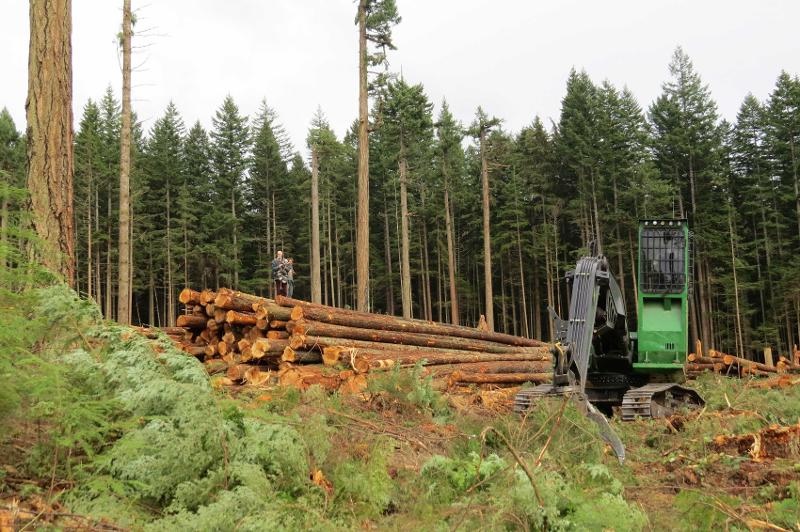
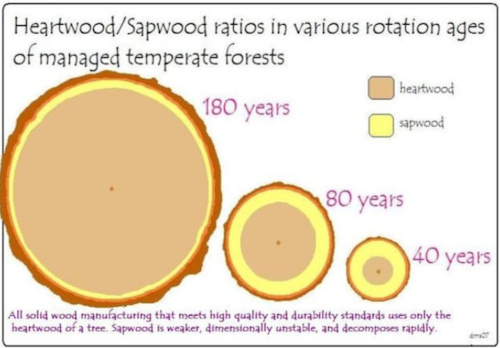
Heartwood & Sapwood in Fir Trees – courtesy David Shipway
David Shipway, a Cortes logger turned builder, explained, “Sometimes you can use a mix of heartwood and sapwood for visual effects, but only indoors where it is going to stay dry. It can be used as a visual feature in cabinetry because it is kind of interesting to have the two colours, but if you are building outdoor stuff you want to stay away from sapwood altogether. It’s only got a few years before it’s rotted. If you build a sundeck that has any sapwood in the cedar, that wood will rot within five years.”
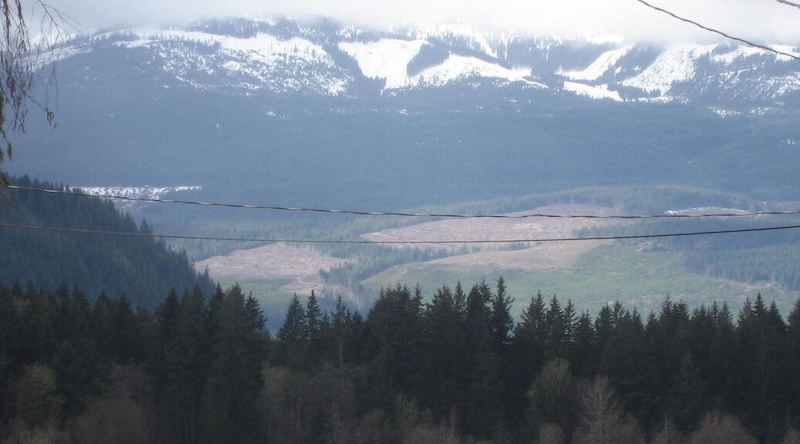
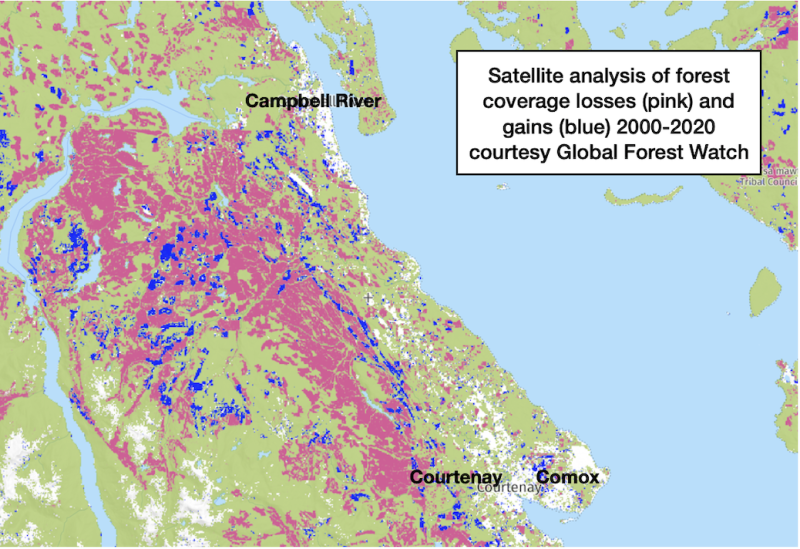
Anyone who seriously doubts that we are over-cutting our forests should look at the satellite based maps on websites like Global Forest Watch (above). Make sure you are looking at the same years and compare the vast pink stretches of ‘forest losses’ to the smaller blue spots of ‘forest gains.’
What does it all mean?
- We need to curtail our consumption.
- We also need to phase out fossil fuels. Very few scientists would still dispute that. There is little chance of limiting the rise of global temperatures to1.5°C, we’ve been on that threshold since 2023. However it may still be possible to not reach 3.0°C in the next fifteen years.
Aaron Gunn told parliament, “As long as the world needs and demands oil, as much of it as possible should come from right here in Canada. To do that, we need pipelines.”
Prime Minister Mark Carney appears to believe the proposed pipeline is a political necessity (to appease Alberta), but this will not happen unless a proponent steps forward to build it.
Links of Interest:
- Why Big Oil Companies are Betting on Renewables – Medium
- How the 6 major oil companies have invested in renewable …
- Articles about, or mentioning, Overshoot
Top image credit: “Ridiculous 4th-largest oil reserves on the planet. $2.09 per litre at the pumps. It’s time to build pipelines, refineries and an energy policy that puts Canada, and Canadians, first!” – Courtesy Aaron Gunn’s Facebook page
Sign-up for Cortes Currents email-out:
To receive an emailed catalogue of articles on Cortes Currents, send a (blank) email to subscribe to your desired frequency:
- Daily, (articles posted during the last 24 hours) – [email protected]
- Weekly Digest cortescurrents – [email protected]