
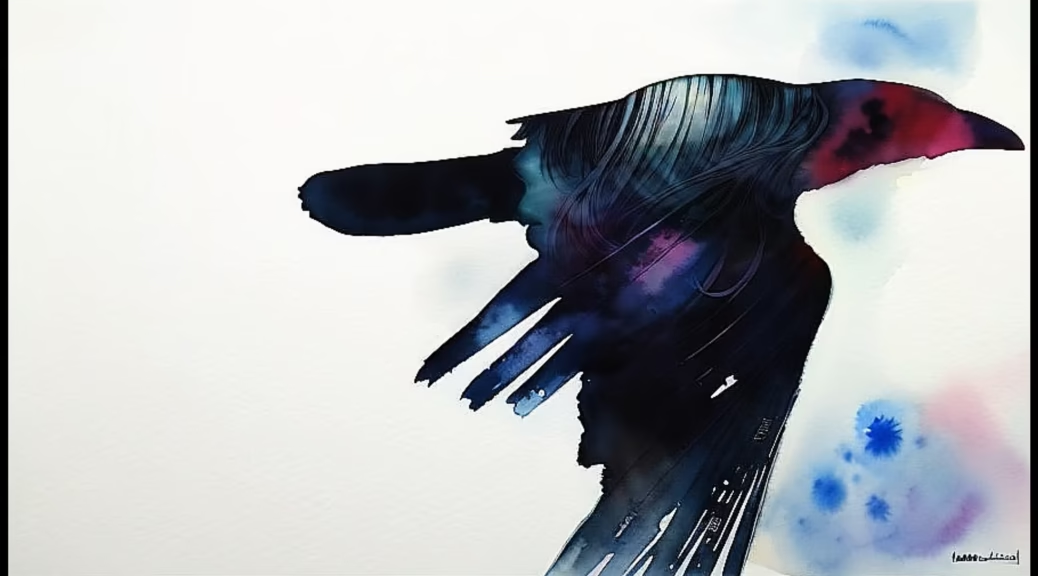

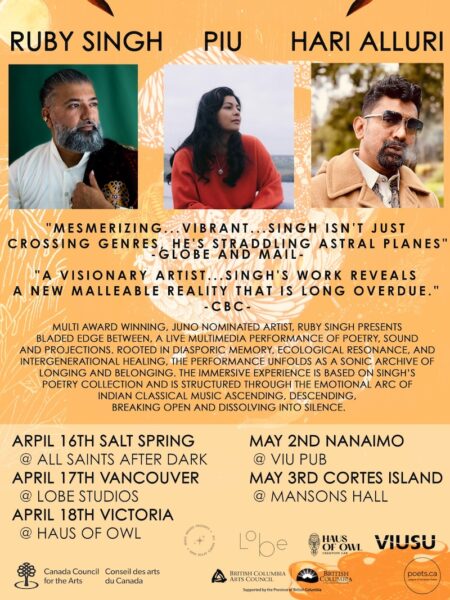
Juno-nominated musician Ruby Singh recently returned to Cortes Island, both as a facilitator for the CASE Youth Leadership Conference at Hollyhock and to give a concert at Manson’s Hall. In this morning’s interview, he talks about his many forms of artistic expression, inspirations, and relationship with Cortes Island.
Ruby Singh: “I find inspiration in a lot of different ways. I feel like we are all just small tendrils of creation, so the act of creation and the act of creativity are among the most natural ways of being. Other artists really inspire me. I am deeply inspired by ancestry and futurity at the same time, so finding ourselves where we are in this timeline of inheritance from our ancestors, and what we are thinking about leaving here when we leave. Long timelines really inspire me, and deep time is a very inspirational thing. I get a lot of inspiration from my community, from the people around me, and from this more-than-human world that surrounds us.”
(The podcast above opens with Down Home, from the album Ruby Singh And The Future Ancestors (below) includes the Mother’s Day piece from The Bladed Performance in Mansons Hall and closes with Tooth ‘N Claw, from the album KraKIN, a collaboration between Ruby Singh and Dr Michael Datura, the principal of the Cortes Island School.
Cortes Currents: You were saying you love to walk in nature. Do you want to talk a little bit about that?
Ruby Singh: “We genuinely are human-centric, and that makes sense, but the idea of being able to extend our relationality out to the natural world is something that I’m working on. Taking a walk in the woods is an opportunity for me to extend my senses and my being into our more-than-human kin that are around us.”
Cortes Currents: How do you see trees?
Ruby Singh: “Intelligent, incredible creatures.”
Cortes Currents: Intelligent? Do you feel a connection?
Ruby Singh: “Yeah, I have sensed through my being, and not just my five senses, there is a connection with trees for sure.”
Cortes Currents: How do you perceive them in terms of senses?
Ruby Singh: “Of course, we smell them, we like to be with them, but there’s almost a forest bath that happens in this exchange between us through oxygen and carbon dioxide, which is happening at various levels. I’ve sometimes sensed almost a breath being shared back and forth.”

Cortes Currents: You also mentioned ancestors
Ruby Singh: “I was the first of my family born here on Turtle Island, and with migrant existence, we are left with a lot of questions of back home. Of course, I’ve traveled back to my ancestral villages, but I feel like there’s a consistent curiosity within me about what my grandparents and great-grandparents were doing. How would they perceive what I’m doing in life? When did we have more of a mystic grasp on how life exists, as opposed to maybe a strictly shrewd, scientific kind of way in which we subdivide the world? How did we move through the world more mystically before? What kind of sounds were surrounding them? What must it have been like to look up and see the stars all the time, as opposed to being in a world full of light pollution? Although we’re on Cortes, we get to see the stars pretty well up here.”
Cortes Currents: Tell us a little more about the place your ancestors came from
Ruby Singh: “We know what continent I’m talking about, but there has been a lot of movement within it. Punjab was fought over by empire after empire. It depends how far back we’re going to go. We had the Mongols, Alexander the Great—that’s where he reached his limit—of course Genghis Khan, the Persians. All sorts of people fought over that land for centuries upon centuries. It’s really fertile farmland, or at least it was until the Brits got in there.”

Cortes Currents: Is there any place which is a sacred spot to you?
Ruby Singh: “I don’t believe that any place is more sacred than another. I think it’s about how we attune to it in that place. But places that attune me really easily have been things like stepping into the forest. Things that are left alone by humans—I find a lot of sacredness in those places. But I’ve had sacred moments on a bus traveling through the Downtown Eastside. I’ve had sacred moments at the top of a mountain at a Hanuman temple..”
“Sacred moments follow me while I’m in the ocean, or in the forest, or while I’m with friends at a coffee shop. I think it’s more about perspective than it is about a place.”
Cortes Currents: What brought you to Cortes?
Ruby Singh: “Years and years and years ago, I think it was Mook and Monique who invited our band to come up and play. It might have been the late ’90s, maybe even ’98, and we played over at the Gorge. We had a band called Sapna. Who was the fantastic woman who ran that bakery there for a long time? Truda baked us a cake on our first arrival, and then after the gig we were shuffled off over to Channel Rock, spent some time there, and instantly felt the gorgeousness of this place. In the ’90s and 2000s, a few of us went to Carrington Bay and camped out there for a while because it was so beautiful.”
“I started coming back again a few years later, working with Charlie Murphy and Peggy Taylor from Power of Hope. They invited me to be an artist at Power of Hope. They said, “Hey, we do this thing up on Cortes,” and I was like, “That sounds great.” It allowed me to start coming up to the area, and then I just started spending a little more time here.”
“We’re looking back over 25 years now. Every August I’m usually back, because that was when we were doing the youth camps. I love coming here in August and just being here, close to the water and the forest, and having a great summertime on Cortes.”
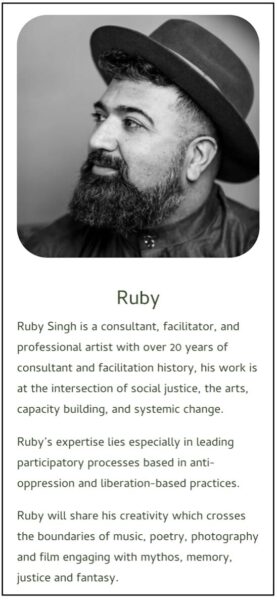
Cortes Currents: I was reading the bio the Cortes Island Academy provides for the CASE Youth Leadership Summit (above). Tell me how your work is at the intersection of social justice, the arts, capacity building, and systemic change.
Ruby Singh: “I have worked in social and ecological organizing and education for over 20 years—working within education systems, within detention centers, and within universities and colleges, running workshops. There’s really something powerful about being able to express our stories and have them listened to. That moves into an idea of agency and being able to move in the world. My artwork has those things at the basis of creation, but I am also just coming off working with all the young people today.”
“The CASE Youth Leadership Conference is organized by some amazing locals: Manda Aufochs Gillespie, Michael Datura, and a bunch of other folks. It was a five or six-day-long gathering at Hollyhock. It brought youth together from some alternative education programs, the sister host nations here, a group of youth from the Okanagan, and some folks who came on their own from Quadra and as far away as Santa Cruz or Santa Barbara.
Essentially, we’re bringing youth together to speak to and look at the world they’re inheriting, and how they’re feeling about it—looking at creativity, and looking at arts and sciences, and bringing those all together to build, essentially, a caring, creative community that seeks to support every kind of member of it in the small amount of time that we have there.”
“So, on the daily, we all wake up, have breakfast, and then get together for a plenary discussion focused on a specific topic. We did lots of language learning with Jesse Louie and Georgina Silby, which was super awesome. We’d have lunch, break out into various workshops that people were offering—everything from conversations to visual art to movement to music—and that’s what I was primarily offering. There were a lot of different music workshops. Then we’d have a little break. They’d have some free time to just be in the place, and then we’d have dinner. We usually had an evening activity, so we did everything from theatre games to culture night. The Klahoose came in for a culture night and gifted us so many songs and dances, and had us join in with them. We had an open mic night. All sorts of great things were happening in the nighttime, and as it’s multiple days, I think our personal guards fall away and we really begin connecting at another level.”
Cortes Currents: It looked like fun, all these different avenues and what have you.
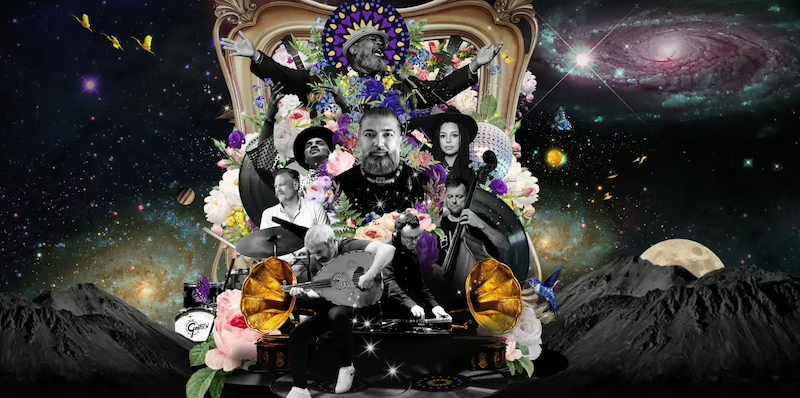
Ruby Singh: “I like to bring a little wildness into my creativity, which allows me to have a lot of fun and really allow myself to pursue and move in inspirational directions, so that I’m able to derive a lot of joy out of the process of creating.”
Cortes Currents: When I walked into your concert at Mansons, there was classical eastern music, then I clicked on a couple of the videos on your website and found myself listening to blues and hip hop.
Ruby Singh: “That checks out. There’s a wide array of expression that happens through me. I feel like a lucky conduit for all the weird ways the muse wants to show up in my life.”
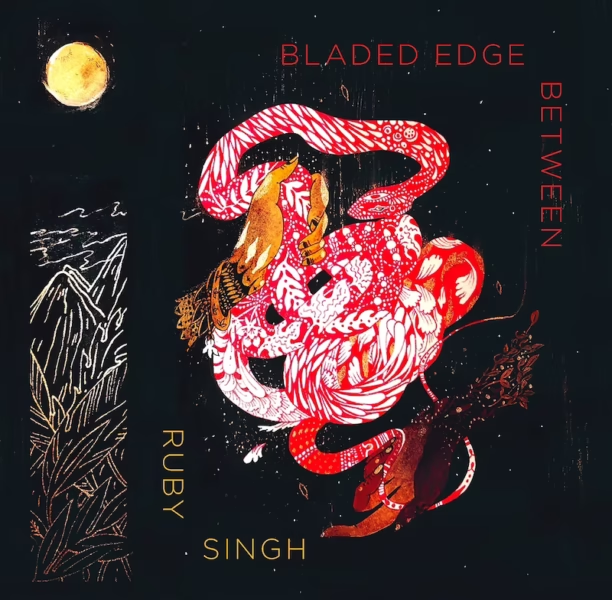
“The concert was based around my poetry book, Bladed Edge Between. I’d gotten together with PIU(Priyanka Chakrabarti) and Hari Alluri, who is also the editor of the collection. We worked together for about a week, creating a performance around it. Priyanka is a trained vocalist in classical Hindustani forms. I have a bit of training in classical Hindustani forms, but really my relationship to sound is what guides my work a little more than any fixed tradition.”
“I worked on a bunch of projections myself, and the poetry obviously, and the music was co-composed with PIU, while Hari Alluri provided another voice in the platform. I really love polyphonic poetry—polyphony as nature philosophy in and of itself—and all of those things kind of swim together and inform the work.”
Cortes Currents: Tell me how systemic change comes into your work.
Ruby Singh: “I feel like the imagination is stuck on one little piece of what we’ve inherited, and that clinging to capitalism as the only way forward means we must hold onto this even when we see it clearly failing us en masse and serving a very small few. I think those kinds of philosophies are infused in the music, and ideally they help with inspiration and spirit work for the good people doing the frontline work. A lot of my work has also been on the front lines working in social change, whether that’s through education or showing up to frontline demonstrations, providing music in those spaces, and providing sound systems.”
Cortes Currents: What kind of demonstrations are you talking about?
Ruby Singh: “Everything from the horrors of humanity that we see playing out in Gaza to looking at the impact of what a pipeline might do to our coast.”
Cortes Currents: Do you spend a lot of your time on those?
Ruby Singh: “I definitely spend a chunk of my time on those. We’re living in a world where we’re getting more information than ever before, which leaves us interconnected and lets me know more about, say, what’s happening in India with droughts in Punjab, what’s happening in Palestine with war, what’s happening in Ukraine, what’s happening in Iran, what’s happening in various places in South America, and the terrible U.S. foreign policy that we see going on.”
“All these things swim around, and then they also become very local in terms of where we live and what’s being funded by our government. Where is the budget being balanced? Who’s getting tax breaks? All these different things play into how I move in the world and shape how I show up in the world as well.”
“Education for me is really the slow social change game. It’s the long-term goal, as we’re looking at generational change. With education in particular, it’s not the quick, in-your-face approach, but the slow burn toward change.”
Cortes Currents: You also mentioned you’re very interested in ancestors. Where do you come from? You said Turtle Island, that’s in Southern Ontario?
Ruby Singh: “No, Turtle Island is an Indigenous name for all of North America. I was the first of my family here, but I was actually born in Blood territory in southern Alberta, in the Crowsnest Pass, and then shuffled around all sorts of places: suburban Toronto, Cranbrook, Abbotsford, and then Vancouver has been my home for close to 30 years.”
Cortes Currents: Is Cortes like a second home?
Ruby Singh: “It feels like a second home to me, for sure. I’m lucky enough to know a lot of people on this island. My shoulders drop, I breathe a little deeper, and I feel good when I’m here.”
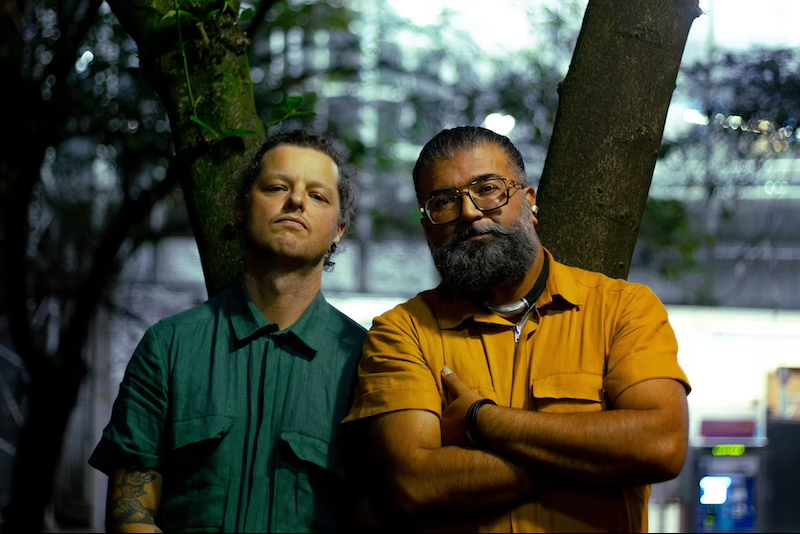
The podcast closes Tooth ‘N Claw, from the album KraKIN, a collaboration between Ruby Singh and Dr Michael Datura, the principal of the Cortes Island School.
Links of Interest:
- The Blades Edge Between
- Ruby Singh (website)
- Ruby Singh YouTube page
- Ruby Singh Facebook page
- Ruby Singh (@rubysingh_) • Instagram photos and videos
All photos and illustrations provided by Ruby Singh
Sign-up for Cortes Currents email-out:
To receive an emailed catalogue of articles on Cortes Currents, send a (blank) email to subscribe to your desired frequency:
- Daily, (articles posted during the last 24 hours) – [email protected]
- Weekly Digest cortescurrents – [email protected]