


Between the opposition MPs who crossed the floor and three by-elections coming up on April 13, Mark Carney’s Liberal government is on the threshold of forming a majority government.
Neither Tanille Johnston, who is currently running for leadership of the NDP, nor Aaron Gunn, the Member of Parliament for North Island–Powell River, were available for comment.
Jessica Wegg, the Green Party candidate during the last two elections, observed, “We’re two votes away from the Liberals having a majority. I don’t know that it matters that much to Carney. His policies skew so far toward what Conservatives would want anyway, he is getting lots and lots of support. I think it would be risky for him to call a general election because it’s not necessary. As he gets closer and closer to having a majority without a general election, it would be harder and harder to sell to Canadians that it would be necessary to call everybody to the polls again, spend all this money again on a general election when he’s doing everything he wants and just ramming through bills without even having a majority.”
(Image credit: Prime Minister Mark Carney – courtesy Prime Minister’s Office via Wikimedia Government Open Data License – India (GODL)
MPs Crossing the floor
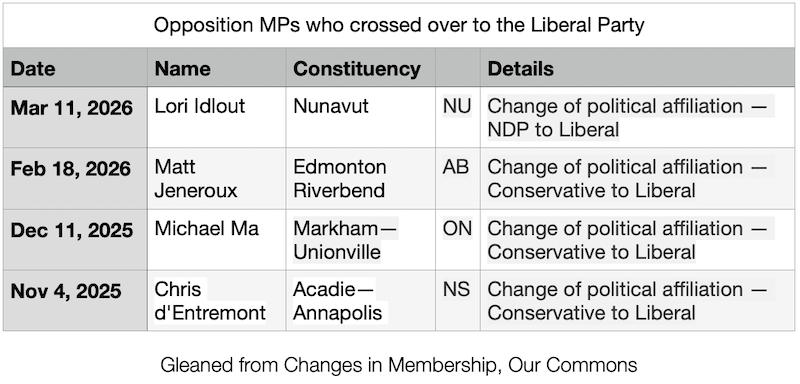
Jennifer Lash, the Liberal candidate for North Island–Powell River in the last election, pointed out, “There’s been four floor crossings recently: three Conservatives, and just the other day an NDP MP from Nunavut.”
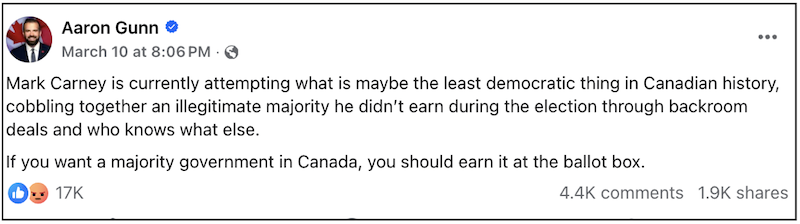
Narrator: In another one of his social media posts, Aaron Gunn declared, “Mark Carney is currently attempting what is maybe the least democratic thing in Canadian history, cobbling together an illegitimate majority he didn’t earn through backroom deals and who knows what else.”
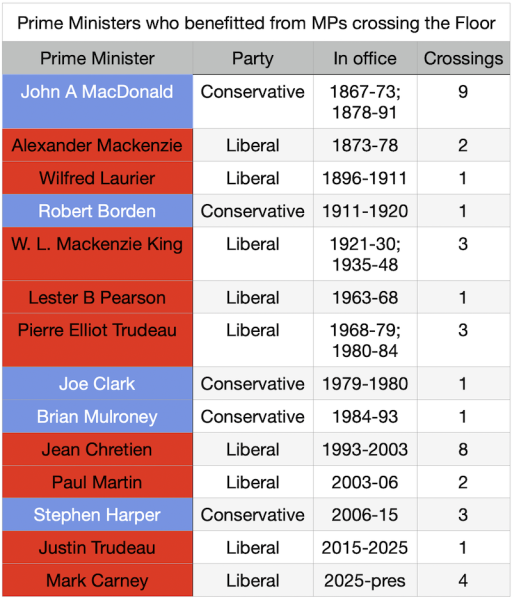
Only this is not the first time MPs have crossed the floor. Most Canadian Prime Ministers have had opposition MP’s join their party. The current record is held by John A MacDonald’s Conservative government, which saw 9 MPs join them. They are closely followed by Jean Chrétien’s Liberals, who gained 8.
Stephen Harper, whose Conservative government benefited from 3 such crossings, once said, ”Members of Parliament should have that freedom and be accountable to their constituents for their decisions at the next election. But I will say this, Mr. Speaker: in my observation, the only parties that really had this as an obsession are the parties that no one ever crosses to.”
By-elections that could lead to a Liberal Majority
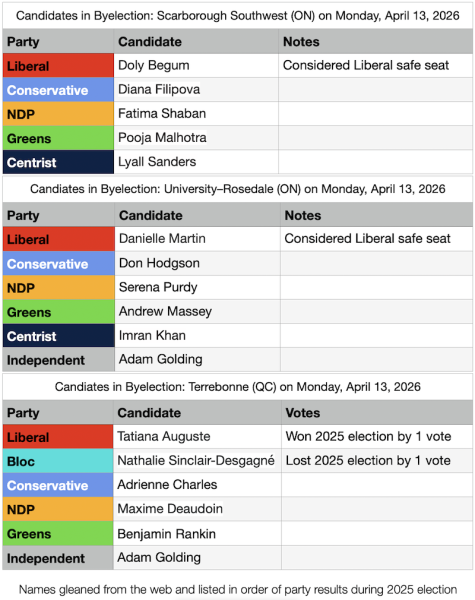
Cortes Currents: In addition to the floor crossings, there will be three by-elections on Sunday, April 13, 2026.
Jennifer Lash explained, “We’ve had two Liberal ministers step down as they’ve taken on different positions, so by-elections are required. Then in Terrebonne, Quebec, the Liberals had won by one vote and that had to go to a by-election. Of those three by-elections, two of them are Liberal strongholds and it’s pretty much assumed that they will go Liberal again. The Quebec by-election is really up for grabs. I’ve listened to people saying the Bloc are going to put everything they can into it and win. I’ve also heard that the polling shows the Liberals are going to win. So who knows? If the Liberals win those two Liberal strongholds (University–Rosedale and Scarborough Southwest) that they have in Ontario, that will bring us to 172 seats, which gets us to a one-seat majority. If we win in Terrebonne as well, that will get us to 173 seats, which means a slightly stronger majority.”
“I’ve never seen a situation like this in Ottawa before, but it’s fascinating for political nerds like myself who love counting seats.”

Jessica Wegg: “We have Green candidates running in those by-elections and I would strongly urge people, if you have friends or family in those ridings where the by-elections are happening, call them and talk to them about how important minority governments are. Look at what Carney’s doing with the numbers he has. He doesn’t technically have a majority, but it doesn’t seem to be stopping him from getting things done. Consider the importance of having diverse voices in the House of Commons and how important it is for our democracy to have different voices.”
Minority Governments
“With a minority government, you have to work with other parties. You have to make compromises to pass laws and to make progress, and for progress to happen. When there’s a majority government, one group of people gets to decide what they want and push it forward, which doesn’t represent Canada at all. A minority government allows for more collaboration. It allows for creative ideas to be heard and sometimes integrated, instead of just rubber-stamping whatever the Liberal party would want.”

Jennifer Lash: “The Green Party talked about how one of the challenges with a majority government is that it’s too much of a concentration of power. They don’t have to listen and collaborate as much, which are fair points, but one thing we need to look at is any party that’s in power wants a majority, and any party that’s not in power doesn’t want a majority. So it’s not surprising that the Greens are saying they don’t want a majority. It’s not surprising the NDP doesn’t want a majority, and the Conservatives.”
Benefits of a Liberal Majority
“There are many advantages that a majority government gives us,. The ones that jump out at me right now are: Prime Minister Carney would be able to spend less time worrying that the government’s going to fall and more time dealing with some of the very critical issues that are facing us right now. Aside from the trade we’re trying to build internationally, the trade we’re trying to defend with the United States and now a war that is increasing every day, the polling shows that a lot of Canadians would rather have someone like Mark Carney spending their time dealing with these issues.”
“The other issue that’s really important is committee. A lot of Canadians don’t really understand committee, but whenever a bill is going through the House, it goes through committee. A committee is supposed to be the checks and balances time to really review whether or not this legislation needs to be tweaked and changed. The MPs that are on that committee can call witnesses and they debate it. The breakdown of seats on a committee is determined by how many seats you have in the House. Right now, the Conservatives, the Liberals and the Bloc are the only official parties. It’s the Bloc, the Conservatives and the Liberals that sit on committee and they review the legislation before it goes back to the House.”
(Elizabeth May asking that all parties be given membership to the standing committee on Procedure and House Affairs)
“The Greens and the NDP do not have official party status and they do not have a seat on committee. They are not allowed to ask House questions unless another party gives them their floor. The Liberals can say, Elizabeth May, we’re going to give you one of our questions. They don’t have allocated questions in the House. They do not have a research team; they have very limited staff. Without official party status, you’re not really in a position where you can do a lot of negotiating.”
Cortes Currents: I keep on hearing of Elizabeth May in committee, how does that work?
Jennifer Lash: “I’ve also seen her in committee, and so there are opportunities to show up, but it’s not a given. I think she can be invited, or someone can give her their seat. So say I were an MP and Elizabeth came to me with a really good point; I think I could give her my seat for just one session. So there are ways to do some trading and negotiating. During Justin Trudeau’s leadership, I know a lot of grace was given to Elizabeth May and she was given that opportunity. Whether that’s still happening under the current Prime Minister, I’m not clear on that.”
(Documentary in which MP Aaron Gunn blames ’destructive, ideological, activist driven policies’ for the closure of BC mills)
“So right now there’s a breakdown of seats on committees where no party holds the majority. As a result, Conservatives have been blocking legislation incessantly. Our MP, Aaron Gunn, is a major culprit in that he has been aggressive in committee. He has humiliated witnesses who are called, and then he clips the footage and posts it on social media. He is not constructive. He’s not trying to collaborate or find solutions to complex problems; he’s simply using cheap media tactics from when he was a documentary filmmaker to build his own brand, and that is not good democracy.”
“When you get to a majority government, you can have a majority of the seats on committee, but it doesn’t happen automatically. In order to reconfigure a committee, the House would have to be prorogued. Mark Carney can go to the Governor General and ask to prorogue the House, which basically resets everything on the order paper. You can pick it up again after the House resets, and reconfigure committees. So whether he does or not is up in the air. We could continue with these struggles in committee even after a majority is formed, but we wouldn’t have the challenges in the House in that we would be able to vote through the legislation.”
Committee Interventions
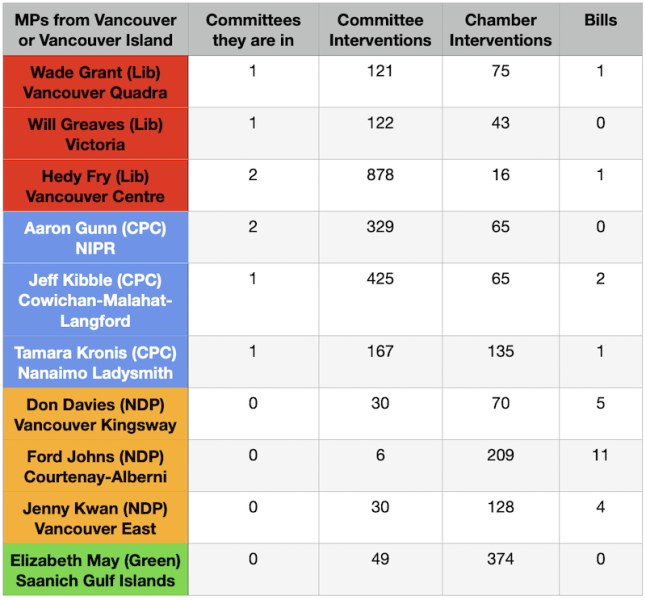
Narrator: To get a better idea of how this works in practise, Cortes Currents turned to the members’ pages on Hansard for Elizabeth May and three members (each) of the NDP, Liberal, and Conservative parties during this current session. All of the committees they belong to, the number of times they spoke during a parliamentary committee meeting (committee interventions), and the number of times they spoke in the House of Commons (chamber interventions) are recorded.

As Jennifer mentioned, only the Liberals and Conservatives sit on committees. All of the Green and NDP MPs performed committee interventions, with Elizabeth May topping that list at 49 times. However, all of the Liberals and Conservatives were members of committees and spoke more than a hundred times. Hedy Fry, the Liberal MP for Vancouver Centre is the Chair for the House of Commons Standing Committee on Health and made 878 interventions; Jeff Kibble, Conservative for Cowichan–Malahat–Langford, 425; and our NIPR MP, Aaron Gunn, 329.
This speaks to the number of times they spoke, not how effective their “interventions” were.
(March 12: Elizabeth May describing Carney’s first year in the House and asking him to work with parliament, not bulldoze it.)
Chamber Interventions
A much different picture emerges when you look at ‘chamber interventions.’ Elizabeth May is the only Green MP and spoke 374 times. On March 12, for example, she addressed the House 9 times and on a variety of subjects (example above).
This is not unusual. Her hard work and effectiveness have been repeatedly recognized by parliament. She has been voted ‘Parliamentarian of the Year’ (2012),’ Orator of the Year’ (2014), and ‘Most Knowledgeable’ (2020). In 2013, the year she was chosen as Canada’s ‘hardest working MP,’ May told the Times Colonist, ““she typically puts in about 15 hours a day, seven days a week, arriving at work just after 7 a.m. and often leaving about 10 p.m. ‘I take off one day a month.’ May has often said she believes she’s the only MP who reads every piece of legislation thoroughly.”
The late politician/broadcaster/writer Rafe Mair once said, “It’s a shame that she won’t be Prime Minister. Far from being just an environmentalist, she has a firm understanding of the history of this country, the geographical distortions and demographic differences, and the sad state of our parliamentary system.”
(Jenny Kwan introducing a private member’s bill to control Canadian arms exports – which was defeated)
Up until last week, there were seven NDP MPs; now there are six. The best known of the three on Cortes Currents’ list is Jenny Kwan, who served as a Vancouver City Councillor and as a Member of the Provincial Legislature prior to becoming the MP for Vancouver East in 2015. Gord Johns, who also became an MP in 2015, made 209; and Don Davies, 70.
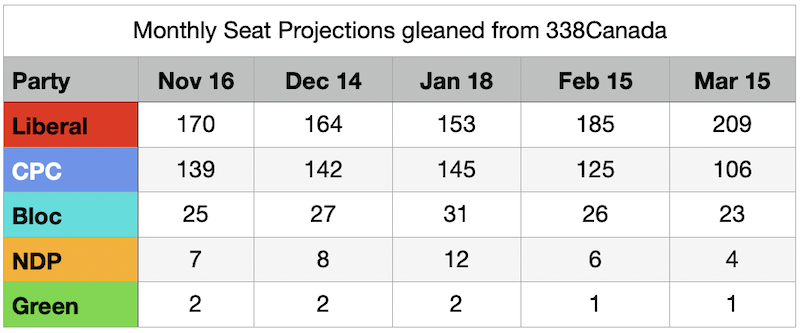
There are currently 170 Liberal and 141 Conservative MPs.
(Hedy Fry questioning her government about reproductive choice)
It is not as important that every member speak; Hedy Fry was originally elected in 1993 and is still very active in committee, but only spoke in the house 16 times. Tamada Kronis, a rookie Conservative MP from Nanaimo Ladysmith, made 135 interventions; Aaron Gunn made 65.
Jennifer Lash: “The Greens could say they hold the balance of power when you’re so close in a minority. Elizabeth May can choose to vote with the Conservatives or with the Liberals and really help get legislation through. But to defeat (the government) you would need Conservatives, the Bloc, the NDP, and the Green all voting together. That’s an unlikely coalition, just in terms of their values.”
“I really think that there is so much uncertainty in our life right now—in terms of the economy, in terms of the United States, in terms of this war in Iran—that the country wants someone who is a balanced, reasoned person at the helm, really steering us in the right direction, and I think Mark Carney is that person. It’s not just me; the polls are showing overwhelmingly that Mark Carney is considered the best prime minister and the Liberals are considered the best party to lead right now.”
“I am a Liberal, a very proud Liberal, so I, of course, am very thrilled that we will move into majority status. Except for one thing: I think Aaron Gunn is embarrassing North Island–Powell River with how he’s showing up in Ottawa. The only reason I would like to go back to the polls is so that North Island–Powell River could have a decent candidate, hopefully myself, but that it wouldn’t be Aaron Gunn.”
“When I look at the broader context of the country, the state of our economy, and for myself to be able to retire, I think that a majority government is what gives this Prime Minister the opportunity to really make substantial changes and progress and ensure that all Canadians are safe and well cared for.”
Links of Interest:
- House of Commons website
- Articles about, or mentioning, the Government of Canada
- Articles about, or mentioning, Mark Carney
- Articles about the Conservative Party
- Articles about, or mentioning, NDP Canada
- Articles about, or mentioning, the Green Party of Canada
Top image credit: The House of Commons Chamber – Photo by Sergey Ashmarin via Wikimedia (CC BY SA 3.0)
Sign-up for Cortes Currents email-out:
To receive an emailed catalogue of articles on Cortes Currents, send a (blank) email to subscribe to your desired frequency:
- Daily, (articles posted during the last 24 hours) – [email protected]
- Weekly Digest cortescurrents – [email protected]