


On January 9, 2025, Campbell River’s City Council gave first and second readings to a public nuisance amendment bylaw intended to prevent floodlighting, spotlighting and directional lighting from shining beyond the properties they protect onto residential areas. Council is giving the public to respond in writing before making a decision.
Bylaw Services Manager (SM) Karl Read pointed out that it has been a year since Paula Burque asked the city to remedy this matter.
She told council, “This is my last option to have this issue remedied. My proposal is that the City of Campbell River adopts a new bylaw enforcing that LED and halogen lighting between homes that are less than 15 metres apart should have lumens power total equal or less than 3000 lumens or 200 watts.”
“It should be pointed on the owner’s property, not toward any other property or house windows. There should be no light spillage, should have a total cut off optics and fully shielded. They should be encouraged to use warmer colour temperature because of how blue light affects the melatonin hormone for sleep.”.
“With the new age of LED and halogen lighting, this has become a homeowner issue. Especially if houses are close in proximity with no fencing or shrubbery in between. It has become an issue in my life where the neighbour’s garage side entrance door faces my bedroom window”
“LED lights are measured in lumens, which is how much brightness it produces as opposed to watts, which is the amount of energy it consumes. LEDs are seven times brighter and more efficient than incandescent lighting.”

“My neighbour has recently replaced a 500 watt spotlight that he was aiming at our bedroom window and installed 40,000 lumens floodlights LED and aims it at the side of our house. The entire side of our house is lit up and the neighbour behind us as well.”
“His yard and chicken coop are lit up. Chickens don’t lay eggs if they can’t sleep. People can’t sleep either. We have settled some immediate issues with the bylaw enforcement officer’s assistant, but because there is no bylaw for nuisance lighting, he cannot assist us with this issue, nor can the police.”
Let me please include a copy of a newspaper article from the 2019 Vancouver Sun, where the city of Vancouver has implemented this bylaw into effect. Please allow me to quote a few small paragraphs from this article. People are telling me It’s not only about losing sleep, it’s having impacts on their mental and physical health, Green Councillor Adrienne Carr said about light pollution.”
“Vancouver’s bylaw regulating untidy premises has been amended to include private property with nuisance outdoor lighting that interferes with neighbours peace and enjoyment of their own homes. The amendment which Council passed last week bans any outdoor light fixture that casts light directly into a neighbour’s window or lighting that unreasonably disturbs the peace, rest and enjoyment, comfort or convenience of the neighbouring property’s occupants.”
“This last paragraph of this article is exactly what’s happening to me. I’ve become stressed, losing sleep over it and quite anxious. And there’s another paper from Vancouver written on various outdoor lighting pollution and on pages 7, 8 and 18 it talks about responsible homeowner and city lighting such as light trespass or light spill in an area where it serves no benefit and how impactful it can be to a neighbour at night.”
“Example, the street light across the street spills light into my entire backyard and the back of my house, being that I’m on a corner lot. A pamphlet giving instructions on outdoor lighting design and what are full cutoff fixtures is included. I propose Campbell River could adopt such a pamphlet as a handout.”
“Also included is a Vancouver paper on outdoor lighting strategy. Improvements can be made for intersection and pedestrian safety, neighborhood lighting design, nuisance lighting, wildlife safety and disruption, and dark sky preservation.”
City staff prepared a resolution which came before council at the January 9, 2025, meeting.
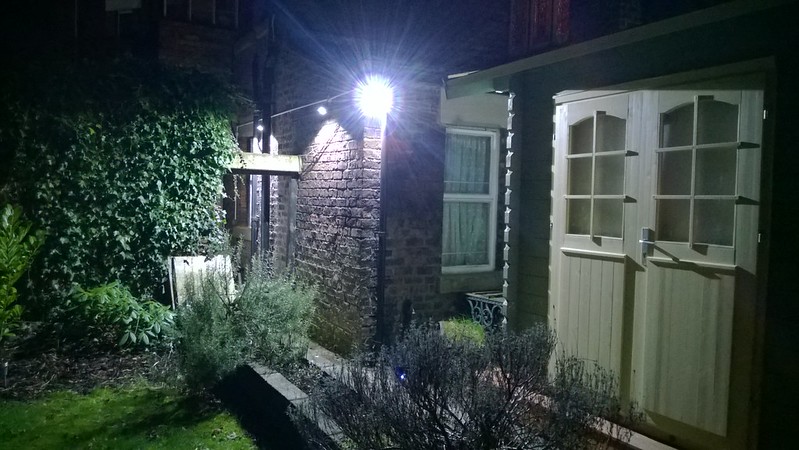
10 watt LED floodlight – photo by Pete via Flickr (Public Domain)
Bylaw SM Read explained, “The BC Community Charter provides authority for municipalities to adopt by law regulations regarding nuisance illumination.”
“There’s been a significant amount of development in lighting over recent years, with the advent of cheaper and more powerful lighting, such as LED bulbs, that can create the potential for more adverse effects. I was only able to identify five BC municipalities that actually have nuisance illumination regulations. The language in those bylaws differ somewhat between the municipalities. The general themes were thou shalt not produce disturbing light and words to that effect and then ranging through to others that required some shielding from nuisance lighting.”
“I did hear back from a couple of municipalities that I approached. Vancouver has some provisions. Their lighting complaints are less than 2% of their total call load. They expressed that theirs is subjective and not that easy to enforce, so they have a procedure in place to help their officers make their decision making.”
“The other place that I spoke to was Esquimalt, who also have the general subjective type regulations, and they get about one complaint a year.”
“The language in this amendment by law, my intention is to create regulations that are prescriptive in nature, removing that subjective element where we can, and we’re assessing.”
“These would enable an officer, if you receive a complaint, to readily check if someone is adhering to the shielding requirements for the directional type lights. Also check the intensity rating that’s on a light if it’s an exposed bulb, like a lantern light. That visual inspection can determine if it’s shielded properly or if it’s above the rating that we’re proposing. I’ve intentionally made it significant enough to allow for security lighting, which obviously we have to allow for, but to provide some response in relation to those more extreme situations where people are adversely affected.”
“The provisions wouldn’t be applied to street lights, in relation to city infrastructure, such as playing fields. We generally have quite good shielding on our lighting. We limit the hours that they’re able to be operated. So as to mitigate any nuisance to the public, but we would also respond and mitigate any impacts in relation to any complaints that we might receive in relation to any lighting that we produce as a city. The last thing I’ll say is that since the resolution, which was earlier last year, we’ve been approached by one other member of the public about nuisance lighting anyway, the recommendation in the report is that the amendment be given first and second reading and I will answer any questions if I can.”

Councillor Ron Kerr asked, “Would this apply to outdoor lights that are motion affected? They turn on and off and on and off all night long.”
Bylaw SM Read: “Yes, it would, but it wouldn’t be the turning on and off that would be assessed. It would be what happens when the lights are turned on. Are they conforming with the restrictions that would be imposed to prevent the nuisance part of it?”
Councillor Susan Sinnot wanted to know how the proposed bylaw could be applied.
“Do you walk into the person’s house and say, I can see it through your window? How do you adjudicate the standard for that one? I mean, my neighbour asked me nicely, ‘you have a light that’s on your deck, and our bedroom window is 15- 20 feet from the deck. Can you make sure it’s off by 11?’ I have a smart light, so yes it is, but is that directly visible?”
Bylaw SM Read: “Ambient light would not be considered a light source. We would tolerate ambient light. It’s that direct glare you get from actual source that we would want mitigated.”
Councillor Sinnot: “I think their concern was in the summer time they might have their blinds open for air flow or something. So they just want it dark. If someone has their bedroom, like my neighbour does, right beside my house and they decide to keep their blinds open in the evening, they might end up getting a direct light source coming in. I’m going to hopefully be a good neighbour and not cause my neighbour grief. But I can see these sorts of vagaries potentially coming up in terms of what do you do when someone says, ‘I have a direct light source, but I choose not to mitigate it on my side and use my blinds.’”
Bylaw SM Read: “That’s why there’s a prescriptive limit to the bulb itself. If it’s not above the limit, then it’s to be tolerated, but if it’s above that more extreme limit, then it has to be brought down to the level that would be acceptable.”
Councillor Ben Lanyon wanted to know, “What is the lumen limit or what’s the measure that we’re using?”
Bylaw SM Read: “If you’ve got the amendment bylaw in front of you, I think it’s 1,000 lumens.”
City Manager Ellie Brovoid said, “It’s 200 watts or 3,000 lumens.”
Bylaw SM Read: “I apologize. Two hundred watts is the traditional style bulb that most of us grew up with. The lumens is the intensity of the light and so an LED bulb which can achieve that with less wattage can’t go above the 3, 000 lumens, even though it may be slightly less wattage because it’s more efficient.”
Councillor Lanyon: “Have you had many of these instances where you just simply say, well there’s nothing I can do, there’s no bylaw regulating it, or is this truly just a rarity that we’re seeing here?”
Bylaw SM Read: “The answer is yes to both of those. I’ve encountered it before, but it’s quite rare. We might get some years where there are none, and we might get three or four or five in other years where people complain, and without bylaw regulations it’s not something that we enforce.”
Mayor Kermit Dahl responded, “I think most people want to be a good neighbour and deal with it. We had a one off, which was being done intentionally. We’ve spent a lot of time, staff time, council’s time. It’s been on the agenda at least twice simply because somebody wouldn’t turn off one switch in one house in the last six years. I’ll support the bylaw, but I think it’s insane that we have our time used up by something so trivial because two people can’t negotiate an agreement between them.”
Councillor Kerr: “I agree with you that that is trivial, but if you have a neighbour that you can’t talk to, you can’t issue, and it’s just another one of those things that throws gas on the fire. Eventually you get a criminal response. The other thing is traditionally, we’ve been more of a rural community, and if we’re Increasing density, we’re going to be increasing the opportunity for situations like this with outdoor light shining into windows. I think it’s a tool for neighbors to go. ‘Look, you can’t do this’ and maybe bypass the bylaw by showing them that there are consequences. Just my thoughts.”
Councillor Sean Smyth declared, “I’m going to support the bylaw too. I just share everyone’s frustration. You can’t make bylaws just because of bad neighbours all the time. My question is the issue that prompted this by law, is that still ongoing? Has that been resolved?”
Bylaw SM Read: “Not to my knowledge. They may be waiting to see a result and, as I mentioned in the briefing notes, we do have one other matter that was brought to our attention. I guess they’re also waiting to see what the outcome of this meeting is.”
The proposed bylaw has been given a first and second reading. Council will give the public time to respond in writing, before making a final decision next month.
Links of Interest
- City of Campbell River Agendas and Minutes
- Archived Webcasts of Council Meetings
- Articles about, or mentioning, Campbell River City Council
- Articles about, or mentioning, Campbell River
Sign-up for Cortes Currents email-out:
To receive an emailed catalogue of articles on Cortes Currents, send a (blank) email to subscribe to your desired frequency:
Weekly Digest cortescurrents – [email protected]
Daily, (articles posted during the last 24 hours) – [email protected]